
The healthcare corpus: budgeting for 12–14% medical inflation

A retirement plan usually starts with a simple assumption: take what you spend today and account for inflation.
The problem is that not every expense grows at the same rate.
Healthcare is one of the clearest examples. A household spending ₹30,000 a month on healthcare today may not think of it as a particularly large expense. But at medical inflation of about 13% a year, that same ₹30,000 becomes roughly ₹3.5 lakh a month in 20 years and close to ₹11.7 lakh a month in 30 years.
That matters because healthcare tends to become more important with age, just as its cost is rising faster than most other household expenses. Treating it like groceries, utilities or travel can therefore leave a meaningful gap in a retirement plan.
So rather than keeping healthcare buried inside general expenses, it helps to give it its own number.
In short: Budget healthcare as a separate corpus, rather than as a line inside your general expenses. According to IRDAI’s Annual Report (2023-24), medical inflation in India is estimated at about 12–14% a year, well above general inflation, and healthcare can become a more significant component of household expenditure in later life, depending on health circumstances. At 13% inflation, a ₹30,000-a-month healthcare bill today can reach around ₹3.5 lakh a month in 20 years. Insurance and personal savings also solve different parts of the problem. Insurance can help with large hospitalisation costs, while a self-funded buffer may be needed for recurring expenses that insurance does not cover. |
On this page
- How much should you budget for healthcare in retirement?
- Why medical inflation outpaces general inflation
- Building a dedicated healthcare corpus
- In their words
- Health insurance vs self-funding after 60
- Planning for long-term and critical care
- How the healthcare corpus fits the total
- Key takeaways
How much should you budget for healthcare in retirement?
Start by separating healthcare from everything else and giving it its own inflation assumption.
One way to model healthcare separately is to take current monthly healthcare expenditure and grow it to retirement using an assumed medical-inflation rate. The illustrations below use IRDAI’s Annual Report (2023-24) that mentions medical inflation at 12–14% and, where applicable, a 30-year retirement horizon. Actual inflation, expenditure and retirement duration may differ.
The reason is simple: medical costs can grow much faster than the rest of your household expenses. Fold healthcare into one general inflation number, and you may underestimate how much you need to set aside for healthcare
The overall retirement corpus can still be calculated separately. The healthcare corpus is one component that plugs into that larger number.
Read how much money do you need to retire in India for the full calculation.
The compounding is what makes the difference visible.
Today's monthly healthcare spend grown to retirement age at 13% medical inflation (illustrative, not a forecast).
| Today's monthly healthcare spend | In 10 years | In 20 years | In 30 years |
| ₹15,000 | ~₹51,000 | ~₹1.7 lakh | ~₹5.9 lakh |
| ₹30,000 | ~₹1 lakh | ~₹3.5 lakh | ~₹11.7 lakh |
| ₹50,000 | ~₹1.7 lakh | ~₹5.8 lakh | ~₹19.6 lakh |
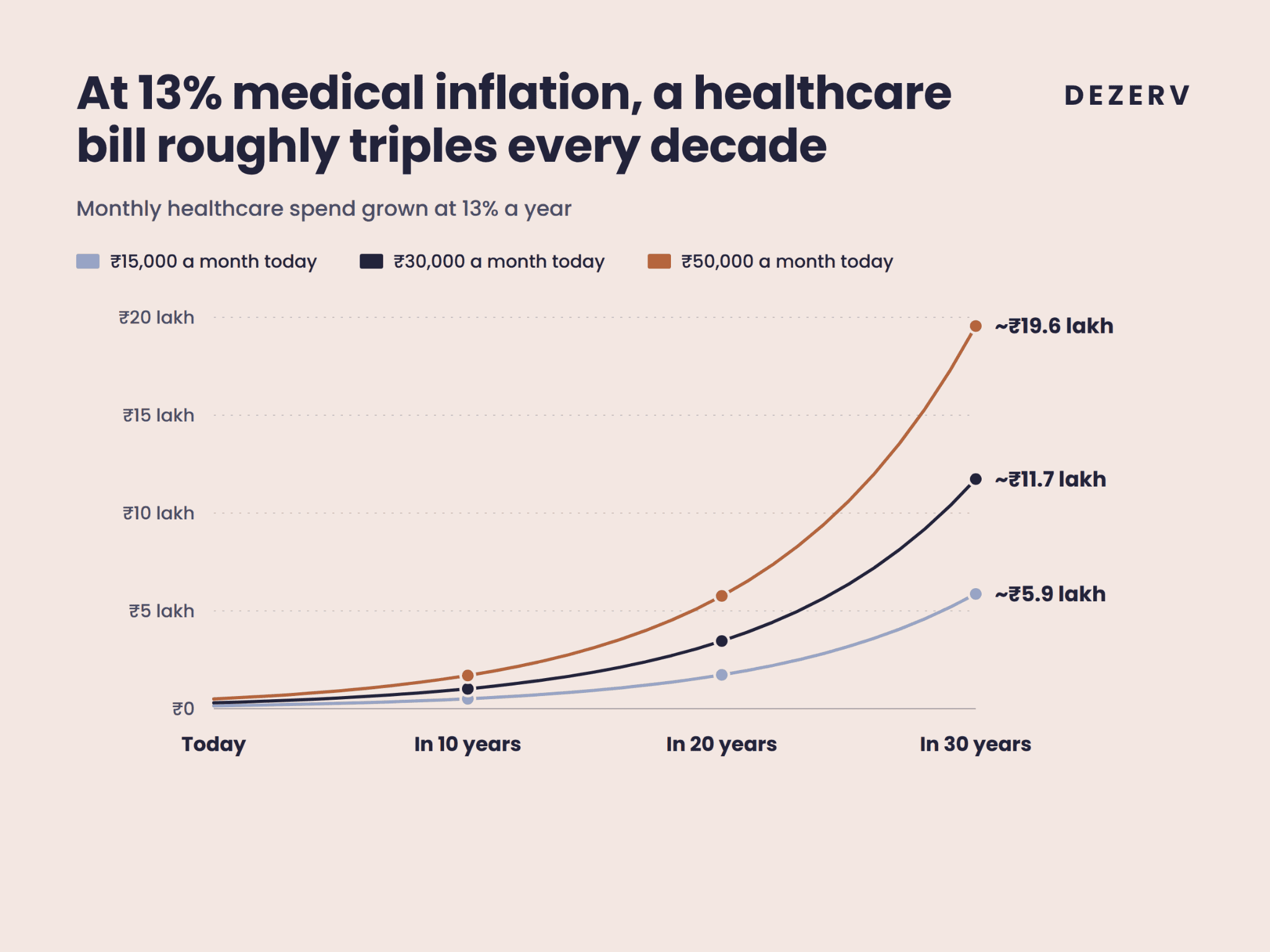
A sample scenario based on the stated assumptions (today's monthly healthcare spend grown at ~13% medical inflation, Source of medical inflation number- IRDAI);
The rate you assume matters almost as much as the time horizon.
Take the same ₹30,000 monthly healthcare bill over 20 years. At 12% inflation, it becomes about ₹2.9 lakh a month. At 14%, it becomes roughly ₹4.1 lakh.
That two-percentage-point difference changes the eventual monthly bill by about ₹1.2 lakh, or roughly a third.
This is why healthcare should not simply borrow the general inflation rate. Even a small difference in the assumption can materially change the eventual number.
Why medical inflation outpaces general inflation
One industry estimate places medical inflation in India at approximately12–14% a year for 2025–26, compared with general retail inflation of roughly4–6%.
At first glance, that can seem inconsistent with the official Consumer Price Index (CPI) health sub-index published by Ministry of Statistics and Programme Implementation (MoSPI), which wasaround 3.4% in late 2025.
The difference lies in what those numbers capture.
The official health index includes items such as generic medicines and basic medical supplies. But a retiree's healthcare spending may be much more concentrated in private hospital rooms, surgeries, diagnostic tests and specialist care.
Differences in treatment mix, technology, provider costs and other healthcare-cost drivers may cause household healthcare expenditure to move differently from broader CPI measures
See how inflation affects retirement planning for the numbers on domestic help, education and travel.
Building a dedicated healthcare corpus
A dedicated healthcare corpus is a separately modelled part of your retirement requirement, sized using a healthcare-specific inflation assumption. It does not need to be maintained as a separate investment account or portfolio
Two things make it different:
- It compounds at12–14%, so the amount required can grow faster than many other expenses.
- Healthcare spending is lumpy rather than smooth. You may have relatively quiet years, followed by a hospitalisation or diagnosis that costs several lakh at once.
In their words
“The concept of surviving on average is irrelevant. You have to survive on the bad days.”
— Howard Marks, Oaktree Capital
Healthcare makes that idea particularly relevant.
A plan built around an “average” healthcare year may look perfectly adequate until one expensive year arrives. A hospitalisation or serious diagnosis can cost several lakh in a short period, even if spending was modest in the years before it.
The Dezerv Retirement Calculator can help illustrate the effect of modelling healthcare separately, including by testing assumptions such as the 12–14% range used in the examples above.
Health insurance vs self-funding after 60
Health insurance and a healthcare corpus solve different parts of the problem, which is why retirement planning may need both.
- Insurance handles the catastrophic: a large-cover base plan or top-up can help with hospitalisation and surgery, where a single claim can dwarf several years of regular healthcare spending. But premiums themselves can also rise, with CNBC mentioning increases of about 10–15% for 2026. Policies can have caps and co-pays, and buying fresh cover can become harder with age and pre-existing conditions.
- Self-funding handles the recurring: consultations, diagnostics, medicines, dental care, physiotherapy and other expenses that may never become a hospital insurance claim. That is what the dedicated healthcare corpus is meant to cover.
Age and health status can affect premiums, underwriting and policy terms. Individuals can therefore wish to review their health-insurance needs before retirement, taking account of their circumstances and the terms of available policies, while also building a self-funded buffer for the recurring costs insurance may not reimburse.
Planning for long-term and critical care
Some of the largest healthcare costs in retirement may not come from a single surgery or hospital stay.
A stroke, dementia or another critical illness can create years of spending on attendants, home modifications or assisted living.
That can be financially heavier than a one-off procedure because the expense can continue month after month for several years.
Critical illness and long-term care can create substantial costs that may continue for years. Insurance can help cover some of these risks, depending on the policy and its terms, but it may not meet the full cost. That is why it can be useful to earmark part of the healthcare corpus for long-term and critical-care expenses rather than assume they will be fully covered by insurance.
This is the tail risk that can turn an otherwise adequate retirement corpus into a shortfall.
How the healthcare corpus fits the total
The healthcare corpus should be calculated separately, but it is ultimately one part of your total retirement requirement, not a substitute for it.
Once you have sized your lifestyle corpus and the healthcare bucket separately, using the higher medical inflation rate for the latter, the two can be combined into the overall retirement corpus.
From there, the same withdrawal planning applies to the healthcare portion too, with one important difference: medical expenses may need to rise at a faster rate over time.
Read how much can you withdraw from your retirement corpus in India for what happens once withdrawals begin.
Keeping the two buckets separate during the planning process helps prevent a potentially fast-rising retirement cost from being hidden inside the broader household budget.
Find the other four factors in the biggest retirement planning mistakes Indian investors make
Key takeaways
- One industry estimate places medical inflation in India at approximately 12–14% a year, well above general inflation, and healthcare spending tends to become more important after 60.
- Budget healthcare as a separate corpus with its own inflation input rather than folding it into the general expense line.
- A ₹30,000-a-month healthcare bill today can reach about ₹3.5 lakh a month in 20 years at 13%.
- Insurance may help address eligible hospitalisation costs, while personal savings may be needed for recurring or uninsured expenditure
- Earmark part of the buffer for long-term and critical care, which can become one of the largest unplanned costs in retirement.
- Size the healthcare component using a dedicated 12–14% medical inflation input, kept separate from the general inflation rate.
Planning for retirement?
The Dezerv Retirement Calculator can help illustrate the effect of modelling healthcare separately, including by testing assumptions such as the 12–14% range used in the examples above.
Frequently Asked Questions
1. How much should I budget for healthcare in retirement in India?
One way to model healthcare separately is to take current monthly healthcare expenditure and grow it to retirement using an assumed medical-inflation rate. The illustrations below use 12–14% and, where applicable, a 30-year retirement horizon. Actual inflation, expenditure and retirement duration may differ.
2. Why can healthcare costs rise faster than general inflation?
A retiree's healthcare spending may be concentrated in areas such as private hospitals, surgeries, diagnostics and specialist care, whose costs can rise faster than general inflation.
The official health index also includes lower-cost categories such as generic medicines and basic medical supplies. Differences in treatment mix, technology, provider costs and other healthcare-cost drivers may cause household healthcare expenditure to move differently from broader CPI measures.
3. Is health insurance enough for retirement, or do I need a healthcare corpus?
Both serve different purposes.
Insurance can help with large hospitalisation costs, but policies may have caps and co-pays, premiums themselves can also rise, with increases of about 11–14% cited for 2026, and many recurring costs of ageing may not be covered.
A self-funded healthcare corpus can therefore cover consultations, medicines, diagnostics and long-term care that insurance leaves out.
4. When should I buy health insurance for retirement?
There is no single appropriate age for everyone. Age and health status can affect premiums, underwriting and policy terms, so reviewing cover before retirement may be useful. Readers should assess suitability and policy terms based on their own circumstances.
Disclaimer: Dezerv Investments Private Limited (DIPL) is a Portfolio Manager with SEBI Registration no. INP000007377. Distribution services are offered through Dezerv Distribution Services Private Limited, a wholly owned subsidiary of DIPL (collectively referred to as "Dezerv") vide AMFI Registration No. (ARN)-248439 and APMI registration no. (APRN)-00615. This article is intended solely for general educational and informational purposes and should not be construed as personalised investment, financial planning, tax or legal advice, or as a recommendation, offer or solicitation to invest in any security, financial product or investment strategy.
Readers are advised to consult with their financial advisor before making investment decisions based on the information provided herein.
The calculations, illustrations, estimates and assumptions herein are for illustrative purposes only and do not represent actual or expected costs, returns or outcomes. Actual outcomes may vary based on individual circumstances and prevailing market, economic, healthcare, insurance, tax and regulatory conditions.
In preparing this material, Dezerv has used publicly available information and other sources believed to be reliable. While reasonable care has been taken, Dezerv does not guarantee the accuracy or completeness of the information. The information is not a complete disclosure of all material facts, terms or conditions and should not be relied upon independently for developing or implementing an investment strategy. Dezerv and its affiliates shall not be liable for any loss or damage arising from its use.
Investment in the securities market is subject to market risks. Please read all related documents carefully before investing. Past performance, where referred to, is not indicative of future performance.


