
The biggest retirement planning mistakes Indian investors make

There is a point in every long flight when you stop thinking about the take-off and start thinking about the landing.
Retirement planning often works the other way.
For years, the focus is on building wealth: earning more, investing more, buying assets, growing the corpus. By the time retirement comes into view, it is easy to assume that the hard part is largely done.
But retirement changes what those assets need to do.
A house that made you wealthier may not help fund monthly expenses. A fixed deposit that protected capital may struggle to protect purchasing power. And a large retirement number can still rest on assumptions that do not hold for 20 or 30 years.
That is where many sensible-looking decisions begin to cause problems. So which decisions deserve a second look before retirement begins?
In short
In short: The biggest retirement planning mistakes are underestimating lifestyle inflation, ignoring healthcare costs, over-relying on illiquid real estate, treating guaranteed products as sufficient on their own, and having no plan for how to draw an income. Two common myths sit underneath several of them: that one headline corpus figure can tell everyone how much they need, and that fixed deposits alone can fund a 30-year retirement. Each mistake below points to the guide or tool that deals with the underlying problem in greater detail. |
On this page
- What are the most common retirement planning mistakes?
- In their words
- Mistake 1: underestimating blended inflation
- Mistake 2: ignoring healthcare costs
- Mistake 3: over-relying on illiquid real estate
- Mistake 4: treating guaranteed products as enough
- Mistake 5: having no withdrawal strategy
- Myth vs reality: "₹40 crore is enough for everyone"
- Myth vs reality: "FDs will fund my retirement"
What are the most common retirement planning mistakes?
Five recur across retirement plans: using the wrong inflation rate, leaving healthcare out of the corpus, counting the family home as retirement money, mistaking guaranteed products for a complete plan, and never designing the withdrawal phase.
They have something important in common. None requires an obviously reckless decision. The problem usually begins with an assumption that looks reasonable today but becomes increasingly inaccurate over 20 or 30 years.
In their words
"A lot of success in life and business comes from knowing what you want to avoid."
— Charlie Munger
Mistake 1: underestimating blended inflation
A retirement calculation is only as useful as the inflation number sitting inside it.
Many plans use retail inflation of5–6%. But a higher-spending household may have a very different expense basket, with private schooling, domestic help, healthcare and travel accounting for a greater share of spending. For the household profile used in Dezerv's retirement analysis, that blended rate is closer to 9% a year.
Note: Dezerv’s inflation estimate is based on category-level inflation assumptions for healthcare (12–14%), domestic staff wages (10–12%), and education/travel (8–10%), blended to roughly 8–9% for the illustrative affluent-household basket; this is not an official inflation statistic
Three percentage points may not appear significant in a one-year budget. Over 20 years, they change the retirement calculation substantially.
Take a household spending ₹2 lakh a month today, retiring at 60 in 20 years and drawing from the corpus for another 30 years. Change only the inflation assumption:
| Inflation rate used | Monthly spend at 60 | Corpus needed at 60 |
| 6% (Retail Consumer Price Index or CPI for short) | ~₹6.4 lakh | ~₹23 crore |
| 9% (blended rate for this spending basket) | ~₹11.2 lakh | ~₹40 crore |
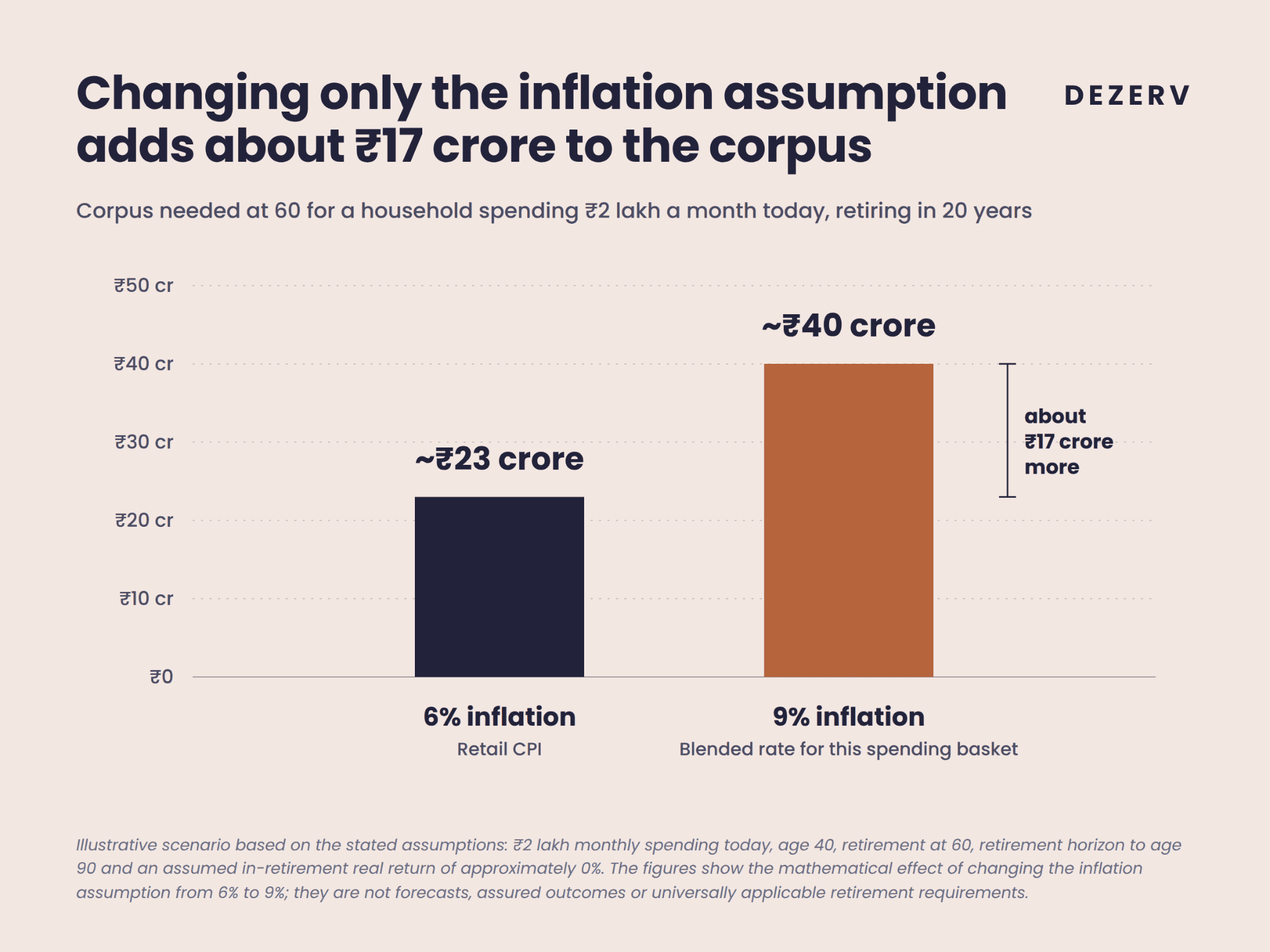
Takeaway: Changing only the inflation assumption from 6% to 9% raises the illustrative estimated corpus by about ₹17 crore. Relative to the approximately ₹40 crore corpus produced by this illustration, using the lower inflation assumption reduces the calculated requirement by roughly 40%
Nothing else in the example has changed: not the lifestyle, retirement age or retirement period. At 6%, the calculation produces a corpus of about ₹23 crore. At 9%, it produces about ₹40 crore.
That ₹40 crore is also a corpus required 20 years from today, not an amount that needs to be available today. At a purely illustrative assumed annual return of 12% post-tax over those 20 years, approximately ₹4.2 crore today would mathematically compound to ₹40 crore. The 12% figure is an assumption used only for this calculation; it is not an expected return, investment recommendation, forecast or guarantee, and actual post-tax outcomes will depend on investment performance, taxation, costs and other factors
The full maths, and the reason different household expense categories can inflate at different rates, sits in [Internal link:how inflation affects your retirement]
Mistake 2: ignoring healthcare costs
Healthcare is one expense for which general inflation can be a particularly poor planning assumption.
Industry estimates place medical-cost inflation at roughly 12–14% a year, well above general retail inflation. Healthcare spending can also become more important later in retirement.
Insurance absorbs part of that risk, but it does not necessarily cover every expense, while premiums themselves can rise over time.
If healthcare is simply folded into the general monthly-expense number, the retirement corpus can end up making too little provision for it. A more useful approach is to estimate healthcare separately, as set out in [Internal link:the healthcare corpus for retirement]
Mistake 3: over-relying on illiquid real estate
A household can own several crores of property and still have very little money available to fund monthly retirement expenses.
That distinction matters.
Property is not necessarily a bad retirement asset, but it is an illiquid one. Selling can take time, the price available when you need liquidity may not be the price you expected, and a primary residence does not generate cash for retirement spending unless you intend to monetise it.
Concentrating too much of a retirement corpus in one or two properties can therefore leave a household asset-rich but short of readily available income.
The primary residence deserves particular care. Unless you plan to sell, downsize or otherwise monetise it, it is not part of the corpus available for regular withdrawals. You live in it; you cannot simultaneously spend its full value.
How much of a retirement corpus to keep liquid is set out in the[Internal link: retirement guide for investors]
Watch out
Counting the house you live in as money available to fund retirement can materially overstate how prepared you are.
Mistake 4: treating guaranteed products as enough
Certainty has a legitimate place in retirement planning.
Guaranteed pension and insurance-cum-investment products can, subject to their contractual terms, provide a predictable base for part of essential expenditure. The problem begins when that predictable base is expected to do the job of the entire retirement portfolio.
If returns remain close to inflation after accounting for taxes, costs and the terms of the product, purchasing power may not grow sufficiently over a retirement lasting several decades. The money may also remain locked in for long periods.
That does not make guaranteed products inherently unsuitable. It means their role is different: they can provide predictability for part of retirement spending, while other assets may be needed to address long-term growth and inflation.
How large that guaranteed component should be depends on the household's other assets, liabilities and spending requirements, which the [Internal link: retirement guide for investors]works through.
Mistake 5: having no withdrawal strategy
Retirement planning usually focuses on one question: how large does the corpus need to become?
Far less attention goes to what happens once withdrawals begin.
That matters because the order in which returns and withdrawals occur can change the outcome. If markets fall early in retirement and an investor has to sell equity immediately to meet expenses, those losses become realised at precisely the point when the portfolio has less capital left to participate in a recovery.
A 20% fall followed by a forced withdrawal can therefore require a much larger subsequent gain to restore the portfolio.
Accumulating a corpus and drawing from it are different problems. A retirement plan needs to deal with both.
One way to see why withdrawal decisions around market falls matter is to look at what can happen when an investor moves out of equities and subsequently misses the recovery.
An analysis of Nifty 50 Total Return Index (TRI) daily returns since 1999 shows how much of the long-term gain was concentrated in a relatively small number of days:
| ₹10 lakh in the Nifty 50 TRI, Jul 1999 → Jun 2026 | Grows to | Versus staying fully invested |
| Stayed fully invested | ₹2.89 crore | — |
| Missed the 10 best days | ₹1.30 crore | −55% |
| Missed the 15 best days | ₹97 lakh | −66% |
| Missed the 30 best days | ₹44 lakh | −85% |
Methodology: Dezerv analysis of Nifty 50 TRI daily data for the period July 1999 to 30 June 2026. The illustration assumes a hypothetical ₹10 lakh investment in the index and compares the value obtained by remaining invested with scenarios in which the 10, 15 or 30 highest-return days are excluded. Excluded days are assumed to earn a 0% return. The calculation does not account for taxes, transaction costs or investor cash flows. This is a historical index illustration only and does not represent the performance of any Dezerv portfolio or strategy. Data source:NSE / niftyindices historical index data; as on 30 June 2026.
The difficulty is that some of the market's strongest days occur very close to its weakest ones. Of the 30 strongest single days since 2005, 22 fell during the 2008 crash, and 7 of the 10 best days landed within two weeks of the 10 worst (NSE / niftyindices index data, 2005–2026; as on 30 June 2026).
So a withdrawal plan should not depend on correctly predicting when to leave and re-enter the market. This does not imply that investors should always remain invested in equities or maintain a particular equity allocation. The appropriate assets, liquidity levels and withdrawal sequence will depend on the investor’s circumstances and should be planned in advance. Deciding in advance which assets will fund near-term spending, and in what order withdrawals will be made, can reduce the need to make those decisions in the middle of a fall.
You can test how a decline in the early years of retirement affects your income in the Dezerv Retirement Calculator.
Myth vs reality: "₹40 crore (or any number) is enough for everyone"
A retirement corpus cannot be separated from the lifestyle it has to fund.
The widely shared ₹40 crore figure comes from one specific profile: a metro household spending ₹1–2 lakh a month today, retiring at 60 and planning for retirement until 90.
Change the spending level, retirement age, city, inflation assumption or retirement horizon and the number changes.
For example, for a household spending ₹50,000 a month today, retiring at 60 and planning to 90 using a ~7% lifestyle inflation assumption, the same method produces a corpus closer to ₹7 crore.
On an assumed 12% post-tax annual return over the 20 years before retirement, approximately ₹72 lakh invested today would compound to that future corpus. This is illustrative, on the stated assumptions; it is not a forecast or guarantee of returns.
That is why anchoring to somebody else's headline number, whether ₹5 crore, ₹10 crore or ₹40 crore, is the wrong starting point.
The useful number is the one derived from your own spending, timeline and assumptions. You can work through those inputs with Dezerv’s Retirement Calculator
Myth vs reality: "FDs will fund my retirement"
A fixed deposit solves one retirement problem very well: certainty about the nominal amount you will receive.
It does not automatically solve the inflation problem.
FD interest is taxed at the applicable slab rate (Income Tax Department). For someone in a higher tax bracket, a headline rate of 7% can therefore translate into a post-tax return of roughly 5%. That can fall below retail inflation and even further below the blended inflation rate assumed for the higher-spending household in the earlier example.
Note: This is an illustrative calculation only; the actual post-tax return will depend on the applicable tax rate, cess, deposit rate and the investor’s individual tax circumstances
This does not mean FDs have no place in retirement. They can be useful for holding money intended to meet the next two to three years of expenditure.
The problem is relying on them to fund the entire 30-year period. If the post-tax return remains below the rate at which expenses rise, the purchasing power of the income generated by the corpus declines over time.
Over a long retirement, protecting the nominal value of money and protecting its purchasing power are not the same thing.
Key takeaways
- Some of the most consequential retirement errors begin with reasonable-looking assumptions: the wrong inflation rate, inadequate provision for healthcare, or counting the family home as spendable corpus.
- Real estate can create a liquidity problem when too much of the retirement corpus is concentrated in it.
- Fixed deposits can play a useful short-term role, but relying on them for an entire 30-year retirement can expose the corpus to inflation risk.
- Guaranteed products can provide predictability for part of retirement spending but may not address every requirement of a long retirement.
- Building a corpus and drawing from it are two separate planning problems.
- Test your own inputs in the Dezerv Retirement Calculator.
Frequently Asked Questions
- What is the single biggest retirement planning mistake?
Underestimating inflation is one of the most consequential. Many plans begin with retail inflation of 5–6%, while households that spend significantly on categories such as healthcare, education, domestic help and travel can experience a higher blended inflation rate. Over 20 years, even a few percentage points can materially change the corpus calculation.
- Is real estate a bad retirement asset?
Not necessarily. The issue is concentration and liquidity. Property can generate rental income and appreciate in value, but it can also take time to sell. A retirement corpus concentrated heavily in real estate can therefore leave a household with substantial assets but insufficient liquid money for regular expenditure. The primary residence requires particular care: unless you intend to sell, downsize or monetise it, its full value is not available to fund retirement spending.
- Can fixed deposits fund my retirement?
They can fund part of it. FD interest is taxed at the applicable income-tax rate, which means the post-tax return for someone in a higher tax bracket can fall below inflation. FDs can therefore be useful for money needed over the next few years, but relying on them alone for a retirement lasting several decades can result in purchasing power declining over time.
- Is ₹5 crore enough to retire in India?
It depends on your monthly spending, retirement age, location, inflation assumptions and how long the money needs to last. The same ₹5 crore can be more than sufficient for one household and inadequate for another. Rather than starting with a universal corpus number, the calculation should begin with the expenses and timeline the corpus actually has to fund.
Disclaimer: Dezerv Investments Private Limited is a SEBI-registered Portfolio Manager (Registration No. INP000007377). Distribution services are offered by Dezerv Distribution Services Private Limited, a wholly owned subsidiary of Dezerv Investments Private Limited, under AMFI Registration No. ARN-248439 and APMI Registration No. APRN-00615. This article is intended solely for general educational and informational purposes and should not be construed as personalised investment, financial planning, tax or legal advice, or as a recommendation, offer or solicitation to invest in any security, financial product or investment strategy. Investors must consider their individual circumstances and obtain appropriate professional advice before making any investment decision.
The calculations, illustrations, estimates and assumptions presented herein are for illustrative purposes only and are based on the assumptions stated in the article. They are not intended to represent actual or expected investment returns or outcomes. Any return or inflation assumptions used are purely illustrative and should not be construed as assured, guaranteed or target returns. Actual outcomes may vary depending on individual circumstances and prevailing market, economic, tax and regulatory conditions.
Investment in the securities market is subject to market risks. Please read all related documents carefully before investing. Past performance, where referred to, is not indicative of future performance. Tax laws and their application are subject to change and may vary depending on individual circumstances.


