
How Much Can You Withdraw From Your Retirement Corpus in India?

Most retirement planning focuses on one number: how much you need to accumulate before you stop working.
But reaching that number creates another question that matters just as much. Once there is no salary coming in, how much can you take out of your retirement corpus every year without planning on the money running out too soon?
Your withdrawals need to continue through good markets and bad ones. They need to rise as your cost of living rises. And if you retire at 60, the same pool of money may have to keep funding your life until 90 or beyond.
One of the most widely used ways of answering this question is the 4% rule.
It says that you begin retirement by withdrawing 4% of your corpus in the first year, then increase that rupee amount with inflation each year after that. So if your first-year expenses are ₹24 lakh, the rule points to a starting corpus of ₹6 crore.
The 4% rule became popular because it held up well across the historical US market periods on which it was tested. But those calculations were built around US inflation, stock and bond returns, and a retirement period of around 30 years.
An Indian retirement can look different on each of those counts.
So the question is not simply, “Can I withdraw 4%?”
It is: how much can I withdraw from my retirement corpus each year while giving that money enough room to support decades of spending?
In short
In short: The 4% rule tells you how much of your corpus you withdraw when retirement begins. If your first-year retirement spending is ₹24 lakh, a 4% starting withdrawal implies a corpus of ₹6 crore. You may also hear this described as the 25x rule, because ₹6 crore is 25 times ₹24 lakh. A lower starting withdrawal requires a larger corpus: roughly 3.3% corresponds to about 30 times annual expenses, while 3% corresponds to about 33 times. These percentages are often called safe withdrawal rates in retirement research. “Safe” is the established name of the concept. It does not mean a particular rate is guaranteed to make the money last. The outcome still depends on inflation, returns, taxes, asset allocation, withdrawals and how long retirement lasts. |
On this page
- What does the 4% rule actually mean?
- Where did the 4% rule come from?
- What changes for an Indian retirement?
- Why the first few years of retirement can matter so much
- How much should you plan to withdraw in India?
- How your spending changes the retirement corpus
- Building the corpus and living off it are two different problems
- Key takeaways
- Frequently asked questions
What does the 4% rule actually mean?
There is one part of the rule that is easy to misunderstand.
You do not withdraw 4% of whatever your portfolio happens to be worth every year.
Suppose your first-year retirement expenses are ₹24 lakh. Under the 4% rule, you would need ₹6 crore when retirement begins. That ₹24 lakh becomes your starting annual withdrawal, and the rupee amount is then increased with inflation in subsequent years.
This is also where terms such as 25x, 30x and 33x come from. They are simply another way of expressing the relationship between your annual spending and your starting corpus.
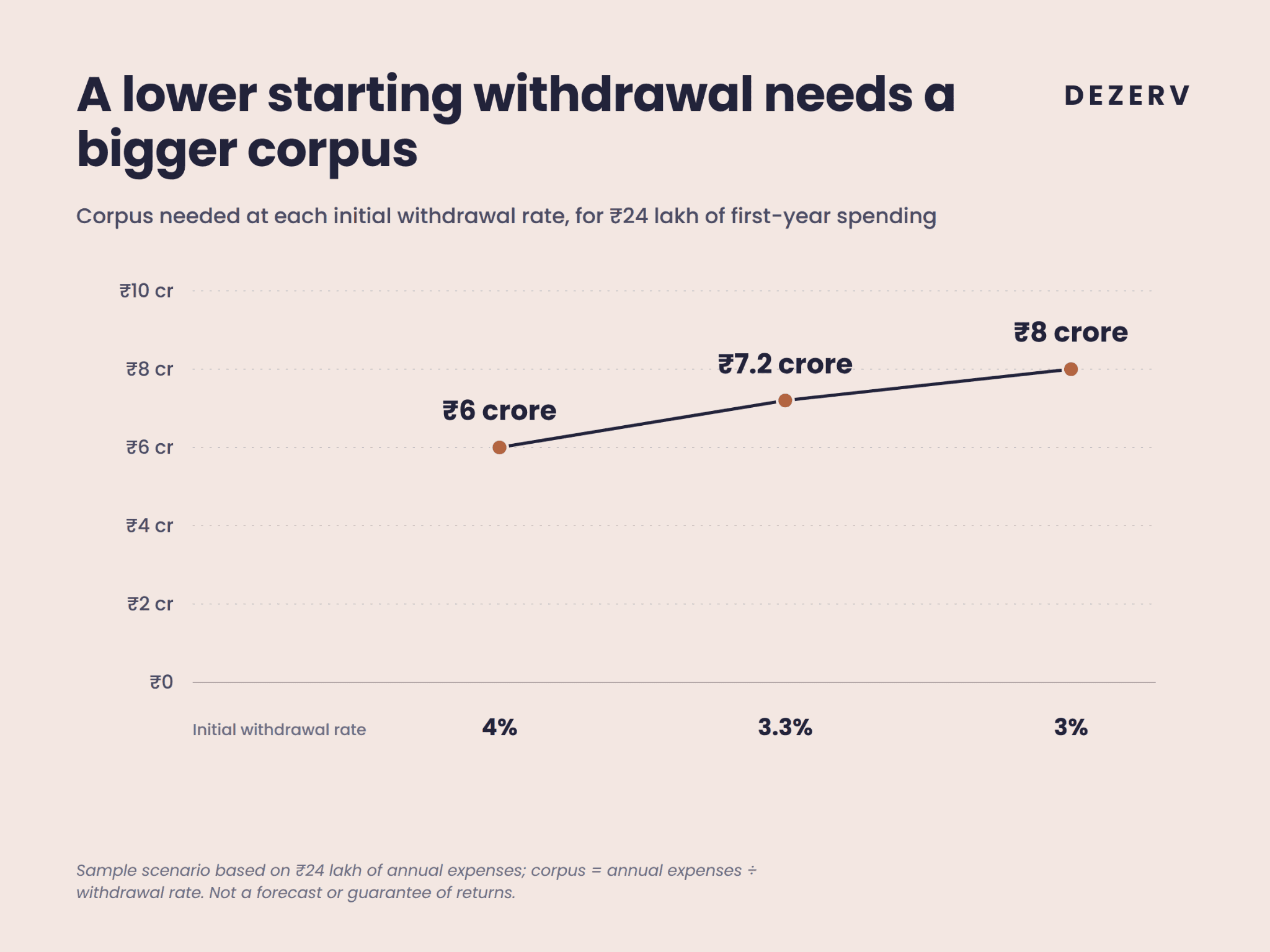
A sample scenario based on ₹24 lakh of annual expenses; corpus = annual expenses ÷ withdrawal rate. Not a forecast or guarantee of returns. Source: Dezerv Investment Team calculation, July 2026.
The lower the proportion you plan to withdraw at the start, the more money you need behind the same lifestyle.
If you want to work backwards from your own spending and retirement timeline, use theDezerv Retirement Calculator.
Where did the 4% rule come from?
The rule began with American market history.
In 1994, financial adviser William Bengen studied historical US market periods to understand how much a retiree could initially withdraw from a stock-and-bond portfolio, increase that withdrawal with inflation, and still make the money last for 30 years.
A 4% initial withdrawal survived every 30-year period in his historical sample. Bengen called the maximum sustainable rate in his work “SAFEMAX”.Read the research on Bengen's withdrawal-rate study.
The Trinity Study later examined different withdrawal rates across different stock-and-bond allocations. A 4% withdrawal from a 50:50 stock-bond portfolio succeeded in about 95% of the rolling 30-year periods it studied.Read the Trinity Study.
That history is why 4% became such a widely used retirement benchmark. But the percentage is only one part of the research. The conditions under which it was tested matter too.
In their words
“A lot of success in life and business comes from knowing what you want to avoid.”
— Charlie Munger
In this context, what an Indian retiree wants to avoid is applying a US assumption set without examining whether it fits their own retirement.
What changes for an Indian retirement?
Two questions become particularly important when the same framework is applied to an Indian household.
1. How quickly will your actual expenses rise?
The inflation that affects your retirement is not necessarily the Consumer Price Index (CPI) number reported every month. It is the inflation in the things you continue paying for.
For an affluent household, that may include healthcare, domestic staff, travel and other categories whose costs can move differently from the overall consumer basket. Dezerv's analysis therefore uses higher lifestyle-inflation assumptions for some affluent spending profiles than headline CPI.
The underlying analysis for this article cites lifestyle inflation near 9% for an affluent household, compared with headline retail inflation of about 4.4% in June 2026.(Source:MoSPI's CPI data.)
Note: Dezerv’s inflation estimate is based on category-level inflation assumptions for healthcare (12–14%), domestic staff wages (10–12%), and education/travel (8–10%), blended to roughly 8–9% for the illustrative affluent-household basket; this is not an official inflation statistic
This becomes more important the longer retirement lasts. ₹24 lakh may be enough to fund the first year, but it is not the amount you will necessarily need 10, 20 or 25 years later.
Your own rate depends on what your household actually spends on. See how inflation affects retirement planning.
2. How many years does the money have to last?
The original 4% research was built around a 30-year retirement.
Retire at 60 and 30 years takes the plan to age 90. If you want the corpus to continue providing beyond that, it has to fund more years than the original research examined.
India's life expectancy at birth is around 70, but life expectancy at birth is not the same as the remaining lifespan of someone who has already reached retirement age. Planning to 90 is therefore a longevity-tail convention rather than a statement about the average lifespan of every Indian.(Source: SRS Abridged Life Tables.)
Five additional years of retirement mean five additional years of housing, healthcare, travel, household expenses and everything else that continues to come out of the corpus.
There is also the portfolio itself. The original research was based on a particular history of US stock and bond returns. Indian asset returns, yields, taxation and inflation do not reproduce that history exactly.
This is why using the percentage on its own tells you less than understanding the assumptions behind it.
The bigger risk can be what happens just after you retire
Average returns can hide one of the most important risks in retirement.
Consider two retirees with the same starting corpus. Over 30 years, both portfolios eventually earn the same average return. One gets strong returns in the first few years and experiences a large market fall much later. The other experiences that fall almost immediately after retirement.
Their outcomes can be very different.
Before retirement, your salary is usually paying the bills. If markets fall, you may be able to leave the portfolio alone and give it time to recover.
After retirement, the portfolio itself may be paying for your lifestyle. If a sharp fall comes early, withdrawals do not stop until markets recover. You may have to sell more units at lower prices to generate the same amount of money. Those units are then no longer invested when the recovery comes.
This is known as sequence-of-returns risk. Indian market history gives a sense of how often difficult periods can arise.
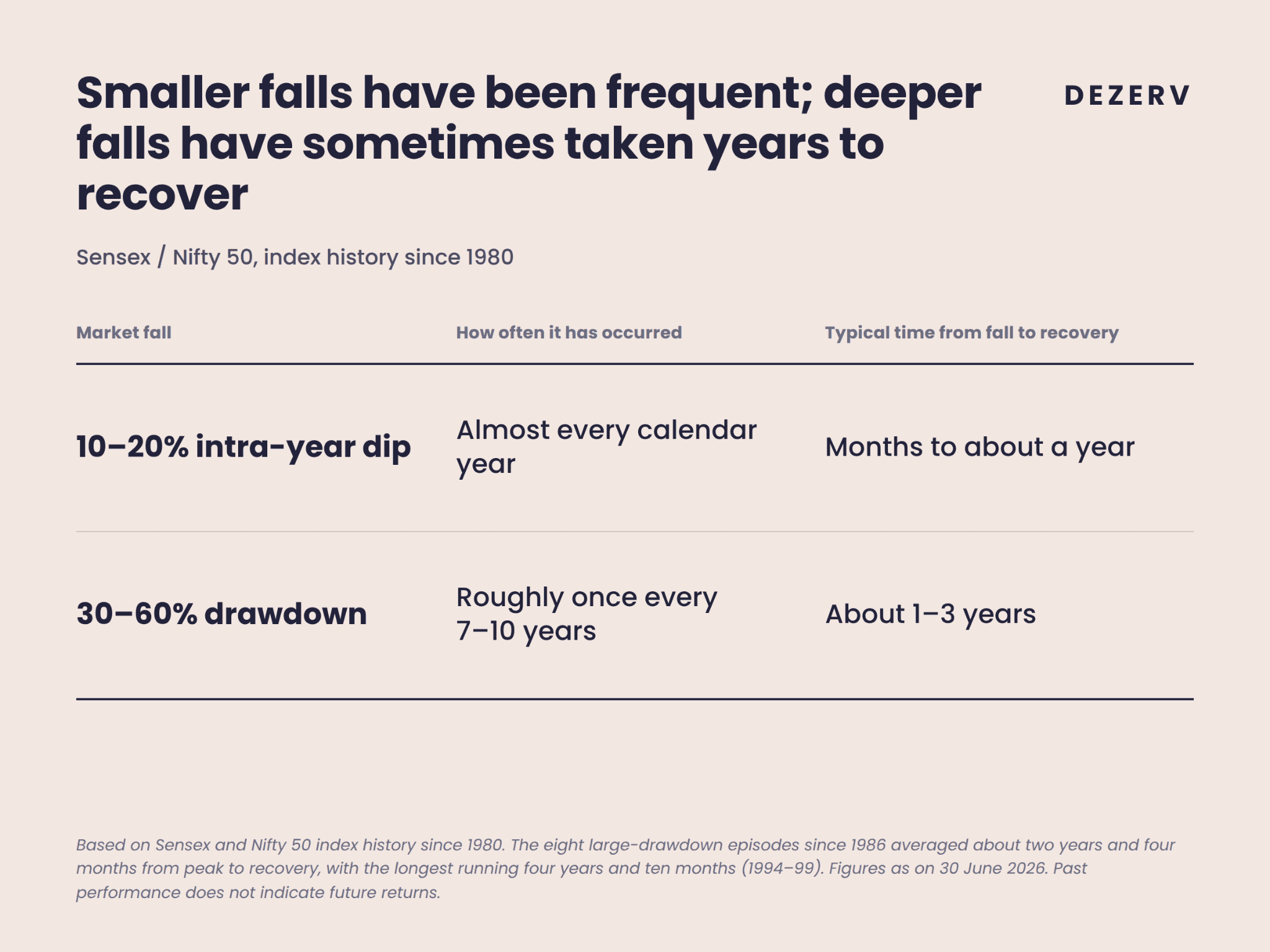
Based on Sensex and Nifty 50 index history since 1980; the eight large-drawdown episodes since 1986 averaged about two years and four months from peak to recovery, with the longest running four years and ten months from 1994–99. Figures as on 30 June 2026; past performance does not indicate future returns. Source: BSE / NSE index history (Sensex, Nifty 50);Nifty Indices historical data.
The same 30% fall can therefore mean two completely different things.
If it happens ten years before retirement, you may still have income coming in and time for the portfolio to recover. If it happens two years after retirement, you could be taking money out at exactly the same time.
That is something a neat average-return assumption cannot capture.
So how much should you plan to withdraw in India?
For the affluent Indian household profiles considered in this article, Dezerv's framework uses a more conservative 3–3.3% initial withdrawal range, equivalent to approximately 30–33 times annual expenses, rather than treating the US 4% framework as the default.
Note: The initial withdrawal range is a Dezerv planning assumption derived for the illustrative profiles and assumptions discussed here; it is not an established industry standard or a universally sustainable withdrawal rate
The household does not need a larger corpus because it suddenly plans to spend more. It needs a larger corpus because the same annual spending represents a smaller share of the money available.
That creates more room for expenses to rise, retirement to run longer than expected and markets to go through difficult periods while withdrawals continue.
It is still a planning range rather than one number for every retiree. The appropriate assumption may change with lifestyle inflation, longevity, asset allocation, taxes, investment returns and the way withdrawals are structured.
Your spending matters more than the round corpus number
This is where corpus multiples become useful.
Thirty times annual spending for someone spending ₹50,000 a month is ₹1.8 crore. For someone spending ₹2 lakh a month, it is ₹7.2 crore. For someone spending ₹5 lakh a month, it is ₹18 crore.
The multiple is the same. The retirement requirement clearly is not.
The analysis used for this retirement series also applies different lifestyle-inflation assumptions to different spending profiles:
| Household profile | Lifestyle-inflation assumption used in the analysis |
| ₹50,000 a month, smaller-city retirement | Nearer 7% |
| ₹2 lakh a month, metro household | Nearer 9% |
| ₹5 lakh a month, UHNI lifestyle | Higher still |
These are Dezerv estimates for the specific spending baskets considered in the analysis, not official inflation statistics or rates applicable to every household.
The higher the lifestyle cost and the faster those expenses rise, the more work the corpus has to do over the same retirement period.
This is why asking “Is ₹5 crore enough?” on its own does not tell you very much. ₹5 crore has no retirement meaning until you know how much has to come out of it every year.
Growing today's spending to the retirement year is where most of the working sits. See how much money you need to retire in India
Building the corpus and living off it are two different problems
Knowing how large the corpus should be does not tell you how to take money out of it every month.
Once retirement begins, you still need to decide where regular income comes from, how much liquidity to maintain and what happens to withdrawals when one part of the portfolio is going through a weak market.
A Systematic Withdrawal Plan (SWP) is one mechanism through which regular withdrawals can be made from a mutual fund.Read Dezerv's SWP explainer. But the mechanics of generating retirement income and the calculation of how large the starting corpus needs to be are separate problems.
The first question is how much money needs to be there when retirement begins. The second is how that money should be managed once you start taking it out.
Both need to be thought through before retirement begins.
If you would rather work through the assumptions against your existing portfolio and retirement goals,Book a call with a Dezerv Expert today.
The number that matters is the one your lifestyle can sustain
The enduring idea behind the 4% rule is not necessarily 4%.
It is that retirement savings and retirement spending cannot be planned separately.
A ₹10 crore corpus may be more than enough for one household and inadequate for another. The answer depends on what needs to come out of it, how quickly that spending rises and how long the withdrawals continue.
Once your salary stops, your portfolio has to do two jobs at the same time: pay for the life you are living now and preserve enough capital for the life you may still be living decades later.
That is the real retirement calculation.
Key takeaways
- A withdrawal rate connects your annual retirement spending to the corpus supporting it.
- The 4% rule originated in historical US research and assumes withdrawals rise with inflation over a roughly 30-year retirement.
- Terms such as 25x and 30x simply express the size of the corpus relative to annual spending.
- For Indian households, the inflation in actual household expenses and the length of retirement can materially change how much the corpus has to support.
- Market falls can have a larger effect after retirement because withdrawals may continue while asset prices are down.
- For the affluent household profiles considered here, Dezerv's framework uses a more conservative initial withdrawal range of around 3–3.3%, rather than treating 4% as the default.
- “Safe withdrawal rate” is a retirement-planning term, not a guarantee that a particular rate will make the money last.
- The retirement corpus should ultimately be built around the lifestyle it has to fund, rather than an arbitrary round target.
Frequently Asked Questions
What is the 4% rule for retirement?
The 4% rule says that you begin retirement by withdrawing 4% of your corpus in the first year and increase that rupee amount with inflation in subsequent years.
For ₹24 lakh of first-year spending, a 4% initial withdrawal would imply a ₹6 crore starting corpus.
Does the 4% rule work in India?
The 4% rule was developed from historical US market data and tested around a 30-year retirement period. Indian households can face different inflation, taxation, investment returns and retirement horizons, so the same percentage should not automatically be treated as the default.
For the affluent household profiles considered in this article, Dezerv's framework uses a more conservative initial withdrawal range of around 3–3.3%.
What is a safe withdrawal rate?
“Safe withdrawal rate” is the established retirement-planning term for the percentage of a corpus that can initially be withdrawn while aiming to make the money last for a specified period.
It does not mean that the outcome is guaranteed. Actual sustainability depends on inflation, investment returns, taxes, asset allocation, longevity and the way withdrawals are managed.
What does 30x mean in retirement planning?
30x means a retirement corpus equal to 30 times your annual retirement spending.
If your first-year annual spending is ₹24 lakh, 30 times that amount is ₹7.2 crore. Mathematically, that corresponds to an initial withdrawal rate of roughly 3.3%.
How is the corpus multiple different from the withdrawal rate?
They express the same relationship from two directions.
The withdrawal rate tells you what proportion of the corpus you begin by spending. The corpus multiple tells you how large the corpus is relative to annual spending.
A lower starting withdrawal therefore requires a larger corpus.
How do I calculate my retirement corpus?
Start with what your lifestyle costs today, estimate what those expenses could be by the time you retire, and decide how many years the corpus may need to support you.
You can work through your own assumptions in the Dezerv Retirement Calculator.
Disclaimer — Dezerv Investments Private Limited is a SEBI-registered Portfolio Manager (Registration No. INP000007377). Distribution services are offered by Dezerv Distribution Services Private Limited, a wholly owned subsidiary of Dezerv Investments Private Limited, under AMFI Registration No. ARN-248439 and APMI Registration No. APRN-00615. This article is intended solely for general educational and informational purposes and should not be construed as personalised investment, financial planning, tax or legal advice, or as a recommendation, offer or solicitation to invest in any security, financial product or investment strategy. Investors must consider their individual circumstances and obtain appropriate professional advice before making any investment decision.
The withdrawal rates, corpus multiples, corpus figures, inflation estimates and other calculations, illustrations and estimates presented herein are for illustrative retirement-planning purposes only and are based on the assumptions and scenarios stated in the article. They are not intended to represent actual or expected outcomes and should not be construed as forecasts, recommendations, assured outcomes or universally applicable retirement requirements. The assumptions and estimates are based on internal analysis and do not constitute official statistics or any assurance of corpus adequacy or sustainability. Actual outcomes may vary depending on individual circumstances and prevailing inflation, investment returns, market conditions, economic conditions, taxation, regulatory requirements and other relevant factors.
Investment in the securities market is subject to market risks. Please read all related documents carefully before investing. Past performance, where referred to, is not indicative of future performance and may or may not be sustained. There can be no assurance or guarantee that any investment or portfolio objective will be achieved. Tax laws and their application are subject to change and may vary depending on individual circumstances.
Meta title: How Much Can You Withdraw From a Retirement Corpus in India?
Meta description: Once the salary stops, the corpus pays the bills. Understand how much you may be able to withdraw each year in India, and what that implies for corpus size.


