
How Much Money Do You Need to Retire in India? The Maths Behind Your Retirement Corpus

Ask someone how much money they need to retire, and you will often hear a neat number: ₹5 crore, ₹10 crore, perhaps ₹20 crore.
But the same corpus can mean very different things for two households. Someone spending ₹1 lakh a month today has a very different retirement requirement from someone spending ₹4 lakh, even if both retire at the same age.
Take the second household. If it spends ₹4 lakh a month today, retires 15 years from now and wants its corpus to last another 30 years, the requirement in our worked example comes to about ₹45.7 crore at retirement.
That number sounds enormous. But there is another useful way to look at it. If a corpus invested today were assumed to compound at 12% post-tax for those 15 years, about ₹8.3 crore today would grow to the same ₹45.7 crore target.
The ₹8.3 crore figure is therefore not simply ₹45.7 crore converted into today's purchasing power. It is the present corpus required under the specific return assumption used in this example. Change that assumption and the ₹8.3 crore figure changes too.
And that is why the assumptions behind a retirement number matter as much as the number itself.
| In short: There is no single retirement number. What you need to retire in India depends on your annual post-work spending, how much that spending grows by the time you retire, and how many years the money must then last. For an affluent household spending ₹4 lakh a month today and retiring in 15 years, that maths lands near ₹45–46 crore in retirement-year rupees, about ₹8.3 crore as the corpus required today under the illustrative 12% post-tax return assumption. The worked example uses an 8% lifestyle-inflation assumption, within Dezerv's estimated 8–9% range for the affluent-household basket described below. This is a Dezerv estimate for this basket based on multiple data points, not an official statistic. You can size your own figure in the Dezerv Retirement Calculator. |
The calculator can generate an illustrative retirement-corpus estimate in minutes based on your inputs and the assumptions selected. If you would rather work through the assumptions with someone who does this daily,Book a call with a Dezerv Expert today.
On This Page
- The Three Inputs That Decide Your Number
- The Corpus-Sizing Method, Step by Step
- The Full Worked Example: ₹4 Lakh a Month
- Find Yourself in This Table
- The Four Forces, and How Much Each One Moves the Number
- Why the Horizon Does the Heavy Lifting
- India's Safe Withdrawal Rate Is Not 4%
- In Their Words
- Is ₹2, ₹5 or ₹10 Crore Enough?
- Building the Corpus and Making It Last Are Two Different Problems
- Key Takeaways
Retirement calculations are often less sensitive to the formula than to the assumptions put into it. Get the important inputs right and the corpus becomes a number you can actually plan toward.
The Three Inputs That Decide Your Number
Three things set the scale of your retirement requirement: how much you spend today, how many years you have until retirement, and how many years the corpus must then support you.
Returns, taxes and withdrawal rates matter too, but these three inputs determine much of the starting requirement.
Inflation is one of the easiest inputs to underestimate.
A household that spends on domestic help, private healthcare, school fees, a car and regular travel does not necessarily experience inflation in the same way as the headline consumer price index (CPI), which was about 4.45% in July 2026 (MoSPI, Jul 2026).
Medical costs, for instance, are estimated to be rising at roughly 11–14% a year (Aon Global Medical Trend Rates Report, 2026; industry estimate), In Dezerv's analysis, categories such as domestic staff wages,education andtravel may also rise faster than general CPI.
The exact inflation experienced by any household will depend on how it spends. For the worked example in this article, Dezerv uses 8% as a planning assumption for an affluent household whose spending basket includes categories such as healthcare, education, domestic help and travel. Based on the underlying expense categories, we estimate that blended lifestyle inflation for such a basket can be roughly 8–9% over time.
This is a Dezerv estimate, not an official inflation statistic, and it should not be treated as the inflation rate for every affluent household. But the distinction matters because using a lower inflation assumption can materially reduce the retirement target on paper.
We unpack this gap in detail in how inflation affects retirement.
The Corpus-Sizing Method, Step by Step
The calculation has four steps: start with what you spend today, adjust it for inflation until retirement, multiply it by the number of years you expect the corpus to support you, and then work backwards to understand what that future requirement could mean in today's terms under an assumed pre-retirement return.
This method assumes that in-retirement returns roughly match in-retirement inflation, leaving the real return close to zero. Under that assumption, the corpus needs to fund a fixed number of years of inflation-adjusted spending.
- Spend. Start with your current monthly spending, S. Annualise it: S × 12.
- Inflate. Grow that spend to your retirement year at your blended lifestyle inflation i over n years: annual spend × (1 + i)^n. This gives you the annual cost of your lifestyle when you retire.
- Multiply. Multiply the retirement-year annual spend by D, the number of years the corpus must last. At roughly zero real return, D years of spending gives you the required corpus.
- Translate. Divide the future corpus by (1 + g)^n, using an assumed pre-retirement return g. This tells you what corpus invested today would need to grow to the retirement-year target under that return assumption.
Steps one to three give you the corpus requirement at retirement. Step four is different: it works backwards from that requirement using an assumed investment return.
It is therefore important not to read the step-four figure as simply the inflation-adjusted value of the future corpus. It depends directly on the return assumption used.
Illustration: ₹4 Lakh a Month
Take an affluent household spending ₹4 lakh a month today, or ₹48 lakh a year.
Assume the family retires in 15 years and wants the corpus to last 30 years, from age 60 to 90.
For this Illustration, we use:
- 8% blended lifestyle inflation
- 30 years of retirement spending
- 12% post-tax pre-retirement return, used only to work backwards from the future corpus to a present-day corpus
The calculation looks like this:
- Spend: ₹48 lakh a year today.
- Inflate: ₹48 lakh × 1.08^15 ≈ ₹1.52 crore a year at retirement. Monthly spending grows from ₹4 lakh to about ₹12.7 lakh.
- Multiply: ₹1.52 crore × 30 ≈ ₹45.7 crore, the corpus required at retirement under the stated assumptions.
- Translate: ₹45.7 crore ÷ 1.12^15 ≈ ₹8.3 crore invested today, assuming it compounds at 12% post-tax for 15 years.
Note: This is an illustration, not a forecast or guarantee of returns, and not personalised advice. Change any input and the number changes entirely. You can derive your own in the Dezerv Retirement Calculator.
The two numbers answer different questions.
₹45.7 crore is the estimated corpus required when retirement begins under this scenario.
₹8.3 crore is the corpus that, if available today and if it compounded at the assumed 12% post-tax return for 15 years, would reach approximately ₹45.7 crore.
That distinction matters. A different return assumption would leave the retirement-year requirement unchanged but change the amount required today.
The figures above refer to the investable corpus intended to fund retirement spending. They do not automatically include the value of the home you live in unless your retirement plan specifically assumes that the property will be sold, rented or otherwise monetised.
The step-by-step calculator walkthrough sits in the retirement calculator guide.
Find Yourself in This Table
The same calculation across four spending levels shows how directly the corpus scales with lifestyle.
All rows assume retirement in 15 years, a 30-year drawdown and 8% blended lifestyle inflation for comparability. The "spend at 60" column shows the monthly spending the corpus is designed to fund.
The final column shows the corpus that would need to be invested today to reach the retirement-year target if it compounded at the assumed 12% post-tax pre-retirement return.
| Spend Today (₹/month) | Spend at 60 (₹/month) | Corpus at 60 (retirement-year ₹) | Corpus Required Today at Assumed 12% Return |
| ₹1 lakh | ₹3.2 lakh | ₹11.4 crore | ₹2.1 crore |
| ₹2 lakh | ₹6.3 lakh | ₹22.8 crore | ₹4.2 crore |
| ₹4 lakh | ₹12.7 lakh | ₹45.7 crore | ₹8.3 crore |
| ₹6 lakh | ₹19.0 lakh | ₹68.5 crore | ₹12.5 crore |
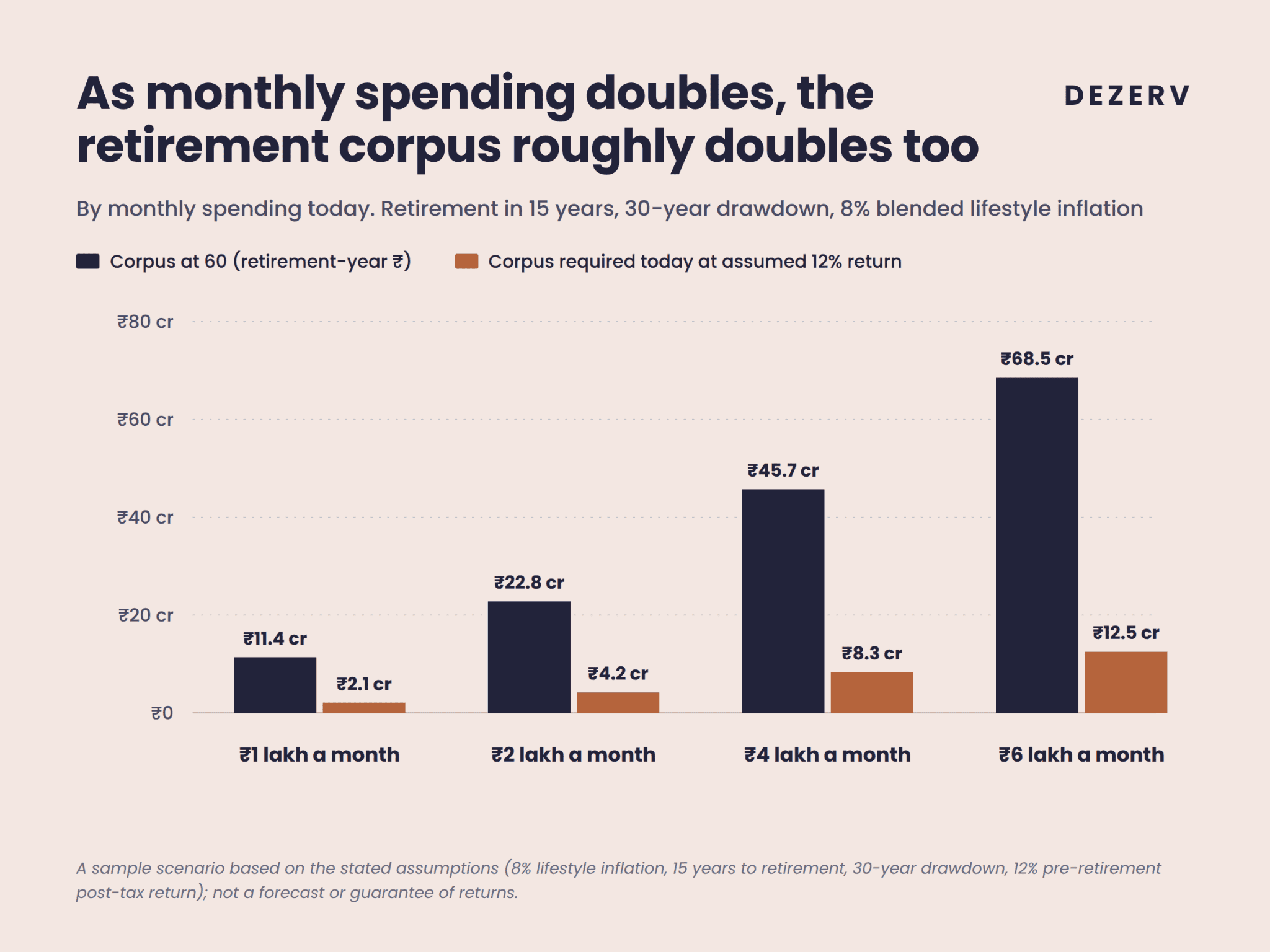
As spending doubles, the retirement corpus roughly doubles too. The amount required today also changes proportionately because every row uses the same time horizon and return assumption.
Your row in this table is a starting point, not a plan. To see how your existing portfolio maps against the figure, Book a call with a Dezerv Expert today.
The Four Forces, and How Much Each One Moves the Number
The ₹45.7 crore figure above is not fixed. Change one assumption and the answer can change materially.
Here is what four important variables do to the ₹4 lakh-a-month household's ₹45.7 crore base case.
Lifestyle inflation
At 6% inflation, the required corpus falls to about ₹34.5 crore.
At 8%, it is ₹45.7 crore.
At 9%, it crosses ₹52 crore.
That is a difference of more than ₹17 crore between the lower and upper assumptions, despite everything else remaining unchanged.
Headline CPI itself was about 4.45% in July 2026 (MoSPI); 6% is used here only as a round comparator. On this particular profile, every percentage point of inflation can move the estimated corpus by roughly ₹6–8 crore.
Healthcare inflation
Health costs are estimated to be rising at roughly 11–14% a year (Aon Global Medical Trend Rates Report, 2026; industry estimate), well above the general inflation basket.
A ₹30,000-a-month healthcare requirement today grows to about ₹1.9 lakh a month in 15 years at 13% inflation. At 8%, the same expense reaches about ₹95,000.
Healthcare can also become a larger share of household spending with age, which is why the dedicated healthcare corpus piece sizes this expense separately.
Longevity
The longer your retirement lasts, the more years of spending the corpus must fund.
In the same ₹4 lakh-a-month example, planning until age 85 rather than 90 reduces the corpus from ₹45.7 crore to ₹38.1 crore.
That ₹7.6 crore difference is the additional corpus required to fund five more years under this simplified scenario.
India's life expectancy at birth is about 70 years, and is higher in urban areas (SRS Abridged Life Tables 2019–23), but life expectancy at birth is not the same as the remaining lifespan of someone who has already reached retirement age. For an urban couple, planning until 90 can therefore provide a buffer against the possibility of a longer retirement.
Taxes
Retirement withdrawals can also have a tax impact, so the amount withdrawn from the portfolio may be higher than the amount ultimately available for spending.
Equity long-term capital gains are taxed at 12.5% above a ₹1.25 lakh annual exemption, while dividends are taxed at the applicable slab rate (Income Tax Department, Section 112A;CBDT via PIB, 23 Jul 2024).
The actual tax impact will depend on the assets held, the taxable portion of each withdrawal and the tax rules applicable at the time. This means a retirement calculation that ignores taxes altogether may underestimate the corpus required.
Why the Horizon Does the Heavy Lifting
The retirement requirement tells you where you may need to get to. How long you have to build that corpus affects how much work your investments need to do along the way.
Starting earlier gives each contribution more time to compound.
Consider a ₹10,000 monthly investment assumed to compound at 12% a year:
| ₹10,000 a Month, Assumed 12% a Year | Corpus by Age 60 |
| Started at 25 | ~₹6.4 crore |
| Started at 35 | ~₹1.9 crore |
| Started at 45 | ~₹50 lakh |
A sample scenario: compounding at an assumed 12% annual return. 12% is an assumption, not a promise, and actual returns vary. Source: Dezerv Investment Team calculation, July 2026.
Under these assumptions, the same ₹10,000 monthly contribution grows to more than twelve times as much when it begins at 25 rather than 45.
The monthly investment has not changed. What changes is the amount of time each contribution gets to compound.
Why the 4% Rule May Not Translate Directly to India
Once you know how much you may spend in retirement, there is another way to approach the corpus question: what percentage of the corpus can you withdraw each year without designing the plan to run out too early?
In retirement planning, this is commonly called the safe withdrawal rate.
The word “safe” is part of the established term. It does not mean that a particular withdrawal rate is guaranteed to work. It refers to a withdrawal rate designed, under a given set of assumptions, to make a corpus last for a chosen retirement period.
Why does that matter here?
Because the withdrawal rate and the corpus multiple are two ways of looking at the same problem.
If your first-year retirement spending is ₹1 crore:
- a 4% withdrawal rate implies a corpus of about ₹25 crore;
- a 3.3% withdrawal rate implies a corpus of about ₹30 crore.
So the lower the withdrawal rate you plan around, the larger the starting corpus generally needs to be.
The famous 4% rule comes from William Bengen's 1994 study in the Journal of Financial Planning (Bengen, 1994). Broadly, it examined whether a US retiree could begin by withdrawing 4% of a stock-and-bond portfolio, increase that withdrawal with inflation each year, and make the portfolio last for 30 years across historical US market periods.
It is a useful framework, but some of the assumptions behind it do not translate neatly to an Indian retirement, including the inflation environment, taxation, asset returns and the length of the retirement period.
For the affluent Indian household used in this article, the relevant variable is the real return after both taxes and inflation.
If that net real return is only 0–1%, the corpus multiple required becomes:
| Net Real Return (post-tax, post-inflation) | 25-Year Drawdown | 30-Year Drawdown | 35-Year Drawdown |
| 0% | 25x | 30x | 35x |
| 1% | 22x | 26x | 29x |
| 2% | 20x | 22x | 25x |
Multiple of your retirement-year annual spending. A sample scenario based on the stated assumptions. Source: Dezerv Investment Team calculation, July 2026.
At a 0–1% real return over a 30-year retirement, the calculation works out to roughly 26–30 times retirement-year annual spending.
That corresponds mathematically to an initial withdrawal rate of approximately 3.3–3.9%.
This does not mean 3.3–3.9% is universally “safe” for every Indian retiree. It is the range produced by the assumptions in this simplified model. Actual sustainability depends on factors including market returns, inflation, taxes, asset allocation, withdrawal timing and longevity.
This is also why the worked example above uses a 30x spending multiple.
The full India adaptation, including the sequence-of-returns risk this table simplifies, is in the 4% rule for India.
In Their Words
"Time is your friend; impulse is your enemy."
— John C. Bogle, The Clash of the Cultures (2012)
The principle applies at both stages of retirement planning.
Before retirement, time allows contributions more opportunity to compound. During retirement, short-term decisions can affect how long the corpus lasts, particularly if growth assets have to be sold after a market fall simply to meet near-term expenses.
Is ₹2, ₹5 or ₹10 Crore Enough?
There is no universal answer because the same corpus can support very different spending levels.
₹5 crore, for instance, looks very different for a household spending ₹50,000 a month in a Tier-2 city than it does for a metro household spending ₹2 lakh or ₹4 lakh a month.
The relevant question is therefore not simply:
“Is ₹5 crore enough?”
It is:
“How much annual spending does ₹5 crore need to fund, for how many years, and under what inflation and return assumptions?”
That is also why ₹40 crore is not a retirement requirement for every Indian. It is the result of a particular spending level, retirement date, inflation assumption and drawdown period.
We run ₹2 crore, ₹5 crore and ₹10 crore against different spending levels side by side in is ₹2, ₹5 or ₹10 crore enough.
Building the Corpus and Making It Last Are Two Different Problems
Calculating the corpus tells you how much you may need when retirement begins. It does not tell you how that money should then be managed for the next 25, 30 or 35 years.
Once earned income stops, withdrawals continue regardless of what markets are doing. Inflation continues too. Taxes, asset allocation and the order in which market returns occur can all affect how long the corpus lasts.
That is why the drawdown period matters as much as the accumulation period.
A corpus designed to last until 85 can face a very different outcome if one or both partners live into their nineties.
Two considerations are particularly important.
First, separate your primary home from the investable corpus that will actually fund retirement.
The house you live in may contribute substantially to your net worth, but unless you plan to sell it, rent it or borrow against it, it does not directly meet monthly expenses. Retirement spending should therefore be sized primarily against investable assets and expected income.
Second, the portfolio may still need a growth component after retirement.
Selling equity after a major market fall to fund near-term spending can reduce the capital available to participate in a subsequent recovery. At the other extreme, moving the entire corpus into fixed deposits at retirement can increase exposure to inflation over a 25-to-30-year period.
Accumulating the corpus and deciding how to draw from it are therefore separate portfolio problems. Both need to be considered before retirement begins.
Key Takeaways
- There is no universal retirement corpus. The number depends primarily on your spending, the years until retirement and how long the corpus must support you.
- The inflation assumption matters materially. The worked example uses 8% lifestyle inflation as a Dezerv planning assumption for the affluent-household basket described in the article, not as an official inflation rate for all affluent Indians.
- ₹45.7 crore and ₹8.3 crore do not mean the same thing. ₹45.7 crore is the estimated retirement-year corpus in the worked example. ₹8.3 crore is the amount that would need to be invested today to reach that target if it compounded at the assumed 12% post-tax return for 15 years.
- Longevity changes the requirement. In the worked example, funding five additional years adds several crore to the corpus.
- “Safe withdrawal rate” is a planning term, not a guarantee. Under the simplified 0–1% post-tax real-return assumptions used here, a 30-year retirement produces a withdrawal-rate range of roughly 3.3–3.9%, corresponding to about 26–30 times retirement-year annual spending.
- Treat your home separately from investable retirement assets unless monetising it is explicitly part of the retirement plan.
- Size your own figure, with every assumption adjustable, with the Dezerv Retirement Calculator.
Knowing the number is the first half of the problem. The second is building a portfolio toward it and planning how that portfolio will fund several decades of withdrawals.
Book a call with a Dezerv Expert today to talk through both.
Frequently Asked Questions
How Much Money Is Enough to Retire in India?
There is no single amount that is enough for everyone.
A useful starting point is your annual spending grown for lifestyle inflation to your retirement year, combined with the number of years the corpus must then support you.
Under the simplified 0–1% post-tax real-return assumptions used in this article, a 30-year retirement corresponds to roughly 26–30 times retirement-year annual spending. For affluent metro households, this can run into several crore. The actual figure changes with spending, retirement age, inflation, returns, taxes and longevity.
What Corpus Do I Need to Retire on ₹4 Lakh a Month?
In the worked example in this article, ₹4 lakh of monthly spending today grows to about ₹12.7 lakh a month after 15 years at an assumed 8% lifestyle inflation rate.
Funding that level of spending for 30 years at roughly zero real return produces a retirement-year corpus requirement of about ₹45.7 crore.
Separately, if a corpus were available today and assumed to compound at 12% post-tax for 15 years, approximately ₹8.3 crore today would grow to that ₹45.7 crore target.
This is a sample scenario based on the stated assumptions. Change the inflation rate, return assumption, retirement age or lifespan and the figures change.
What Withdrawal Rate Is Safe in India?
“Safe withdrawal rate” is a retirement-planning term for the percentage of a corpus that can be withdrawn while aiming to make the money last for a specified retirement period. It does not mean the outcome is guaranteed.
Under the simplified assumptions used in this article, a 0–1% post-tax real return over a 30-year retirement corresponds to an initial withdrawal rate of roughly 3.3–3.9%, or a corpus of approximately 26 to 30 times retirement-year annual spending.
The appropriate rate for an individual investor can differ based on inflation, market returns, taxes, asset allocation, longevity and withdrawal patterns.
Why Is the Retirement Number So Much Larger Than People Expect?
One reason is that retirement targets are usually calculated in the rupees of the year in which retirement begins.
In the worked example above, 15 years of 8% lifestyle inflation takes annual spending from ₹48 lakh today to about ₹1.52 crore at retirement.
That higher annual spending then has to be funded across a 30-year retirement.
The inflation assumption also matters. In this scenario, using 6% rather than 8% reduces the estimated corpus by roughly a quarter.
Does the Retirement Number Include My Home?
Usually not, unless your retirement plan specifically assumes that you will sell, rent or otherwise monetise it.
Your primary residence may be a valuable part of your net worth, but it does not ordinarily fund monthly expenses while you continue living in it.
Size the retirement corpus primarily from investable assets and expected income, and treat illiquid property separately unless it forms part of the drawdown plan.
Disclaimer:Dezerv Investments Private Limited is a SEBI-registered Portfolio Manager (Registration No. INP000007377). Distribution services are offered by Dezerv Distribution Services Private Limited, a wholly owned subsidiary of Dezerv Investments Private Limited, under AMFI Registration No. ARN-248439 and APMI Registration No. APRN-00615. This article is intended solely for general educational and informational purposes and should not be construed as personalised investment, financial planning, tax or legal advice, or as a recommendation, offer or solicitation to invest in any security, financial product or investment strategy.
The calculations, illustrations, estimates and assumptions presented herein are for illustrative purposes only and are based on the assumptions stated in the article. They are not intended to represent actual or expected investment returns or outcomes. Any return or inflation assumptions used are purely illustrative and should not be construed as assured, guaranteed or target returns. Actual outcomes may vary depending on individual circumstances and prevailing market, economic, tax and regulatory conditions.
Investment in the securities market is subject to market risks. Please read all related documents carefully before investing. Past performance, where referred to, is not indicative of future performance. Tax laws and their application are subject to change and may vary depending on individual circumstances.


