
How to plan a retirement budget: the three-phase spending curve

Think about what you might spend money on in your first few years of retirement.
There may finally be time for the trips that kept getting postponed. You could spend more on hobbies, family visits, eating out or simply doing things that were harder to fit around work.
Now move the clock forward twenty years.
Some of those expenses may have fallen considerably. But another part of the budget could have moved in the opposite direction: healthcare, insurance, domestic help and perhaps assisted care.
Yet retirement planning often begins by taking today’s monthly expenses, applying an inflation rate and carrying essentially the same spending pattern forward for the next 25 or 30 years.
That is convenient for a calculation. It is less convincing as a picture of how people actually live.
A better way to think about a retirement budget is in phases. The amount you spend may change, but more importantly, what you spend it on changes. Retirement may begin with relatively high discretionary spending, move into quieter years and eventually become increasingly shaped by healthcare and support costs.
Understanding that shift can help you build a retirement budget that reflects the life the money actually has to fund.
In short: A retirement budget should not simply be one monthly number projected for 30 years. Think about spending across three broad phases: an active early retirement, a slower middle period and a later phase in which healthcare and care-related expenses become much more important. Build the budget category by category, account for the fact that different costs can rise at different rates, and then work backwards to the income your retirement corpus may need to support.
On this page
- How do you build a retirement budget?
- In their words
- The three-phase spending curve
- Which expenses rise and which fall
- Budgeting healthcare separately
- Template: a monthly budget by phase
- How inflation reshapes the budget over 30 years
- Turning the budget into a withdrawal figure
How do you build a retirement budget?
The easiest place to start is your current monthly spending, but not as one total.
Break it into categories such as housing, food, travel, healthcare, domestic help and discretionary spending. Then ask how each category might behave as you move through retirement.
Travel, for example, may be relatively high in the first decade and fall later. Work-related expenses may disappear altogether. Healthcare may do precisely the opposite.
Once you have a reasonable monthly budget for each phase, you can account for inflation and the taxes that may apply to withdrawals to estimate the income your corpus will need to support.
This category-by-category approach requires more thought than applying one replacement-rate rule to your current income. But retirement itself does not happen in one neat financial phase.
The budget is also only one part of the wider retirement-planning exercise, which we cover in our biggest retirement mistakes indian investors make
In their words
“Save, but also spend, on things that give you joy… life is not a race of who has the highest NAV, but who has lived most joyfully.”
— Radhika Gupta, CEO, Edelweiss Mutual Fund (Outlook Money, 2025)
The three-phase spending curve
There is no fixed age at which one stage of retirement ends and another begins. Health, family circumstances, work and lifestyle can shift the timeline considerably.
But for planning purposes, it can help to think about retirement in three broad phases.
Early retirement: roughly your 60s to early 70s
For many people, this is the most active part of retirement. Health and mobility are usually better, and there is finally time for things that working life kept postponing: travel, hobbies, family visits and experiences.
That can keep discretionary spending relatively high, and deliberately so. Retirement planning is supposed to fund a life, not simply preserve the largest possible account balance.
Middle retirement: roughly the mid-70s to early 80s
Over time, the rhythm of life can change. Long-distance travel may become less frequent, discretionary purchases may reduce, loans may already have been repaid and the household itself may become smaller.
Some parts of the monthly budget can therefore begin to fall.
Late retirement: the 80s onward
By this stage, many discretionary expenses may have fallen considerably. But healthcare and support can take up a much larger part of the budget.
Medical treatment, insurance premiums, domestic assistance, home modifications or assisted care can become increasingly significant. So even where total spending does not rise sharply, the composition of spending can look completely different from the one you began retirement with.
That is the important point behind the three-phase spending curve. The boundaries are not fixed, and neither will the pattern be identical for every household. But assuming that every expense simply moves upward at the same rate misses how retirement spending can evolve.
Which expenses rise and which fall?
The clearest way to see the change is to stop looking at the total budget for a moment and look at what sits inside it.
Travel and leisure may begin high and fall as mobility reduces. Work-related costs disappear. EMIs can fall away if loans have been repaid before retirement, and household food expenditure may change as family circumstances change.
Healthcare costs may move in the other direction and become more significant over time. Insurance premiums can rise with age, while domestic help, assisted care and home maintenance may become more important as tasks that were once handled independently are increasingly outsourced.
Other expenses, such as housing, utilities and basic household running costs, may change less dramatically.
This means two retirement years with similar overall spending can still require very different financial preparation. ₹2 lakh spent at 62 and ₹2 lakh spent at 82 may be funding completely different lives.
Budgeting healthcare separately
Healthcare deserves more attention than simply assigning it a percentage of the household budget.
Unlike travel or discretionary consumption, it is both difficult to postpone and capable of becoming considerably more expensive over time. ICICI Lombard estimates medical inflation in India at around 12–14% annually, compared with approximately 5–6% for general inflation. ICICI Lombard describes these as indicative rates, with actual rates and impacts varying.
Healthcare can also take up a larger share of the household budget as you grow older. Insurance can absorb part of the burden, but it does not make healthcare expenditure disappear. Premiums themselves can increase, while deductibles, exclusions and expenses outside the policy can leave costs that still need to be funded.
That is why it can be useful to think of healthcare as a separate retirement requirement rather than allowing it to disappear inside a general monthly-expense assumption.
We discuss the sizing of this requirement in more detail in our healthcare corpus for retirement article.
Template: a monthly budget by phase
To see how this could work in practice, consider a hypothetical household spending ₹2 lakh a month at the start of retirement, in today’s money.
The example below is not based on an average Indian household or a published household-spending dataset. The category allocations and changes across phases are illustrative assumptions designed to show how the composition of retirement spending could shift over time, particularly from travel and discretionary spending towards healthcare and care-related expenses.
Methodology: This is a hypothetical retirement-budget scenario for a household spending ₹2 lakh a month at the start of retirement. The category allocations and changes across phases are illustrative assumptions used to demonstrate how spending priorities may shift over time. Figures are in today’s money and are not based on an average household, a forecast or a recommendation.
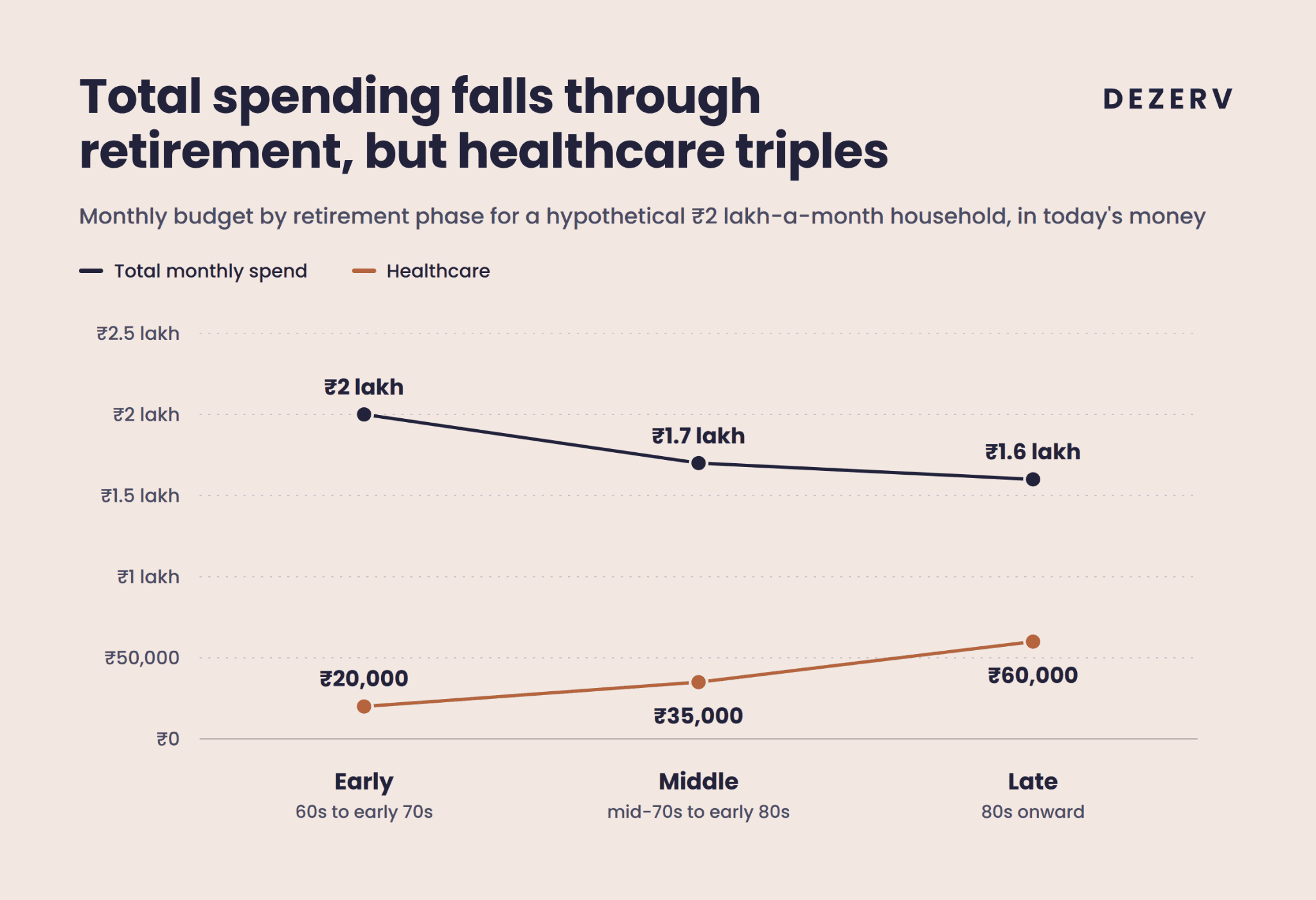
The most revealing row in the table is not the total. It is healthcare.
It rises from ₹20,000 to ₹60,000 a month even as overall spending in this scenario falls from ₹2 lakh to ₹1.6 lakh. Healthcare therefore moves from about 10% of monthly spending to more than a third.
That is why planning retirement around one aggregate expense number can hide as much as it reveals. The total may fall, but the expenses that are harder to avoid can become much more important.
This illustrative table makes the shift visible: healthcare increases from ₹20,000 to ₹60,000 even while the overall monthly figure declines.
How inflation reshapes the budget over 30 years
There is another complication: everything in the table above is expressed in today’s money.
Over a retirement lasting two or three decades, those expenses will not necessarily rise at the same rate.
ICICI Lombard estimates medical inflation in India at around 12–14% annually, compared with approximately 5–6% for general inflation.
That does not mean a 12–14% rate should automatically be assumed for every healthcare expense over the entire retirement period. But it does show why using one inflation rate for the entire household budget can miss an important part of the picture.
Consider healthcare in the example above. It begins at only ₹20,000 a month. If healthcare costs rise faster than other expenses for a sustained period, its share of future spending may increase for two reasons at once: you may need more healthcare as you age, and the underlying cost of that care may itself be rising faster.
This is why a ₹1.6 lakh late-retirement budget expressed in today’s money should not be confused with actually spending ₹1.6 lakh a month 20 or 25 years from now. The nominal rupee amount could be substantially larger by then, and the categories within it may have inflated very differently.
The more useful approach is to model categories separately and revisit those assumptions over time rather than treating one blended inflation rate as permanent.
The full mechanics are covered in how inflation affects your retirement.
Turning the budget into a withdrawal figure
Once the spending plan is built, the next question is not simply, “What will I spend?”
It is: How much income will my portfolio have to provide?
Start with the annual spending requirement across the different phases. Account for the inflation that may have accumulated by that point and, where relevant, the taxes associated with generating or withdrawing that income.
The portfolio then needs to be planned around funding withdrawals while continuing to support the remaining retirement horizon.
Retirement does not necessarily require the entire corpus to be held in cash. Over a long retirement, the portfolio may also need to address the risk of inflation eroding purchasing power.
The Nifty 50 Total Returns Index has compounded at 12.38% annually since its base date of November 1995, while the Nifty Composite G-sec Index, a benchmark of liquid government bonds, has compounded at 7.56% annually since its base date of January 2011 (both as on 31 August 2026, per NSE Indices factsheets). Consumer price inflation, by comparison, has averaged around 5% a year over the past decade, based on MoSPI data. On these measures, equity has historically exceeded inflation by roughly 6 to 7 percentage points a year and high-quality government debt by roughly 2 percentage points, before tax.
How much growth exposure to retain, which assets to draw from first and how to manage withdrawals during a market decline are separate decisions. We cover those in our guide to investing your retirement funds for a monthly income.
The retirement budget tells you what the money eventually needs to pay for. The investment and withdrawal plan determines how the corpus attempts to keep doing that through the years.
Key takeaways
- A retirement budget is better thought of in phases than as one fixed monthly expense carried forward for decades.
- The composition of spending changes: travel and discretionary expenses may fall, while healthcare and care-related costs can rise.
- Healthcare may merit separate modelling because both its share of household spending and the cost of care can increase over time
- ICICI Lombard estimates medical inflation in India at around 12–14% annually, compared with approximately 5–6% for general inflation. These are indicative rates rather than fixed assumptions for an entire retirement.
- Consider applying different inflation assumptions to major spending categories rather than assuming every part of the household budget will rise at the same rate
- Translate those spending needs into the income your retirement corpus will have to support at different stages.
- Explore how different assumptions affect your retirement estimates using the Dezerv Retirement Calculator
Frequently Asked Questions
How much should my monthly budget be in retirement?
There is unlikely to be one monthly figure that remains appropriate throughout retirement.Estimate the spending required through different stages of retirement, account for inflation and applicable taxes, and then model the portfolio required to support those withdrawals over the intended retirement period.
Start with what you spend today, break it into categories and then consider how those categories may change over time. Early retirement could involve more travel and leisure, while later years may devote a much larger share of spending to healthcare and support.
The objective is not to predict every future bill precisely. It is to avoid treating 30 years of retirement as though your lifestyle and spending mix never change.
Does spending go down in retirement?
Some expenses can.
Work-related costs, travel and discretionary spending may reduce over time. Others, particularly healthcare, insurance and care-related expenses, can rise.
As a result, retirement spending does not necessarily decline in a smooth straight line. Even in a scenario where the overall monthly budget becomes smaller, the mix of expenses can change substantially.
How do I budget for healthcare in retirement?
Treat healthcare as a separate part of the retirement budget rather than hiding it inside general household expenses.
Consider insurance premiums as well as expenses that insurance may not cover, and use a healthcare-specific inflation assumption where appropriate. ICICI Lombard estimates medical inflation in India at around 12–14% annually, compared with approximately 5–6% for general inflation.
That does not mean every household should automatically assume healthcare costs will rise at 12–14% every year throughout retirement. The assumption should be reviewed periodically as healthcare costs, insurance coverage and personal circumstances change.
How does a budget become a retirement corpus?
The budget is the starting point.
Estimate spending across different stages of retirement, account for relevant inflation and tax assumptions, and then assess the corpus that may be required to support those withdrawals over the intended retirement period.
Investment returns, asset allocation and the sequence in which withdrawals occur will also affect the corpus calculation.
Disclaimer:
Dezerv Investments Private Limited is a SEBI-registered Portfolio Manager (Registration No. INP000007377). Distribution services are offered by Dezerv Distribution Services Private Limited, a wholly owned subsidiary of Dezerv Investments Private Limited, under AMFI Registration No. ARN-248439 and APMI Registration No. APRN-00615. This article is intended solely for general educational and informational purposes and should not be construed as personalised investment, financial planning, tax or legal advice, or as a recommendation, offer or solicitation to invest in any security, financial product or investment strategy. This document should not be construed to be an offer to buy/sell any securities. Readers are advised to consult with their financial advisor before making investment decisions based on the information provided herein.
The budget figures, return and inflation estimates, calculations, illustrations and assumptions presented herein are sample scenarios based on the assumptions stated in the article and the cited sources. They are for illustrative purposes only and do not represent actual or expected returns or outcomes, nor should they be construed as forecasts or guarantees of future returns. Actual outcomes may vary depending on individual circumstances and prevailing market, economic, tax and regulatory conditions. The information contained herein is not a complete disclosure of every material fact, term or condition.
Investment in the securities market is subject to market risks. Please read all related documents carefully before investing. Past performance, where referred to, is not indicative of future performance and may or may not be sustained.


