
Is ₹2, ₹5 or ₹10 crore enough to retire in India?

₹5 crore sounds like the kind of number that should settle the retirement question.
But imagine two households retiring at 60 with exactly that amount. One spends ₹1 lakh a month. The other spends ₹2 lakh. Their starting corpus is identical, but their retirements can look very different. Under the assumptions used in this article, the second household could exhaust the money in roughly 21 years, around age 81.
That is the problem with asking whether ₹2 crore, ₹5 crore or ₹10 crore is “enough”. A corpus does not tell you much until you put a life around it.
How much will you spend every month? Will you retire at 55 or 60? Does the money need to fund life in a smaller city or an expensive metro? And how many years does it need to last?
Once you answer those questions, ₹2 crore, ₹5 crore and ₹10 crore stop being abstract milestones. They become very different amounts of retirement runway.
In short: Under the assumptions used in this article, a corpus drawn down over 30 years at a near-zero real return works out to roughly 3.3% of the starting corpus each year. That translates to about ₹55,000 a month for ₹2 crore, ₹1.4 lakh for ₹5 crore and ₹2.8 lakh for ₹10 crore in today’s money. Whether any of those amounts is enough depends on whether your retirement spending fits within it.
On this page
- Is ₹2 crore enough?
- Is ₹5 crore enough?
- Is ₹10 crore enough?
- The matrix: corpus, lifestyle, age and city
- What monthly income each corpus supports
- How long each corpus lasts
- Why the jump from ₹5 to ₹10 crore is smaller than it looks
- In their words
- What tips a corpus from enough to not enough
- Key takeaways
One assumption before we compare the three numbers
To compare ₹2 crore, ₹5 crore and ₹10 crore meaningfully, we need to hold a few things constant.
Throughout this article, we assume retirement lasts 30 years, from age 60 to 90, and that the portfolio earns roughly what inflation takes away. In other words, the real return is close to zero. This is a simplified illustration and does not model the impact of taxes, fees, or the sequence and variability of actual investment returns.
Under those assumptions, spending 1/30th of the starting corpus each year works out to roughly 3.3%, or about ₹27,800 a month for every ₹1 crore of corpus.
Every figure below is a sample scenario calculated using these assumptions. It is not a forecast or guarantee of returns. How the corpus itself is derived is covered in how much you need to retire in India, while the thinking behind the withdrawal rate is explained in the 4% rule for India.
Is ₹2 crore enough?
₹2 crore can fund a retirement, but there is not much room for the spending plan to drift.
Under these assumptions, at the 3.3% planning rate, it supports roughly ₹55,000 a month in today’s money for 30 years. For someone with a paid-off home, relatively modest expenses and a smaller-city lifestyle, that may cover the essentials of retirement.
But the picture changes quickly as spending rises.
At ₹1 lakh a month, the same corpus lasts roughly 17 years under this illustration. Someone retiring at 60 would therefore reach the end of the corpus in their late seventies under these assumptions.
So the question is not really whether ₹2 crore is a “large” retirement corpus. It is whether a retirement costing around ₹55,000 a month fits the life you expect to lead.
Is ₹5 crore enough?
₹5 crore provides greater spending flexibility under the same assumptions, but the answer still depends heavily on lifestyle.
At the same 3.3% rate, the corpus supports around ₹1.4 lakh a month for 30 years.
Now compare that with a household spending ₹2 lakh a month. Nothing about the starting corpus has changed, but under these assumptions the money lasts roughly 21 years instead. A couple retiring at 60 could therefore reach the end of the corpus around age 81 in this illustration.
For higher-spending households, that is where the retirement question can become less comfortable. ₹5 crore may look substantial on paper, yet the margin can narrow once a higher monthly lifestyle and rising healthcare expenses are built into the plan.
Is ₹10 crore enough?
At ₹10 crore, the room for spending expands considerably.
Under the same assumptions, the corpus supports roughly ₹2.8 lakh a month for 30 years. At ₹3 lakh a month, it lasts around 28 years, which takes someone retiring at 60 almost to age 90.
But ₹10 crore is not unlimited either.
Under the same assumptions, a household spending ₹5 lakh every month would exhaust the corpus in roughly 17 years.
That comparison is useful because it shows why there is no corpus number that is automatically “enough”. Even ₹10 crore can be more than adequate for one household and insufficient for another if their spending patterns are very different.
The matrix: corpus, lifestyle, age and city
So far, we have changed only one variable: monthly spending.
In practice, two other things can alter the answer before retirement even begins.
The first is retirement age. Retiring at 55 instead of 60 means the corpus may need to fund 35 years rather than 30. Under the assumptions used here, those five additional years reduce the amount the corpus can support every month.
The second is where you live. A lifestyle costing ₹1 lakh a month in one city may cost substantially more in another. A household’s housing, healthcare, domestic help, travel and everyday expenses can all vary depending on where it plans to spend retirement.
That is why the table below is more useful than asking whether a corpus sounds large in isolation.
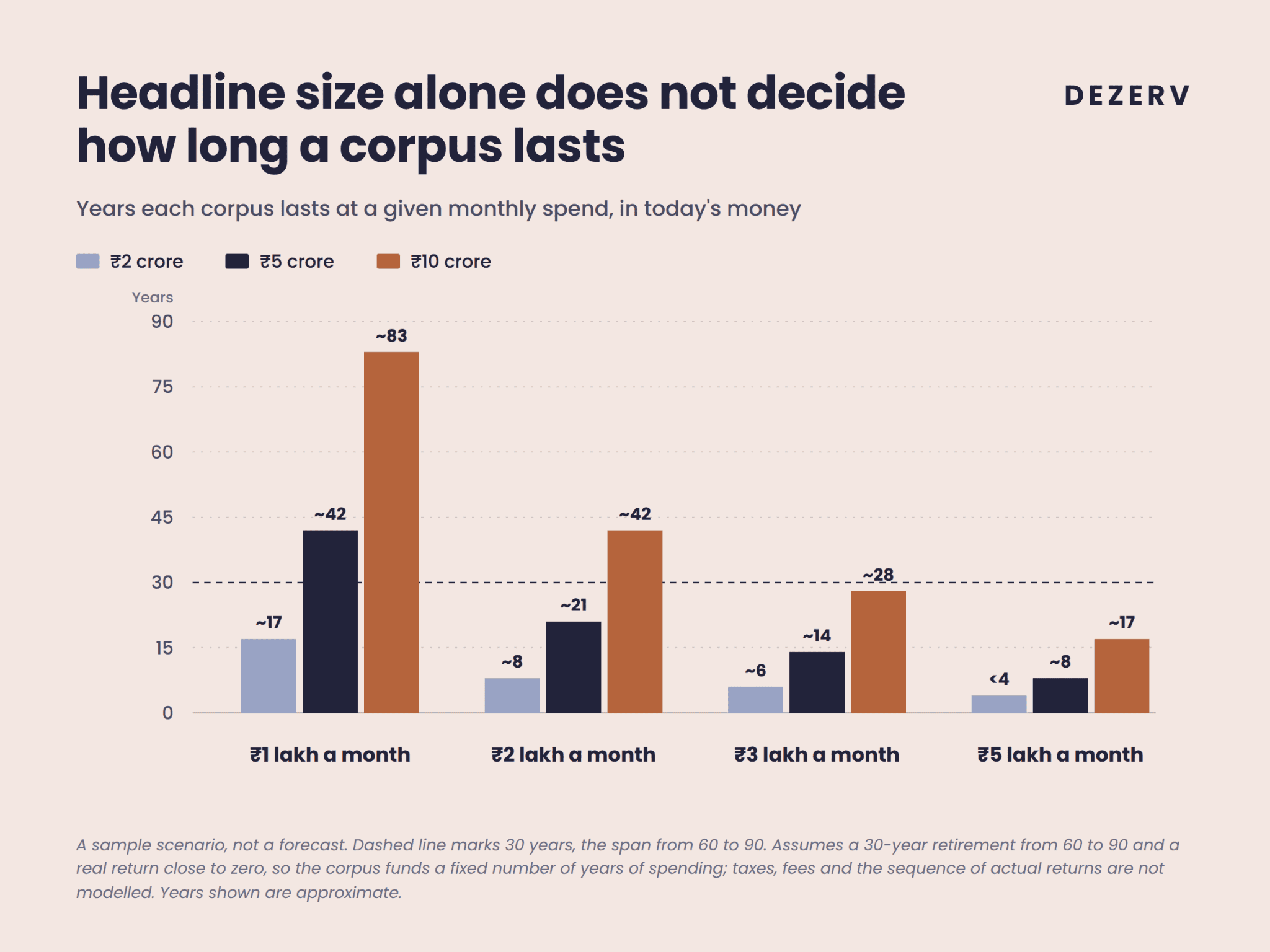
How to read this chart: each bar shows how many years a corpus lasts after retirement at 60, if you spend that amount every month in today's money. The dashed line marks 30 years, or age 90. A bar above the line means the corpus outlasts the plan; a bar below it means the money runs out first
Years each corpus lasts at a given spending level
Today’s money; real return near zero; a sample scenario.
If your plan is built to age 90, you are looking for the combination that gives you at least 30 years.
Look at the difference spending makes. ₹5 crore lasts roughly 42 years at ₹1 lakh a month, but around 21 years at ₹2 lakh. ₹10 crore lasts about 42 years at ₹2 lakh a month, but only around 17 years at ₹5 lakh.
The corpus matters, but it only makes sense alongside the lifestyle it is expected to fund.
What monthly income each corpus supports
Another way to look at the same problem is to reverse the calculation.
Instead of asking, “How long will my money last if I spend ₹2 lakh a month?”, ask, “How much can this corpus support if I want it to last 30 years?”
Under the assumptions used throughout this article, dividing the starting corpus by 30 gives the annual amount available for spending. That is equivalent to a withdrawal rate of roughly 3.3%.
Sustainable monthly income for a 30-year retirement
Today’s money; a sample scenario, not a guarantee of returns.
The relationship is straightforward. Under these assumptions, spending below that level extends the corpus runway, while spending above it accelerates the drawdown of capital.
How long each corpus lasts
Retirement planning often focuses on the size of the corpus at the starting line.
But the more important test may come much later.
Take the ₹5 crore example again. A household spending ₹2 lakh a month does not look underfunded in year one. It still has crores invested. It may not look particularly worrying in year ten either.
Under this scenario, the corpus is depleted around year 21, when someone who retired at 60 would be roughly 81.
That is what a depletion calculation makes visible. The corpus does not only need to support the early years of retirement. It may also need to fund later retirement years, when earning capacity may be lower and healthcare may account for a larger share of spending
Why the jump from ₹5 to ₹10 crore is smaller than it looks
Suppose your calculation tells you that ₹5 crore is a little short of the retirement you want, while ₹10 crore gives you considerably more room.
Seeing those numbers next to each other can make the second target feel twice as difficult.
But building the second ₹5 crore does not necessarily take as long as building the first.
As a corpus grows, the same percentage return translates into a larger gain in rupee terms. Under a positive compounding assumption, each additional crore can take less time to accumulate than the one before it.
Consider a sample scenario in which an existing corpus compounds at an assumed 12% a year, with no withdrawals.
Years to add each additional crore
A sample scenario, not a forecast.
This is a sample scenario using an assumed 12% annual return with no withdrawals. 12% is an assumption, not a promise, and actual returns vary.
Under those assumptions, moving from ₹5 crore to ₹10 crore takes roughly another six years. More importantly, the additions do not happen at an even pace. The move from ₹9 crore to ₹10 crore takes much less time than the move from ₹1 crore to ₹2 crore.
So if a retirement calculation produces a target that initially looks far away, time and investment returns can change the distance between corpus milestones, depending on the returns actually achieved.
In their words
“The possibility of permanent loss is the risk I worry about.”
— Howard Marks, Oaktree Capital (The Most Important Thing, 2011)
In investing, permanent loss usually refers to capital that does not come back.
Retirement introduces another version of that risk: the money runs out while the expenses do not.
That is why longevity cannot sit at the edge of the retirement calculation. A plan that appears sufficient to age 80 may produce a different outcome when the planning horizon extends to age 90.
The longevity maths behind that assumption is explored further in [internal link: planning to 90: the longevity maths].
What tips a corpus from enough to not enough
The examples so far deliberately keep several assumptions fixed. Real retirement plans do not get that luxury.
A corpus that appears sufficient today can look very different if the assumptions underneath it change.
Lifestyle inflation above headline Consumer Price Index (CPI). CPI tracks a nationally averaged basket of goods and services. An affluent household can spend a much larger share of its budget on categories such as private healthcare, domestic staff, education and travel, where costs can rise at different rates. This analysis uses an illustrative affluent-household inflation assumption of roughly 8–9%, built from the category-level assumptions described below, rather than treating headline CPI as a household’s personal inflation rate. You can also check how inflation affects retirement
Note: Dezerv’s inflation estimate is based on category-level inflation assumptions for healthcare (12–14%) and education/travel (8–10%), combined for an illustrative affluent-household spending basket. These category ranges and the resulting 8–9% estimate are analytical assumptions and are not official inflation statistics.
Healthcare. Healthcare deserves particular attention because its costs can rise faster than the broader household basket. Medical inflation in India has been estimated at around 12–14%, which is why healthcare may need to be modelled separately rather than assumed to move in line with general inflation.
Longevity. The longer retirement lasts, the longer the same pool of money has to fund expenses. Adding five years to the planning horizon can materially alter what looks like an adequate corpus today.
Retiring early. Someone retiring at 55 is asking the same corpus to do more work than someone retiring at 60. A longer withdrawal period changes how much can reasonably be spent each year.
Taxes on withdrawals. The amount available to spend may not always be the same as the amount withdrawn from the portfolio. Taxes can therefore affect the pre-tax corpus required to support a given lifestyle.
These variables do not mean the retirement target needs to keep getting larger indefinitely. They mean the number should be tested against the life it is supposed to fund rather than treated as a milestone in isolation.
Watch out: All else equal, a positive real return would extend the life of the corpus in the simplified examples above. But if a retirement plan works only when returns remain high and steady, even a modest difference between the assumption and reality can change the outcome. That is why the illustrations in this article use a near-zero real-return assumption.
Key takeaways
₹2 crore, ₹5 crore and ₹10 crore may each be sufficient retirement corpuses for different households, depending on spending needs, retirement duration and the assumptions used. Under the assumptions in this article, they support roughly ₹55,000, ₹1.4 lakh and ₹2.8 lakh a month respectively over 30 years.
The bigger lesson is that the corpus cannot be separated from the spending it has to support. ₹5 crore lasts more than 40 years at ₹1 lakh a month in our illustration, but only around 21 years at ₹2 lakh.
Retirement age and longevity can change the number further because they determine how many years the corpus needs to last. Inflation matters because the lifestyle you are funding today may cost very differently decades later, particularly when spending is concentrated in categories such as healthcare, domestic help, education and travel.
You can model your own spending, retirement age and other assumptions in the Dezerv Retirement Calculator
Frequently Asked Questions
Is ₹5 crore enough to retire in India?
It can be, depending on how much you spend and how long the corpus needs to last. Under the assumptions in this article, ₹5 crore supports around ₹1.4 lakh a month for 30 years. At ₹2 lakh a month, the same corpus lasts roughly 21 years instead. These are sample scenarios based on the stated assumptions, not forecasts.
How much monthly income does ₹10 crore give in retirement?
Under the 30-year, near-zero-real-return assumptions used here, ₹10 crore supports roughly ₹2.8 lakh a month in today’s money. Spending more shortens how long the corpus lasts. This is a sample scenario, not a guaranteed income.
Can I retire on ₹2 crore in India?
It depends on the lifestyle the corpus has to support. Under the assumptions in this article, ₹2 crore supports roughly ₹55,000 a month over 30 years. At ₹1 lakh a month, however, it lasts around 17 years. Someone with a paid-off home and lower expenses in a smaller city will therefore get a very different answer from a higher-spending metro household.
What withdrawal rate is safe in India?
There is no single withdrawal rate that can be considered safe for every retirement. The article uses an illustrative planning rate of roughly 3.3% for its illustrations, equivalent to drawing about 1/30th of the starting corpus each year over a 30-year retirement with a near-zero real return.. The reasoning behind this assumption is explained further in the 4% rule for India
Disclaimer
Dezerv Investments Private Limited is a SEBI-registered Portfolio Manager (Registration No. INP000007377). Distribution services are offered by Dezerv Distribution Services Private Limited, a wholly owned subsidiary of Dezerv Investments Private Limited, under AMFI Registration No. ARN-248439 and APMI Registration No. APRN-00615. This article is intended solely for general educational and informational purposes and should not be construed as personalised investment, financial planning, tax or legal advice, or as a recommendation, offer or solicitation to invest in any security, financial product or investment strategy. This document should not be construed to be an offer to buy/sell any securities. Readers are advised to consult with their financial advisor before making investment decisions based on the information provided herein.
The returns, figures, calculations, illustrations, estimates and assumptions presented herein are sample scenarios based on the assumptions stated in the article and historical index data. They are for illustrative purposes only and do not represent actual or expected returns or outcomes, nor should they be construed as forecasts or guarantees of future returns. Actual outcomes may vary depending on individual circumstances and prevailing market, economic, tax and regulatory conditions. The information contained herein is not a complete disclosure of every material fact, term or condition.
Investment in the securities market is subject to market risks. Please read all related documents carefully before investing. Past performance, where referred to, is not indicative of future performance and may or may not be sustained.


