Someone who has been saving for retirement may already have several accounts without having made a plan for how they work together. The complication is that each account follows its own rules.
The Employees' Provident Fund (EPF) reports to the EPF Organisation, the National Pension System, known as NPS, to the pension regulator, the Public Provident Fund (PPF) to the Finance Ministry, and mutual funds to the Securities and Exchange Board of India (SEBI). Each has its own exit rules and its own tax treatment, set without reference to the other three.
Those differences matter when contributions have to become withdrawals. Setting up a plan means deciding what each account is meant to do while you work, what you can access at retirement and how the savings will eventually provide income.
In short
A retirement plan in India runs in three phases: building a corpus while you earn, moving it towards stability in the last five to ten working years, and drawing an income once you stop. EPF, NPS, PPF and mutual funds each do part of that work, under different exit and tax rules. You can open NPS, PPF and mutual funds yourself with a PAN and Aadhaar; EPF comes through your employer. Running the plan for 25 years is the harder part: you can run the market-linked money yourself or hand it to a portfolio manager, while EPF, NPS and PPF stay in your own name.
Table of contents
Three phases, three different jobs
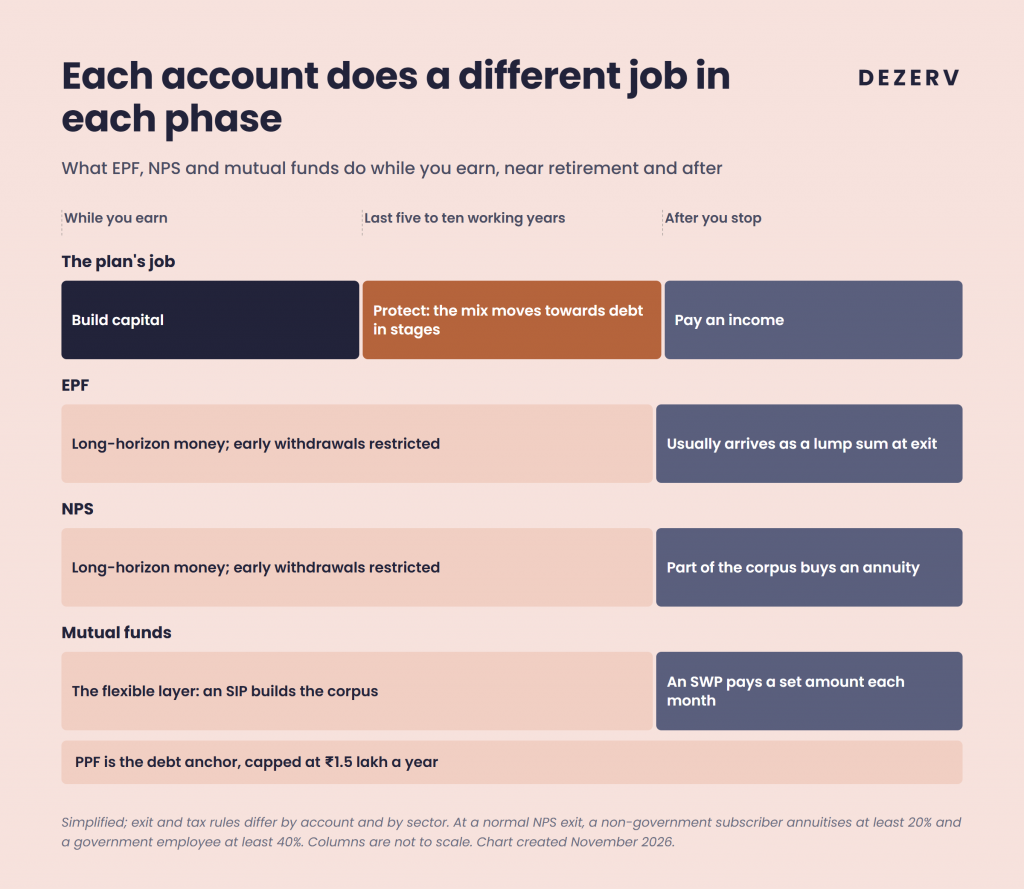
During the accumulation years, the plan's main job is to build capital. Regular contributions and growth-oriented investments, including equity where appropriate to the investor's time horizon and capacity for risk, can play a larger role. Market falls still matter, but money that will not be needed for years generally has more time to recover than money supporting immediate withdrawals.
In the last five to ten years before you stop working, the job becomes protection, because a sharp fall a year before retirement does far more damage than the same fall at forty, when a salary still pays the bills and there are years left to wait for a recovery. So the mix moves towards debt in stages.
After you stop, the job is income. The corpus has to pay you every month while the remaining balance stays invested long enough to outlast you.
Many expensive mistakes come from doing one phase's job in another's years, like chasing growth the year before retiring or keeping a thirty-five-year-old's savings in cash. The size of the corpus is a separate question, and a retirement calculator works it out from your own age and spending.
Which account does which job
EPF, NPS, PPF and mutual funds make up the statutory and market-linked core of a salaried Indian's retirement plan.
| Account | Who can open it | When the money comes out | Tax on the way out (Income-tax Act, 2025) |
|---|---|---|---|
| Employees' Provident Fund (EPF) | Employees of EPFO-covered establishments; the employer enrols you and also contributes | At retirement; EPFO's trustee board approved simplified partial-withdrawal parameters in October 2025, including 12 months' service and retaining 25% of contributions. Operative eligibility depends on notified scheme provisions and EPFO claim rules. | Balance exempt after five years' continuous service; interest on your own contributions above ₹2.5 lakh a year (₹5 lakh where the employer does not contribute) is taxable |
| National Pension System, known as NPS | Indian citizens from 18 (upper entry age set by the Pension Fund Regulatory and Development Authority, PFRDA); government employees join through their employer | Non-government: normal exit at 60 or superannuation as applicable; a 15-year subscription route is available only to eligible non-employment-linked schemes. Up to 80% lump sum and at least 20% annuity at normal exit. Government: up to 60% lump sum, at least 40% annuity. | On a qualifying exit, a lump-sum withdrawal up to 60% of the corpus is exempt; an amount withdrawn above that ceiling is taxable. The portion used to purchase an NPS annuity is not taxed on purchase; subsequent annuity income is generally taxable. |
| Public Provident Fund (PPF) | Resident individuals; no new accounts for NRIs | Matures after 15 full financial years, extendable in five-year blocks; one partial withdrawal a year from the seventh financial year | Interest and maturity value exempt |
| Mutual funds | Anyone with completed KYC | Redemption requests for open-ended funds can generally be submitted on business days, subject to scheme terms and restrictions; ELSS units are locked in for three years from their respective allotment dates | Equity-fund gains held over 12 months taxed at 12.5% above ₹1.25 lakh a year; 20% if held for less; units of specified debt-oriented mutual funds acquired from 1 April 2023 generally have gains deemed short-term under section 50AA, taxed at applicable rates; the qualifying fund definition changed from 1 April 2026 |
Sources: Income-tax Act, 2025 (Gazette of India, 21 August, 2025); the EPFO trustee board decision of 13 October, 2025 (PIB; SCC Online); PFRDA Exit and Withdrawal Regulations, consolidated through 20 July 2026 (PFRDA); the PPF Scheme, 2019 (National Savings Institute; SBI). Rules as of October 2026.
The EPFO's Central Board of Trustees recommended 8.25% on EPF balances for 2025-26 (PIB, 2 March, 2026), a rate the government has since ratified (Ujjivan Small Finance Bank, 22 June, 2026).
PPF pays 7.1% for October to December 2026, a rate the Finance Ministry left unchanged for that quarter (Department of Economic Affairs notice, 30 September, 2026; National Savings Institute rate history). The government reviews the PPF rate every quarter and the EPF rate every year, so neither figure is fixed for the life of the account.
Read across the rows and each account has a job: EPF and NPS hold the long-horizon money and restrict early withdrawals, and PPF is the debt anchor, capped at ₹1.5 lakh a year. Mutual funds are the flexible layer. They are the one account you can draw on freely in mid-career, and later the main source of a flexible monthly income.
How to set up each account
NPS, PPF and mutual funds can be opened in an afternoon; EPF comes through your employer.
- EPF. Your employer enrols you and deducts the contribution from salary. Your part is the Universal Account Number (UAN). Generate or activate it in the UMANG app with Aadhaar face authentication, which EPFO made compulsory for that route from August 2025 (Business Today, 7 August, 2025). Then link your bank account and file a nomination with EPFO.
- NPS. Register online through eNPS, verifying yourself with an Aadhaar OTP or a PAN-based bank KYC, and sign the form with Aadhaar eSign (Protean). Pick a pension fund manager and an equity-debt mix, and you receive a 12-digit Permanent Retirement Account Number (PRAN).
- PPF. Open the account at a post office or an authorised bank, in a branch or through net banking. Deposit between ₹500 and ₹1.5 lakh in each financial year (National Savings Institute).
- Mutual funds. Complete KYC once with your PAN and Aadhaar, then invest directly with a fund house, a registered platform or a distributor. A monthly Systematic Investment Plan (SIP) builds the corpus, and in the income years a Systematic Withdrawal Plan (SWP) pays it out.
Watch out
Add a nominee to every account on the day you open it. For mutual fund folios and demat accounts, SEBI caps nominees at three from 1 September, 2026, existing accounts included (SEBI circular, 29 May, 2026). Without a nominee, your family claims the money with succession documents instead.
How the accounts turn into income
In the income years, the money comes from three streams: an annuity bought with part of the NPS corpus, interest from fixed-income holdings, and regular withdrawals from mutual funds.
Under the PFRDA exit rules as amended effective 16 December, 2025, a non-government subscriber must put at least 20% of the corpus into an annuity at a normal exit and may take up to 80% as a lump sum. A government employee keeps the older floor of 40% in an annuity.
Under the usual government- and non-government-sector normal-exit provisions, a corpus up to ₹8 lakh can be withdrawn in full; above ₹8 lakh and up to ₹12 lakh, up to ₹6 lakh can be received as a lump sum, with the balance through Systematic Unit Redemption over at least six years or an annuity. Eligible All Citizen Model subscribers who entered after age 60 have separate small-corpus provisions, including full withdrawal options up to ₹12 lakh.
Both sectors can defer the lump sum and the annuity purchase to 85.
The Income-tax Act, 2025 exempts only 60% of the corpus, so a non-government subscriber who takes the full 80% pays slab-rate tax on the slice between 60% and 80%. The NPS exit rules, step by step, works through each case.
The mutual fund stream works through an SWP. It redeems a set amount every month while the rest of the holding stays invested.
EPF, gratuity and leave encashment usually arrive as lump sums at exit, and how each of those payouts is taxed decides how much of the cheque is left to invest.
How to keep the plan working after account setup
Opening accounts is only the first step. Review contributions when income or household responsibilities change; compare the combined allocation across EPF, NPS, PPF and mutual funds rather than treating every account separately; and check whether the income plan still covers the expected spending period. Set a review date and define what would trigger an earlier review, such as a major job change, health cost or significant change in risk capacity.
Regular rebalancing and a written withdrawal order can be managed personally or delegated. Vanguard’s Advisor’s Alpha research offers US-based illustrations of the possible value of advice, particularly behavioural support; it is not evidence of a specific return benefit from an Indian manager or Dezerv.
Where a managed portfolio fits
Professional oversight may be useful where a household does not want to maintain the rebalancing and withdrawal process itself. It does not remove market risk or prevent a client from deciding to redeem during a downturn. Consider fees, permitted investments and whether the service solves a need that would otherwise go unmanaged.
For a household that can reliably maintain its own written plan, direct mutual funds and periodic reviews may be sufficient. A portfolio management service is a separate, paid delegation option that should be assessed against its actual terms.
Dezerv Investments Private Limited offers Portfolio Management Services (PMS) that provide exposure to relevant asset classes, primarily through underlying mutual funds, in accordance with each investment approach's mandate. The minimum investment amount for PMS is ₹50 lakh, subject to applicable regulatory requirements and the terms of the relevant service. Investments are subject to market risks, and returns are not guaranteed.
Liquidity, withdrawal, termination and applicable charges under a Dezerv PMS depend on the relevant strategy and client documentation. Review the applicable disclosure document, fee schedule and client agreement before investing.
Clients may onboard directly with Dezerv without a distributor. Depending on the PMS arrangement, fees may include fixed asset-based charges, performance-linked charges subject to the high-water-mark principle, or a combination of both, together with applicable expenses. The precise terms are set out in the client agreement and disclosure document. Investment in the securities market is subject to market risks, and there is no assurance that a portfolio's objectives will be achieved.
Under the present PMS framework applicable in October 2026, the standard minimum investment is ₹50 lakh per client. The ordinary minimum does not apply to qualifying accredited investors, and co-investment PMS arrangements have separate conditions. SEBI notified the separate mutual-fund-focused PRIM framework in its Portfolio Managers Regulations, 2026, effective from 1 April 2027, with a ₹25 lakh entry threshold. It is not the operative conventional PMS route as of 16 October 2026, and actual availability depends on the manager offering it. Account setup itself does not require a portfolio manager: start by confirming your UAN, nominations and contribution instructions.
Key takeaways
- A retirement plan in India runs in three phases (building, protecting, paying out), and the costly mistakes come from doing one phase's job in another's years.
- EPF, NPS, PPF and mutual funds each have their own exit rules and tax treatment under the Income-tax Act, 2025; only 60% of an NPS corpus is tax-free even where 80% can be withdrawn.
- NPS, PPF and mutual funds can be opened by you in a single sitting; EPF comes through your employer, and your part is the UAN, now generated or activated in UMANG with face authentication.
- Add nominees on day one; mutual fund folios and demat accounts take up to three from 1 September, 2026.
- Once the accounts are set up, review the combined allocation, contribution rates, beneficiaries and withdrawal assumptions periodically. Delegation is optional and should be judged against its fees, mandate and practical value to the household.
Frequently Asked Questions
What is the difference between EPF, NPS and PPF?
EPF is a payroll-linked retirement fund that an eligible employer opens and contributes to; withdrawal tax treatment depends on the applicable service and contribution rules. NPS is market-linked: eligible non-government subscribers may take up to 80% at normal exit, but the 15-year normal-exit route applies only to qualifying non-employment-linked schemes, not corporate NPS. Employment-linked subscribers should check the applicable age-60 or superannuation exit condition. Up to 60% of the corpus qualifies for the stated NPS lump-sum exemption. PPF is a 15-year small-savings account with a government-set rate and a ₹1.5 lakh annual contribution cap.
Can I set up a retirement plan myself, without an advisor?
Yes. NPS, PPF and mutual funds can be opened directly, online or at a branch, with a PAN and Aadhaar. EPF is opened by your employer, and your part is generating or activating the UAN in the UMANG app with Aadhaar face authentication, then naming a nominee. No advisor is needed to assemble the accounts. The harder part is running the plan consistently for decades, which is where some investors choose to delegate.
How do I get a monthly income once I retire?
By drawing on three streams: an annuity bought with part of the NPS corpus, interest from fixed-income holdings, and a Systematic Withdrawal Plan from mutual funds that redeems a set amount each month while the rest stays invested. A non-government NPS subscriber annuitises at least 20% at a normal exit, a government employee at least 40%. Sized against a withdrawal rate the corpus can sustain, the combination aims to last through a long retirement.
Is a managed option worth the cost over doing it myself?
It depends on the cost, investment mandate and whether you would otherwise maintain the plan consistently yourself. Vanguard’s Advisor’s Alpha work describes potential benefits of advice in a US setting; it is not an Indian performance estimate or a promise of improved returns from any particular PMS.
When should I start moving money from growth to safety?
Over the five to ten years before you stop earning, in stages. A sharp market fall just before retirement does more damage than the same fall mid-career, because there is no salary left to wait it out. Moving gradually spreads the timing risk across several years instead of betting it on one date, and leaves part of the corpus in growth assets for a retirement that can run three decades.
Disclaimer
Dezerv Investments Private Limited is a SEBI-registered Portfolio Manager (Registration No. INP000007377). Distribution services are offered by Dezerv Distribution Services Private Limited, a wholly owned subsidiary of Dezerv Investments Private Limited, under AMFI Registration No. ARN-248439 and APMI Registration No. APRN-00615. This article is intended solely for general educational and informational purposes and should not be construed as personalised investment, financial planning, tax or legal advice, or as a recommendation, offer or solicitation to invest in any security, financial product or investment strategy. Readers are advised to consult their financial advisor before making investment decisions based on the information provided herein.
The information on retirement accounts, contribution limits, withdrawal rules, tax treatment and interest rates is based on cited sources and may change. Examples and calculations are illustrative, not guarantees of future outcomes. Actual outcomes may vary depending on individual circumstances, longevity, inflation, healthcare costs, investment performance, taxes, fees and prevailing market, economic and regulatory conditions. This article is not a complete disclosure of every material fact, term or condition.
Investment in the securities market is subject to market risks. Please read all related documents carefully before investing. Past performance may or may not be sustained in the future.