
A retirement plan is often presented as a choice of schemes. But the return a scheme pays and the income a household needs after work stops are two very different numbers.
The Senior Citizens' Savings Scheme pays 8.2% a year for October–December 2026 (Central Bank of India), the joint-highest rate among India's small savings schemes (Business Today).
The cap is ₹30 lakh per person. Filled to that limit, it pays ₹61,500 a quarter, about ₹20,500 a month before tax.
For a household spending ₹2 lakh a month, that is roughly one-tenth of its expenses. Choosing a good scheme is only one part of retirement planning; the larger task is working out where the rest of the income will come from, and how long it must last.
In short
A retirement plan is designed to turn savings into income throughout retirement, with a corpus and withdrawal approach sized to the household's needs and expected lifespan. It has three parts: a corpus, a rule for drawing from it, and a named source for each rupee of income. EPF, NPS, PPF and the Senior Citizens' Savings Scheme can each be a part of a plan, but none of them is one, because none is sized to what a large household spends each month. A plan names that monthly figure in rupees and the age it is built to last to.
Table of contents
A retirement plan is defined by the income it pays
A retirement plan is the set of decisions that converts savings into income once the salary stops, sized against the spending that income has to replace. Products hold the money; the plan is the arithmetic that ties them to a monthly figure.
Pension economists measure the result with a replacement rate. It is retirement income as a share of earnings before retirement.
The OECD uses it to compare pension systems, and its 2025 edition puts the average net replacement rate at 63.2% for a full-career average earner in mandatory schemes (OECD, Pensions at a Glance 2025). India comes last of 52 systems on the 2025 Mercer CFA Institute pension index, so a high earner's own corpus must do more of the work.
India's last-place rank is one of the five numbers behind retirement planning.
Earnings are the wrong base for a household. Tax, loan payments and the monthly saving that built the corpus mostly stop at retirement, so the number to replace is what the household spends.
| Same household, two bases | Before retirement | Income needed in year one | Replacement rate |
|---|---|---|---|
| Measured against earnings | ₹60 lakh a year, before tax | ₹24 lakh a year | 40% |
| Measured against spending | ₹24 lakh a year (₹2 lakh a month) | ₹24 lakh a year | 100% |
A sample scenario, not a forecast or guarantee. Assumptions: a household earning ₹60 lakh a year before tax and spending ₹2 lakh a month; tax on the retirement income itself is ignored.
Both rows describe the same family. Measured on pay, the target looks like a modest 40%. Measured on spending, every rupee of the lifestyle still has to be found, and that second row is the one a plan works from.
Employer plans and personal plans
An employer plan is the retirement saving your job runs for you. In India that is chiefly the Employees' Provident Fund (EPF) and, for many salaried people, the National Pension System, known as NPS, through the workplace. Contributions come out of the salary automatically under rules the scheme sets, and the amount follows basic pay and years of service.
A personal plan is what you hold in your own name and control: your own NPS account, the Public Provident Fund (PPF), mutual funds, shares, property and, after 60, the Senior Citizens' Savings Scheme (SCSS). You decide how much goes in and where it sits.
The two layers differ most at the exit. EPF is paid out as a lump sum, and NPS rules fix how much of the corpus must buy an annuity.
Outside NPS, the personal layer lets you set the order and pace in which money comes out.
How far the statutory schemes go
Published rates make government-backed schemes easy to slot into a plan. Their limits cap what they pay a large household.
| Scheme | Layer | Rate or rule now | What it pays after you stop working | The limit that binds |
|---|---|---|---|---|
| EPF | Employer | 8.25% for 2025-26, recommended and since ratified | A lump sum (plus a small Employees' Pension Scheme pension for members) | Contributions follow basic pay |
| NPS | Employer or personal | Market-linked. At normal exit, non-government subscribers may take up to 80% as a lump sum and must annuitise at least 20%; government employees take up to 60% and annuitise at least 40% | An annuity plus a lump sum | Only 60% of the corpus is tax-free |
| PPF | Personal | 7.1% | A tax-free sum at maturity after 15 years | No regular payout |
| SCSS | Personal, 60 and over (55 to 60 for some retirees) | 8.2%, interest paid quarterly | Quarterly interest for five years, extendable in three-year blocks | ₹30 lakh per person |
Sources: EPF rate recommended by the EPFO Central Board of Trustees on 2 March, 2026 (PIB) and since ratified by the government (Ujjivan Small Finance Bank, 22 June, 2026); NPS split per the PFRDA exit regulations as amended on 16 December, 2025 (PFRDA), tax exemption under the Income-tax Act, 2025; PPF and SCSS rates for October–December 2026 held unchanged by the Department of Economic Affairs, 30 September, 2026 (PPF 7.1% per the National Savings Institute rate history; SCSS 8.2% per Central Bank of India); SCSS limit raised to ₹30 lakh in the Union Budget 2023-24 (Budget Speech 2023-24); SCSS term and eligibility (Central Bank of India; Outlook Money, 31 October, 2025); SCSS extension in any number of three-year blocks since the November 2023 amendment (Department of Posts, 14 November, 2023; Value Research, 16 June, 2025); Employees' Pension Scheme pension for members with ten years of service (EPFO; PIB, 10 March, 2025). Notified rates for the period shown, reset each quarter; not a promise of future rates.
For eligible non-employment-linked All-Citizen NPS schemes, a normal exit may be available after at least 15 years of subscription, or at age 60. The 15-year provision does not apply to subscriptions made on account of employment, including corporate NPS. For an employment-linked subscriber, the relevant normal-exit event is generally age 60 or superannuation under the applicable scheme. At normal exit, eligible non-government subscribers may withdraw up to 80%, but no more than 60% of the corpus is exempt under the cited NPS tax provision; the amount above that limit is taxable. Small-corpus exceptions and annuity decisions are covered in the dedicated NPS withdrawal article.
A couple who each fill an account to ₹30 lakh receive about ₹41,000 a month between them, a fifth of a ₹2 lakh budget. That income stays level while prices rise. The other four-fifths has to come from money the household invests itself.
How retirement plans work in India shows how each of those accounts turns into income.
A worked example: turning ₹5 crore into a monthly figure
Take that household, spending ₹24 lakh a year and retiring at 60 with ₹5 crore invested outside the statutory schemes, a sum that looks like twenty years of spending on a statement. How much can the first year draw if each later year's draw rises with prices, for thirty years or more?
What Bengen's data supports
The best-known answer is an American one. William Bengen's 1994 study of US retirements from 1926 found that a 4% first-year draw, raised yearly for inflation, never emptied a half-equity, half-bond portfolio in under 33 years, and a rate of 3% to about 3.5% lasted at least 50 (Bengen, Journal of Financial Planning, October 1994).
Indian inflation and asset returns differ from US experience. Bengen raised his US estimate to 4.7% in 2025, but that figure cannot simply be applied to India. Rajan Raju and Ravi Saraogi's 2024 study of Indian asset returns and inflation (2000–2023) supports a starting-draw range around 3–3.5% under its tested assumptions, including about 3.5% for a 60% debt, 30% equity and 10% gold portfolio (what ₹1 crore lasts). These are useful starting comparisons, not withdrawal rates guaranteed for Indian retirees. Source: Raju & Saraogi, Balancing Acts (SSRN, 2024)
| Starting draw rate | Year-one income from ₹5 crore | Per month | Corpus needed for ₹24 lakh a year |
|---|---|---|---|
| 3.0% | ₹15 lakh | ₹1.25 lakh | ₹8 crore |
| 3.5% | ₹17.5 lakh | ₹1.46 lakh | ₹6.86 crore |
| 4.0% | ₹20 lakh | ₹1.67 lakh | ₹6 crore |
| 4.8% | ₹24 lakh | ₹2 lakh | ₹5 crore |
A sample scenario, not a forecast or guarantee. Assumptions: ₹5 crore invested corpus; ₹24 lakh first-year need; the year-one draw is raised each later year for inflation; the 3%, 3.5% and 4% draw rates are research findings (Bengen, 1994, US data); 4.8% is the rate this example needs; before tax.
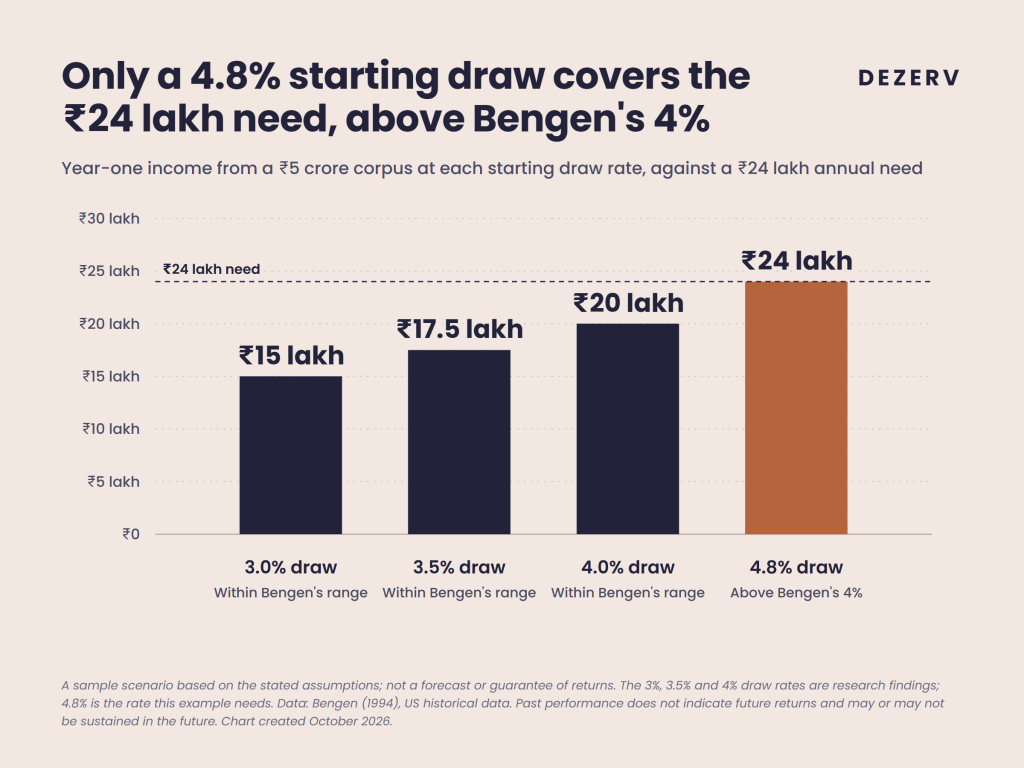
Covering the whole ₹24 lakh from ₹5 crore needs a 4.8% starting draw, above the 4% that Bengen's data supported for thirty years. On his rates the household falls short from the first year. The gap is ₹4 lakh to ₹9 lakh a year, or ₹1 crore to ₹3 crore of extra capital.
Where the rest of the income comes from
A plan closes that gap by naming sources. At a 4% draw the corpus pays ₹20 lakh.
Two SCSS accounts of ₹30 lakh each add about ₹4.9 lakh. Together they cover the year-one need on ₹5.6 crore of capital, before tax on the interest and withdrawals.
The SCSS share stays flat for five years. Each three-year extension after that is flat too, at the rate in force on the maturity date. Every later rise in spending then falls on the invested corpus, and the order of its returns in the first years of drawing matters most.
A veteran fund-industry professional on The Net Worth Show (15 September, 2026) sorts retirement money by when it will be spent. Six-month money sits in liquid funds and two-year money in short-term bond funds, with hybrid and multi-asset funds for the years beyond. Only money not needed for eight years or more goes into diversified equity on that view.
That sorting fixes where each year's money sits, while a draw rate fixes how much comes out. A complete plan sets out both, in rupees.
"The single most important thing to me in the stock market for anyone is to know what you own."
— Peter Lynch, investor and former mutual fund manager, lecture at the National Press Club, 1994 (as quoted by Value Research, 23 August, 2021)
Where the word "plan" misleads
"Qualified" and "non-qualified" are US tax terms with no legal meaning in India, though much of what a search for "retirement plan" returns uses them. The closest Indian equivalents of the tax-advantaged layer are EPF, NPS and PPF, each with its own scheme rules and its own treatment under the Income-tax Act, 2025.
In India the word turns up most often on insurance products. Insurers sell deferred annuities under names such as "pension plan", built so that the money saved ends up buying a regular income from the insurer. Whether converting part of a corpus into an annuity suits your household is its own decision, weighed in should you annuitise your retirement corpus.
A household whose pension and statutory income already cover its spending needs little of this arithmetic.
It matters most to one retiring on a market-linked corpus of fifteen to twenty-five times its annual spend, where the draw rate decides whether the money lasts. For that household, the Dezerv retirement calculator lets you set the spending, life expectancy, inflation and return assumptions and see the corpus they imply.
Key takeaways
- A retirement plan turns savings into a stated monthly income for life: a corpus, a rule for drawing from it, and a named source for each rupee.
- Set the target against what the household spends: the same family needs a 40% replacement rate measured on earnings and 100% measured on spending.
- EPF, NPS, PPF and SCSS are building blocks with published rules, but their limits cap what they pay. Two full SCSS accounts cover about a fifth of a ₹2 lakh monthly budget.
- On Bengen's 3% to 4% starting draw rates, ₹5 crore pays ₹15 lakh to ₹20 lakh in year one, short of a ₹24 lakh need unless other named sources fill the gap.
- "Qualified" and "non-qualified" are US tax terms with no meaning in Indian law.
Frequently Asked Questions
What is a retirement plan in simple terms?
A retirement plan is designed to turn savings into income after your salary stops, with withdrawals sized to your household's needs and expected retirement horizon. It has three parts: a corpus, a rule for how much to draw from it each year, and a named source for each rupee of income. Products such as EPF, NPS, PPF or an annuity can sit inside a plan, but a product on its own is not a plan unless it is sized to the monthly income the household needs.
What is the difference between a personal and an employer retirement plan?
An employer plan is retirement saving your job runs for you, chiefly EPF and often a workplace NPS account, with automatic contributions and scheme-set rules. A personal plan is what you build and control yourself, such as your own NPS account, PPF, SCSS after 60 and your own investments. The employer layer mostly arrives as a lump sum or a fixed annuity share; outside NPS, the personal layer is where you decide how and when money comes out.
What is a good replacement rate for retirement?
A replacement rate is retirement income as a share of pre-retirement earnings. Across OECD countries, mandatory schemes replace about 63.2% of a full-career average earner's pay, net of taxes (OECD, Pensions at a Glance 2025). For your own household, a better target is a share of what you spend, because tax, loan payments and saving mostly stop at retirement. A family that earned ₹60 lakh and spent ₹24 lakh a year needs ₹24 lakh of income, which is 40% of earnings but 100% of spending.
What are qualified and non-qualified retirement plans?
These are United States terms with no legal meaning in India. A qualified plan is a US employer plan, such as a 401(k), that meets the Internal Revenue Code's qualification rules and gets tax advantages. A non-qualified plan, usually deferred pay for senior executives, does not meet all of those rules. In India the comparable tax-advantaged layer is EPF, NPS and PPF, each governed by its own scheme rules and the Income-tax Act, 2025.
Is NPS a complete retirement plan on its own?
In most cases, no. At normal exit a non-government subscriber may take up to 80% of the corpus as a lump sum and must annuitise at least 20%, while government employees take up to 60% and annuitise at least 40% (PFRDA, as amended 16 December, 2025). Only 60% of the corpus is tax-free under the Income-tax Act, 2025. For most high earners NPS is one source among several, alongside PPF, SCSS and their own investments.
How much corpus do I need to retire?
Work backwards from the income you want. Take your first-year spending, subtract what pensions and statutory schemes will pay, and divide the rest by a starting draw rate. At 4% the corpus is 25 times that annual amount; at 3%, about 33 times. A household needing ₹24 lakh a year from its investments would need ₹6 crore at 4% and ₹8 crore at 3%. A retirement calculator lets you test your own assumptions.
Disclaimer
Dezerv Investments Private Limited is a SEBI-registered Portfolio Manager (Registration No. INP000007377). Distribution services are offered by Dezerv Distribution Services Private Limited, a wholly owned subsidiary of Dezerv Investments Private Limited, under AMFI Registration No. ARN-248439 and APMI Registration No. APRN-00615. This article is intended solely for general educational and informational purposes and should not be construed as personalised investment, financial planning, tax or legal advice, or as a recommendation, offer or solicitation to invest in any security, financial product or investment strategy. Readers are advised to consult their financial advisor before making investment decisions based on the information provided herein.
The retirement planning examples, estimates, calculations, withdrawal rates and research discussed herein are illustrative and based on the sources and assumptions referenced. They are not guarantees of returns or future retirement outcomes. Actual outcomes may vary based on individual circumstances, market performance, inflation, taxes, fees and regulatory changes. Readers should independently verify applicable scheme rules, withdrawal conditions and tax treatment before making financial decisions.
Investment in the securities market is subject to market risks. Please read all related documents carefully before investing. Past performance may or may not be sustained in the future.