
In post-war Japan, families had a name for the three things every home dreamed of owning. They called them the “three sacred treasures”: a black-and-white television, an electric washing machine and a refrigerator.
Owning them took real sacrifice. Japan’s first domestically made television cost roughly three years’ salary for a young high school graduate. In 1957, just 7.8% of homes had a TV and only 2.8% had a fridge.
Within a generation, that changed. Salaries rose, factories churned out appliances, and the treasures moved into ordinary living rooms. By the mid-1960s, families were chasing a new list, the “3Cs”: a colour TV, a cooler and a car. Between 1950 and 1980, Japan’s nominal GNP (Gross national product) grew tenfold.
As the economy grew, the government also tracked how people felt. Since 1958, the Prime Minister’s Office had run a nationwide survey called the Public Opinion Survey on the Life of the People, asking thousands of adults how satisfied they were with life. Yet for all that growth, the numbers barely budged.
Across the Pacific, economist Richard Easterlin found the same pattern in America. In 1974, after studying happiness surveys from 19 countries, he showed that Americans had grown far richer since World War II without growing any happier, because their aspirations rose with their incomes.
Half a century later, it’s India’s turn. Indian employers plan raises of 8.3% for 2027, against 3.3% in the US and 1.7% in Switzerland. Few countries hand out bigger increments, yet for many Indians, the feeling of being richer hasn’t kept pace with the payslip.
So this week, I want to walk you through who is getting the biggest raises in India, why they buy less than we think, and where most of that money ends up. I’ll close with a simple, Nobel Prize-backed framework to make your next raise add meaningfully to your wealth.
In this edition:
- What the world’s biggest raise actually looks like
- How much does your raise really buy?
- Where is the modern Indian’s raise actually going?
- How can the SMarT framework make your next hike count?
What does the world’s biggest raise actually look like?
For twenty years, an offer letter from an Indian IT major was the closest thing to a golden ticket. It paid for the first bike, then the first flat on EMI, and eventually for a good share of the gated communities, private schools and weekend getaways that came to define India’s new middle class.
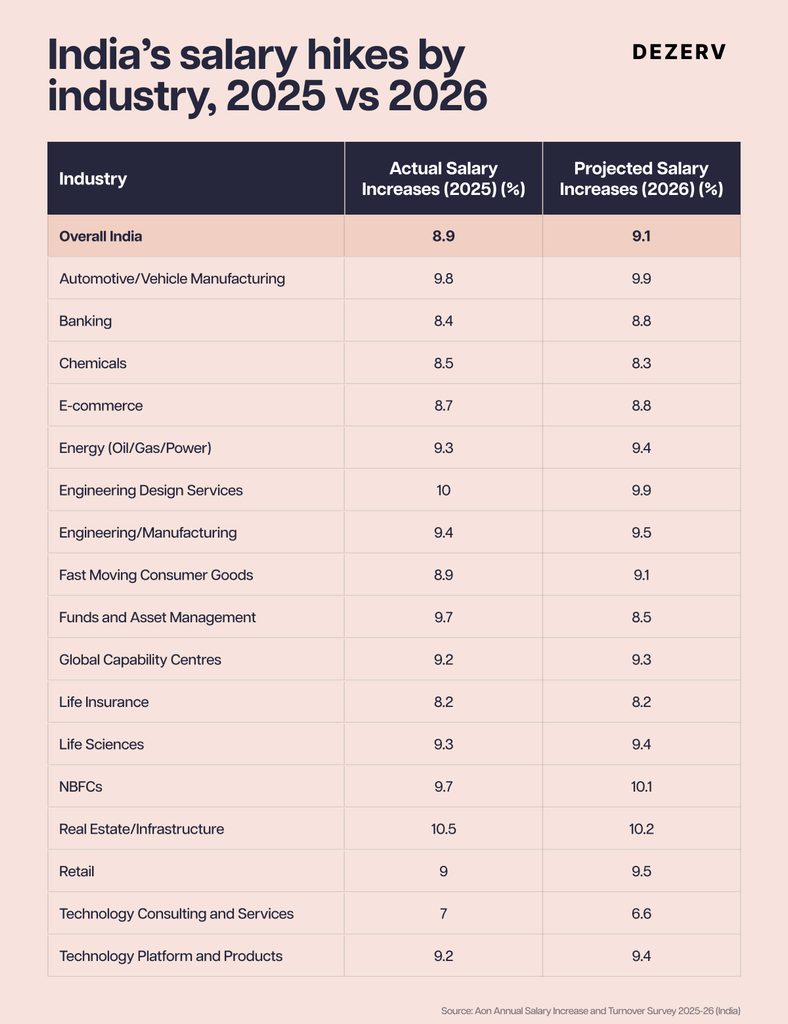
This year, the biggest raises are going somewhere else. Real estate and infrastructure firms plan to raise salaries by 10.2%, and NBFCs by 10.1%. Technology consulting and services, the industry that handed out all those golden tickets, sits at the bottom at 6.6%.
The reason has little to do with how good people are at their jobs. A raise is the price a company pays to keep a skill it can’t easily replace, so it follows wherever the economy needs that skill most.
Right now, India is spending heavily on roads, railways, ports and housing, and credit is flowing freely to fund them. Experienced site engineers, project managers and credit officers take years to develop, so companies are paying more to hold on to them.
Look closely within technology and you’ll see the same logic. Companies building their own tech products and platforms are planning raises of 9.4%, and global capability centres 9.3%. It’s mainly the services model, where firms bill clients by team size and hours, that’s under pressure as AI helps clients get more done with smaller teams. Engineers working on products, platforms and AI are still very much in demand.
So a raise depends partly on you and partly on where money is flowing that year. Even a strong performer can end up in a part of the economy that’s paying less this year.
In my view, that’s why a raise can’t make anyone wealthy on its own. It keeps your income in step with what your skill is worth this year. Wealth comes from the part of your income you turn into something you own, whether that’s equity in your company or the investments you build outside it.
How much does your raise really buy?
Every raise is up against two kinds of inflation. The first is the one the government measures. The second is the one your peers create, and for affluent families it’s usually the bigger of the two.
In October 2025, India’s official retail inflation fell to 0.25%, the lowest on record. Around the same time, the RBI asked households in 19 cities how fast they thought prices were rising. Their median answer was 6.6%.
The difference lies in what each number measures. Official inflation compares prices today with a year ago. Households compare prices with what they paid a few years ago, and most of those increases never reversed. Since April, inflation has risen every month, reaching 5.54% in September. A slowdown in prices barely registers with people, but a rise is noticed right away.
The second kind of inflation is harder to spot. Some things can’t be produced in larger numbers just because more people want them. A good school has only so many seats. A well-connected neighbourhood, close to the office and the city’s best restaurants, has only so many flats. The economist Fred Hirsch called these positional goods, because what you’re really paying for is your position relative to others.
Hirsch compared this to a crowd watching a parade. If one person stands on tiptoe, they see better. If everyone does, nobody sees any better, and everyone is more uncomfortable.
Researchers have tested how much this instinct matters to us. In the 1990s, two Harvard researchers asked 257 students and staff a simple question. Would you rather earn $50,000 while everyone around you earns $25,000? Or earn $100,000 while everyone around you earns $200,000? Prices would be the same either way.
Nearly half picked the first option. They were happy to earn half as much, as long as they earned more than the people around them.
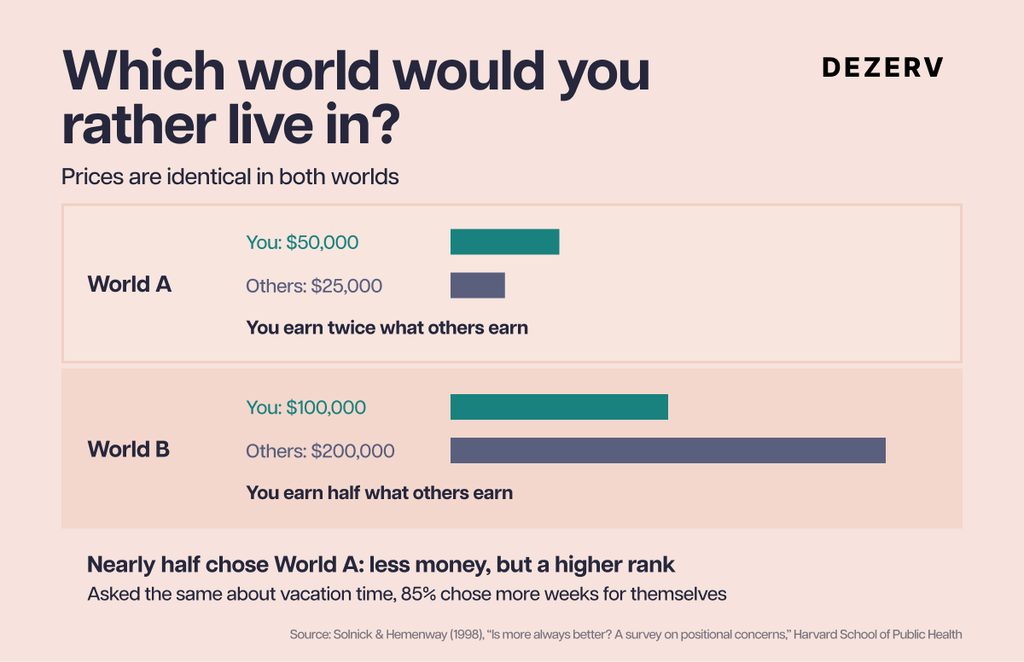
That’s what happens to a raise in an affluent circle. When every family in your peer group gets a 9% hike, all that extra money goes after the same limited seats and the same limited flats. Schools respond by raising fees, and developers build pricier homes.
You can see this in housing. Four years ago, most new flats in India’s big cities cost less than ₹1.5 crore. Today, most cost more. Builders are focusing on pricier homes because buyers can afford them, while rising land and construction costs make cheaper homes less viable. So even as salaries rise, homes get more expensive, leaving buyers with little extra purchasing power.
In my view, this is the most useful way to think about the raise. Some of your spending is on things whose value doesn’t depend on anyone else, like good food, good healthcare and time with family. A raise improves those. The rest is a race for position, and in that race a raise only keeps you where you are. Families who build wealth tend to be clear about which races they’re running, and comfortable skipping a few of them
Where is the modern Indian’s raise actually going?
On 22 September 2024, at noon, about 1.3 crore people logged into BookMyShow at the same time to buy roughly 1.5 lakh Coldplay tickets. The site buckled, the queue stretched into the lakhs, and the tickets were gone in under an hour.
It was a glimpse of where Indian money now goes. A generation ago, a raise went into things that lasted, like a fridge, a scooter, gold or a plot of land. Today, more of it goes into convenience and experiences. The government’s own spending survey shows that in urban India, food now makes up only about 40% of household spending, and within that, the biggest single item is beverages, refreshments and processed food rather than vegetables or milk.
Two things make this kind of spending hard on a raise. First, it repeats. A fridge is bought once, but convenience is bought every day. Second, it’s getting expensive the fastest. In September, restaurant and hotel prices rose over 9%, while overall inflation was 5.54%.
More and more of it is also being paid for with borrowed money. Household debt has climbed from about 36% of GDP in 2021 to 45.5% by June 2026. Loans are increasingly being used to cover day-to-day spending rather than to buy assets, and salaried Indians now put more than a third of their monthly income towards EMIs.
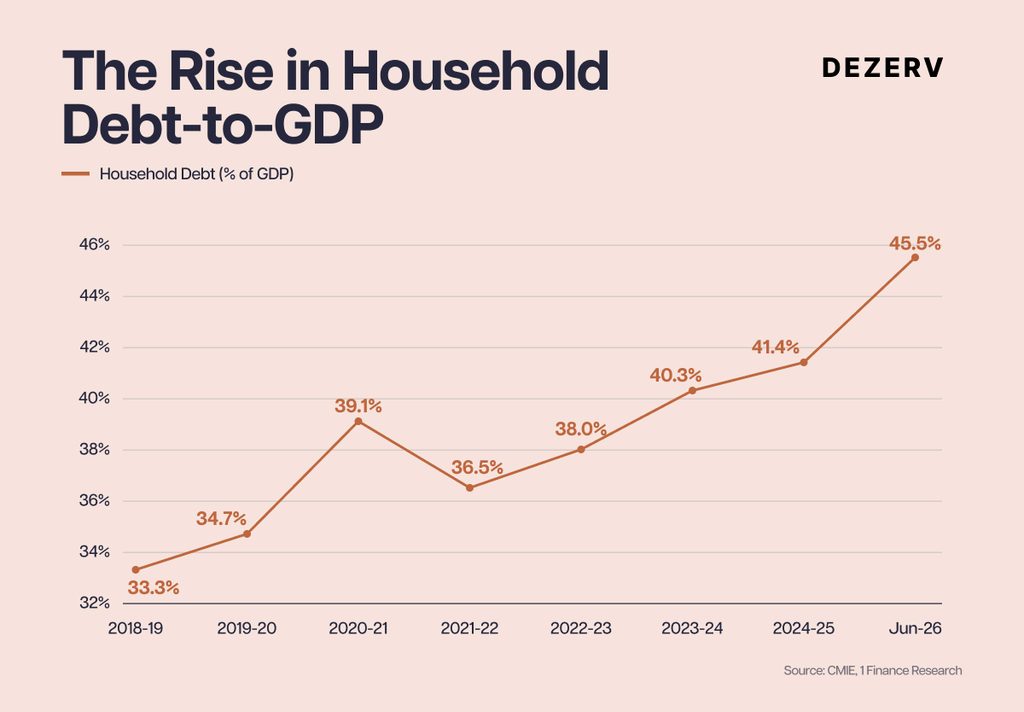
Every EMI for a lifestyle purchase assumes you’ll earn more next year. In a way, we’re spending money we haven’t earned yet. And that just got more expensive: in October, the RBI raised interest rates for the first time since 2023.
In my view, this is why a 9% raise doesn’t feel like wealth. Wealth is built from things that keep growing after you’ve paid for them. Much of what a modern raise buys is gone by the next morning, and a growing share of it is paid for with money we haven’t earned yet.
How can the SMarT framework make your next hike count?
In 1998, a mid-sized American manufacturing company let two economists run an experiment on its employees. Richard Thaler, who later won the Nobel Prize, and Shlomo Benartzi had noticed that most workers wanted to save more, but very few actually did. The problem wasn’t laziness. People simply hated seeing their take-home pay go down.
So Thaler and Benartzi designed a new savings plan and offered it to the employees. Under the plan, nobody had to start saving more right away. Instead, employees agreed in advance that a part of their next raise would go straight into savings, and that their savings would go up again with every raise after that.
They named the idea Save More Tomorrow, aka SMarT. Of the employees who were offered the plan, 78% signed up, and 80% of them were still in it after four pay raises. Over 40 months, their average savings rate rose from 3.5% to 13.6%.
SMarT worked because of four small design choices, and each one beats a habit that usually gets in our way.
- The decision came early. Employees signed up months before the raise. It’s much easier to commit to your future self than your present self.
- The savings came out of the raise. Take-home pay still went up, just by a little less. Nobody felt a loss, so nobody resisted.
- It ran automatically. Savings rose again at every raise until they hit a target.
- People could leave anytime. That freedom made it easy to say yes, and most never left.
For Indian professionals, two tweaks help. First, salary hikes here can be very different from one year to the next, so it’s better to promise a percentage of your hike rather than a fixed amount. That way, the plan still works in a year when your raise is smaller. Second, keep some of the raise to enjoy, because a plan that takes all of it is hard to stick with.
The table below turns SMarT into seven simple steps for your next hike, your bonuses, your loans and your spending. You can fill it in before your next appraisal.
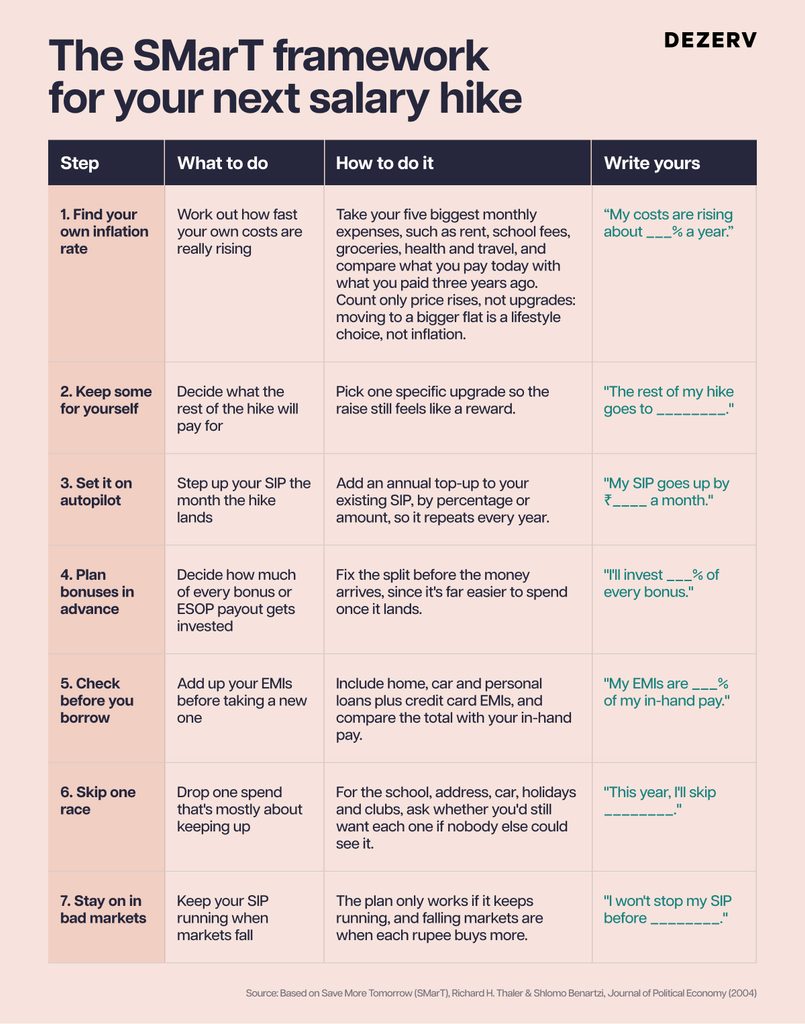
Most of us spend weeks preparing for an appraisal, from building the case and tracking our wins to negotiating the number. Very few spend even an hour thinking about what to do with the money once it comes in. A raise is the one moment each year when your income moves and your habits haven’t caught up yet, and whatever you decide in that window is likely to stay with you for years. So this appraisal season, give the plan as much attention as the hike.
DISCLAIMER: Investment in the securities market is subject to market risks. Read all related documents carefully before investing. The information contained in this newsletter is for general informational and educational purposes only and does not constitute investment advice, a recommendation, or an offer to buy or sell any securities. The information provided is not a complete disclosure of every material fact, term or condition relating to any investment or security. In preparing this newsletter, Dezerv has relied on publicly available information and other sources believed to be reliable. While reasonable care has been taken to ensure the accuracy of the information, Dezerv does not guarantee its accuracy, completeness or reliability. The views and opinions expressed are based on information available as on the date of publication and may change without notice. Past performance is not indicative of future returns. All trademarks, logos and brand names mentioned are used for identification purposes only.