A retirement benefit is not necessarily the same as the amount you can spend after tax. Gratuity, leave encashment and provident-fund payments can arrive close together, but they are not treated identically by law.
The ₹20 lakh ceiling on tax-free gratuity was fixed in March 2018. Both laws it was written under have since been repealed. The Payment of Gratuity Act, 1972 gave way to the Code on Social Security on 21 November, 2025, and on 1 April, 2026 the Income-tax Act, 1961 gave way to the Income-tax Act, 2025.
The ₹20 lakh gratuity ceiling survived these legal changes. For someone receiving a much larger retirement payout, the useful question is which portions are exempt, which are taxable and what amount is actually available to invest.
In short
Under the Income-tax Act, 2025, in force since 1 April, 2026, retirement benefits are deductions from salary in the Act's table of salary deductions, each with its own ceiling. Gratuity is deductible up to ₹20 lakh for private-sector employees, leave encashment up to ₹25 lakh, and commuted pension up to the commuted value of one-third of the pension (one-half if no gratuity was received); the rest is taxed at your slab rate in the tax year you receive it. A recognised EPF balance can be exempt after the requisite continuous service or an applicable exception, but interest credited after employment ceases needs separate tax assessment. Tribunal decisions have treated post-employment interest as taxable in particular circumstances; the conclusion depends on the applicable law and facts. The Act's relief for salary and similar sums paid in arrears, claimed on Form 39, can soften the tax on a large gratuity; it does not raise the ceiling.
Table of contents
How each exit payment is taxed in 2026
The Income-tax Act, 2025 treats gratuity, leave encashment, commuted pension and voluntary retirement scheme (VRS) compensation as deductions from salary, listed in the Act's table of salary deductions. The 1961 Act called them exemptions.
"Previous year" and "assessment year" have gone too. The new Act speaks of a single tax year (Income-tax Act, 2025). The rupee amounts carried over unchanged. Almost every section number, though, has moved.
| Benefit (non-government employee) | Tax-free up to | Above the ceiling |
|---|---|---|
| Gratuity, covered by the gratuity law | Statutory amount, capped at ₹20 lakh | Taxed as salary |
| Gratuity, not covered | Least of three, ₹20 lakh cap | Taxed as salary |
| Leave encashment at exit | Least of four, ₹25 lakh cap | Taxed as salary |
| Commuted pension | One-third of the pension's commuted value (one-half if no gratuity) | Taxed as salary |
| VRS compensation | ₹5 lakh, once in a lifetime | Taxed as salary |
| EPF accumulated balance | Full, after five years' continuous service | Interest on large contributions taxable |
Source: Income-tax Act, 2025 (Gazette of India, 21 August, 2025): the table of salary deductions and the schedules on provident funds, as of October 2026. Government employees are fully exempt on gratuity, leave encashment at retirement and commuted pension.
Which Act applies depends on the tax year the payout falls in.
A payout taxed in a year that began before 1 April, 2026 stays under the 1961 Act, which the 2025 Act's repeal clause keeps alive for those years. A payout falling in tax year 2026-27 or later is governed by the 2025 Act.
Gratuity: one ceiling, two rulebooks
Gratuity for most private-sector employees is now paid under the Code on Social Security, 2020. The formula is 15 days' wages for every completed year of service, counting a part-year above six months, with the monthly wage divided by 26 (Code on Social Security, 2020).
The Code caps that statutory amount at whatever the Centre notifies. The ₹20 lakh set by the Labour Ministry's notification of 29 March, 2018 continues (Gazette of India). The tax rule then splits in two. An employee covered by the gratuity law deducts what they receive only up to that statutory amount (Income-tax Act, 2025).
An employee outside it deducts the least of three figures: the gratuity received, the notified ₹20 lakh, and half a month's average salary for each completed year. For this group, the Act also makes the ₹20 lakh an aggregate across every employer and year.
Statutory gratuity on its own cannot exceed ₹20 lakh. The tax bites when an employer scheme pays more than the statute requires, which the Code expressly allows.
The two loose ends in the drafting
The Act's entry for employees covered by the gratuity law still points to the gratuity formula in the repealed Payment of Gratuity Act, and no clarification from the Central Board of Direct Taxes (CBDT) on how it now reads had been found by October 2026.
The Act also prints no rupee figure for employees outside the gratuity law. The ₹20 lakh comes from a March 2019 CBDT notification under the old Act (Gazette of India), which the 2025 Act's savings clause keeps alive, since no fresh notification under the 2025 Act has been found. The amount stands under either reading.
How the ceilings have moved
The ceilings themselves have moved twice in the last decade, each time in a single large step:
| Ceiling | Earlier figure | Current figure | In force from | Set by |
|---|---|---|---|---|
| Gratuity under the gratuity law | ₹10 lakh | ₹20 lakh | 29 March, 2018 | Labour Ministry notification, 29 March, 2018, now saved under the Code |
| Gratuity, employees outside that law (tax) | ₹10 lakh (set in June 2010, per the CBDT) | ₹20 lakh | Exits on or after 29 March, 2018 | CBDT notification, 8 March, 2019 |
| Leave encashment, non-government (tax) | ₹3 lakh (set in May 2002) | ₹25 lakh | 1 April, 2023 | CBDT notification, 24 May, 2023 |
Source: Gazette of India, notifications of 29 March, 2018, 8 March, 2019 and 24 May, 2023; the June 2010 figure per the CBDT's press release of 11 June, 2010; earlier figures also per Taxguru (2018), Taxguru (2019) and Taxmann (2023); all as of October 2026.
The leave ceiling sat at ₹3 lakh for almost 21 years before it moved. The gratuity ceiling has now gone more than eight years without one.
Leave encashment: the least of four numbers
Leave encashment for a non-government employee is deductible up to the least of four figures (Income-tax Act, 2025):
- the cash value of earned leave at exit, counting no more than 30 days for each year of service;
- ten times the average monthly salary of the last ten months;
- the notified ₹25 lakh;
- the amount actually paid.
"Salary" here is basic pay plus dearness allowance where the terms of employment include it, and nothing else. The ₹25 lakh is an aggregate across employers and years, and it continues under the May 2023 CBDT notification the same way the gratuity figure does.
The deduction attaches to leave encashed at retirement "whether on superannuation or otherwise".
Leave encashed while you are still in service gets no deduction. Cashing it in during your final working years means tax at your top slab on every rupee.
Commuted pension: cash now or income for life
Commutation means taking part of a pension as a one-time lump sum. It trades income later for cash now.
A non-government employee who also received gratuity deducts the commuted value of one-third of the pension; one who did not deduct one-half (Income-tax Act, 2025). The Act fixes that commuted value from the recipient's age, health, an interest rate and official mortality tables.
The pension you keep is taxed as salary every year it is paid.
The tax-first instinct is to commute the maximum, since that share comes out tax-free. There is a fair case for the opposite.
The uncommuted pension is paid for as long as you live, so commuting less keeps more income that cannot run out. The price is slab-rate tax on each year's payment.
A retiree who expects a long life, and has little other secure income, may value that stream above a one-time saving. The choice is made without knowing how long the pension will run, so it can only be judged on the odds at the time it is made.
"Improving decision quality is about increasing our chances of good outcomes, not guaranteeing them."
— Annie Duke, decision strategist and former professional poker player, Thinking in Bets (Portfolio, 2018)
EPF: when the interest stops being tax-free
The EPF balance is excluded from income once you have five or more years of continuous service, and service with earlier employers counts if that balance was transferred in (the Act's rules for recognised provident funds). Most long-serving employees clear that easily.
Two kinds of EPF interest are still taxable. The first is interest on your own contributions made from 1 April, 2021, on the part above ₹2.5 lakh a year (₹5 lakh where the employer does not contribute). The Act carves it out of the exemption, and the Income-tax Rules, 2026 set how the taxable interest is worked out.
Interest after you leave
The second taxable kind is interest credited after you leave employment. Income-tax tribunals have held that it falls outside the exemption, because the employer-employee link has ended (the Bangalore bench of the Income Tax Appellate Tribunal in ACIT v. Dilip Ranjrekar, ITA No. 858/Bang/2016, 10 November, 2017, as reported by Taxguru).
The Employees' Provident Fund Organisation (EPFO) says in its FAQs that a member who retires at 55 or later earns that interest for 36 months after retirement, after which the account turns inoperative. A member who leaves before 55 earns it until turning 58.
Leaving the balance parked for a while is not automatically a mistake.
The EPFO's Central Board of Trustees recommended 8.25% for 2025-26 (PIB, 2 March, 2026), and the government has since ratified it (Ujjivan Small Finance Bank, 22 June, 2026). For a retiree taxed at 31.2% (the 30% slab plus 4% cess, no surcharge), that still leaves about 5.7% after tax (a sample scenario, not a forecast).
Whether to keep it there is covered in the first 90 days with a retirement lump sum.
A sample scenario: a ₹60 lakh gratuity
Take an employee covered by the gratuity law who retires after 28 years on last-drawn wages of ₹4 lakh a month. Before applying the applicable statutory ceiling, the usual 15/26 wage formula yields approximately ₹64.6 lakh on these figures. Assume the employer's arrangement nevertheless pays ₹60 lakh. For this tax illustration, the exemption or deduction is limited to ₹20 lakh, making ₹40 lakh taxable.
| Step | Amount |
|---|---|
| Gratuity received | ₹60 lakh |
| Statutory formula: 15/26 × ₹4 lakh × 28 years | ≈ ₹64.6 lakh |
| Deductible: the formula amount, capped at ₹20 lakh | ₹20 lakh |
| Taxable, added to salary for the tax year | ₹40 lakh |
| Tax on the ₹40 lakh at a 35.9% marginal rate | ≈ ₹14.4 lakh |
| Left after tax, before any arrears relief | ≈ ₹45.6 lakh |
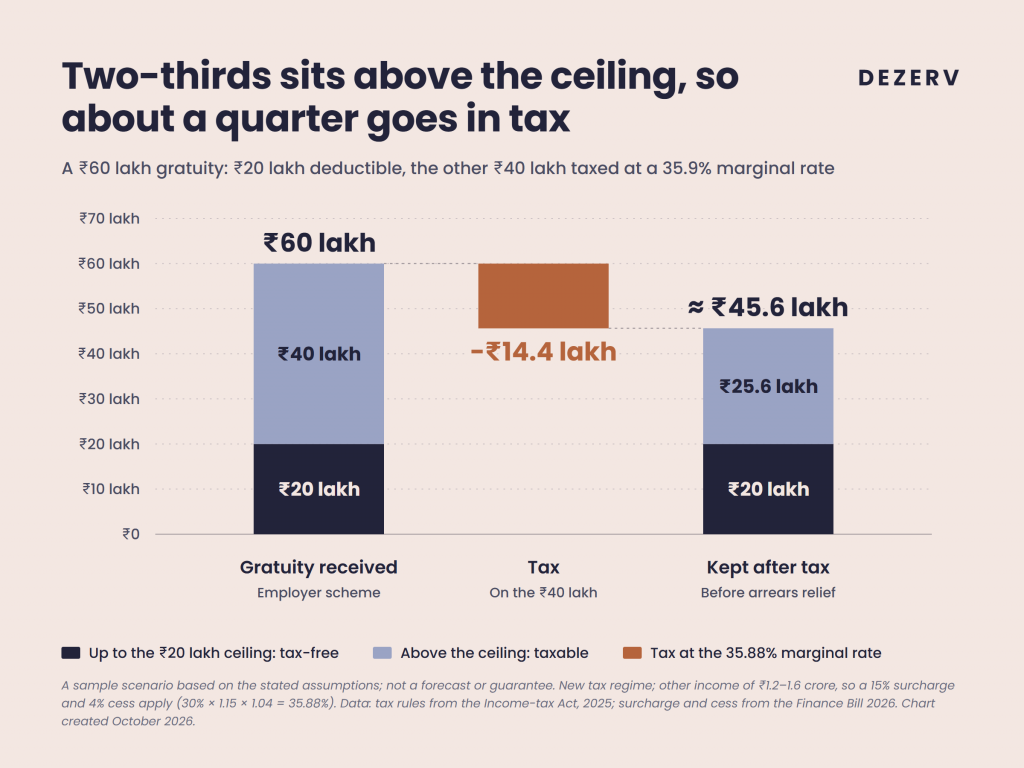
About a quarter of this gratuity goes in tax, because two-thirds of it sits above the ceiling.
A sample scenario, not a forecast or guarantee. Assumptions: employee covered by the Code on Social Security, 2020; employer scheme above the statutory amount; 28 years of service; last-drawn basic pay plus dearness allowance ₹4 lakh a month; new tax regime (Income-tax Act, 2025); other income for the tax year, before the gratuity, between ₹1.2 crore and ₹1.6 crore, so a 15% surcharge and 4% cess apply (30% × 1.15 × 1.04 = 35.88%; rates per the Finance Bill 2026).
That 35.9% holds only inside one income band. Change the other income and the tax on the same ₹40 lakh shifts, because crossing ₹1 crore lifts the surcharge on the whole bill:
| Other income for the year, before the gratuity | Tax on the ₹40 lakh | Marginal rate on the ₹40 lakh |
|---|---|---|
| ₹60 lakh | ≈ ₹13.7 lakh | 34.3% |
| ₹80 lakh | ≈ ₹15.4 lakh | 38.5% |
| ₹1 crore | ≈ ₹15.7 lakh | 39.2% |
| ₹1.2 crore to ₹1.6 crore | ≈ ₹14.4 lakh | 35.9% |
A sample scenario, not a forecast or guarantee. New-regime slabs (Income-tax Act, 2025); surcharge 10% above ₹50 lakh, 15% above ₹1 crore and 25% above ₹2 crore, with marginal relief, and 4% cess (Finance Bill 2026; rates unchanged per the Budget memorandum); before arrears relief.
The ₹1 crore row is the expensive one. A retiree sitting just under that line pays more on the same gratuity than one already above ₹1.2 crore, because the payout drags the whole year's tax into the next surcharge band.
Arrears relief, and the VRS trade-off
Arrears relief, the Income-tax Act's relief for salary and similar sums paid in arrears or in advance, applies when a lump sum such as gratuity pushes a year's income into a higher rate. You claim it on Form 39 (formerly Form 10E) by the return due date, or by giving the particulars to your employer.
For gratuity paid for at least five years of past service, the Income-tax Rules, 2026 (notified on 20 March, 2026) set the method.
The rule compares this year's average tax rate with the average rate of the previous two years (under 15 years of service) or three years (15 years or more). Before that comparison, a half or a third of the gratuity is notionally added to each of those earlier years.
If this year's rate is higher, the difference on the gratuity comes back as relief.
The size of that relief varies widely. If your earlier years were already taxed near the top slab, it may be small. If you earned much less in those years, it can be large.
On a VRS package you get the relief or the ₹5 lakh VRS deduction, never both. The Act refuses the relief on any compensation for which that deduction was claimed, in that tax year or any other, and the VRS deduction's own conditions work the same bar in reverse.
Which is worth more is worked through in the tax on a VRS package.
If an employee dies in service
Gratuity received by a widow, children or dependants on an employee's death is excluded from their income under the Act's schedule of exempt income, with the excluded amount worked out by the same rules that would have applied to the employee's own deduction. A family pension is taxed as income from other sources.
The deduction on a family pension is one-third of it or ₹25,000, whichever is less, under the new regime, and one-third or ₹15,000 under the old one (Income-tax Act, 2025). Both payments reach the survivor without any decision on their part, as long as the paperwork names the right person.
A current nomination on the gratuity form and the EPF account decides who receives the money; a will decides the rest.
After the tax: the money that is left
In the scenario, ₹45.6 lakh arrives after tax, often within a few months of the leave encashment and the EPF withdrawal. Some retirees choose to invest it themselves. Others would rather hand the day-to-day management to someone else, and turning a lump sum into a regular income becomes the next question.
For those who want to delegate, a portfolio management service (PMS) is one route. Dezerv Investments Private Limited offers Portfolio Management Services (PMS) that provide exposure to relevant asset classes, primarily through underlying mutual funds, in accordance with each investment approach's mandate. The minimum investment amount for PMS is ₹50 lakh, subject to applicable regulatory requirements and the terms of the relevant service. Investments are subject to market risks, and returns are not guaranteed.
On its own, the ₹45.6 lakh in this example is below the ₹50 lakh minimum, so a PMS fits it only if other holdings are moved in alongside it, in cash or as existing mutual funds and shares.
This piece is not for someone whose gratuity stays under ₹20 lakh and whose leave balance stays under ₹25 lakh, because for them the main exit payments are tax-free. It is for the retiree whose employer pays above the statute.
For that reader, the tax year the exit lands in and the share of pension commuted move the final number most, and an arrears-relief claim can bring part of the tax back. With that number in hand, you can estimate the corpus your retirement needs and measure the cheque against it.
Key takeaways
- Since 1 April, 2026, retirement benefits are deductions from salary under the Income-tax Act, 2025; the 1961 Act's provisions apply only to payouts taxed in years before 2026-27.
- Gratuity is deductible up to ₹20 lakh for private-sector employees; a payout above it usually comes from an employer scheme that pays more than the statutory amount.
- Leave encashment at exit is deductible up to the least of four figures, capped at ₹25 lakh; leave encashed during service is fully taxable.
- EPF interest on contributions above ₹2.5 lakh a year is taxable, and so, according to income-tax tribunal rulings, is interest credited after you stop working.
- Arrears relief (claimed on Form 39) can reduce the tax on a large gratuity, but on VRS compensation it cannot be combined with the ₹5 lakh VRS deduction.
Frequently Asked Questions
Is gratuity above ₹20 lakh taxable?
Yes. Under the Income-tax Act, 2025, a private-sector employee covered by the gratuity law deducts gratuity only up to the statutory amount, which is capped at ₹20 lakh. An employee outside that law deducts the least of the amount received, ₹20 lakh and a service-based formula. Anything above is taxed as salary in the tax year received. The Act's arrears relief, claimed on Form 39, may reduce the tax but does not raise the ceiling.
What is the leave encashment exemption limit now?
For non-government employees, leave encashment at retirement or other exit is deductible up to the least of four figures: the cash value of earned leave (at most 30 days per year of service), ten months' average salary, ₹25 lakh, and the amount received (Income-tax Act, 2025). The ₹25 lakh, set by a CBDT notification from 1 April, 2023, is an aggregate across all employers. Leave encashed during service is fully taxable; government employees are fully exempt at retirement.
When does EPF interest become taxable?
In two situations. Interest on your own contributions made from 1 April, 2021 is taxable on the part of those contributions above ₹2.5 lakh a year, or ₹5 lakh if your employer does not contribute. Interest credited after employment ends may require separate tax treatment; tribunal decisions have found it taxable on particular facts, but the conclusion depends on service history, possible transfers and the relevant law. EPFO stops crediting interest once an account turns inoperative, generally 36 months after retirement at 55 or later.
How is commuted pension taxed in India?
A government employee's commuted pension is fully exempt. Under the Income-tax Act, 2025, a non-government employee who also receives gratuity deducts the commuted value of one-third of the pension; one who receives no gratuity deducts one-half. The rest of the commuted amount, and every monthly payment of the pension you keep, is taxed as salary.
Can I reduce the tax on a large retirement payout?
You cannot change the ceilings, but timing and relief help. The Income-tax Act's arrears relief, claimed on Form 39, can tax excess gratuity closer to your average rate of the previous two or three years. Drawing leave encashment at exit rather than during service, sizing the pension commutation, and watching which surcharge band the payout lands in all change the bill. On a VRS exit, the ₹5 lakh VRS deduction and arrears relief on that compensation cannot both be claimed.
Disclaimer
Dezerv Investments Private Limited is a SEBI-registered Portfolio Manager (Registration No. INP000007377). Distribution services are offered by Dezerv Distribution Services Private Limited, a wholly owned subsidiary of Dezerv Investments Private Limited, under AMFI Registration No. ARN-248439 and APMI Registration No. APRN-00615. This article is intended solely for general educational and informational purposes and should not be construed as personalised investment, retirement planning, financial, tax or legal advice, or as a recommendation, offer or solicitation to invest in any security, financial product or investment strategy. Readers are advised to consult their financial and tax advisors before making decisions based on the information provided herein.
The information relating to the taxation of gratuity, leave encashment, commuted pension, VRS compensation, EPF and other retirement benefits is based on publicly available information and the sources cited in this article. Illustrative calculations and tax scenarios are for explanatory purposes only and do not guarantee any particular tax outcome. Actual outcomes may vary depending on individual circumstances, income, service history, applicable tax rates and prevailing legal, economic and regulatory conditions. This article is not a complete disclosure of every material fact, term or condition.
Investment in the securities market is subject to market risks. Please read all related documents carefully before investing. Past performance may or may not be sustained in the future.