Most people who accept a voluntary retirement offer read the compensation as a reward for the years they have already worked. The Income-tax Act reads it as salary. Beyond the first ₹5 lakh, a ₹1.5 crore package is taxed in a single tax year, most of it at the top rate.
Meanwhile the pension that is meant to take over may still be six or eight years away. So what is that cheque really for, and how long can it last?
In short
A voluntary retirement scheme (VRS) package works best as an income bridge, covering the years between leaving work and your pensions starting. Only ₹5 lakh of VRS compensation is deductible under the Income-tax Act, 2025, so in the sample scenario a ₹1.5 crore package leaves about ₹1.03 crore after tax. Drawn at ₹1 lakh a month, rising 7% a year, and earning 7% a year after tax, it reaches 60 with about ₹12.5 lakh to spare, while an annuity at an assumed 7% rate would cover about 60% of the first year's spending.
Table of contents
Step 1: Count the years the package must cover
A VRS package has one job: to replace a salary until other income starts. So the first number to pin down is the length of that gap, in years, before deciding anything about where the money goes.
Who takes VRS
The schemes are often built for people in their fifties. The 2019 scheme at BSNL and MTNL was open to staff aged 50 and above (Union Cabinet decision, 23 October, 2019), and 92,956 employees took it, 78,569 at BSNL and 14,387 at MTNL (Department of Telecommunications reply to the Lok Sabha, 28 July, 2021; The Week, 30 March, 2020).
When the next income starts
- EPS pension: the Employees' Pension Scheme (EPS) pays a pension to members with ten years of service. It can start early, from 50, at a reduced rate (Employees' Pension Scheme, 2026; Business Today, 27 August, 2024).
- Employer pension: starts at the age your scheme's rules set, so check whether leaving early defers or reduces it.
- NPS, non-government: Eligible voluntary, non-employment-linked NPS subscribers can qualify for normal exit after the specified 15-year subscription period. That provision does not apply to NPS subscribed to on account of employment, including corporate NPS; check the applicable age-60 or superannuation rules instead (PFRDA exit regulations, consolidated through 20 July 2026).
- NPS, government: an employee who leaves before superannuation falls under the premature-exit rule, which sends at least 80% of the corpus into an annuity (same regulations).
How an NPS exit and its annuity work sets out both sectors in full. For a 52-year-old whose main pensions begin at 60, that leaves eight years with no salary.
We call those years the bridge. Every figure below is built for them.
Watch out
Spending in the first few months does the most damage. A car or a renovation bought from the package in year one is money the bridge can no longer draw on in year eight.
Chasing a quick gain with the package drains the bridge just as surely.
"Don't treat it like Las Vegas and speculate for quick money – you'll lose money quickly."
— Raamdeo Agrawal, market veteran, quoted in YourStory (27 January, 2021)
Step 2: Work out what the cheque is worth after tax
What is taxed
From tax year 2026-27, VRS compensation is a deduction from salary under the Income-tax Act, 2025.
You deduct the amount received or ₹5 lakh, whichever is lower. That is the same ₹5 lakh the old Act's VRS exemption allowed.
The deduction is available once in a lifetime, and everything above ₹5 lakh is taxed as salary in the tax year you receive it, on top of any salary earned earlier that year. The deduction survives the default new tax regime. The Act lists the deductions the new regime takes away, and the VRS deduction is not among them.
| Step | Amount |
|---|---|
| Gross VRS compensation | ₹1.5 crore |
| Less: VRS deduction (once in a lifetime) | ₹5 lakh |
| Less: standard deduction, new regime | ₹75,000 |
| Taxable income for the year | ₹1.44 crore |
| Less: tax, including 15% surcharge and 4% cess | ≈ ₹46.7 lakh |
| Left to fund the bridge | ≈ ₹1.03 crore |
A sample scenario, not a forecast or guarantee. Assumptions: exit on 1 April, so the package is the only income of tax year 2026-27; new-regime slab rates under the Income-tax Act, 2025; surcharge 15% for income between ₹1 crore and ₹2 crore and 4% cess, at the Finance Act rates for tax year 2026-27, which Budget 2026 left unchanged; no arrears relief claimed on Form 39 (see "Deduction or relief" below). The tax works out to about 31% of the gross package.
The conditions the scheme must meet
The ₹5 lakh deduction applies only if your employer is on the Act's list of eligible employers: a company, public sector or private, a statutory or local authority, a co-operative society, a university or an Indian Institute of Technology, a government, or a notified institution. A partnership firm is not on it.
The scheme must then follow the VRS guidelines in the Income-tax Rules, 2026, notified on 20 March, 2026, which replaced the guidelines in the old rules:
- it is open to employees with ten years of service or aged 40 (a test that does not apply to a public sector company's voluntary separation scheme);
- it covers all employees, workers and executives alike, except directors;
- it reduces the overall headcount, and the vacancy is not filled;
- the retiree is not re-employed by a concern under the same management;
- the compensation is no more than three months' salary for each completed year of service, or salary for the months left to retirement, whichever is less.
Deduction or relief
Arrears relief is the relief the Income-tax Act, 2025 allows on salary received in arrears, in advance or as compensation on leaving a job, claimed on Form 39. On VRS compensation, arrears relief and the ₹5 lakh deduction are alternatives. Claim one and the other is barred on that compensation, in that tax year or any other.
How retirement benefits are taxed explains what decides which is worth more, so run both numbers with a chartered accountant before you file.
Step 3: Line up the other exit money
Gratuity, leave encashment and the Employees' Provident Fund (EPF) balance usually arrive within weeks of the VRS cheque, each with its own relief, separate from the ₹5 lakh. For most private-sector employees, gratuity is deductible up to ₹20 lakh and leave encashment up to ₹25 lakh.
Both limits were set by notifications under the old Act, the gratuity limit in March 2019 and the leave-encashment limit in May 2023, and both continue under the 2025 Act. No fresh notification had been found by October 2026. Under the Income-tax Act, 2025, the EPF balance is tax-free after five years of continuous service.
The EPF also does not have to be withdrawn on day one. A member who leaves before 55 keeps earning interest on an untouched balance until turning 58, a rule the labour ministry set out in Parliament in July 2017 that the Employees' Provident Fund Organisation (EPFO) still gives in its FAQs (Business Today, 4 September, 2026).
Someone who retires at 55 or later earns it for 36 months, after which the account turns inoperative.
The tax treatment of post-employment interest can differ from that of an eligible accumulated EPF balance. In the Dilip Ranjrekar matter, the Bangalore tribunal treated post-employment interest as taxable on the facts before it; the result should not be assumed for every member or exit circumstance without checking the relevant law.
For a 52-year-old, that makes the EPF a reasonable place to hold money meant for years five and six of the bridge. Settle the claim by the time you turn 58. What to do with everything else in the first weeks is covered in the first 90 days with a retirement lump sum.
Step 4: Decide whether to annuitise any of it
An immediate annuity turns a lump sum into a fixed income for life, and for an eight-year bridge a full annuity carries two costs and one advantage.
The first cost is the shortfall. Take the post-tax ₹1.03 crore and an assumed annuity rate of 7% a year on a life-only option. That buys about ₹7.2 lakh a year, which covers 60% of a ₹12 lakh first-year need and only about 38% of the ₹19.3 lakh the same lifestyle costs at 59 if prices rise 7% a year.
Your own quote will differ from this one. The insurer sets the rate by age and option, and options that return the purchase price on death pay less each year. Annuity income is also taxed at your slab rate every year.
The second cost is the capital. Once the annuity is bought, the ₹1.03 crore cannot be drawn on for a hospital bill or a child's wedding.
Where the annuity wins is longevity. The drawdown route in Step 5 leaves about ₹12.5 lakh at 60, while the annuity keeps paying for life, through 75 and 85, long after the bridge is crossed.
Annuitising part of a corpus once the bridge is crossed is a separate decision, and the case for and against annuitising weighs it at that stage. For the bridge itself, the fixed payout falls further behind spending every year.
Step 5: Test the bridge, and how it breaks
The base case
The drawdown route keeps the package invested and takes out each year's spending at the start of the year. Here is the post-tax ₹1.03 crore, year by year.
| Age | Withdrawal for the year (₹ lakh) | Pot at year-end (₹ lakh) |
|---|---|---|
| 52 | 12.0 | 97.7 |
| 53 | 12.8 | 90.8 |
| 54 | 13.7 | 82.4 |
| 55 | 14.7 | 72.4 |
| 56 | 15.7 | 60.7 |
| 57 | 16.8 | 46.9 |
| 58 | 18.0 | 30.9 |
| 59 | 19.3 | 12.5 |
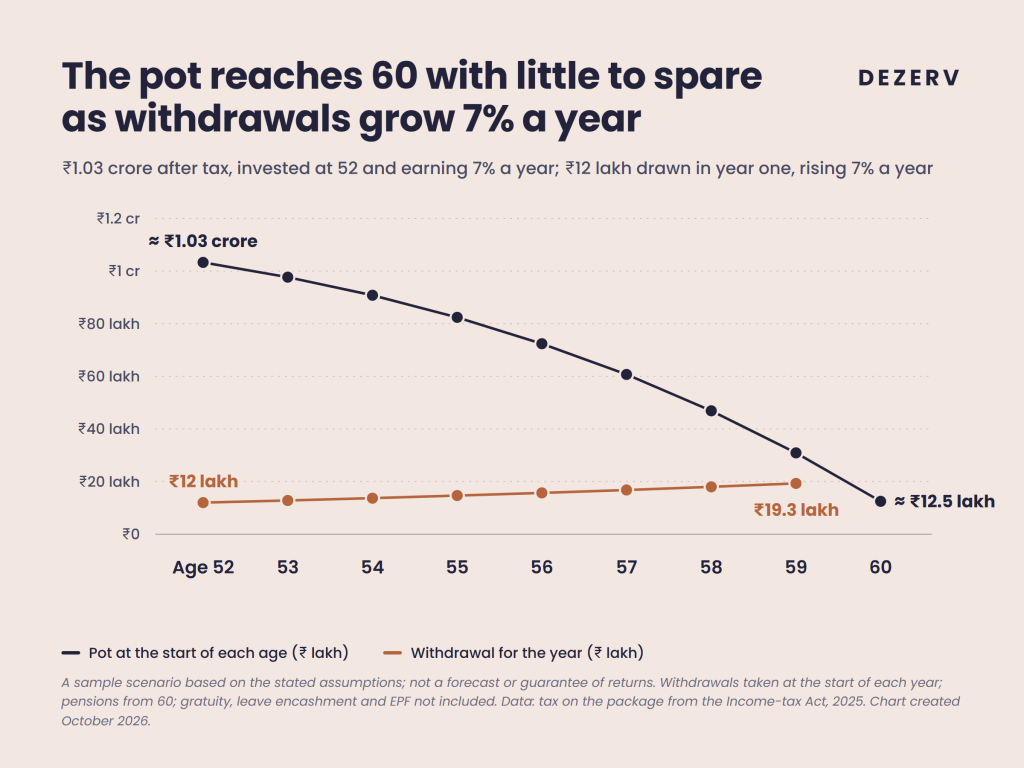
A sample scenario, not a forecast or guarantee of returns. Assumptions: about ₹1.03 crore after tax, invested at 52; spending of ₹1 lakh a month (₹12 lakh in year one) rising 7% a year; the pot earning 7% a year after tax; withdrawals at the start of each year; pensions from 60; gratuity, leave encashment and EPF not included.
Over the eight years about ₹1.23 crore comes out, and about ₹12.5 lakh of the package is still there at 60. The bridge holds, but only just.
Package size
| VRS package (gross) | After tax | Drawdown at ₹1 lakh a month: left at 60 | Annuity at 7%: income a year | Share of the ₹12 lakh first-year need |
|---|---|---|---|---|
| ₹1 crore | ≈ ₹72.5 lakh | Runs out at 58 | ≈ ₹5.1 lakh | 42% |
| ₹1.5 crore | ≈ ₹1.03 crore | ≈ ₹12.5 lakh | ≈ ₹7.2 lakh | 60% |
| ₹2.5 crore | ≈ ₹1.60 crore | ≈ ₹1.10 crore | ≈ ₹11.2 lakh | 93% |
A sample scenario, not a forecast or guarantee of returns. Same assumptions as the drawdown table; tax computed as in Step 2 for each package (a 10% surcharge on the ₹1 crore package, 25% on the ₹2.5 crore one); the 7% annuity rate is an assumed life-only rate, not a quote.
Stress tests
Change one input at a time on the ₹1.5 crore package:
| Change from the base case | Result |
|---|---|
| None (₹1 lakh a month, 7% return, pensions at 60) | ≈ ₹12.5 lakh left at 60 |
| Pensions start at 62 | Runs out during the year you turn 60, more than a year short |
| Spending of ₹1.25 lakh a month | Runs out during the year you turn 58 |
| 6% return instead of 7% | ≈ ₹6.4 lakh left at 60 |
| ₹4 lakh a year of earned income, ages 52 to 59 | ≈ ₹56 lakh left at 60 |
A sample scenario, not a forecast or guarantee of returns. Same assumptions as the drawdown table except for the one change in each row; earned income is flat at ₹4 lakh a year and reduces each year's withdrawal.
None of these is far-fetched. Pension paperwork slips, medical costs climb and returns disappoint, and that is when the gratuity, leave encashment and EPF money outside this table earns its keep.
A retirement calculator lets you re-run the bridge with your own spending, pension age and return.
Step 6: Shrink the withdrawal with income from 52
A 52-year-old leaving after three decades in banking or telecom usually has skills that still sell: consulting, a small practice, teaching, board or advisory work. That income does not need to replace the salary to change the outcome.
In the stress table's last row, ₹4 lakh a year cuts the first year's draw on the pot by a third, and over eight years it adds about ₹44 lakh to what is left at 60. A one-point fall in return, by comparison, takes about ₹6 lakh away.
Where the work comes from matters too. The VRS guidelines in Step 2 bar re-employment by a concern under the same management, so a job back inside your old group can cost you the ₹5 lakh deduction. Ask a chartered accountant how a consulting contract with that group would be read before you sign it.
Who should manage the bridge
Some retirees run the drawdown themselves, often through a systematic withdrawal plan (SWP), which redeems a fixed amount from a mutual fund each month. Others would rather hand the investing and the rebalancing to a manager, and draw on it when they need to.
For those who delegate, a portfolio management service (PMS) is one route. Dezerv Investments Private Limited offers Portfolio Management Services (PMS) that provide exposure to relevant asset classes, primarily through underlying mutual funds, in accordance with each investment approach's mandate. The minimum investment amount for PMS is ₹50 lakh, subject to applicable regulatory requirements and the terms of the relevant service. Investments are subject to market risks, and returns are not guaranteed. Transfers of eligible securities or fund holdings must meet the strategy mandate and client documents.
In the ₹1.5 crore scenario, planned withdrawals bring the drawdown pot below ₹50 lakh during age 57. Under the conventional PMS framework, client-initiated partial withdrawals generally must leave the applicable minimum invested, while a decline caused solely by market valuation does not automatically require a top-up. For bridge money needed over the next few years, liquidity, withdrawals, costs and strategy risk therefore matter more than whether the portfolio initially clears the entry threshold; consider PMS separately for longer-term assets where its terms suit the mandate.
The bridge arithmetic is not for someone whose pension begins on the day they leave, or whose package is small next to their gratuity and EPF. For them, Step 5 matters far less. It is for the reader who has to live on the package for years, and who now knows how many.
Key takeaways
- Count the gap first: EPS, employer pensions and NPS each follow their own exit rules and ages, so a VRS at 52 can leave a bridge of six to eight years.
- Only ₹5 lakh is deductible: under the Income-tax Act, 2025, and only if the scheme meets the VRS guidelines in the Income-tax Rules, 2026; in the sample scenario ₹1.5 crore becomes about ₹1.03 crore.
- Deduction or relief, never both: claiming the ₹5 lakh VRS deduction rules out arrears relief (claimed on Form 39) on that compensation in any tax year, and the reverse.
- EPF can wait, up to a point: a member who leaves before 55 earns interest until 58, although interest credited after employment ceases may require separate tax assessment, depending on the facts and applicable provisions.
- Earned income is the strongest lever you control: ₹4 lakh a year from 52 to 60 raises the money left at 60 from about ₹12.5 lakh to about ₹56 lakh in the sample scenario.
Frequently Asked Questions
How much of a VRS payout is tax-free in 2026?
Under the Income-tax Act, 2025, in force from 1 April, 2026, VRS compensation is deductible from salary up to ₹5 lakh, or the amount received if lower. The deduction can be claimed once in a lifetime, and only if the employer is an eligible one and the scheme follows the VRS guidelines in the Income-tax Rules, 2026. Anything above ₹5 lakh is taxed as salary in the tax year it is received.
How long will a VRS package last?
It depends on the package after tax, your spending and when your pensions start. In the sample scenario, a ₹1.5 crore package leaves about ₹1.03 crore after tax; drawn at ₹1 lakh a month rising 7% a year, and earning 7% a year after tax, it reaches 60 with about ₹12.5 lakh left. On the same terms a ₹1 crore package runs out at 58, and spending ₹1.25 lakh a month empties the ₹1.5 crore package during the year you turn 58.
Is the VRS deduction available under the new tax regime?
Yes. The Income-tax Act, 2025 lists the exemptions and deductions that are lost under the default new regime, and the ₹5 lakh VRS deduction is not one of them. A new-regime taxpayer also gets the ₹75,000 standard deduction. Everything above ₹5 lakh is taxed at the new-regime slab rates, plus any surcharge and 4% cess.
Does my EPF keep earning interest after VRS?
Under a rule the labour ministry set out in Parliament in July 2017, which EPFO's FAQs still give (Business Today, 4 September, 2026), a member who leaves before 55 keeps earning interest until turning 58, and one who retires at 55 or later earns it for 36 months before the account turns inoperative. Interest credited after employment ends needs separate tax assessment. Income-tax tribunal decisions have treated it as taxable on particular facts; check the applicable statutory conditions and case law before assuming the full credit is tax-free.
Should I annuitise my VRS package or invest it?
For the years before your pensions start, an annuity is usually the weaker fit. In the sample scenario, ₹1.03 crore at an assumed 7% annuity rate pays about ₹7.2 lakh a year, 60% of a ₹12 lakh first-year need, fixed and taxed at slab. Drawn down instead, the same sum lasts to 60 with about ₹12.5 lakh left. The annuity's advantage is that it keeps paying for life after 60.
Disclaimer
Dezerv Investments Private Limited is a SEBI-registered Portfolio Manager (Registration No. INP000007377). Distribution services are offered by Dezerv Distribution Services Private Limited, a wholly owned subsidiary of Dezerv Investments Private Limited, under AMFI Registration No. ARN-248439 and APMI Registration No. APRN-00615. This article is intended solely for general educational and informational purposes and should not be construed as personalised investment, financial planning, tax or legal advice, or as a recommendation, offer or solicitation to invest in any security, financial product or investment strategy. Readers are advised to consult their financial advisor before making investment decisions based on the information provided herein.
The tax provisions, pension and retirement benefit rules, withdrawal calculations and annuity illustrations discussed in this article are based on the sources cited and are intended for general informational purposes only. The illustrative calculations, including assumed investment returns, inflation rates, withdrawal amounts and annuity rates do not represent actual or assured outcomes. Actual results may vary depending on individual circumstances, eligibility, applicable laws, taxes, fees, inflation, healthcare costs, investment performance and prevailing market, economic and regulatory conditions. This article is not a complete disclosure of every material fact, term or condition.
Investment in the securities market is subject to market risks. Please read all related documents carefully before investing. Past performance may or may not be sustained in the future.