For a senior government officer, choosing between pension arrangements is not only a question of which one produces the largest monthly cheque. The value of guaranteed income has to be weighed against accessible capital and what remains for family.
Take a central government officer whose basic pay averages ₹2.2 lakh a month. Under the Unified Pension Scheme (UPS), that officer would draw about ₹21.8 lakh in the first year on today's pay, counting a 4% draw on its lump sum, with the pension revised for Dearness Relief twice a year. Matching it from a National Pension System, known as NPS, exit would take roughly ₹4.5 crore in the sample scenario.
The sample comparison makes the choice concrete, but it does not settle it. When the window to switch closed on 30 November 2025, PTI described the response as tepid. Understanding why some officers stayed with NPS requires looking beyond the first-year payout to inflation, market risk and survivor benefits.
In short
The Unified Pension Scheme (UPS) offers eligible central government employees a pay-linked retirement payout. After 25 years of qualifying service, the full assured monthly amount is calculated at 50% of the final 12 months' average basic pay, with applicable Dearness Relief. The amount actually paid can be lower if the individual corpus falls short of the benchmark or the subscriber takes a final withdrawal. The scheme separately provides a tax-free lump sum of one-tenth of monthly pay plus Dearness Allowance for every completed six months of service. An NPS exit pays less in the first year unless the corpus is very large, about ₹4.5 crore for an officer on ₹2.2 lakh basic in the sample scenario below, but it leaves 60% of the corpus as tax-free capital the officer owns and can pass on. The Old Pension Scheme (OPS) is closed to central civil servants who joined on or after 1 January, 2004, and the window for serving staff to move from NPS to UPS closed on 30 November, 2025; new recruits still choose within 30 days of joining.
Table of contents
The three schemes, side by side
The three schemes differ most on who carries the market risk and what is left at death.
| Feature | OPS (Old Pension Scheme) | NPS (National Pension System) | UPS (Unified Pension Scheme) |
|---|---|---|---|
| Type | Defined benefit, paid from the budget | Defined contribution, market-linked | Assured payout inside NPS, funded by contributions plus a pooled fund |
| Pension basis | 50% of last emoluments or the 10-month average, whichever is higher | The annuity the corpus buys | Full assured payout: 50% of last 12 months' average basic pay at 25 qualifying years; proportionate from 10 years and subject to conditions. Admissible payout can be reduced by corpus shortfall or final withdrawal; minimum payout subject to scheme conditions. |
| Government contribution | None to an individual account | 14% of basic + DA | 10% of basic + DA to the individual corpus, plus about 8.5% to a pooled fund |
| Employee contribution | None | 10% of basic + DA | 10% of basic + DA |
| Who carries market risk | Government | The employee | Largely the government; a corpus below the benchmark cuts the payout |
| Inflation cover | Dearness Relief | None on a level annuity | Dearness Relief on the payout |
| Lump sum at exit (gratuity is paid under all three) | Commutation and gratuity | Up to 60% of the corpus | One-tenth of monthly pay + DA per six months served, plus an optional withdrawal of up to 60% of the corpus |
| Who can join now | Closed to central civil servants who joined from 1 January, 2004 (the armed forces and some states follow different rules; a 2023 one-time option covered posts advertised before 22 December, 2003) | Default for new central government recruits | New recruits within 30 days of joining; the window for serving staff closed on 30 November, 2025 |
Source: MoF (DFS) Notification FX-1/3/2024-PR, 24 January, 2025 (Gazette of India); PFRDA's UPS regulations as summarised on PFRDA's UPS page, on the payout, the lump sum, the family payout, the benchmark corpus, enrolment and the switch back; CCS (Pension) Rules, 2021, on the amount of pension; DoPPW OM of 3 March, 2023 (Department of Posts circular; Outlook Money); gratuity for NPS and UPS staff under the Central Civil Services gratuity rules for NPS, 2021 (PIB, 18 June, 2025); all as of October 2026. DA = Dearness Allowance. The table describes scheme rules, not any individual's outcome.
UPS is written for central government employees. A state government officer depends on what that state has adopted.
In April 2025 the Department of Personnel and Training asked states to offer UPS to willing All India Services officers (West Bengal Treasuries circular, 5 May, 2025).
How UPS pays: a payout, a lump sum and an option
The UPS full assured payout is set by pay and qualifying service, and is subject to possible reduction in the admissible payout. With 25 qualifying years, the base is half the average basic pay of the last 12 months, and the formula in PFRDA's UPS regulations (PFRDA's UPS page) is A = ½P × Q/300, where Q is qualifying service in months, capped at 300; below 120 months, UPS does not apply at all.
Dearness Relief is added on top. The January 2025 notification attaches it to the assured and family payout (PFRDA) and pays it only once the payout starts. Central government pensioners have drawn 60% since 1 January, 2026 (Union Cabinet decision, 18 April, 2026). The scenario below assumes the same rate on a UPS payout from month one.
The regulations add a lump sum that does not reduce the payout: one-tenth of last basic pay plus DA per completed six months of service. At exit, a UPS member may also withdraw up to 60% of the individual corpus or the benchmark corpus, whichever is lower, and the payout falls in proportion.
If the individual corpus meets the benchmark and the subscriber makes the maximum permitted final withdrawal, the admissible monthly payout falls to 40% of the full assured payout, with applicable Dearness Relief. A corpus shortfall can reduce it further.
The benchmark corpus is what the same contributions would have grown to in the default investment pattern. An individual corpus above it earns a refund of the excess; one below it cuts the payout unless the officer makes up the gap.
The deadline, the switch back and who can still choose
Serving NPS members first had until 30 June, 2025 to choose UPS. The cut-off then moved to 30 September and finally 30 November, 2025. The ministry cited requests from stakeholders for more time. PTI, which put the central government workforce on NPS at about 23 lakh, described the response as tepid (The Week / PTI, 30 September, 2025).
By the deadline, 1,22,123 people had opted in, a count that included new recruits and past retirees as well as serving staff (Outlook Money, 16 December, 2025). The ministry later told the Lok Sabha the figure was 1,18,195 as of 19 July, 2026 (Outlook Money, 4 August, 2026).
Neither number came with a breakdown. The fall cannot be read as officers leaving.
A recruit joining from 1 April, 2025 can still pick UPS within 30 days (PFRDA).
A UPS member also has a switch back to NPS until 12 months before superannuation, under the same regulations. The switch is one-time and one-way. The Government's contribution for the UPS years is then topped up from 10% to 14%, with returns. The switch is barred after removal, dismissal or compulsory retirement as a penalty, and while proceedings are pending.
Watch out
A serving officer who did not opt by 30 November, 2025 stays on NPS. No notice reopening that window had been issued as of 14 October, 2026, so for this officer the decisions that remain are about the NPS exit, covered in the last section.
Year-one income: UPS against a 60/40 NPS exit
The fair comparison sets UPS against what a government NPS exit allows: up to 60% of the corpus as a tax-free lump sum and at least 40% into an annuity. The December 2025 amendment retained that split for the government sector while moving non-government subscribers to 80/20 (PFRDA exit regulations, amended 16 December, 2025).
UPS income depends on pay and service, provided the corpus meets its benchmark. NPS income depends on the corpus. So the table runs three corpus sizes against one UPS officer; the NPS exit rules in full sit in a separate guide.
| Year one, before tax | UPS (pay-linked) | NPS, ₹2 crore corpus | NPS, ₹3 crore corpus | NPS, ₹4 crore corpus |
|---|---|---|---|---|
| Pension or annuity income | ₹21.1 lakh (₹13.2 lakh payout + ₹7.9 lakh Dearness Relief) | ₹4.8 lakh | ₹7.2 lakh | ₹9.6 lakh |
| Tax-free capital received at exit | ₹17.6 lakh lump sum | ₹1.2 crore | ₹1.8 crore | ₹2.4 crore |
| Drawing 4% of that capital | ₹0.7 lakh | ₹4.8 lakh | ₹7.2 lakh | ₹9.6 lakh |
| Total year-one income | ₹21.8 lakh | ₹9.6 lakh | ₹14.4 lakh | ₹19.2 lakh |
| Does the pension rise with prices? | Yes, through Dearness Relief | No on a level annuity; a variant rising 3% a year (simple) is on PFRDA's list | No | No |
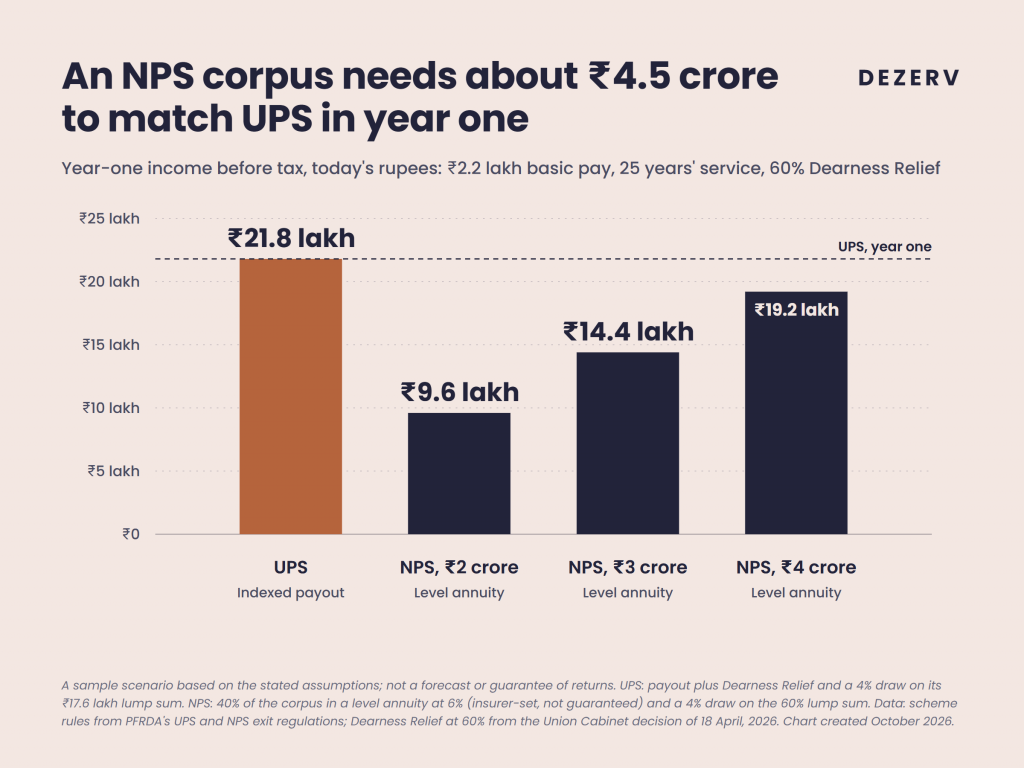
A sample scenario in today's rupees, not a forecast or guarantee of returns. Assumptions: average and last-drawn basic pay ₹2.2 lakh a month; 25 years of qualifying service (Q = 300, 50 half-years); Dearness Relief and DA at 60%, the rate from 1 January, 2026, assumed to apply from the first payout; government NPS exit of 60% lump sum and 40% annuity; a level annuity at 6% a year (indicative, not guaranteed; insurer-set, and lower for joint-life or return-of-purchase-price options); a 4% first-year draw from the capital on both routes; no optional UPS withdrawal; the same officer is assumed to hold the corpus shown. The first NPS-era officers reach 25 years of service only in 2029, so read this as today's pay applied to that officer.
Under the illustration's assumed 6% level annuity and 4% first-year capital draw, an NPS corpus of about ₹4.55 crore produces the same before-tax year-one cash flow as the modelled UPS arrangement (₹21.8 lakh ÷ 4.8%). The two are not equivalent lifetime benefits.
After year one: indexation and the 40% option
The gap then widens with every revision of Dearness Relief. If prices rise 5% a year and Dearness Relief keeps pace, by year ten the UPS cheque is about ₹32.8 lakh, while a ₹3 crore officer's annuity is still ₹7.2 lakh (a sample scenario, not a forecast or guarantee).
The optional withdrawal turns UPS into a 60/40 split as well. Assuming the individual corpus meets the benchmark, take the permitted 60% final withdrawal and the admissible payout drops to 40% of the full assured amount, here about ₹8.4 lakh a year, still subject to Dearness Relief, against a flat ₹7.2 lakh annuity from the NPS 40% of a ₹3 crore corpus. The UPS corpus is usually smaller, though.
The Government puts 10% into a UPS corpus against 14% into an NPS account, and the withdrawal is capped at 60% of the lower of the individual and benchmark corpus.
A large corpus is also different from an above-benchmark one. The benchmark grows with the same contributions, so only returns ahead of the default pattern create an excess, and that excess comes back as a refund rather than a larger pension.
What reaches the spouse and the heirs
The year-one table counts income only, and what each scheme leaves behind is where NPS makes its case. Under UPS, a legally wedded spouse receives 60% of the payout for life, with Dearness Relief: about ₹12.7 lakh a year at today's rates here, and nothing goes to children (PFRDA). When the spouse dies, the payout ends.
What passes on is what the officer took at exit: the ₹17.6 lakh lump sum, any optional withdrawal and any above-benchmark refund.
Under NPS, the annuity option decides the survivor's income. A joint-life annuity continues to the spouse.
A return-of-purchase-price version hands the 40% back to the nominees after both deaths, ₹1.2 crore on a ₹3 crore corpus, at a lower annuity rate, which each insurer sets on the day of purchase and fixes for life.
That capital case assumes the officer lives to the exit. A government subscriber who dies in service must, small corpus aside, put at least 80% of the NPS corpus into the default annuity for the spouse (PFRDA exit regulations).
The 60% lump sum, or what remains of it, passes by nomination and a will; where it sits in demat accounts or mutual fund folios, SEBI has capped nominees at three per account since 1 September, 2026. Whether to buy more annuity than the rules require is a one-way decision worth testing before the exit date.
For an officer with no heirs beyond a spouse to provide for, or a corpus well under ₹4 crore, the UPS trade is hard to beat. Where the family needs the capital itself, NPS keeps it.
How each route is taxed in 2026
Under the Income-tax Act, 2025, the qualifying UPS service-linked lump sum and permitted final withdrawal are exempt. Where the individual corpus exceeds the benchmark corpus, 60% of the excess refunded to the subscriber is exempt and the remaining 40% is taxable. At a government-sector NPS normal exit, the eligible lump-sum withdrawal up to 60% of the corpus is exempt. UPS monthly pension and NPS annuity income are generally taxable when received, subject to the applicable provisions.
| Receipt | Tax treatment | Provision |
|---|---|---|
| UPS monthly payout | Taxed as salary (pension) at your slab rate | DFS FAQ on UPS tax treatment, September 2025 |
| UPS lump sum (one-tenth per six months) | Exempt | Income-tax Act, 2025: exempt income, UPS lump sum |
| UPS final withdrawal, up to 60% of the individual corpus | Exempt for the permitted final withdrawal. If an individual corpus exceeds the benchmark, a separate excess refund is only 60% exempt; the remaining 40% is taxable. | Income-tax Act, 2025: exempt income, UPS withdrawal |
| UPS family payout to the spouse | Taxed as income from other sources | DFS FAQ, September 2025 |
| NPS lump sum at a government exit, up to 60% | Exempt | Income-tax Act, 2025: exempt income, NPS lump sum |
| NPS annuity income | Taxed at your slab rate as received | Income-tax Act, 2025 |
Source: Income-tax Act, 2025, its list of exempt income, as of October 2026; DFS FAQs on tax treatment under UPS, September 2025 (PIB, 23 September, 2025), whose payout answers also appear in PFRDA's UPS FAQs (Q.68–79).
Under the new regime for tax year 2026-27, the ₹21.1 lakh UPS pension is taxed as salary after the ₹75,000 standard deduction: about ₹2.2 lakh a year with cess. An NPS annuity below ₹12 lakh pays nothing once the Income-tax Act's rebate for incomes up to ₹12 lakh applies, assuming no other income.
Tax narrows the income gap without closing it. In the sample scenario above, the year-one breakeven after tax falls from about ₹4.5 crore to about ₹4.1 crore, counting the 4% draws as untaxed capital.
Tax on what that capital earns would push the NPS figure back up (a sample scenario, not a forecast or guarantee).
Returns on the invested capital are taxed by instrument. A government officer's 60% NPS lump sum sits entirely inside the 60% exemption; the taxed slice above 60% affects only non-government subscribers who take up to 80%.
Gratuity and leave encashment sit outside both schemes; how they are taxed is covered separately.
If you stayed on NPS: the decisions still open
For an officer who stayed on NPS, the first open decision is the exit mix. At a government exit the lump sum can be up to 60%, taken at once or phased, and the annuity at least 40%; both can be deferred to 85.
The second is the annuity: joint-life or single, with or without return of the purchase price, and from which provider.
The third is who runs the 60%. A ₹1.2 crore to ₹2.4 crore lump sum needs an allocation across equity, debt and safer income assets, regular rebalancing, and a withdrawal plan that can survive a bad first few years without forcing sales at the bottom.
Some officers are happy to run that themselves. For those who would rather delegate, a portfolio management service (PMS) is one route. Dezerv Investments Private Limited offers Portfolio Management Services (PMS) that provide exposure to relevant asset classes, primarily through underlying mutual funds, in accordance with each investment approach's mandate. The minimum investment amount for PMS is ₹50 lakh, subject to applicable regulatory requirements and the terms of the relevant service. Investments are subject to market risks, and returns are not guaranteed.
Each lump sum above clears that minimum. A PMS manages the money you take out of NPS, while the NPS account stays with its pension fund.
This section is not for an officer whose corpus is modest and whose family needs a secure monthly income more than capital. For that officer, UPS was the stronger choice while the window was open, and it is the option a new recruit with the same priorities has 30 days to weigh.
Run your own figures through a retirement calculator with your actual pay, service and expenses.
Key takeaways
- For an eligible subscriber with 25 qualifying years, the full UPS assured payout is based on 50% of the last 12 months' average basic pay, plus applicable Dearness Relief. The admissible payout can fall if the individual corpus is below the benchmark or a final withdrawal is taken. A separate qualifying lump sum is calculated at one-tenth of monthly basic pay plus DA for each completed six months of service.
- Year one: on ₹2.2 lakh basic, UPS pays about ₹21.8 lakh including a 4% draw on its lump sum; an NPS exit needs a corpus of about ₹4.5 crore to match it (sample scenario).
- UPS permits a final withdrawal of up to 60% of the lesser of the individual and benchmark corpuses. With no corpus shortfall, taking the maximum reduces the admissible pension to 40% of the full assured payout, with applicable Dearness Relief; a shortfall can reduce it further.
- NPS keeps the capital: at a government exit, 60% of the corpus is tax-free and passes to heirs; a UPS payout ends with the spouse.
- The window for serving staff closed on 30 November, 2025; new recruits choose within 30 days, and UPS members keep a one-time switch back to NPS.
Frequently Asked Questions
What is the main difference between UPS, NPS and OPS?
OPS is a defined-benefit pension paid from the government budget and closed to central civil servants who joined on or after 1 January, 2004 (the armed forces and some states follow different rules). NPS is a market-linked, defined-contribution scheme in which the employee carries the investment risk and owns the corpus. UPS, notified on 24 January, 2025, sits inside NPS and calculates a full assured payout at 50% of the last 12 months' average basic pay after 25 qualifying years, with Dearness Relief. Actual admissible payments can be reduced for a corpus shortfall or final withdrawal.
How is the UPS pension calculated?
The full assured payout is ½ × the average basic pay of the last 12 months × qualifying months ÷ 300, with months capped at 300 and UPS unavailable below 120. Actual admissible payout also depends on the individual-versus-benchmark corpus and any final withdrawal. Service of 10 years or more earns at least ₹10,000 a month. Dearness Relief is added from the first payout, and the spouse receives 60% for life. A separate lump sum pays one-tenth of last basic pay plus DA for every completed six months of service.
Can a central government employee still choose UPS?
Serving NPS members had until 30 November, 2025, after two extensions, and no notice reopening that window had been issued as of October 2026. A new recruit joining on or after 1 April, 2025 can still choose UPS within 30 days of joining. A UPS member has a one-time switch back to NPS until 12 months before superannuation, with the Government's contribution for the UPS years topped up to 14%, with returns.
Should an officer with a large NPS corpus have switched to UPS?
It depends on what the family needs. In a sample scenario on ₹2.2 lakh basic, UPS pays about ₹21.8 lakh in year one, indexed through Dearness Relief, and an NPS exit needs a corpus of about ₹4.5 crore to match it, and even then the annuity does not rise with prices. A government NPS exit instead leaves 60% of the corpus as tax-free capital the officer owns and can pass on, while a UPS payout ends with the spouse.
How is the UPS pension taxed?
Under the Income-tax Act, 2025, the qualifying UPS service-linked lump sum and permitted final withdrawal are exempt. If the individual corpus exceeds the benchmark, 60% of that excess refund is exempt and 40% is taxable. UPS monthly pension is generally taxed as salary, while family pension received by the spouse is generally taxed as income from other sources (PFRDA UPS tax FAQs).
Disclaimer
Dezerv Investments Private Limited is a SEBI-registered Portfolio Manager (Registration No. INP000007377). Distribution services are offered by Dezerv Distribution Services Private Limited, a wholly owned subsidiary of Dezerv Investments Private Limited, under AMFI Registration No. ARN-248439 and APMI Registration No. APRN-00615. This article is intended solely for general educational and informational purposes and should not be construed as personalised investment, financial planning, pension, tax or legal advice, or as a recommendation, offer or solicitation to invest in any security, financial product or investment strategy. Readers should consult their financial, tax or legal advisors, as applicable, before making decisions based on the information provided herein.
The information relating to the OPS, NPS and UPS, including eligibility conditions, pension benefits, contributions, withdrawal options, family benefits and tax treatment, is based on publicly available information and the sources cited in this article. Scheme provisions, government notifications, tax laws and regulatory requirements may change. The applicability and benefits of each scheme may vary depending on an individual's employment category, qualifying service, corpus, withdrawal choices and other applicable conditions. Actual outcomes may vary based on individual circumstances, investment performance, inflation, taxes, fees, and prevailing market conditions and regulations. This article is not a complete disclosure of all material facts, terms or conditions.
Investment in the securities market is subject to market risks. Please read all related documents carefully before investing. Past performance may or may not be sustained in the future.