A person approaching retirement with a large National Pension System, known as NPS, balance now faces a more complicated choice than the familiar 60/40 split suggests. The rules changed, but the tax treatment did not move in exactly the same way.
In December 2025, the pension regulator, the Pension Fund Regulatory and Development Authority (PFRDA), raised the cash share of a National Pension System, known as NPS, pot at retirement from 60% to 80% (PFRDA exit regulations). The change covered most private-sector and self-employed savers.
The Income-tax Act, 2025, in force since April 2026, kept the tax-free share at 60%. So on a ₹2 crore pot, an extra ₹40 lakh can now come out as cash, and every rupee of it is taxable.
The extra withdrawal flexibility creates a real choice between accessible money, tax and lifelong annuity income. The right answer begins with understanding which rules apply to the subscriber, not simply taking the largest amount the form permits.
In short
At a normal exit, a non-government NPS subscriber can take up to 80% of the corpus as a lump sum and must use at least 20% to buy an annuity, under the PFRDA exit regulations in force from 16 December, 2025; government-sector subscribers can still take up to 60% and must annuitise at least 40%. The Income-tax Act, 2025 exempts only 60% of the corpus paid out at closure, so the slice between 60% and 80% is added to your income and taxed at slab rates in the tax year you take it. On a ₹2 crore corpus, that tax runs to about ₹9.7 lakh to ₹14.1 lakh in the sample scenarios below, depending on your other income. That is the price of keeping the money instead of turning it into a larger annuity.
Table of contents
The exit rules after December 2025, by sector
NPS exit rules now depend on which side of the system you are on, because the amendment to the PFRDA (Exits and Withdrawals under the NPS) Regulations, 2015, in force from 16 December, 2025, treated the two sectors differently (PFRDA).
NPS divides non-government subscribers into different exit situations. For an eligible voluntary All-Citizen scheme that is not linked to employment, normal exit may become available after 15 years of subscription or at age 60. Corporate and other employment-linked NPS subscriptions cannot rely on the 15-year condition; their age-60 or superannuation provisions must be considered. For eligible non-government normal exits with a corpus above the relevant threshold, up to 80% may be taken as a lump sum and at least 20% used for an annuity. The earlier general non-government minimum was 40%.
A government-sector subscriber exits normally at superannuation, and that split did not move: up to 60% as a lump sum, at least 40% in an annuity, under the government-sector exit rule in the same regulations. Corporate-model staff of government-owned companies and statutory bodies follow the same 60/40 rule on superannuation, under a proviso to the non-government rule.
Officers weighing the Unified Pension Scheme (UPS) can compare all three routes in UPS, NPS or the Old Pension Scheme.
| Exit route | Who, and when | Lump sum (maximum) | Annuity (minimum) |
|---|---|---|---|
| Normal exit, non-government | Eligible voluntary All-Citizen / non-employment-linked: 15-year route or age 60; employment-linked corporate: age-60 or superannuation criteria, not the 15-year provision. | 80% | 20% |
| Normal exit, government sector | Government employees, and Corporate staff of government-owned bodies, at superannuation | 60% | 40% |
| Small corpus, normal exit (both sectors) | Corpus of ₹8 lakh or less, under usual normal-exit routes | 100% | Nil |
| Mid-size corpus, normal exit (both sectors) | Corpus above ₹8 lakh, up to ₹12 lakh, under usual normal-exit routes (separate rules for eligible All Citizen subscribers entering after 60) | Up to ₹6 lakh | Nil if the rest is drawn through SUR over at least six years; otherwise an annuity |
| Premature exit (both sectors) | Leaving before your normal-exit point | 20% (all of it if the corpus is ₹5 lakh or less) | 80% |
Source: PFRDA (Exits and Withdrawals under the NPS) Regulations, 2015, government-sector and non-government exit rules, as amended with effect from 16 December, 2025 (consolidated text last amended 20 July, 2026), as of October 2026. SUR is Systematic Unit Redemption.
Why an 80% withdrawal is not 80% tax-free
PFRDA decides how much you may take out of NPS. The Income-tax Act decides how much of it is taxed, and in December 2025 the two stopped lining up.
The Income-tax Act, 2025 lists a payment from the NPS Trust at closure among the incomes it does not tax, but only if it does not exceed 60% of the total amount payable.
That exemption replaced the matching one in the Income-tax Act, 1961 from 1 April, 2026, with the cap unchanged at 60%. Under the Act's NPS rules, anything above that line is income of the year you receive it, so a non-government subscriber taking the full 80% pays slab-rate tax on the 60–80% slice that year.
Money used to buy an annuity in the same year is treated as not received, so it escapes tax at purchase, though the pension it buys is taxable income. A government-sector subscriber is capped at a 60% lump sum, which sits entirely inside the exemption. The tax on the top slice falls only on non-government subscribers.
Gratuity, leave encashment and EPF often arrive in the same year. How each retirement benefit is taxed covers those caps.
What the top slice costs at three corpus sizes
The 60–80% slice is one-fifth of the corpus, and its tax turns on how large that fifth is and on your other income that year.
| Corpus at exit | Taxable slice (60–80%) | Tax on the slice, other income ₹5 lakh | Tax on the slice, other income ₹25 lakh | Extra annuity if the slice is left in (6%, pre-tax) |
|---|---|---|---|---|
| ₹50 lakh | ₹10 lakh | ≈ ₹1.09 lakh | ≈ ₹3.12 lakh | ₹60,000 a year |
| ₹2 crore | ₹40 lakh | ≈ ₹9.67 lakh | ≈ ₹14.07 lakh | ₹2.4 lakh a year |
| ₹5 crore | ₹1 crore | ≈ ₹32.65 lakh | ≈ ₹36.39 lakh | ₹6 lakh a year |
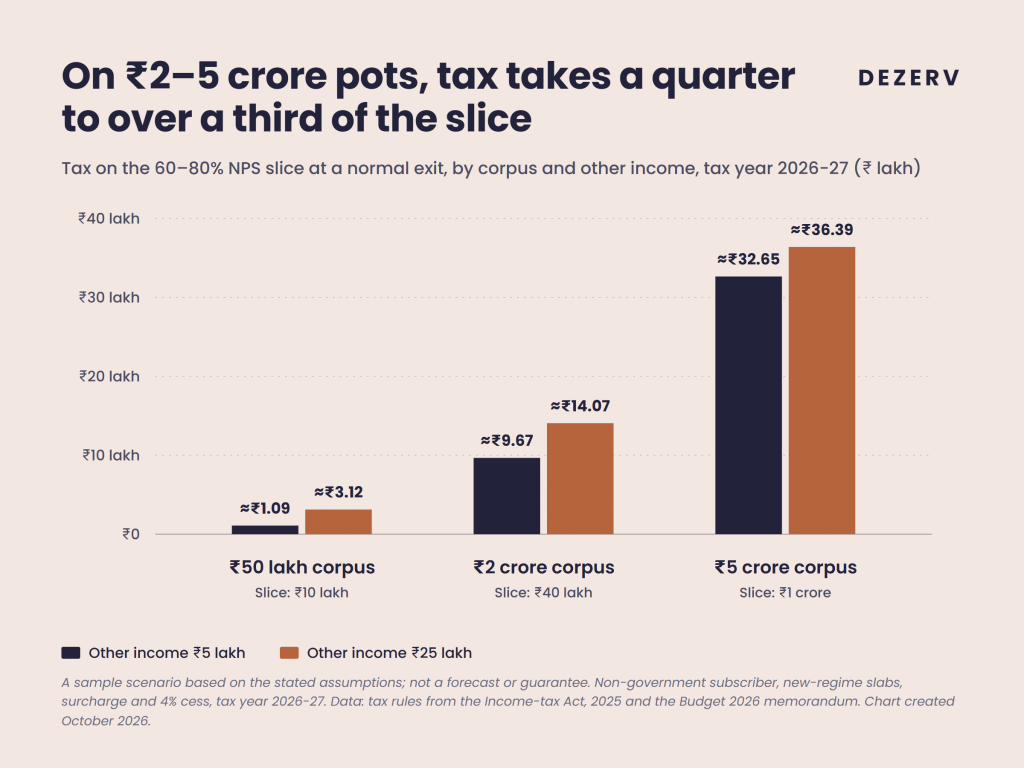
A sample scenario, not a forecast or guarantee. Assumptions: non-government subscriber taking the full 80% at a normal exit in tax year 2026-27; new-regime slabs and the rebate for total income up to ₹12 lakh, under the Income-tax Act, 2025; "other income" is taxable income for the same year before the slice.
Surcharge of 10% above ₹50 lakh and 15% above ₹1 crore, with marginal relief, plus 4% cess, at the rates the Finance Act, 2026 set for tax year 2026-27 (Budget 2026 memorandum). Annuity rate 6% a year, level: an assumption of this scenario, not an insurer's quote; indicative, not guaranteed, since the insurer sets the rate on the day you buy. Tax on the slice is tax with it minus tax without it.
With little other income, the lower slabs absorb part of the slice. On ₹2 crore, ₹9.67 lakh is about 24% of the ₹40 lakh. Once other income already sits in the 30% slab, the slice is taxed at 31% or more, and past ₹50 lakh of total income the surcharge lifts that to about 34% (about 36% past ₹1 crore).
On a ₹50 lakh corpus the slice costs ₹1–3 lakh, small beside the ₹30 lakh that comes out tax-free.
Take the slice, or let it buy a larger annuity
You do not have to take the full 80%. Whatever part of the slice you leave behind enlarges the annuity.
One way to compare them is to ask what the kept cash must earn to match the annuity it replaces: on ₹2 crore with ₹25 lakh of other income, the ₹40 lakh slice leaves about ₹25.9 lakh after tax.
The extra annuity would pay ₹2.4 lakh a year. Relative to the illustrated after-tax cash, that corresponds to an initial cash-yield comparison of about 9.3% before tax on investment earnings; it is not a like-for-like comparison with a lifetime annuity that can have different capital and survivor rights. That is well above the 6% annuity rate, because the cash is measured after tax. With ₹5 lakh of other income, less of the slice goes in tax and the bar falls to about 7.9%.
| Corpus at exit | Extra annuity if the slice is left in (6%) | Return the kept cash must earn, other income ₹5 lakh | Return the kept cash must earn, other income ₹25 lakh |
|---|---|---|---|
| ₹50 lakh | ₹60,000 a year | ≈ 6.7% (on ₹8.91 lakh after tax) | ≈ 8.7% (on ₹6.88 lakh after tax) |
| ₹2 crore | ₹2.4 lakh a year | ≈ 7.9% (on ₹30.33 lakh after tax) | ≈ 9.3% (on ₹25.93 lakh after tax) |
| ₹5 crore | ₹6 lakh a year | ≈ 8.9% (on ₹67.35 lakh after tax) | ≈ 9.4% (on ₹63.61 lakh after tax) |
A sample scenario, not a forecast or guarantee, on the same assumptions as the tax table above. The return needed is the extra annuity divided by the slice left after tax, before any tax on that return. The 6% annuity rate is an assumption of this scenario; indicative, not guaranteed.
Either way the cash keeps the capital for you or your heirs; an annuity hands it back to a nominee only under a return-of-purchase-price option, which pays less.
Longevity cover and the annuity menu
The annuity's strength is longevity insurance. It pays for as long as you live, however long that turns out to be. For a retiree whose other lifetime income is thin, leaving part of the slice in can be the better use of it even after the tax arithmetic.
Most NPS annuities pay a level amount, though rising and capital-refund options are on the menu; one insurer's list for NPS subscribers includes a life annuity that rises at a simple 3% a year and options that return the purchase price to a nominee (LIC NPS subscriber corner, page updated 25 September, 2026).
Each feature is paid for out of the same purchase price. Compare the starting payouts before choosing one.
How much income to buy through an annuity beyond the NPS floor is a wider question, taken up in should you annuitise at retirement.
"When you've won the game, why keep playing it?"
— William Bernstein, author of The Ages of the Investor, interview with George Mannes, Money magazine (CNNMoney, archived, 4 September, 2012)
Phasing and deferral: SLW, SUR and waiting until 85
The lump sum need not arrive as one cheque, since the amended regulations let you take it as periodic payouts through Systematic Lump-sum Withdrawal (SLW) or Systematic Unit Redemption (SUR), with the balance staying invested in your NPS funds (PFRDA). Either can pay monthly, quarterly, half-yearly or yearly, up to age 85 (Central Recordkeeping Agency exit procedure, June 2026).
SLW pays the lump sum in instalments of an amount you choose, or spreads it until an age you pick (NPS Trust). SUR redeems your NPS units at set intervals. It is also how a ₹8–12 lakh corpus skips the annuity: the balance after a lump sum of up to ₹6 lakh is paid out over at least six years.
You may defer the lump sum, the annuity purchase or both until 85 and exit at any point in between, though you bear the account's charges while the money stays in (PFRDA exit regulations). That suits a retiree with enough other income for the next few years who would rather leave the corpus invested in its NPS funds.
Will phasing spread the tax?
Phasing looks like a way to spread the taxable slice across several tax years and keep each year in a lower band.
Whether the tax works that way is unsettled. The Act's exemption tests the 60% against the total amount payable at closure, and no Central Board of Direct Taxes (CBDT) guidance on instalments had been found by October 2026. Confirm the treatment with a chartered accountant before planning around it.
Where the withdrawn money goes next
Once the lump sum is received, the tax consequences still have to be determined for the applicable tax year, with any tax payable subject to the relevant withholding, payment and return-filing requirements.
Held in mutual funds and drawn through a Systematic Withdrawal Plan (SWP), only the gain in each withdrawal is taxed. For qualifying equity-oriented mutual-fund units, eligible long-term capital gains above the aggregate ₹1.25 lakh annual threshold are generally taxable at 12.5%, plus applicable surcharge and cess. Gains on specified debt-oriented mutual-fund units acquired on or after 1 April 2023 are generally deemed short-term, regardless of holding period, under special rules. The statutory specified-fund definition changed from 1 April 2026 (Income-tax Act, 2025).
Some retirees run that withdrawal plan themselves. Others hand the portfolio to a manager through a portfolio management service (PMS). Dezerv Investments Private Limited offers Portfolio Management Services (PMS) that provide exposure to relevant asset classes, primarily through underlying mutual funds, in accordance with each investment approach's mandate. The minimum investment amount for PMS is ₹50 lakh, subject to applicable regulatory requirements and the terms of the relevant service. Investments are subject to market risks, and returns are not guaranteed.
For a non-exempt applicant, that standard minimum rules out the smallest case above on its own. On a ₹50 lakh NPS corpus, the maximum 80% lump sum is ₹40 lakh, so it does not meet the ordinary ₹50 lakh PMS minimum by itself. On ₹2 crore, the illustrative post-tax lump sum exceeds that standard minimum. Liquidity, withdrawals, termination charges and other fees under a Dezerv PMS depend on the selected strategy, disclosure document, fee schedule and client agreement; qualifying accredited investors may have a different minimum.
The decision matters most to a non-government saver with a large pot and other income in the year of exit. Before choosing a split, size the income you need with a retirement corpus calculator.
Key takeaways
- At a normal exit, non-government NPS subscribers can take up to 80% as a lump sum and must annuitise at least 20%; government-sector subscribers stay at 60% / 40% (PFRDA, from 16 December, 2025).
- Only 60% of the corpus is tax-free (Income-tax Act, 2025); the 60–80% slice is taxed at slab in the year you take it.
- On a ₹2 crore corpus that slice costs about ₹9.7–14.1 lakh in tax in the sample scenarios above; leaving it in buys about ₹2.4 lakh a year of taxable annuity at an assumed 6%.
- For the usual normal-exit categories, a corpus up to ₹8 lakh can be taken in full; above ₹8 lakh and up to ₹12 lakh, the annuity can be avoided by drawing the residual portion through SUR over at least six years. A separate full-withdrawal provision up to ₹12 lakh applies to eligible All Citizen Model subscribers who joined after age 60.
- The lump sum can be phased through SLW or SUR, or deferred to 85; how the 60% exemption applies to instalments is unresolved.
Frequently Asked Questions
How much of my NPS can I withdraw tax-free at 60?
Up to 60% of the corpus is tax-free at exit under the Income-tax Act, 2025, the same cap the 1961 Act's NPS exemption carried. A non-government subscriber may now withdraw up to 80% as a lump sum, but the slice between 60% and 80% is taxed at slab rates in the year it is received. Government-sector subscribers can take up to 60%, so their whole lump sum is tax-free.
Is NPS annuity income taxable?
Yes. The part of the corpus used to buy the annuity is not taxed at purchase, because the Income-tax Act, 2025 treats it as not received. Under the same Act, the annuity pension is income in each year you receive it, taxed at your slab rate. A quoted annuity rate therefore overstates what you keep, especially in the 30% slab.
Can I avoid buying an annuity at NPS exit?
Yes, if the corpus is modest. Under the usual normal-exit provisions, a corpus of ₹8 lakh or less can be withdrawn in full. Above ₹8 lakh and up to ₹12 lakh, up to ₹6 lakh can be withdrawn as a lump sum, with the rest through Systematic Unit Redemption over at least six years or an annuity. Eligible All Citizen Model subscribers who entered after age 60 have a separate full-withdrawal provision up to ₹12 lakh. Above ₹12 lakh, non-government subscribers must annuitise at least 20% and government-sector subscribers at least 40%.
Can I delay my NPS withdrawal after 60?
Yes. Under the PFRDA exit regulations as amended in December 2025, you can defer the lump sum, the annuity purchase or both until age 85, and exit at any time in between. You can also take the lump sum in instalments through Systematic Lump-sum Withdrawal or Systematic Unit Redemption. How the 60% tax exemption applies to instalments is not settled, so confirm it with a tax advisor.
What happens if I exit NPS before the normal exit point?
A premature exit is one made before the normal-exit condition applicable to your scheme. Government-sector subscribers generally use their superannuation rules. For non-government subscribers, the 15-year provision is confined to eligible voluntary non-employment-linked schemes; corporate subscribers cannot use it solely because fifteen years have passed. Premature-exit annuitisation and small-corpus exceptions differ from normal exit, and should be confirmed under the latest PFRDA regulations for the relevant subscriber category.
Disclaimer
Dezerv Investments Private Limited is a SEBI-registered Portfolio Manager (Registration No. INP000007377). Distribution services are offered by Dezerv Distribution Services Private Limited, a wholly owned subsidiary of Dezerv Investments Private Limited, under AMFI Registration No. ARN-248439 and APMI Registration No. APRN-00615. This article is intended solely for general educational and informational purposes and should not be construed as personalised investment, retirement planning, financial, tax or legal advice, or as a recommendation, offer or solicitation to invest in any security, financial product or investment strategy. Readers are advised to consult their financial and tax advisors before making decisions based on the information provided herein.
The NPS withdrawal rules, tax provisions, annuity options and calculations discussed in this article are based on publicly available information and the sources cited, as understood at the time of writing. Regulatory provisions and tax treatment may change and may vary depending on the subscriber's category, exit conditions and individual circumstances. Actual outcomes may vary depending on individual circumstances, investment performance, inflation, taxes, fees, annuity terms and prevailing market, economic and regulatory conditions. This article is not a complete disclosure of every material fact, term or condition.
Investment in the securities market is subject to market risks. Please read all related documents carefully before investing. Past performance may or may not be sustained in the future.