The usual answer to where a retiree should invest is a short list of government schemes and bank deposits. For a couple with more than ₹1 crore, it runs out long before the money does.
Filled to their caps by a couple, the Senior Citizens' Savings Scheme and the post-office monthly income scheme take ₹78 lakh, a monthly equivalent of about ₹52,100 before tax at October to December 2026 rates, which are revised every quarter (a sample scenario).
With ₹3 crore, ₹2.22 crore has no line in the catalogue, so the first step is to see where the template stops.
In short
After retirement, organise money by the job each rupee does: an income floor for planned spending, a buffer for the unplanned, equity for rising costs and a gold stabiliser. Government schemes fill the floor up to ₹78 lakh for a couple; above ₹1 crore the rest of it is bonds and debt funds. On index data since 2000, a minority share of equity lifted a mostly-debt blend's return for a modest worst fall, so most long retirements keep some. Fill the buffer first and equity last.
Table of contents
Why the SCSS, FD and POMIS template stops working above ₹1 crore
The standard answer is a product list: the Senior Citizens' Savings Scheme (SCSS), the Post Office Monthly Income Scheme (POMIS) and a few bank fixed deposits (FDs). Each is sound, and each has a ceiling: ₹30 lakh per person in SCSS at 8.2%, paid quarterly (Central Bank of India), and ₹9 lakh per single POMIS account at 7.4%, paid monthly (India Post).
Those are October to December 2026 rates (National Savings Institute), indicative, not guaranteed and revised quarterly. Taxed at slab, the couple's ₹78 lakh is close to four-fifths of a ₹1 crore corpus, a quarter of ₹3 crore and under a sixth of ₹5 crore.
Limits, payouts and tax are in what comes after SCSS maxes out. This piece starts where they stop.
The best investment plan after retirement is a menu by job, not a product
A retirement corpus has four jobs. Each has its own instruments, tax treatment and access speed.
The three-layer withdrawal structure is the map: Layer 1 pays for planned spending, Layer 2 absorbs the unplanned, and Layer 3 is the equity you protect. The menu fills each layer.
| Job | What goes in | Layer | Tax on the income or gain | How fast you can get at it |
|---|---|---|---|---|
| Income floor: the next 5 to 7 years of planned spending | SCSS and POMIS to their caps; RBI floating-rate bonds; a ladder of government and AAA-rated bonds; short-duration and target-maturity debt funds | Layer 1 | Interest at your slab; debt-fund gains at your slab | Quarterly or monthly payouts; listed bonds and funds sell in days; SCSS is a 5-year account; RBI floating-rate bonds cannot be sold, with early exit after 4 to 6 years by age |
| Liquidity buffer: 12 to 24 months of spending for the unplanned | Liquid and overnight funds; a sweep deposit | Layer 2 | At your slab | Same or next working day |
| Growth sleeve: money untouched for 7 years or more | Diversified equity funds; a multi-asset or balanced-advantage fund; Real Estate Investment Trusts (REITs) and Infrastructure Investment Trusts (InvITs) for the income-leaning part | Layer 3 | Long-term gains on equity funds at 12.5% above ₹1.25 lakh a year; REIT payouts taxed by component | Equity-fund redemptions pay out in a few working days; listed REITs trade on the exchange |
| Stabiliser: about 10%, moving differently from equity and debt, and capped because gold swings like equity | Gold funds or exchange-traded funds | Across the layers | Gains taxed by holding period (the fund's scheme document states which rule applies) | Funds and ETFs sell in days |
Tax lines are the rules for the tax year beginning 1 April, 2026 under the Income-tax Act, 2025; units acquired since 1 April 2023 of mutual funds covered by the specified-mutual-fund rules are generally taxed at the applicable short-term rate; from April 2026 the definition depends on the prescribed debt and money-market exposure. Tax depends on your circumstances and can change with each Budget. Each fund's riskometer and scheme information document set out its risks; read them before buying.
The jobs do not get equal money: for most retirees the debt side is the larger. The year counts are this piece's assumptions; its five-to-seven-year floor is shorter than the three-layer structure's seven to ten, sized to carry the planned draw through the slowest equity recoveries on record. A pension, a shorter horizon or other assets shrinks either.
Over a long horizon, some equity exposure may help address inflation, but the appropriate share can also be zero depending on a retiree’s pension, liquidity, liabilities, health, spending needs and capacity to bear market losses.
How much equity after 60
There is no universal equity percentage after 60. Equity may help a corpus keep pace with rising spending over a long retirement, but its appropriate weight depends on other income, spending flexibility, horizon and ability to withstand losses. The historical illustration below shows how different equity proportions affected one chosen portfolio model; it does not determine the allocation for an individual retiree.
For comparison, Vaibhav Porwal's House View letter of 7 October, 2026 calls 65/25/10 (equity / fixed income / gold) closest to Dezerv's positioning, and sets out 50/40/10 and 30/60/10 as scenario mixes; it is Dezerv's positioning, not a recommendation for any reader, whose share turns on spending, other income and the fall they can sit through.
Take 9% a year for an affluent household's spending over a 25 to 30-year retirement, an assumption rather than a measured rate: headline CPI was 5.54% in September 2026 (MoSPI, provisional), employer medical-plan costs in India are projected to rise 11.5% in 2026 (Aon), and CPI inflation ran above 9% in both 2012-13 and 2013-14 (RBI Handbook of Statistics, Table 236).
What adding equity to debt did since 2000
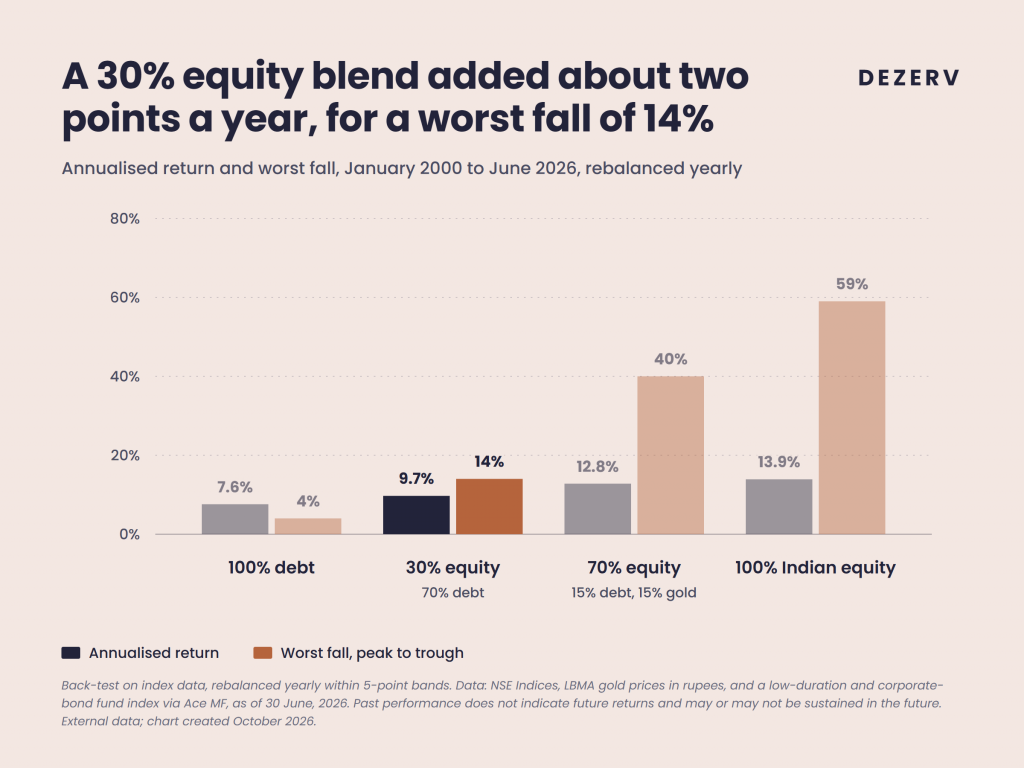
The central trade-off is that a portfolio holding more equity has a greater potential for long-term growth and larger interim declines. A portfolio holding more high-grade debt ordinarily has lower equity-market exposure but must also manage reinvestment, tax and inflation risk. These trade-offs can be demonstrated without asserting an optimal historical return from a proprietary back-test.
Illustrative allocation discussion: the mix, permitted instruments, liquidity and total portfolio risk matter more than any one historical annualised return. Historical market examples are context, not a prediction of what a specific portfolio will earn.
A blend with some equity may offer more growth potential than debt alone, but there is no fixed equity percentage or historical back-test that establishes the appropriate mix for every retiree. A spending buffer may reduce forced asset sales during downturns without eliminating losses.
The growth sleeve is money you will not touch for about seven years. The rolling-return odds behind that line, and the cost of cutting equity to zero at 58, are in the glide path piece; the all-FD trap covers when a mostly-deposit portfolio is reasonable.
The order to fill the menu with ₹2 to ₹5 crore
The order matters because the first rupees go to the jobs that cannot wait.
- The buffer first. Twelve to 24 months of planned spending in liquid or overnight funds and a sweep deposit. This is the money that stops a hospital bill, or a bad year in the market, from forcing a sale of anything else.
- The government floor to its caps. Two SCSS accounts and two single POMIS accounts, ₹78 lakh for a couple.
- RBI floating-rate bonds for the slice of the floor you will not need for seven years. No upper limit; 8.05% for July to December 2026, reset every six months at the National Savings Certificate (NSC) rate plus 0.35 points (indicative, not guaranteed; RBI); early exit after six years for investors aged 60 to 70 (bond terms).
- The rest of the floor. A ladder of government and AAA-rated bonds, and short-duration or target-maturity debt funds, sized so that planned spending through year seven is covered once the schemes and the bonds are counted.
- Gold to 10%. A gold fund or exchange-traded fund, bought in monthly instalments.
- Equity last, as one decision. Whatever remains is the growth sleeve. The House View letter favours putting lump sums to work: a lump sum parked waits for a price that may never come. If that is too much volatility at the start, spread the purchases over months fixed in advance, so that no price decides them.
One illustrative allocation sequence is shown for three corpus sizes, with equity capped at 30% solely for the example; it is not a prescribed order or asset mix. The government floor stays fixed in rupees while everything else grows with the corpus.
At each size the debt side ends up covering about twelve and a half years of spending, well beyond the seven years step 4 needs.
| Job | ₹2 crore | ₹3 crore | ₹5 crore |
|---|---|---|---|
| Buffer (18 months of spending) | ₹14.4 lakh (7%) | ₹21.6 lakh (7%) | ₹36 lakh (7%) |
| Government floor (SCSS + POMIS at a couple's caps) | ₹78 lakh (39%) | ₹78 lakh (26%) | ₹78 lakh (16%) |
| Rest of the floor (bonds, short-duration funds) | ₹27.6 lakh (14%) | ₹80.4 lakh (27%) | ₹1.86 crore (37%) |
| Gold | ₹20 lakh (10%) | ₹30 lakh (10%) | ₹50 lakh (10%) |
| Equity | ₹60 lakh (30%) | ₹90 lakh (30%) | ₹1.5 crore (30%) |
| Monthly spending assumed | ₹80,000 | ₹1.2 lakh | ₹2 lakh |
A sample scenario, not a forecast or guarantee of returns. Assumptions: monthly spending of 0.4% of the corpus (4.8% a year), an 18-month buffer, a couple's scheme caps of ₹78 lakh, gold at 10% and equity capped at 30%, as in the back-test's 30:70 row (gold comes out of the debt side); the rest of the floor takes the balance. The scheme balances, the bonds and the buffer carry different rates and taxes, which this table ignores. Scheme caps from India Post. This is one hypothetical filling order based on the stated spending and asset-allocation assumptions, not a recommended sequence for every household.
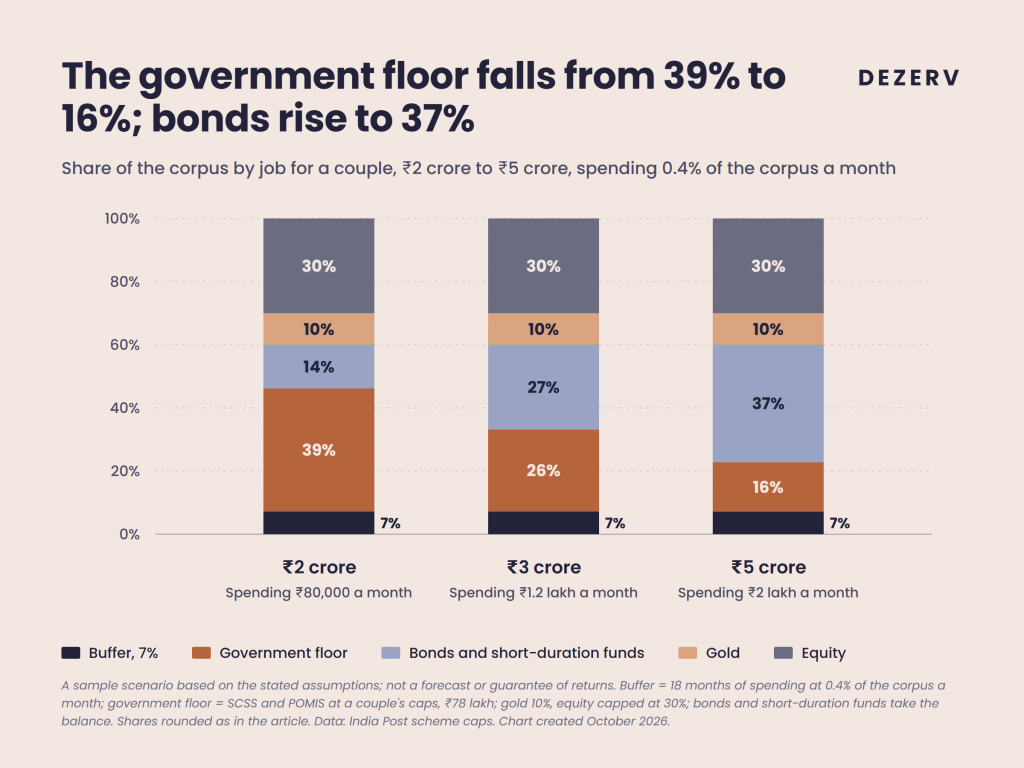
With equity capped, the row that grows is the third: above ₹1 crore, the instrument a retiree most needs to understand is the bond and debt-fund sleeve that carries the rest of the floor. The ₹2 crore scenarios run a menu like this year by year against an all-FD and an all-SWP alternative.
Debt: what belongs in the floor
The floor is money spent within about seven years, chosen for how reliably each rupee comes back on time: SCSS and POMIS, RBI floating-rate bonds, government securities held to maturity, AAA-rated bonds and, for the part you may sell, short-duration and target-maturity debt funds. Interest and gains on debt funds bought since April 2023 are taxed at your slab (Income-tax Act, 2025).
Duration is the floor's quiet risk. On 7 October, 2026 the RBI raised the repo rate by 25 basis points to 5.50%, its first increase since February 2023, and moved its stance to "calibrated tightening" (RBI); short duration suits the floor better than a bet on falling yields. Every rate and yield here is indicative, not guaranteed.
A bond paying two or three points over a government bond of the same maturity is being paid for credit risk. Ladders, ratings and bond tax are in bonds for retirement income.
Property and REITs: income or not
A second flat is the most common "income" asset in an affluent retiree's menu and the least examined. Rental yields on residential property run in the low single digits, from 3.2% in Delhi to 4.6% in Bengaluru in the second quarter of 2026 (ANAROCK via Business Today, 4 August, 2026), before vacancy, maintenance, society charges and tax. A flat also cannot be sold in slices.
City-by-city yields sit in the property and REIT income piece.
A REIT answers the liquidity problem and part of the yield problem. SEBI's rules require a listed REIT to distribute at least 90% of its net distributable cash flow to unit holders, declared at least once every six months (SEBI REIT Regulations), and the units trade on the exchange like a share.
The payout arrives as dividend, interest and a return of capital, each taxed differently (the property piece explains). In the menu a REIT sits in the income-leaning corner of the growth sleeve, beside InvITs, and stays out of the floor: its payout is not fixed and its price moves with the market.
Gold's 10% and what it is for
Gold is in the menu for stability, not return, and 10% is a ceiling as much as a target. Trim back to 10% after a rally, top up after a fall; the framework does not change because the price did. The House View letter also holds gold at about 10%, as Dezerv's positioning rather than a recommendation.
The ceiling needs defending because gold has been as volatile as equity. It has traded more than 10% below its previous peak on about half of all days* (an analysis of lbma.org gold prices in rupees, as on 30 June, 2026).
On the same prices, its 30 to 60% falls have taken seven to eight years to recover*.
And a good year moves the weight fast. Gold in rupees rose 35.3% in the twelve months to 30 June, 2026*.
A 10% sleeve in a portfolio whose other holdings rose 5% would have ended that year at about 12.5% (a sample scenario, not a forecast or guarantee of returns), and only a rebalance takes it back to 10%.
Past performance does not indicate future returns and may or may not be sustained in the future.
What to avoid: yield traps, "safe and high return" products, over-diversification
Retirees' recurring mistakes start with "what is safe and pays well", which no product can answer until the rupee has a job.
Yield traps. Any product pitched to a retiree on a rate two or three points above a government bond, with the word "safe" somewhere nearby, is carrying credit risk, liquidity risk or both.
Unrated company deposits, perpetual bank bonds and structured notes have all been sold this way. The test is who issues it and what rating it carries.
Diversification that is only a long list. A portfolio assembled one tip, one new fund offer and one bank visit at a time can end up holding dozens of mutual funds.
When most of them hold the same large-cap names, it is one portfolio bought many times over, with many expense ratios.
A handful of equity funds with little overlap does the job. Sandeep Jethwani, co-founder of Dezerv, puts the number at seven or eight (The Money Mindset podcast with Sonia Shenoy, early 2026); one wealth-management executive has argued the opposite, that an eight-fund limit is not statistical and what matters is whether the portfolio beats the index (Feroze Azeez, Money Talks, 13 June, 2026).
That second test is the real one, and the persistence data warns against building long lists from last year's winners: only about one in four top-quartile equity funds stayed top-quartile over the next three years, and about one in five over five years* (Ace MF diversified-equity fund data, 2002 to 2025; a subscription database with no public page).
Past performance does not indicate future returns and may or may not be sustained in the future.
Anti-asset allocation. S. Naren of ICICI Prudential AMC names the third mistake (the "Good to Great" podcast, 23 September, 2026).
Everyone says they do asset allocation, then practises its opposite, pouring money into whatever has just done well and selling whatever has not. His examples were record flows into gold ETFs near a top and into small-cap funds after a run.
A retiree's menu survives only while the weights are held, so the rule is written in advance: gold at 12.5% goes back to 10% however good the rally felt, and equity is sold after a fall only when the written refill rule calls for it, never to calm nerves.
Keeping it simple to run at 75
A menu built at 62 has to be run at 75 and, with reasonable odds, at 85, often by a spouse who did not build it. That makes simplicity a design constraint.
Three rules keep it runnable. Hold the menu in as few accounts as the instruments allow, with one statement that shows every job.
Name nominees on every account and folio: SEBI via its circular dated May 29, 2026 modified the norms applicable for nomination and has since 1 September, 2026 allowed up to three per demat account or mutual-fund folio (SEBI circular).
Then write the refill rule down: which sleeve tops up the buffer below twelve months, and when equity is left alone.
A Dezerv PMS can run the bond sleeve and the income corner for investors who would rather delegate them, from ₹50 lakh per client (SEBI's minimum; accredited investors are exempt), a minimum a ₹2 to ₹5 crore corpus meets after the floor and buffer and a ₹1 crore one does not.
For the bond sleeve, Dynamic Debt holds debt funds, arbitrage funds, bonds and debentures, and may charge a 1% exit load within 90 days of investment (accounts opened from 1 October, 2025); for the income corner, Infra Yield Assets holds REITs, InvITs and mutual funds. Fees, charges and the underlying funds' costs, borne by the client, are in the disclosure document. Dezerv disclosure document, September 2026: https://d21ldyuk035o7q.cloudfront.net/pdf/Disclosure_Doc.pdf
The schemes, the RBI floating-rate bonds (which cannot be transferred, RBI) and the buffer stay outside it, and a PMS does not remove market risk.
Even a well-structured portfolio cannot make up for an insufficient retirement corpus. If your essential expenses are too high relative to your savings and other retirement income, simply shifting money between deposits, bonds and equity will not solve the problem. The first step is to assess whether your corpus can support your spending over retirement, as explained in our retirement income planning guide.
Key takeaways
- Before buying any product, decide which job the rupee does: planned spending, the unplanned bill, the decades ahead or the shocks.
- Expect a monthly equivalent of about ₹52,100 before tax from a couple's ₹78 lakh government floor at October to December 2026 rates, which reset quarterly, and plan everything above it in bonds and funds (a sample scenario; rates indicative, not guaranteed).
- Retirement allocations should reflect essential spending, secure pension income, liquidity needs and capacity to withstand investment losses; historical performance of any one blend does not establish a guaranteed advantage.
- Fill in order: buffer, government floor to its caps, the rest of the floor in bonds and short-duration funds, gold to 10%, equity last; with equity capped, each extra crore lands mostly in the bond sleeve.
- Avoid yield chasing, long-list "diversification" and selling what has fallen; write the refill rule down so the menu can be run at 75.
Frequently Asked Questions
Where should a retiree invest ₹2 crore in India?
By job rather than by product. In a sample scenario for a couple spending ₹80,000 a month, ₹2 crore divides into an 18-month buffer of about ₹14 lakh in liquid funds, ₹78 lakh in SCSS and POMIS at their caps, about ₹28 lakh in bonds and short-duration debt funds to extend the income floor, ₹20 lakh in gold and ₹60 lakh in diversified equity funds for growth (not a forecast or guarantee of returns). The buffer is filled first and equity last, and the weights are rebalanced every year.
How much equity should I hold after 60?
For a retirement horizon of 25–30 years, some equity may help address long-term inflation, but its suitability depends on pension and other guaranteed income, expenses, liabilities, health, time horizon and ability to withstand losses. There is no universally correct equity allocation for someone over 60.
Which instruments should a retiree buy, and in what order?
Buffer first: 12 to 24 months of spending in liquid or overnight funds. Then the government floor to its caps, SCSS and POMIS, followed by RBI Floating Rate Savings Bonds for money not needed for seven years. Then a ladder of government and AAA-rated bonds, or short-duration debt funds, for the rest of the next seven years' spending. Then gold to 10%, bought in instalments. Equity, in diversified funds, takes whatever remains, as the last decision rather than the first.
Is the Senior Citizens' Savings Scheme enough for a retired couple?
It is the right first instrument and the wrong whole plan. Each person can deposit up to ₹30 lakh, so a couple holds ₹60 lakh at 8.2% a year for October to December 2026 (indicative, not guaranteed), paid quarterly and taxed at slab: a monthly equivalent of about ₹41,000. With a single POMIS account of ₹9 lakh each, the government floor reaches ₹78 lakh, a monthly equivalent of about ₹52,100. For a corpus above ₹1 crore the schemes are exhausted quickly, and the balance of the income floor has to come from bonds and short-duration debt funds.
Should a retiree buy a second flat for rental income or invest in REITs?
A second flat earns a low single-digit rental yield before vacancy, maintenance and tax, and cannot be sold in parts when the income floor needs topping up. A listed REIT must distribute at least 90% of its net distributable cash flow to unit holders at least every six months under SEBI's rules, and its units trade on the exchange, so it fits the income-leaning part of the growth sleeve. Neither belongs in the floor, because neither payout is fixed.
What is the best investment plan after retirement in India?
Not a product. The plan that holds up is a menu of four jobs: an income floor of government schemes and high-quality bonds for the next five to seven years of planned spending, a 12-to-24-month liquidity buffer, a growth sleeve of diversified equity for money untouched for about seven years, and a gold stabiliser at a fixed weight. How much each job gets turns on spending, pension income, health and horizon; the fill-order table shows one sample scenario.
Disclaimer
Dezerv Investments Private Limited is a SEBI-registered Portfolio Manager (Registration No. INP000007377). Distribution services are offered by Dezerv Distribution Services Private Limited, a wholly owned subsidiary of Dezerv Investments Private Limited, under AMFI Registration No. ARN-248439 and APMI Registration No. APRN-00615. This article is intended solely for general educational and informational purposes and should not be construed as personalised investment, financial planning, tax or legal advice, or as a recommendation, offer or solicitation to invest in any security, financial product or investment strategy. Readers are advised to consult their financial advisor before making investment decisions based on the information provided herein.
The investment instruments, asset allocations, interest rates, returns, tax treatments and portfolio scenarios discussed are illustrative, based on the assumptions and sources cited, and do not constitute investment recommendations, forecasts or guarantees. Investment suitability depends on individual circumstances, financial goals, liquidity needs and risk tolerance. Investments in equities, debt instruments, mutual funds, gold, REITs and InvITs carry varying risks. Interest rates, tax provisions, scheme limits and regulatory requirements may change, and past performance does not guarantee future results. References to Dezerv's investment views and services are for informational purposes only and do not imply suitability for any investor. Readers should review relevant documents and consult their financial, tax and legal advisors before making investment decisions. This article is not a complete disclosure of every material fact, term or condition.
Investment in the securities market is subject to market risks. Please read all related documents carefully before investing. Past performance may or may not be sustained in the future.