The most cautious-looking asset a retiree can own is a paid-off second flat. Let in Mumbai at the city's average yield, a ₹3 crore flat would have brought in about ₹1.08 lakh a month in the June 2026 quarter (a sample scenario), before anything was paid out of it.
The same ₹3 crore at the median yield of five of India's six listed trusts owning offices and malls would have paid a monthly equivalent of about ₹1.45 lakh at 24 September, 2026 prices, paid quarterly (a sample scenario; indicative, not guaranteed). But higher cash received is not necessarily a higher economic return: some REIT distributions repay invested capital rather than represent income earned. A fair comparison must distinguish income, capital repayments, changes in asset value and tax.
Which one, and should a retiree keep, sell or swap the flat?
In short
A let flat in six ANAROCK-tracked cities earns 3.2% to 4.6% gross (Q2 2026); after vacancy, costs and top-slab tax, a ₹3 crore flat keeps 1.3% to 2.3% (a sample scenario, not a forecast or guarantee). A Real Estate Investment Trust (REIT) must hold at least 80% of assets in completed, rent-earning property and distribute at least 90% of distributable cash; five of India's six REITs yielded 4.8% to 6.3% at late-September 2026 prices (indicative, not guaranteed). Tax, liquidity and succession favour the unit; the flat keeps land and resale upside. The choice turns on when the income is needed.
Table of contents
What a second flat actually pays: the 1–2% problem
The gross rental yield on a flat is the annual rent divided by the flat's market value. In the six cities ANAROCK's Q2 2026 figures name, it sat between 3.2% in Delhi and 4.6% in Bengaluru, with Mumbai and Gurugram at 4.3%, the number an owner quotes (ANAROCK Research via Business Today, 4 August, 2026).
Four costs sit between that figure and the bank account.
The flat stands empty between tenants. The society and the municipality are paid whether or not it is let, and the tax comes last.
| ₹3 crore Mumbai flat, one year | ₹ | % of the flat's value |
|---|---|---|
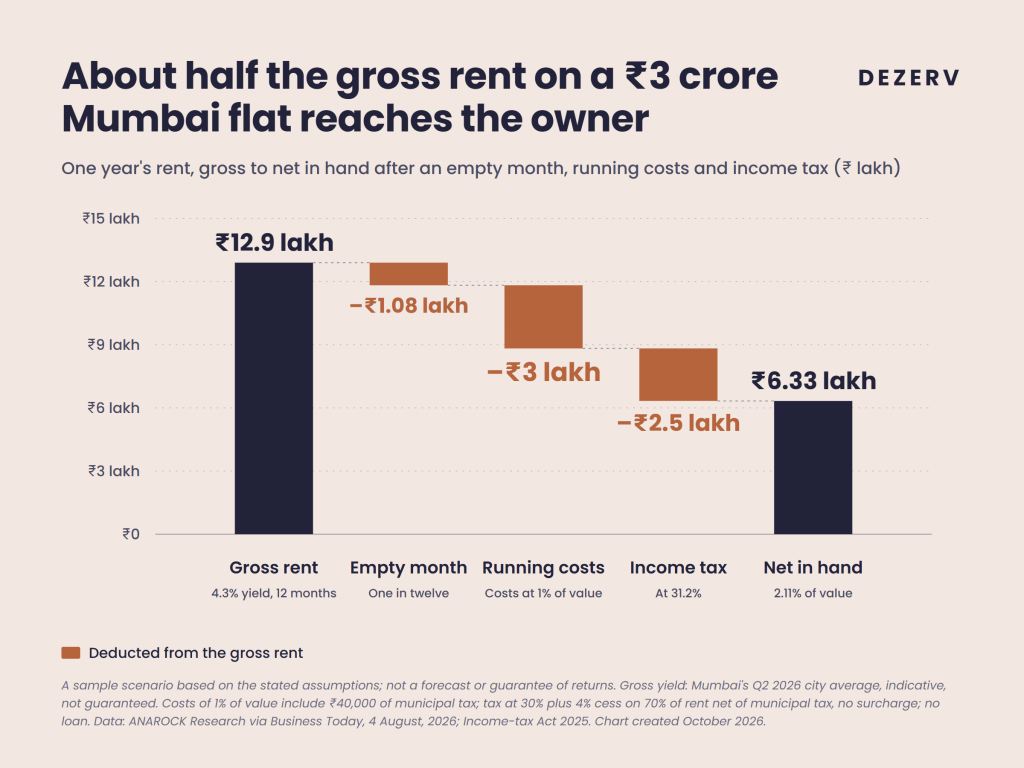
| Gross rent at a 4.3% yield (12 months) | 12,90,000 | 4.30% |
| Less one empty month | −1,07,500 | |
| Rent received (11 months) | 11,82,500 | 3.94% |
| Less society charges, repairs, insurance and property tax (1% of value) | −3,00,000 | |
| Less income tax at 31.2% on 70% of rent net of property tax | −2,49,522 | |
| Net in hand | 6,32,978 | 2.11% |
A sample scenario, not a forecast or guarantee of returns. Assumptions: ANAROCK's Q2 2026 Mumbai gross yield of 4.3% (ANAROCK Research), read as annual rent over market value (the reports print no formula; at ANAROCK's ₹29,270 per sq ft, ₹3 crore buys about 1,025 sq ft); one empty month in twelve and running costs of 1% of value a year (₹40,000 of it municipal tax), both round assumptions rather than measured rates (two empty months take the net to ₹5.49 lakh, 1.83%); taxable rent = rent received less municipal tax, less the 30% standard deduction the Income-tax Act 2025 allows on house property; tax at the new-regime 30% slab plus 4% cess with no surcharge (at a 15% surcharge the net falls to ₹5.96 lakh, 1.99%). No loan. Computed October 2026.
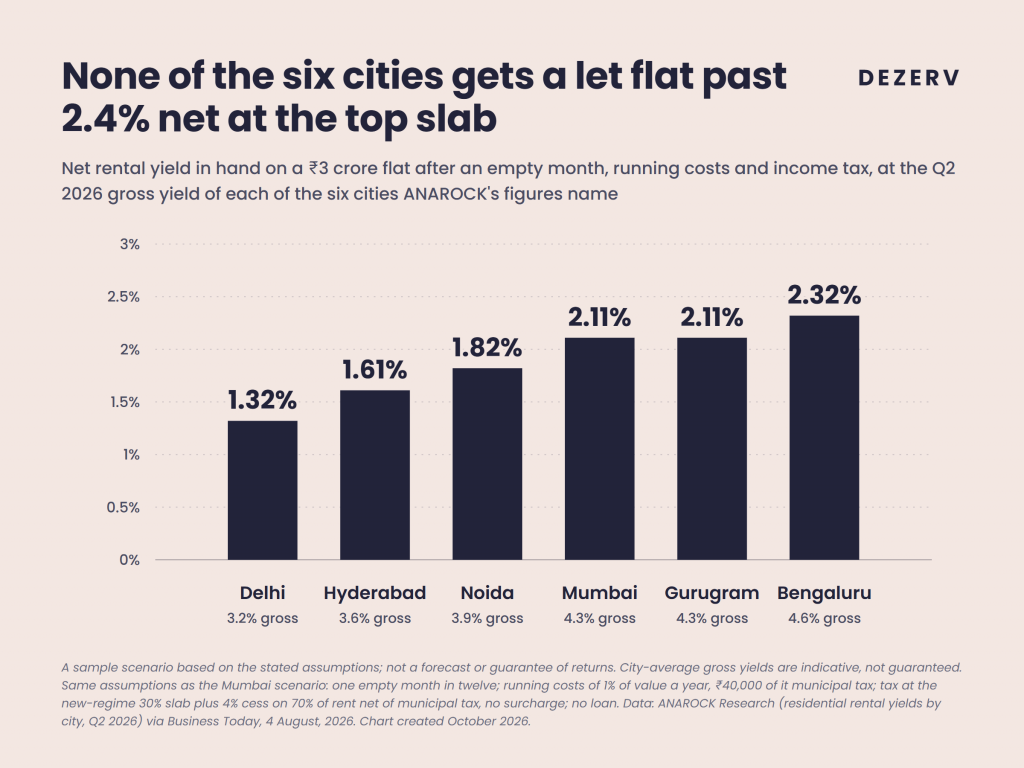
A better city does not fix it. Changing the city moves the gross yield by up to 1.4 percentage points and the net by only about one, because the running costs and the tax do not shrink with the rent.
| City | Gross yield, Q2 2026 | Net in hand on a ₹3 crore flat | Net yield |
|---|---|---|---|
| Delhi | 3.2% | ₹3.97 lakh | 1.32% |
| Hyderabad | 3.6% | ₹4.83 lakh | 1.61% |
| Noida | 3.9% | ₹5.47 lakh | 1.82% |
| Mumbai | 4.3% | ₹6.33 lakh | 2.11% |
| Gurugram | 4.3% | ₹6.33 lakh | 2.11% |
| Bengaluru | 4.6% | ₹6.97 lakh | 2.32% |
A sample scenario, not a forecast or guarantee of returns, on the same assumptions as the table above. Gross yields: ANAROCK Research via Business Today, 4 August, 2026. Computed October 2026.
The second half of a flat's return is the price. Over the twenty years to December 2025, an annual rate derived from NHB Residex data puts the rise at about 7.9%* a year (National Housing Bank RESIDEX, index to December 2025, as on 30 June, 2026).
That figure hides two decades on the same derived basis: close to 15%* a year from 2002 to 2012 (RESIDEX itself was launched in 2007, so treat that leg and the twenty-year figure's start as approximate), and about 5%* a year from 2013 to 2025, so a retiree who bought in 2013 has lived only through the slower one.
Past performance does not indicate future returns and may or may not be sustained in the future.
The economist Robert J. Shiller, who has tracked American house prices back to 1890, put the same caution to US homebuyers in 2021.
"But buyers need to be sure that they can accept what could be a rather bumpy and disappointing long-term path for home values."
— Robert J. Shiller, 2013 Nobel laureate in economics, "Should You Buy a Home in the US?" (Project Syndicate, 25 October, 2021)
What a REIT is, and why its distributions are not rent
A Real Estate Investment Trust (REIT) is a trust listed on a stock exchange that owns income-producing commercial property and passes most of the rent to its unitholders; Dezerv's REIT explainer covers how units are bought, and this piece what they pay.
The SEBI REIT Regulations (amended up to 18 April, 2026) give the income its shape: at least 80% of a REIT's assets must sit in completed, rent- or income-generating property, and at least 90% of its net distributable cash flows must be paid out, declared at least twice a year.
Borrowings may never exceed 49% of the value of its assets.
India has six listed REITs. For the quarter ended 30 June, 2026, they paid ₹3,136 crore to more than 4.85 lakh unitholders (Indian REITs Association via Free Press Journal, 17 August, 2026), against ₹1,559 crore paid by four trusts a year earlier (Business Today, 5 October, 2026).
Each trust holds its buildings through special purpose vehicles (SPVs), which pay the slices below.
| Trust | Distribution per unit, quarter ended 30 June, 2026 | Of which: interest | Dividend | Return of capital (SPV-debt repayment) |
|---|---|---|---|---|
| Embassy Office Parks REIT | ₹6.31 | ₹0.37 | ₹0.80 | ₹5.14 |
| Nexus Select Trust | ₹2.442 | ₹1.041 | ₹0.861 | ₹0.537 (plus ₹0.003 other) |
Source: each trust's results release or stock-exchange filing for the quarter ended 30 June, 2026 (Embassy 30 July; Knowledge Realty 28 July; Nexus 3 August; Mindspace 5 August; Brookfield August 2026, release undated; Bagmane 11 August, 2026). Nexus's component split: its NSE filing as reported by scanx.trade. Per-unit amounts are not comparable across trusts because unit prices differ. Bagmane's first distribution after listing drew ₹374.11 crore of its ₹510.04 crore distributable cash from surplus cash reserves (its NSE filing of 11 August, 2026). Past performance does not indicate future returns and may or may not be sustained in the future.
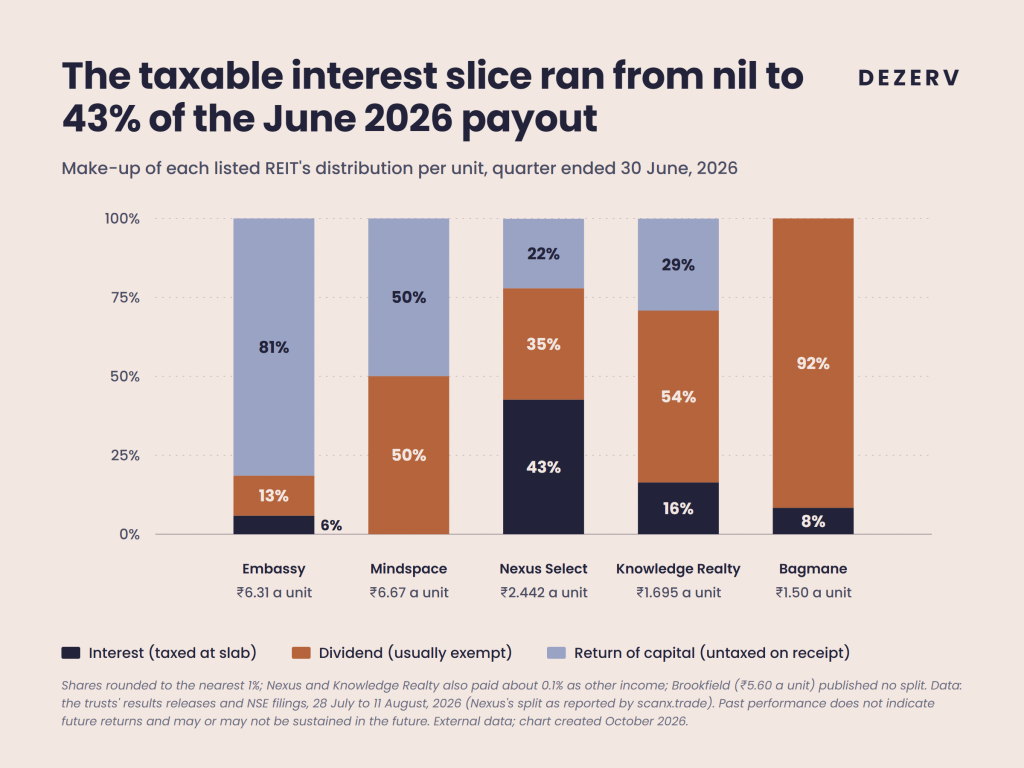
At prices on 24 September, 2026, the five trusts in Business Today's comparison (not Bagmane) yielded 4.8% to 6.3%, median 5.8% (Business Today, 5 October, 2026), indicative, not guaranteed. They are gross: before tax and brokerage, counting returned capital as payout, and moving with each payout and price; a snapshot, not a retirement-long rate.
How the yields reproduce: Business Today states no basis, but each trust's distributions per unit for the year to March 2026 over its 24 September, 2026 exchange close give Brookfield ₹21.40 ÷ ₹336.98 = 6.35%, Embassy ₹25.28 ÷ ₹439.77 = 5.75%, Nexus ₹9.081 ÷ ₹166.42 = 5.46% and Mindspace ₹24.09 ÷ ₹504.59 = 4.77%. Knowledge Realty, listed in August 2025, has no full year; four times its June-quarter ₹1.695 over ₹113.87 gives 5.95%. On the four quarters to June 2026, the median is 5.9%. Distributions: the trusts' results releases; closes: NSE's bhavcopy.
Dezerv's co-founder Vaibhav Porwal has argued in Mint (August 2026) that a REIT belongs to the equity family. A bond promises a coupon and the return of principal on a date; a REIT promises neither, because its distributions are the trust's rent after costs and its price is whatever the market pays that day.
How each is taxed: rent at slab, a REIT distribution in three parts
Rent is taxed as income from house property.
The Income-tax Act 2025 subtracts municipal taxes paid, allows a flat 30% of the rest as a standard deduction, and taxes the balance at the owner's slab. Society charges, repairs and brokerage do not reduce it further.
A REIT distribution is taxed piece by piece. Each slice keeps the character it had inside the trust.
| Income type | How it is taxed in the unitholder's or owner's hands | Who collects it |
|---|---|---|
| Rent from a flat | At slab, on 70% of rent net of municipal tax | You, through advance tax and the return |
| REIT: interest from the SPV | At slab; tax deducted at source by the trust | The trust deducts, you pay the balance |
| REIT: dividend from the SPV | Exempt where the SPV pays tax under the older corporate regime; the Taxation and Other Laws (Amendment) Act, 2026 (assent 17 August, 2026) is read as extending the exemption whichever regime the SPV uses | Usually nil |
| REIT: return of capital (SPV-debt repayment) | Not taxed when received while total repayments on the unit since issue stay below its issue price; any excess above the issue price is taxed at slab as other income | Nil until repayments pass the issue price |
| Sale of REIT units held over 12 months | Long-term capital gain at 12.5% above the ₹1.25 lakh annual exemption | On the return |
| Sale of a flat held over 24 months | Long-term capital gain at 12.5%, or 20% on the indexed gain for property bought before 23 July, 2024 | On the return |
Sources: Income-tax Act 2025 (income from house property, business-trust pass-through, repayments above the issue price, long-term gains on land and buildings, long-term gains on listed units); the Taxation and Other Laws (Amendment) Act, 2026, Gazette of India, 17 August, 2026, which, on its plain reading, removes the condition tying the dividend exemption to the SPV's tax regime; the Bill was described by Business Today (11 August, 2026). As of 15 October, 2026.
On the same ₹3 crore, a basket of REIT units at the 5.8% median yield (indicative, not guaranteed) pays ₹17.4 lakh a year gross, and how much survives tax turns on the interest slice.
| Same ₹3 crore, one year | Gross income | Cash received after illustrated tax (includes returned capital) |
|---|---|---|
| Mumbai flat (after an empty month, running costs and tax) | ₹12.9 lakh | ₹6.33 lakh |
| REIT basket, 6% interest and 81% capital returned (Embassy's June quarter) | ₹17.4 lakh | ₹17.1 lakh |
| REIT basket, 43% interest and 22% capital returned (Nexus's June quarter) | ₹17.4 lakh | ₹15.1 lakh |
The 5.8% is an illustrative annual cash-distribution yield selected from a dated REIT yield snapshot; the precise yield on any day varies with unit prices and distributions. The tax calculation is hypothetical and assumes the distribution component mix specified above.
Watch out
The return-of-capital slice is your own money coming back. It stays untaxed only while the total repaid on a unit since issue is below the unit's issue price; every rupee beyond that is taxed at slab as other income. A higher cash distribution should not be mistaken for a higher economic yield or total return.
Liquidity and succession: the flat versus the unit
A flat is sold whole or not at all. A retiree who needs ₹20 lakh for a surgery cannot sell a bedroom.
The choice is a loan against the property, a reverse mortgage with its own cap and arithmetic, or a sale that takes months and a buyer.
REIT units sell in lots of one on the exchange, so a holding can be drawn down in the exact amount needed, and the cash settles in days. Selling units costs brokerage and securities transaction tax, measured in basis points; a flat's brokerage is a percentage of the whole price, and the buyer pays stamp duty on top.
Succession runs the same way. Demat units move to the nominee by transmission, and from 1 September, 2026, a demat account may name up to three nominees (SEBI circular of 29 May, 2026).
Who finally owns them still follows the will or succession law. A flat passes by will or succession law too, then through a mutation in the society's and the municipality's records. Two heirs who disagree about a flat face a sale neither controls, or a partition suit that can run for years.
Selling the second flat: the relief cap and where the proceeds go
A flat held more than two years is sold at a long-term capital gain; for a flat bought before 23 July, 2024, a resident owner pays the lower of 12.5% on the plain gain or 20% on the indexed gain; a later purchase has only the 12.5% route.
The Act's relief for reinvesting in another home ignores any new-house cost above ₹10 crore, so the largest sales no longer wash the whole gain away.
| Sale of the ₹3 crore flat | ₹ |
|---|---|
| Sale price | 3,00,00,000 |
| Purchase price (2014-15) | 1,20,00,000 |
| Gain | 1,80,00,000 |
| Indexed gain (cost-inflation index 240 → 384) | 1,08,00,000 |
| Tax: the lower route, 20% on the indexed gain, plus the 15% surcharge and 4% cess | 25,83,360 |
| Proceeds after tax | 2,74,16,640 |
| Income the proceeds would earn in REIT units at 5.8% (gross) | 15,90,165 a year |
| Net rent the flat was earning | 6,32,978 a year |
A sample scenario, not a forecast or guarantee of returns. Assumptions: a 2014-15 purchase at ₹1.2 crore and a sale in 2026-27; the lower of the two routes the Act allows: 20% on the gain indexed with the cost-inflation index (240 for 2014-15, 384 for 2026-27), against ₹26.9 lakh on the 12.5% plain route; the 15% surcharge, the cap that applies to capital gains, because the ₹1.08 crore indexed gain on its own takes total income above ₹1 crore (without it the tax would be ₹22.5 lakh); no brokerage; the 5.8% median distribution yield as of 24 September, 2026 (Business Today), indicative, not guaranteed. Computed October 2026.
The sale need not end in REITs. The proceeds join the income plan as a whole, and the three-layer withdrawal structure sizes what belongs in an income floor, a buffer and growth assets.
Dezerv's view on REITs and InvITs (October 2026), and the case against them
Vaibhav Porwal's House View letter of 7 October, 2026 is neutral to positive on REITs and Infrastructure Investment Trusts (InvITs), held at a target weight for income and diversification, and favours putting lump sums to work over holding cash; it is Dezerv's positioning, not a recommendation for any reader.
His Mint reading (August 2026) is to buy a REIT for cash flow first and distrust the highest-yielding trust, since a sustainable, growing distribution matters more than this quarter's number.
Many InvITs hold roads and transmission lines with a finite concession life; in Team Dezerv's view (Mint, June 2026) much of the payout returns capital from an asset that runs out. A REIT's buildings never expire, yet Embassy's June payout was 81% capital too. Both can fit an income allocation; both mislead a retiree reading the yield as interest.
Feroze Azeez, a wealth-management executive, disagrees. On a personal-finance show in October 2025 he argued that Indian REITs give the least return for a high standard deviation, that India is a very thin REIT market, and that he would not hold them.
Porwal's Mint reading answers the first point: a REIT's price floats because the trust is equity-family and rent-linked, which is why the House View holds it at a target weight, as one income layer. On the flat, where Azeez tells metro households to rent rather than buy, the arithmetic above makes his case for him.
REITs and InvITs may form part of a diversified managed investment approach where permitted by its investment mandate. Dezerv’s portfolio-management offerings, investment limits, fees and withdrawal terms are governed by its September 2026 disclosure document and the applicable client agreement. The ordinary PMS minimum is ₹50 lakh per client, subject to the regulatory accredited-investor exception; market and liquidity risks continue to apply.
A REIT or InvIT distribution is not contractual fixed-income interest, and cash distributions may contain taxable income and repayment of invested capital. Compare the contractual and underlying-fund costs, applicable exit charges and liquidity terms before treating any managed exposure as part of a retirement-income arrangement.
Keep, sell or swap: the decision table
The arithmetic above supports three answers; the household's situation picks between them.
| Choose | When | What you accept |
|---|---|---|
| Keep the flat | The household does not need the income yet; a child will live in it; the location has a credible re-rating story (a metro line, a new office district); the owner can manage tenants at 75 | A net yield near 2%; an asset that cannot be drawn on in parts; an estate that must be sold whole |
| Sell and redeploy | The income is needed now; the heirs do not want the flat; the gain is large and the reinvestment relief is capped anyway; managing a tenant has become a burden | A one-time tax of about 14% of the gain on the indexed route, with the surcharge; the loss of any future price gain on that flat |
| Swap for REIT units | Property income is wanted without a tenant; the money must stay liquid; distributions can be reinvested in the years they are not needed | A unit price that moves daily; payouts that fall when occupancy falls; a taxable interest slice, and tax on capital returned once repayments pass the unit's issue price |
Editorial reading of the scenarios above; not a recommendation for any household. Yields indicative, not guaranteed.
The arithmetic is hardest on a household that keeps the flat because it feels safe while drawing down its liquid investments to live. Run the numbers through the Dezerv retirement calculator, with the flat's net rent as one income line and the corpus drawing the rest.
Key takeaways
- A let flat earned 3.2% to 4.6% gross in six cities (ANAROCK, Q2 2026) but keeps 1.3% to 2.3% after vacancy, costs and top-slab tax (a sample scenario, not a forecast or guarantee).
- Five listed REITs yielded 4.8% to 6.3% gross at 24 September, 2026 prices, a snapshot that moves with every payout and price (indicative, not guaranteed).
- The tax on a REIT distribution turns on its interest slice, which ran from nil to 43% of the June 2026 payout across the trusts that disclosed it.
- Units sell one at a time and pass to a nominee by transmission; a flat sells whole and passes through a mutation.
- A flat bought before 23 July, 2024, is taxed on sale at the lower of 12.5% plain or 20% indexed; reinvestment relief ignores new-house cost above ₹10 crore.
Frequently Asked Questions
Are REITs a good source of retirement income in India?
A listed REIT must pay out at least 90% of its net distributable cash flows under SEBI's rules, and India's six listed trusts paid ₹3,136 crore for the quarter ended 30 June, 2026. Five of the six yielded 4.8% to 6.3% gross at 24 September, 2026 prices, indicative, not guaranteed. The income is rent-linked, so it can fall when occupancy falls, and the unit price moves daily. For a retiree, REIT units suit the income layer of a portfolio held at a fixed weight, not the whole corpus.
What is the real yield on a second flat after costs and tax?
The gross yield in the six cities ANAROCK's Q2 2026 figures name was 3.2% to 4.6%. On a ₹3 crore Mumbai flat at 4.3% gross, one empty month, running costs of 1% of value and income tax at 31.2% on 70% of the rent leave about ₹6.33 lakh, or 2.11% of the flat's value, in the owner's hands (a sample scenario, not a forecast or guarantee). Delhi's lower yield leaves about 1.3% and Bengaluru's higher one about 2.3% on the same assumptions.
How are REIT distributions taxed in India?
Under the Income-tax Act 2025 each part of a REIT distribution keeps the character it had inside the trust. Interest is taxed at your slab. Dividend is exempt where the property company pays tax under the older corporate regime, and the Taxation and Other Laws (Amendment) Act, 2026 is read as extending it to those on the concessional regime. Return of capital is not taxed while total repayments on the unit stay below its issue price; any excess is taxed at slab. Units sold after 12 months attract 12.5% on gains above ₹1.25 lakh a year.
Should a retiree sell a second flat and invest the money?
It depends on whether the household needs the income now. A flat's net rental yield is near 2% at the top slab, and selling triggers long-term capital gains tax of 12.5%, or 20% on the indexed gain for property bought before 23 July, 2024, and the reinvestment relief ignores any new-house cost above ₹10 crore. On a ₹3 crore flat bought in 2014-15 for ₹1.2 crore, the lower indexed route gives a tax of about ₹25.8 lakh with the 15% surcharge (a sample scenario, not a forecast or guarantee).
The issuer-level examples above show why total cash distributions should be broken down into dividend, interest and repayment of capital. Their composition can differ across trusts and reporting periods.
Not on the headline yield alone. Many InvITs hold roads and transmission assets with a finite concession life, so part of each payout can return your own capital, which lifts their yields. A REIT's buildings have no concession end date, so its payout is not running down a finite asset, though part of it can still be debt repayment (81% of Embassy's June-quarter payout). SEBI treats REIT investments by mutual funds as equity-related from 1 January, 2026, and keeps InvITs classified as hybrid. Both suit an income allocation held at a fixed weight; neither is a fixed-income instrument. Issuer distribution history: https://www.embassyofficeparks.com/investors/distribution-history/
Disclaimer
Dezerv Investments Private Limited is a SEBI-registered Portfolio Manager (Registration No. INP000007377). Distribution services are offered by Dezerv Distribution Services Private Limited, a wholly owned subsidiary of Dezerv Investments Private Limited, under AMFI Registration No. ARN-248439 and APMI Registration No. APRN-00615. This article is intended solely for general educational and informational purposes and should not be construed as personalised investment, financial planning, tax or legal advice, or as a recommendation, offer or solicitation to invest in any security, financial product or investment strategy. Readers are advised to consult their financial, tax and legal advisors before making investment decisions.
The rental yields, REIT distribution yields, tax calculations, capital appreciation figures and investment scenarios discussed in this article are illustrative, based on the sources, dates and assumptions stated, and are not guaranteed or indicative of future returns. Actual rental income, expenses, vacancy periods, REIT distributions, unit prices, taxation and investment outcomes may vary depending on market conditions, individual circumstances and applicable laws, which may change. REIT distributions may include interest, dividends and repayment of invested capital and should not be treated as assured income or equivalent to rental income or total investment returns. Investments in REITs and real estate carry risks, including market, liquidity, income and capital-loss risks. This article is not a complete disclosure of every material fact, term or condition.
Investment in the securities market is subject to market risks. Please read all related documents carefully before investing. Past performance may or may not be sustained in the future.