A retiree living on interest is drawn to the highest coupon, and some of the highest coupons sit on bonds with no fixed repayment date. On 10 March, 2021, the Securities and Exchange Board of India (SEBI) told every mutual fund to value one such bank bond as if it would be repaid a hundred years after issue (SEBI).
The same circular warned they may be riskier than other debt. They may also be written off to absorb a bank's losses.
Choosing well starts with what a bond does that a deposit cannot.
In short
Bonds earn their place as a retiree's income floor: government and AAA-rated paper maturing in each of the next few years, sized to that year's spending and held to maturity, so equity need not be sold in a bad year. RBI auctions of 1–14 October, 2026 priced a one-year treasury bill near 6.5% and a seven-year government security near 7.2% (indicative, not guaranteed; each reinvestment earns the rate of its day). In a sample scenario, a ₹79.1 lakh ladder funds six years of ₹1.2 lakh-a-month spending. Interest is taxed at slab.
Table of contents
What a bond gives a retiree that a fixed deposit does not
A bond is a loan you make to a government or a company, with a fixed coupon and a fixed date on which the principal comes back.
A fixed deposit (FD) is the same promise from a bank. The DICGC insures it up to ₹5 lakh per depositor per bank (DICGC).
A bond can mature in any year you choose, where a bank FD runs out at ten years (SBI), and a listed bond can be sold before maturity, where an FD is broken with a penalty, and a government security also carries the sovereign's own credit, a step above any bank's.
A bond's price is not fixed, though. Between purchase and maturity its market value moves with interest rates, and you can ignore that movement only if you hold to the date, the condition that shapes everything below and the main trade-off in our bonds versus fixed deposits comparison. An FD's value does not move until you break it.
The retiree's fixed-income toolkit
Government rows carry no company credit risk; every company row buys its extra yield with it.
| Instrument | Who issues it | Credit risk | How income is taxed | Liquidity | Yield now (indicative, not guaranteed) | Layer it fills |
|---|---|---|---|---|---|---|
| Treasury bills (T-bills), 91 to 364 days | Government of India | Sovereign | Gain at slab | Tradable; matures within a year | 5.7% to 6.5% (RBI, 14 October, 2026) | Buffer; year-1 spending |
| Government securities (G-secs), 1 to 50 years | Government of India | Sovereign | Coupon at slab; listed gains 12.5% after 12 months | Tradable before maturity | 6.8% (3-year), 7.2% (7-year), 7.5% (15-year) (RBI, 1 October and 9 October, 2026) | Ladder rungs 1 to 7 |
| State development loans (SDLs) | State governments | State-government credit; a small spread over G-secs | As G-secs | Less traded than G-secs | 7.9% to 8.0% for 6 to 10 years (RBI, 13 October, 2026) | Ladder rungs 3 to 7 |
| RBI Floating Rate Savings Bond 2020 | Government of India via RBI | Sovereign | Interest at slab | Cannot be sold or transferred; repaid after seven years, earlier for those aged 60 and above | 8.05% for July to December 2026, resets half-yearly (RBI) | Ladder rung 6 or 7; coupons half-yearly |
| PSU and corporate bonds (NCDs) | Public-sector units, banks, companies | Depends on rating: AAA to unrated | As G-secs if listed; unlisted gains always at slab | Varies by issue; ₹10,000 face value since July 2024 for privately placed issues to be listed, where a merchant banker is appointed | Spread over G-secs by rating; check the issue | Ladder rungs, AAA only |
| Target-maturity debt funds | Mutual funds | Index of G-secs, SDLs or AAA PSU bonds | Gains at slab for units bought on or after 1 April, 2023 | Open-ended; redeem any day | Portfolio yield in the factsheet | Ladder rungs, one fund per year |
| Short-term and money-market debt funds | Mutual funds | Portfolio-dependent; read the riskometer | Gains at slab for units bought on or after 1 April, 2023 | Redeem any day | Portfolio yield in the factsheet | Years 1 to 2; the SWP source |
Yields are indicative, not guaranteed, and change daily. Sources: RBI auction results of 1, 9, 13 and 14 October, 2026 and the RBI floating-rate bond notice of 1 July, 2026; fund categories per the SEBI scheme-categorisation circular (26 February, 2026); face value per SEBI (3 July, 2024). Tax per the Income-tax Act, 2025, tax year 2026-27; it depends on individual circumstances and may change.
The Senior Citizens' Savings Scheme belongs to this floor too, at 8.2% a year for October–December 2026 (India Post; reset each quarter, indicative, not guaranteed), but it stops at ₹30 lakh per person (how the capped schemes fill up). Above that line the floor has to come from the table.
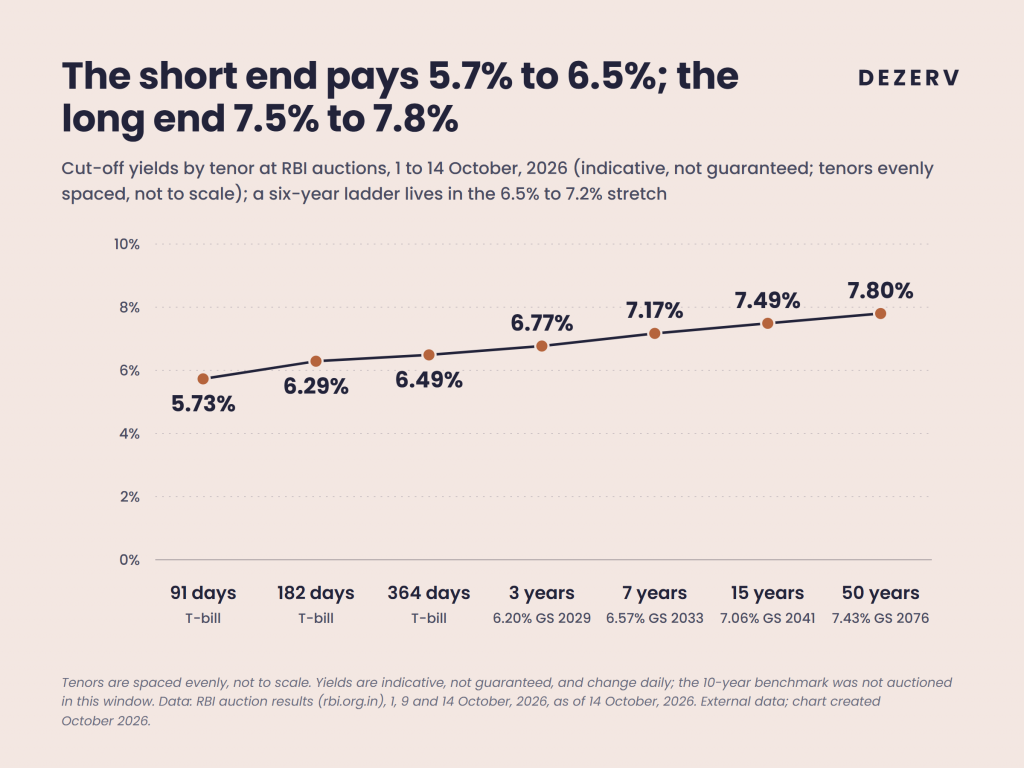
| Tenor | Security | Cut-off yield (indicative, not guaranteed) | Auction date |
|---|---|---|---|
| 91 days | T-bill | 5.73% | 14 October, 2026 |
| 182 days | T-bill | 6.29% | 14 October, 2026 |
| 364 days | T-bill | 6.49% | 14 October, 2026 |
| 3 years | 6.20% GS 2029 | 6.77% | 1 October, 2026 |
| 7 years | 6.57% GS 2033 | 7.17% | 1 October, 2026 |
| 15 years | 7.06% GS 2041 | 7.49% | 9 October, 2026 |
| 50 years | 7.43% GS 2076 | 7.80% | 9 October, 2026 |
Source: RBI auction results of 1 October, 9 October and 14 October, 2026. The 10-year benchmark was not auctioned in this window; CCIL's tenor-wise indicative yields put the 6.94% GS 2036 at 7.38% on 15 October, 2026 (CCIL; indicative, not guaranteed).
Which bond funds which layer
Bonds sit in the first two layers of the three-layer withdrawal structure; equity and the post-retirement menu fill the third. Layer 1 wants money arriving on a known date in a known amount: G-secs, SDLs, AAA bonds or target-maturity funds, a rung a year. Layer 2 wants money sellable tomorrow near cost: T-bills, money-market or overnight funds.
The RBI floating-rate bond fails that test: even those aged 60 and above wait four to six years to encash it (RBI operational guidelines).
Long bonds do harm in the growth layer. A 50-year G-sec out-yields a seven-year one, but a one-point rise in yields can cut its price 11% (table below). After tax at the 30% slab, its 7.80% yield leaves 5.46%, or 5.37% with cess, below September's 5.54% retail inflation (MoSPI; a sample scenario, yield indicative, not guaranteed).
Building a bond ladder for six years of spending
A bond ladder is a set of bonds maturing in consecutive years, each sized to aim to match annual spending through a combination of maturing principal and scheduled coupons. That annual match alone does not ensure cash is available each month. The point is sequencing. When equity falls in year two, year two's bills are already sitting in a bond that matures that year, so nothing is sold at the bottom.
Take, as a sample scenario, a retiree spending ₹1.2 lakh a month: ₹14.4 lakh in year one, rising 6% a year. Six years is this sample's assumption, not a rule: the three-layer structure's seven-to-ten-year Layer 1 also holds deposits, SCSS and short debt, and a pension or a lower draw needs fewer rungs, large dated bills more.
For this pre-tax illustration, six hypothetical rungs are modelled at par using the yields above (the 2-, 4-, 5- and 6-year yields interpolated), each solved backwards so the year's cash matches the year's need. Later rungs earn whatever the market pays on the day they are bought, not October 2026's rates.
| Year | Spending need | Coupons or discount accruals modelled for year | Principal maturing that year | Scheduled total for year (pre-tax; not monthly) |
|---|---|---|---|---|
| 1 | ₹14.4 lakh | ₹5.4 lakh | ₹9.0 lakh | ₹14.4 lakh |
| 2 | ₹15.3 lakh | ₹4.8 lakh | ₹10.4 lakh | ₹15.3 lakh |
| 3 | ₹16.2 lakh | ₹4.1 lakh | ₹12.0 lakh | ₹16.2 lakh |
| 4 | ₹17.2 lakh | ₹3.3 lakh | ₹13.8 lakh | ₹17.2 lakh |
| 5 | ₹18.2 lakh | ₹2.4 lakh | ₹15.8 lakh | ₹18.2 lakh |
| 6 | ₹19.3 lakh | ₹1.3 lakh | ₹18.0 lakh | ₹19.3 lakh |
| Total | about ₹1 crore | ₹21.4 lakh | ₹79.1 lakh | about ₹1 crore |
A sample scenario, not a forecast or guarantee of returns. Par bonds with one coupon a year at the RBI cut-offs of 1 to 14 October, 2026 (1-year 6.49% on 14 October, 3-year 6.77% and 7-year 7.17% on 1 October; other rungs interpolated; indicative, not guaranteed); spending ₹14.4 lakh rising 6% a year; coupons counted before tax; totals computed before rounding, so the rounded rows may not add to them exactly. Source: RBI auction results, October 2026. The figures reconcile scheduled cash received over each year, not monthly access to spending money. Treasury bills are discount securities rather than bonds paying annual coupons, and the 2-, 4-, 5- and 6-year tenors use interpolated yields rather than actual offered par-priced securities. A spendable month-by-month plan requires separate liquidity and correct coupon, bill maturity and tax timing.
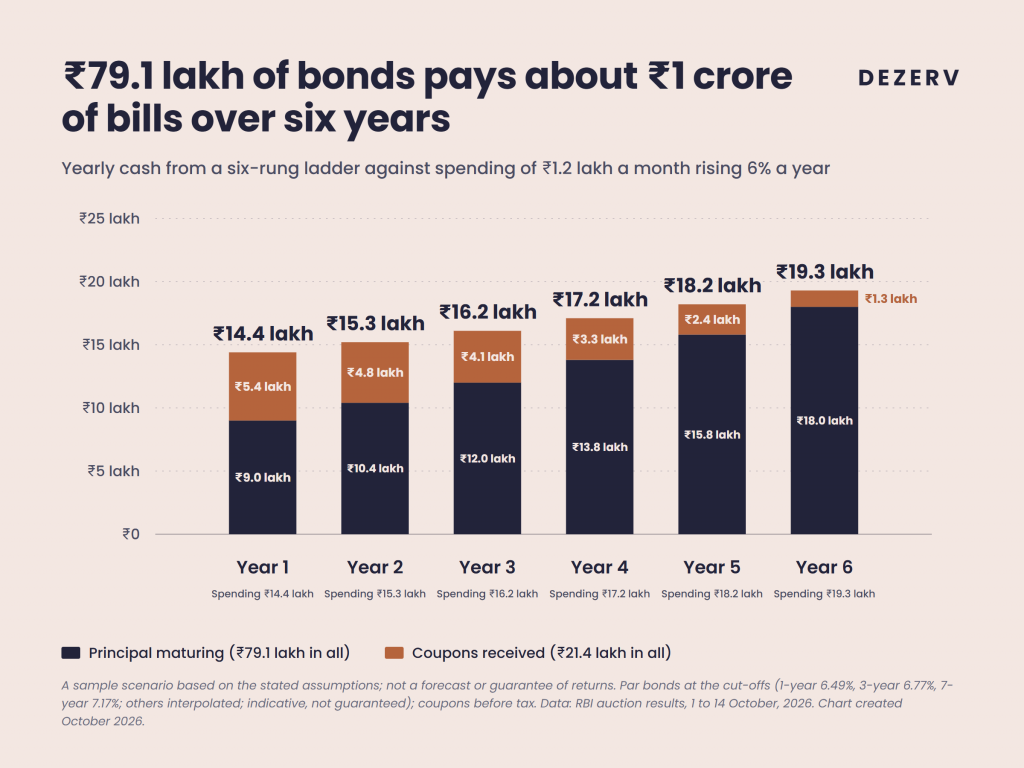
On a ₹3 crore corpus, the ₹79.1 lakh ladder is 26.4%, leaving ₹2.21 crore for the buffer and the growth layer. The ₹79.1 lakh is a pre-tax illustrative annual model, not an independently validated six-year monthly spending plan. Actual spending needs separate month-to-month liquidity, a cash-flow schedule and provision for taxes. Cash arrives in lumps, not monthly: G-sec coupons come half-yearly (this sample counts one a year) and each rung's principal once, so the year's money waits in a short-term debt fund that feeds the monthly draw.
Worth knowing
A target-maturity debt fund can provide debt exposure with a target maturity date, but is not contractually equivalent to a directly held government security: its redemption value is not guaranteed, and its holdings, fees, tracking difference and market risks affect the outcome. The price is that its gains are taxed at slab, where a directly held listed G-sec sold after a year is taxed at 12.5% (tax year 2026-27; rules may change).
Credit quality: why AAA is not optional for the floor
A price fall on a bond held to maturity can be waited out; a default cannot. Money due on a date sits in sovereign and AAA paper only.
On 23 April, 2020, a fund house issued winding-up notices for six debt schemes, and by the time the Supreme Court directed the wind-up to proceed, unitholders had waited "for over ten months" for their money (Supreme Court, hosted by SEBI, 2021). The fund house's own notice called them "yield-oriented" funds. It blamed a liquidity crunch in corporate bonds.
Under SEBI's scheme rules, a corporate bond fund keeps at least 80% in paper rated AA+ and above, while a credit risk fund keeps at least 65% in paper rated AA and below (SEBI, 26 February, 2026). The second is a legitimate product for money not needed on a fixed date, held by an investor paid to take that risk.
Watch out
A yield two or three points above a G-sec of the same maturity is mostly the market's price for the chance you do not get the principal back.
Duration: what a one-point rise in yields does to a bond
A bond's price moves against yields, and the longer the maturity, the harder it moves.
| Tenor | Starting yield (indicative, not guaranteed) | Price if yields rise 1 point | Price if yields fall 1 point |
|---|---|---|---|
| 1 year | 6.49% | −0.9% | +0.9% |
| 3 years | 6.77% | −2.6% | +2.7% |
| 7 years | 7.17% | −5.2% | +5.5% |
| 15 years | 7.49% | −8.3% | +9.4% |
| 50 years | 7.80% | −11.2% | +14.2% |
A sample scenario, not a forecast or guarantee of returns. Par bonds with annual coupons at the RBI cut-offs of 1, 9 and 14 October, 2026; the move is computed from the full price formula, not an approximation. Source: RBI auction results, October 2026.
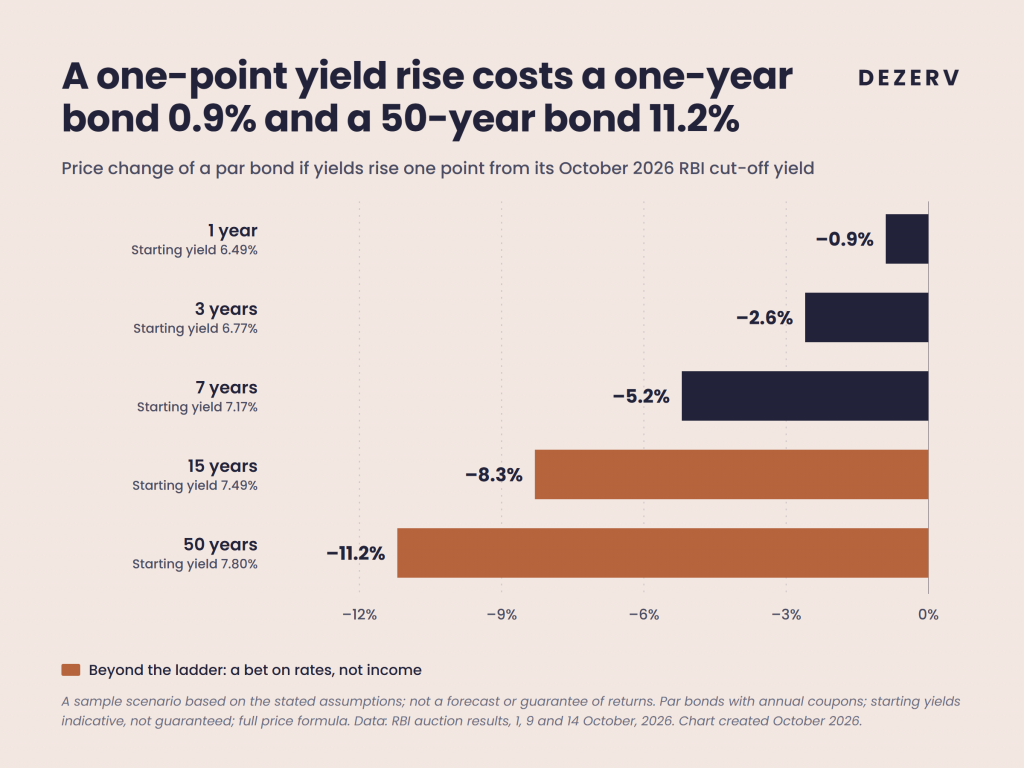
Rates have been rising. The 364-day T-bill cleared at 5.77% on 22 July, 2026 and at 6.49% on 14 October (indicative, not guaranteed), and on 7 October, 2026 the RBI raised the repo rate 25 basis points to 5.50%, with September's retail inflation at 5.54% (MoSPI). None of these rates is fixed for a 25-year retirement.
Vaibhav Porwal's House View letter of 7 October, 2026 favours short duration and accrual and rates long-duration debt negative. The Dezerv co-founder put it this way to clients.
"Your return comes from the interest the bond pays, not from betting that yields will fall."
— Vaibhav Porwal, Dezerv co-founder, Dezerv House View client letter (7 October, 2026)
The six-rung ladder is this article's own sample scenario, not a reading of the house view: each rung is held to its date, so a price fall before maturity need not be realised. Anything longer is a bet on rates. The table prices the losing side at 8.3% to 11.2% for a one-point rise.
How bond income is taxed, in plain words
Under the Income-tax Act, 2025, what sets the rate is coupon or gain, and listed or unlisted.
| What you hold | How the income is taxed | How a gain on sale is taxed |
|---|---|---|
| G-sec, SDL, listed PSU or corporate bond | Coupon at your slab | 12.5% if held more than 12 months; slab if sold earlier |
| RBI floating-rate bond, FD | Interest at your slab | No sale possible |
| Unlisted bond or NCD | Coupon at your slab | Slab, whatever the holding period |
| T-bill | The discount, at your slab | No separate gain |
| Debt mutual fund (more than 65% in debt and money-market paper), units bought on or after 1 April, 2023 | No interest paid out | Slab, whatever the holding period |
| Hybrid or multi-asset fund with more than 35% but less than 65% in equity (not equity-oriented) | No interest paid out | 12.5% after 24 months; slab before that |
Per the Income-tax Act, 2025, as amended by the Finance Act, 2026; tax year 2026-27; before surcharge and cess; the debt-fund rule per the Income Tax Department's page on specified mutual funds. Tax depends on individual circumstances and may change.
At the 30% slab, a 6.75% one-to-two-year senior-citizen FD (SBI, rates from 15 December, 2025) leaves 4.7% and a 7.17% seven-year G-sec leaves 5.0% (a sample scenario, before surcharge and cess; yields indicative, not guaranteed). Held to maturity, a par bond's coupon and a debt fund's gain are both taxed at slab. The fund's old tax edge is gone.
The ₹50,000 deduction (old regime, age 60 and above) covers interest on deposits with banks, co-operative banks and the post office; bond coupons get none.
Where to buy, and the minimum ticket
The RBI's Retail Direct platform lets an individual bid in the primary auctions for T-bills, G-secs and SDLs from ₹10,000, with no fee for the account (RBI), which makes government paper the easiest to buy directly. The account and the demat route are set out in our guide to government bonds in India.
SEBI cut the face value of privately placed corporate bonds from ₹10 lakh to ₹1 lakh in October 2022 and then to ₹10,000 from 3 July, 2024 for issues to be listed, where a merchant banker is appointed (SEBI); in between, in November 2022, it brought online bond platforms under a registration framework (SEBI).
Online platforms list every bond; our page on bonds for senior citizens keeps a floor's list to government, PSU and AAA paper.
The counter-view: is debt for long money like smoking?
Some practitioners would not hold bonds at all for money that is not needed for a decade.
Feroze Azeez, a wealth-management executive, argued on a personal-finance show in October 2025 that holding debt for ten-year money is like smoking: a 30-year-old, in his view, should hold no FDs or bonds at all. His other point, that debt-plus-arbitrage funds suit short-term goals because the 2023 tax change made pure debt funds short-term forever, agrees with the structure above.
For a 30-year-old with a salary, the smoking comparison is a fair reading; for a retiree it answers the wrong question, because the ladder holds the next few years of bills so that equity can be left alone for his ten. A retiree whose pension already covers the bills is closer to that 30-year-old, and can hold less debt.
Mistakes that turn a floor into a trap
- Chasing the coupon. A non-convertible debenture (NCD) at 11% (indicative, not guaranteed) from an unrated or single-A issuer is a credit position, and the floor takes none below AAA. If credit belongs anywhere, it is in a diversified, rated credit sleeve beside the floor, sized small.
- Perpetual and additional tier-1 (AT1) bank bonds. These are the bonds from the opening, with no maturity date and a write-down clause. SEBI's 2021 valuation rule treats them as 100-year instruments and caps a scheme's holding at 10% of its debt portfolio, and 5% from any one issuer (SEBI, 10 March, 2021).
- One maturity for everything. A single five-year bond funds one year's spending and leaves the other four exposed to wherever yields sit when it matures. The ladder spreads that reinvestment risk across six dates.
- Reaching for the long end. A 50-year bond yielding 7.80% earns 0.6 points more than a seven-year yielding 7.17% (indicative, not guaranteed), and a retiree who needs that money back in year seven has to sell it at whatever price the market sets that year.
- Forgetting the FD's one advantage. Below ₹5 lakh per bank, an FD is insured and a bond is not. For the small buffer that is a reason to keep a deposit.
Running the bond sleeve without running it yourself
A ladder needs a rung redeployed every year and ratings re-checked. A portfolio management service (PMS) can run it; the draw stays yours.
Dezerv's Dynamic Debt Plus PMS strategy holds bonds, debentures, REITs and InvITs (real estate and infrastructure investment trusts) directly, plus mutual funds and arbitrage funds; at 9 September, 2026 its bonds were rated A to AA+ (September 2026 factsheet). The minimum is ₹50 lakh per client (SEBI minimum; accredited investors are exempt), in cash or transferred holdings.
That is credit below the AAA line, a risk a PMS does not remove; on a 36-month recommended horizon it is accrual beside the ladder, not the reserve.
The disclosure document sets no lock-in. Money redeemed within 90 days of investment may carry a 1% exit load (accounts opened from 1 October, 2025); the client bears underlying-fund costs and exit loads, and fees and charges are set out there.
Whichever route you take, size the floor first; the Dezerv retirement calculator starts from your monthly spending.
Key takeaways
- With a dated ladder, the next few years of bills already sit in bonds that mature in those years, so equity need not be sold to pay them in a bad year.
- Size each rung to that year's spending and hold it to maturity; a rung you might sell early belongs in Layer 2.
- If a bond pays two or three points more than a G-sec of the same maturity, treat it as a credit bet and keep it out of the floor.
- Sovereign and AAA paper only for the floor, kept short: a one-point rise in yields costs a seven-year bond about 5% and a 50-year bond about 11%.
- Hold a rung you might sell after a year as a listed G-sec (12.5% on the gain in tax year 2026-27); a target-maturity fund suits only money you will hold to its date, because its gains are taxed at slab.
Frequently Asked Questions
Are corporate bonds safe for retirees?
Only the highest-rated ones belong in a retiree's floor, the money that must arrive on a date; even AAA paper can be downgraded. A corporate bond's safety is its credit rating and the issuer's balance sheet, not its coupon. For the income floor, government securities, state development loans and AAA-rated PSU or corporate bonds are the usable set. A bond yielding two or three points more than a government security of the same maturity carries a real chance of default, which is the one loss a floor exists to avoid.
How does a bond ladder work for retirement income?
A bond ladder is a series of bonds maturing in different years, designed to align receipts of principal and coupons with future spending. The illustrative ₹79.1 lakh ladder matches six annual pre-tax spending totals on the stated assumptions, beginning with ₹14.4 lakh in year one and rising 6% annually. It assumes a separate liquid account for monthly bills, since coupons and maturities do not arrive evenly each month; taxes, security prices and purchase-date cash flows change the exact amount needed. At each maturity, the retiree can reassess the next rung at the then-prevailing yield.
G-secs vs corporate bonds vs debt funds: which is better for retirement income?
Government securities carry sovereign credit, can be bought from ₹10,000 through RBI Retail Direct, and a listed one sold after 12 months is taxed at 12.5% (tax year 2026-27). AAA corporate bonds pay a spread over them for more risk. A target-maturity debt fund does not contractually return a specified amount at its target date; it can serve a similar duration-planning role but with fund-specific costs and risks. It is not a guaranteed maturity payment like a directly held sovereign bond, and the taxation of units depends on the specified-mutual-fund definition, acquisition date and applicable rules. For most retirees the floor is G-secs and AAA paper, with a short-term debt fund as the account the SWP draws from.
What do government bonds yield in India right now?
At RBI auctions between 1 and 14 October, 2026, cut-offs were 5.73% for a 91-day treasury bill, 6.49% for a 364-day bill, 6.77% for a three-year government security, 7.17% for a seven-year, 7.49% for a 15-year and 7.80% for a 50-year; ten-year state development loans cleared at about 8.0%. The RBI floating-rate bond pays 8.05% for July to December 2026. All of these are indicative, not guaranteed, and change daily.
How is income from bonds taxed for a retiree in India?
Under the Income-tax Act, 2025, coupon interest from any bond and fixed-deposit interest are taxed at your slab. A listed bond sold after more than 12 months is taxed at 12.5% on the gain; an unlisted bond's gain is taxed at slab whatever the holding period. Units of a debt mutual fund holding more than 65% in debt, bought on or after 1 April, 2023, are taxed at slab on redemption. The ₹50,000 deduction for those aged 60 or more covers deposit interest only, not bond coupons, in the old regime. Tax depends on individual circumstances and may change.
Disclaimer
Dezerv Investments Private Limited is a SEBI-registered Portfolio Manager (Registration No. INP000007377). Distribution services are offered by Dezerv Distribution Services Private Limited, a wholly owned subsidiary of Dezerv Investments Private Limited, under AMFI Registration No. ARN-248439 and APMI Registration No. APRN-00615. This article is intended solely for general educational and informational purposes and should not be construed as personalised investment, financial planning, tax or legal advice, or as a recommendation, offer or solicitation to invest in any security, financial product or investment strategy. Readers are advised to consult their financial, tax and legal advisors before making investment decisions.
The yields, interest rates, tax treatments, bond price movements, portfolio allocations and calculations discussed in this article are illustrative, based on the sources, dates and assumptions stated, and are not guaranteed or indicative of future returns. Actual yields, prices, cash flows, taxation and investment outcomes may vary depending on market conditions, the securities selected, individual circumstances and applicable laws, which may change. The features, risks, fees and exit loads of any investment or portfolio management service should be reviewed in the relevant offer documents, disclosure document and client agreement before investing. This article is not a complete disclosure of every material fact, term or condition.
Investment in the securities market is subject to market risks. Please read all related documents carefully before investing. Past performance may or may not be sustained in the future.