
Planning to 90: the longevity maths urban couples get wrong

When people calculate how much they need for retirement, a lot of attention goes to expenses, inflation and investment returns.
But there is another number sitting underneath the entire calculation: how many years does the money need to last?
For someone retiring at 60, planning until 85 means funding 25 years without earned income. Planning until 90 means funding 30. On paper, five years can look like a small difference. In a retirement plan, it means five additional years of living expenses being funded from the same pool of money.
This becomes even more important for couples.
Life expectancy at 60 in India is already 17.5 years for a man and 19.8 years for a woman, according to MoSPI's SRS Abridged Life Tables 2020–2024. National averages may not capture all the factors relevant to an individual household, including geography, socioeconomic circumstances and access to healthcare.
More importantly, when two people retire together, their corpus does not need to last for the average of their two lifespans. It needs to support whoever lives longer.
That is why planning only until 85 can look reasonably conservative and still leave a meaningful gap.
So how long should retirement money actually be built to last?
In short: For a couple retiring around 60, it can be useful to test a retirement-planning horizon extending to age 90 rather than stopping at 85. Life expectancy at age 60 in India is already 17.5 years for men and 19.8 years for women, according to MoSPI's SRS Abridged Life Tables 2020–2024 and higher still in urban India, at 18.9 and 20.8 years, while wealthier households may need to prepare for longer lifespans still. For couples, the relevant horizon is the longer of the two lives. In the sample scenario used later in this article, extending the planning horizon from 85 to 90 increases the required corpus by roughly a fifth.
On this page
- How long will your retirement actually last?
- Indian urban life-expectancy data
- Longevity risk: outliving your money
- In their words
- How planning to 90 vs 85 changes the corpus
- Joint-life planning for couples
- Buffers and annuities against longevity risk
- Key takeaways
How long will your retirement actually last?
A 30-year retirement, from 60 to 90, is a useful planning baseline to test.
The temptation is to look at India's average life expectancy and build the plan around that number. But national averages combine very different populations and circumstances, including differences in income, geography and access to healthcare. A higher-spending urban household may therefore choose to test a longer planning horizon rather than use the national average as the end point of its retirement plan.
Life expectancy at age 60 in India is 17.5 additional years for men and 19.8 years for women, according to MoSPI's SRS Abridged Life Tables 2020–2024. That takes the average man to about 78 and the average woman to nearly 80.
The important word here is average.
Some people will live considerably longer. And if a retirement plan is built only around the average lifespan, the financial consequence of being one of them can be significant.
For retirement planning, the question is therefore not only, “How long is the average person expected to live?” It is also, “How long should my money be prepared to last if I live well beyond that?”
Indian urban life-expectancy data
There are two reasons to be careful about using today's national life-expectancy figure as the end date of a retirement plan.
First, life expectancy at 60 has risen over time. Someone retiring today could therefore spend more years in retirement than someone from an earlier generation.
Second, women already have a longer life expectancy at 60 than men: 19.8 additional years compared with 17.5, based on the same SRS life tables.
And the urban figures are higher still. In urban India, life expectancy at 60 is 18.9 additional years for men and 20.8 years for women, per the same report — taking the average urban man to about 79 and the average urban woman past 81. A plan that stops at 85 is therefore clearing the average urban lifespan by only a few years, before considering that many people live well beyond the average.
For couples, that difference matters because retirement does not end when the first spouse dies.
The surviving spouse may continue to bear a large part of the household's expenses for several more years. Housing, utilities, domestic help, healthcare and many other costs do not fall in proportion to the number of people in the household.
A higher-spending metro couple that simply uses the national average as its planning horizon may therefore wish to test whether that horizon is sufficiently conservative for its circumstance.
Longevity risk: outliving your money
There is a name for the risk created by this uncertainty: longevity risk.
It is the risk of living longer than your retirement corpus lasts.
Market volatility gets much more attention because you can see it immediately. A portfolio falls, the loss appears on the screen and the problem feels urgent.
Longevity risk works differently. A corpus can look perfectly adequate at 60, 65 or even 75, yet still become insufficient much later because the retirement lasted longer than expected.
That is also why simply removing all volatility from a portfolio at retirement does not automatically remove retirement risk.
Moving entirely into fixed deposits may reduce market fluctuations, but a retirement that lasts 25 or 30 years also has to contend with inflation. If the corpus struggles to preserve purchasing power over that period, avoiding volatility can create a different problem: the money may run out slowly rather than suddenly.
In their words
“Time is your friend; impulse is your enemy.”
— John C. Bogle, founder of Vanguard (The Clash of the Cultures, 2012)
That idea takes on a different meaning when retirement itself can last three decades.
A portfolio does not stop having a long investment horizon simply because the salary stops. Some of the money may not be needed for another 15, 20 or even 25 years. Reducing growth exposure too aggressively at the beginning of retirement may increase the risk that the corpus does not keep pace with rising expenses over a long retirement.
How planning to 90 vs 85 changes the corpus
The impact becomes much clearer when those extra years are translated into money.
Take a household spending ₹2 lakh a month in today's money, or ₹24 lakh a year. To isolate the effect of the retirement horizon, assume a near-zero real return, where investment returns broadly keep pace with inflation.
Planning from age 60 to 85 means funding 25 years.
Planning to 90 means funding 30.
Planning to 95 means funding 35.
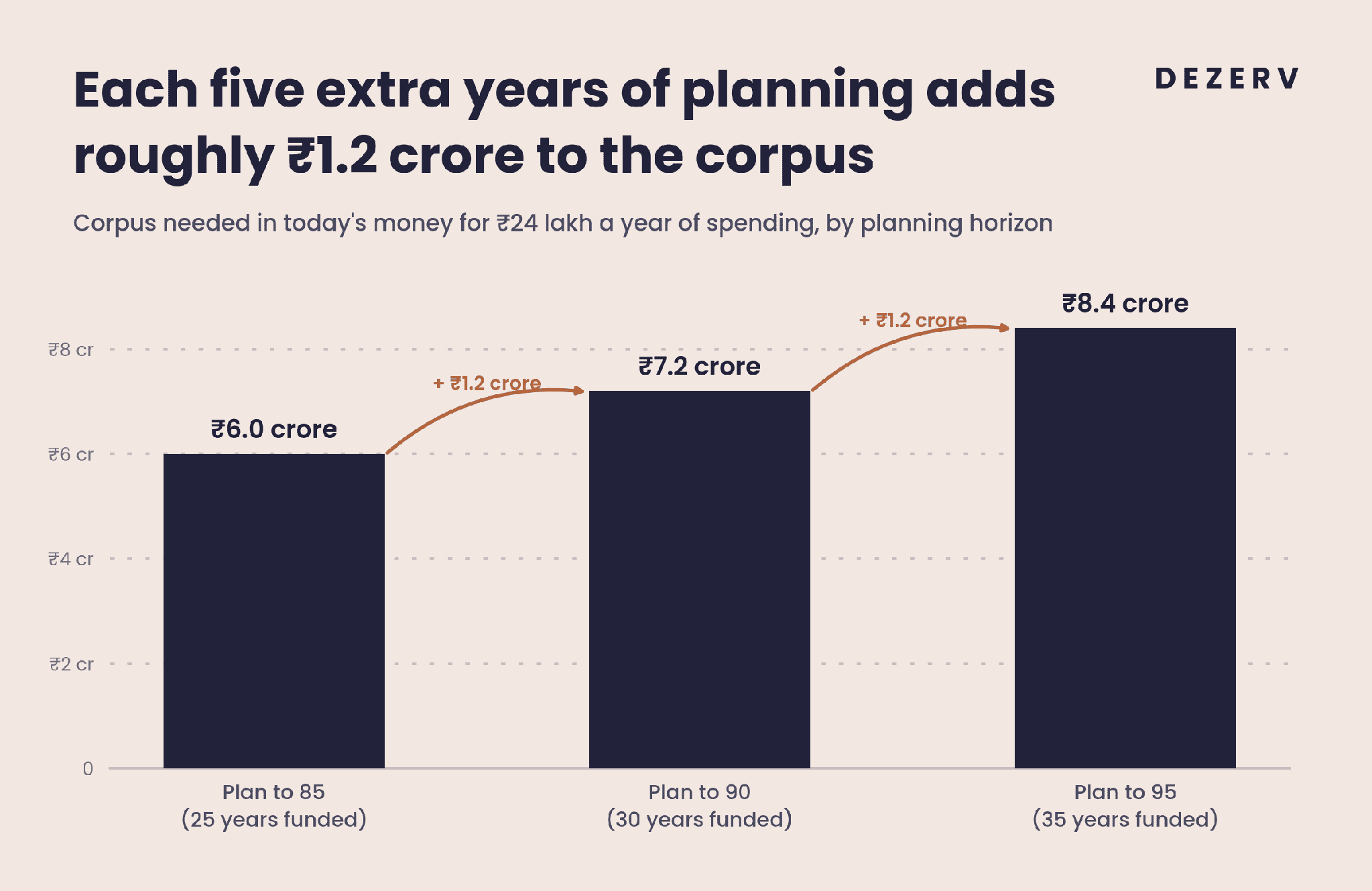
An illustrative scenario: corpus needed in today's money for ₹24 lakh a year, by planning horizon (near-zero real return). This is not a forecast or guarantee of returns.
In this illustrative scenario, moving the planning horizon from 85 to 90 adds about ₹1.2 crore, or roughly a fifth, for the same assumed annual spending.
Nothing about the household's annual spending changed. Nothing about the assumed real return changed. The difference comes entirely from recognising that the corpus may have to support another five years of retirement.
That is why longevity assumptions deserve more attention than they often receive. Getting the horizon wrong is easy to do when retirement is still years away. Discovering the shortfall in your 80s is much harder to correct.
Joint-life planning for couples
For couples, there is another layer to the calculation: you are planning around the survivor, not an average of two lifespans.
The probability that at least one person in a couple reaches an older age is higher than the probability for either person individually.
MoSPI does not publish joint-survival probabilities for couples. Derived from the survivorship (lx) column of the urban life table in MoSPI's SRS Abridged Life Tables 2020–2024, a couple aged 65 has roughly a 57% probability that at least one partner reaches 85, higher than for either partner alone. This is an illustrative calculation from the cited table, not a figure published by MoSPI.
That changes how a couple may need to think about the corpus.
The retirement plan therefore needs to consider the longer-surviving spouse. But the plan must also remain workable after the first spouse dies.
This becomes particularly relevant when a household relies on pensions or annuities. If an income stream stops or falls significantly after the first death, the surviving spouse may need to fund expenses for many additional years with substantially less regular income.
Joint-life retirement planning is therefore not only about estimating how long two people may live. It is also about asking whether the finances still work when only one person remains.
Buffers and annuities against longevity risk
Once the planning horizon has been set realistically, the next question is how the corpus can be structured to support it.
Two tools can play different roles.
A life annuity can provide income for the lifetime covered under the policy, transferring a portion of longevity risk to the insurer, subject to the terms of the annuity. Many conventional annuity options provide fixed nominal payouts rather than payouts explicitly linked to inflation, so their purchasing power may decline over a long retirement. Of course, their product terms may vary. An annuity can therefore be considered as one way to create a floor for essential spending, rather than necessarily funding the entire retirement.
A growth allocation addresses a different part of the problem. If retirement lasts 25 or 30 years, a part of the corpus may still need to grow faster than inflation over long periods. Moving completely into fixed income at retirement may reduce volatility, but it can also make it harder for the portfolio to preserve purchasing power across several decades.
The appropriate mix will depend on the household's circumstances, spending needs, risk capacity and other sources of retirement income.
The withdrawal mechanics that turn these assets into monthly income, including how to manage the risk of selling growth assets at an unfavourable time, are a separate topic. The focus here is simply to test an appropriate planning horizon and assess whether the corpus is designed to support it.
Healthcare, which can become a larger expense in the later years of retirement, may be useful to model separately from general living expenses.
Key takeaways
- Planning from 60 to at least 90 gives the retirement corpus a 30-year horizon to prepare for.
- Life expectancy at age 60 in India is 17.5 years for men and 19.8 years for women — and higher in urban India, at 18.9 and 20.8 — according to MoSPI's SRS Abridged Life Tables 2020–2024.
- For couples, retirement planning should consider the longer-surviving spouse rather than relying only on an average of the two lifespans.
- In the sample scenario above, moving the planning horizon from 85 to 90 increases the required corpus by roughly a fifth.
- Longevity risk is the possibility that retirement lasts longer than the money set aside to fund it.
- A retirement portfolio may need to account for both short-term volatility and the longer-term risk of losing purchasing power to inflation.
- You can set your own life-expectancy input in the Dezerv Retirement Calculator to see how changing the horizon may affect your retirement corpus.
Frequently Asked Questions
How long should I plan for my retirement to last in India?
Planning for at least 30 years, from age 60 to 90, can be a useful baseline to test. Life expectancy at 60 is already 17.5 years for men and 19.8 years for women, according to MoSPI's SRS Abridged Life Tables 2020–2024, while individual lifespans can extend well beyond those averages.
For higher-spending urban households, it may therefore be useful to test the retirement plan against a longer lifespan rather than using the national average as the end point of the planning horizon.
What is longevity risk in retirement?
Longevity risk is the risk of outliving your retirement corpus.
A longer-than-expected retirement means funding additional years of spending while continuing to deal with inflation. This is why retirement planning needs to consider not only how large the corpus is at retirement, but also how long it has to remain capable of funding expenses.
How does planning to 90 instead of 85 change the corpus I need?
In the sample scenario used in this article, a household spending ₹24 lakh a year in today's money needs about ₹6 crore to fund 25 years at a near-zero real return.
Extending the horizon from 85 to 90 means funding 30 years instead, increasing the illustrative corpus to about ₹7.2 crore.
That is an additional ₹1.2 crore, or roughly a fifth, purely because the money needs to last five years longer. These figures are a sample scenario rather than a forecast.
How should couples plan for life expectancy?
Couples may need to consider how long the surviving spouse may live rather than relying only on an average of the two lifespans.
The corpus may have to support one spouse for many years after the first death. Any pension or annuity may therefore also be assessed for what happens to the income after one spouse dies, including whether it continues in full, falls or stops.
Disclaimer
Dezerv Investments Private Limited is a SEBI-registered Portfolio Manager (Registration No. INP000007377). Distribution services are offered by Dezerv Distribution Services Private Limited, a wholly owned subsidiary of Dezerv Investments Private Limited, under AMFI Registration No. ARN-248439 and APMI Registration No. APRN-00615. This article is intended solely for general educational and informational purposes and should not be construed as personalised investment, financial planning, tax or legal advice, or as a recommendation, offer or solicitation to invest in any security, financial product or investment strategy. This document should not be construed to be an offer to buy/sell any securities. Readers are advised to consult with their financial advisor before making investment decisions based on the information provided herein.
The life-expectancy estimates, corpus figures, calculations, illustrations and assumptions presented herein are sample scenarios based on the assumptions stated in the article and the cited sources. They are for illustrative purposes only and do not represent actual or expected returns or outcomes, nor should they be construed as forecasts or guarantees of future returns. Actual outcomes may vary depending on individual circumstances and prevailing market, economic, tax and regulatory conditions. The information contained herein is not a complete disclosure of every material fact, term or condition.
Investment in the securities market is subject to market risks. Please read all related documents carefully before investing. Past performance, where referred to, is not indicative of future performance and may or may not be sustained.


