
NSE IPO: Is it a great business or just a big one?

₹93 of every ₹100 traded in Indian shares passes through one company. For three decades it has been the plumbing of the Indian equity market, and on 24 September the plumbing itself lists — on its rival BSE, because the rules do not let an exchange list on itself.
Most of this week’s coverage has focused on grey-market premiums and listing-day arithmetic. At our recent Decipher with Dezerv webinar, we looked at a more fundamental question with Prashasta Seth, Founder of Prudent Investment Managers. Between 2017 and 2020, while at IIFL Asset Management, Seth committed about ₹2,500 crore to NSE through IIFL’s pre-IPO funds, at a time when its listing was nowhere close.
What did he see in the business then, and how does that thesis hold up at today’s IPO valuation?
That is really the question behind this article: is NSE a great business, or just a very big one? What follows brings together the key insights from that conversation with data from NSE’s offer documents.
| In short: The NSE IPO opens from 17–21 September at ₹1,700–1,785 per share, a ₹22,562 crore offer for sale valuing the exchange at about ₹4.42 lakh crore at the upper end of the band. NSE holds 93% of cash-equity turnover and 99.8% of equity futures, earns about ₹60 of every ₹100 of income from options, and kept ₹55 of every ₹100 as profit in FY26. At about 43x trailing earnings, it is cheaper than BSE and MCX but well above the 25x median for the developed-market exchanges we compared it with. This is a framework for assessing the offer, not a recommendation |
What is on offer in the NSE IPO?
| NSE IPO | Detail |
| Bidding window | 17–21 September 2026 (anchor bids 16 September) |
| Price band | ₹1,700–1,785 per share |
| Lot size | 8 shares (₹14,280 minimum at the upper band) |
| Issue size | ₹22,562 crore, 100% offer for sale |
| Implied market value | ₹4.42 lakh crore at the upper band |
| Allotment / listing | 22 September / 24 September, on BSE |
Source:NSE offer documents
At the upper band, this is one of India's largest IPOs. The entire issue consists of existing shareholders selling about 5.1% of the company. NSE itself gets none of the money because there is no fresh issue.
That distinction matters. This is not a company coming to the market because it needs capital to build factories, fund acquisitions or repair its balance sheet. NSE is already highly cash-generative. The IPO is primarily creating a listed market for existing shareholders.
The large shareholders are also not exiting completely. LIC, the largest shareholder at 10.7%, is selling nothing. Temasek's Aranda vehicle retains around 90% of its stake, while SBI retains around 80%. Several shareholders also reduced the amount they planned to sell after the offer was priced. (Reuters)
There is no conventional promoter either. NSE is institutionally owned and professionally managed, with shareholders including LIC, Temasek's Aranda Investments, Stock Holding Corporation, SBI Capital Markets and SBI.
Its ownership is also widely dispersed. SEBI's rules generally restrict a shareholder in a recognised stock exchange to 5%, although certain institutions such as stock exchanges, depositories, banks, insurers and public financial institutions can hold up to 15%. (Securities and Exchange Board of India)
Why is NSE listing on BSE?
An exchange cannot supervise trading in its own shares, so NSE cannot list on itself. Its shares will therefore trade on BSE.
There is a small irony here. A company that handles around 93% of India's cash-equity turnover will itself trade exclusively on the exchange that handles much of the remaining market.
For BSE, that means one of India's largest listed companies will suddenly become an important part of its own cash segment.
How does NSE actually make money?
A single order placed on a broking app can touch NSE more than once.
NSE can provide the venue where the trade takes place, clear and settle it through its infrastructure, collect listing fees from companies, license indices such as the Nifty, and earn from market data and colocation services used by sophisticated trading firms.
So the business is much larger than the trading screen an investor sees.
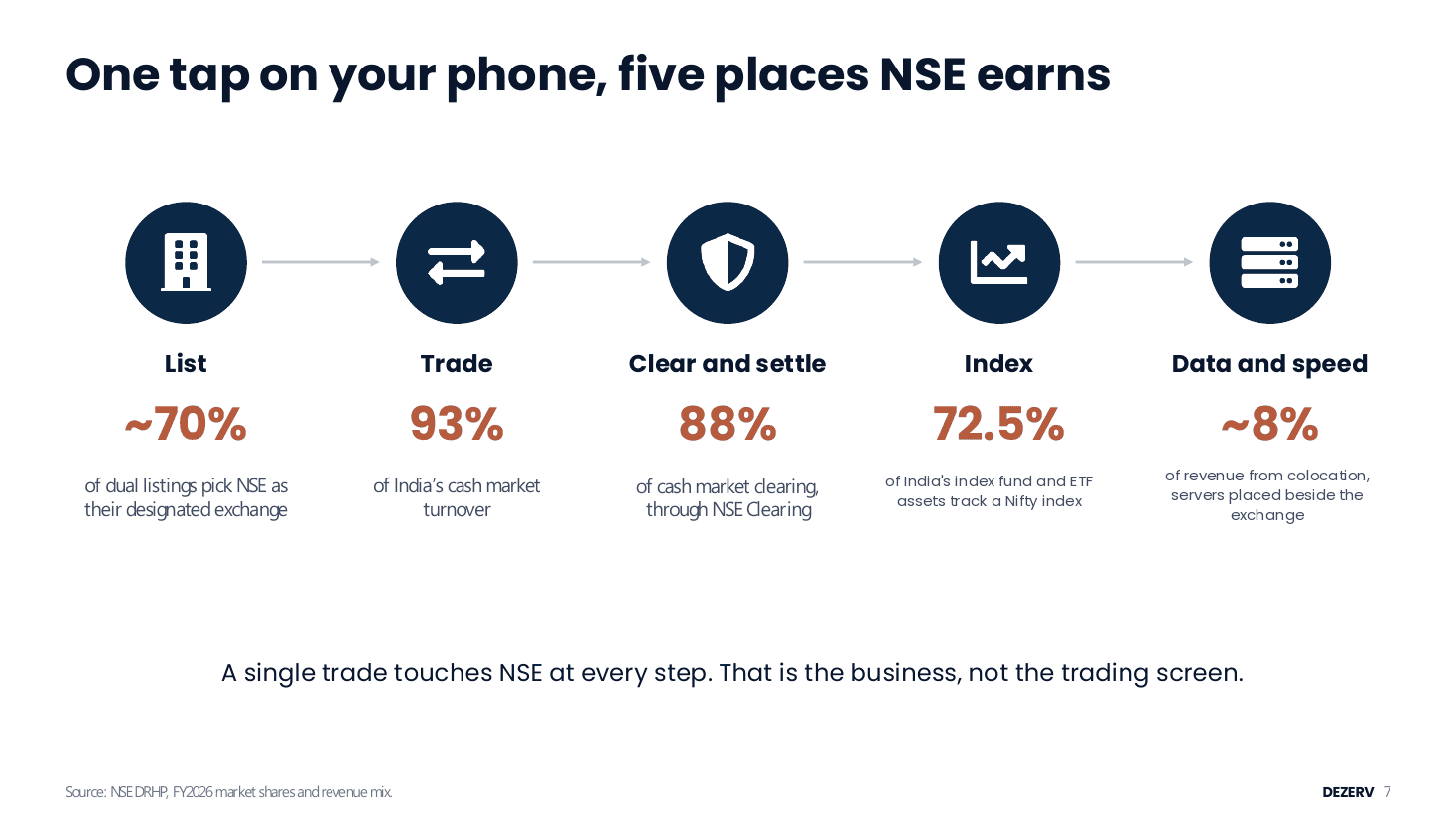
The revenue, however, is much more concentrated than the number of businesses suggests.
Of every ₹100 NSE earned in FY26, around ₹60 came from options trading. Cash, futures and other trading contributed another ₹19, while ₹21 came from the rest of the business. NSE ultimately retained about ₹55 of every ₹100 of total income as profit: ₹10,302 crore on total income of ₹18,713 crore.
Prashasta Seth also pointed out an important feature of Indian market infrastructure during the webinar. Trading, clearing and settlement can sit within the exchange ecosystem, allowing NSE to participate economically in several stages of the same transaction.
That is why looking at NSE simply as a place where stocks trade understates the business.
Is NSE a monopoly?
The FY26 numbers certainly resemble one: 93.0% of cash equities, 99.8% of equity futures and 74.7% of equity options by premium turnover.
The reason is liquidity.
A trader dealing in a large position cares not only about what an exchange charges, but whether there are enough buyers or sellers on the other side. More traders create deeper liquidity. Deeper liquidity makes it easier to trade large positions without moving the price too much. That attracts even more traders.
It becomes self-reinforcing.
That is why simply offering lower fees is often not enough for a competing exchange to take share. As Seth explained during the webinar, the cost of being unable to exit a large position efficiently can be much greater than whatever is saved on transaction fees.
BSE has competed aggressively in the cash market, yet NSE still accounts for about 93% of turnover.
Options are the major exception. BSE has managed to build meaningful market share there, helped in part by regulatory changes around weekly index-option expiries.
But the same forces work against NSE elsewhere. NSE has spent years trying to build its commodities business and still has only around 0.6% market share in a category dominated by MCX.
Even India's largest exchange struggles to dislodge an incumbent when the liquidity already sits somewhere else.
A deep moat on a long runway
The liquidity advantage explains why NSE is difficult to displace. But a strong moat becomes far more valuable when the market around it still has room to grow.
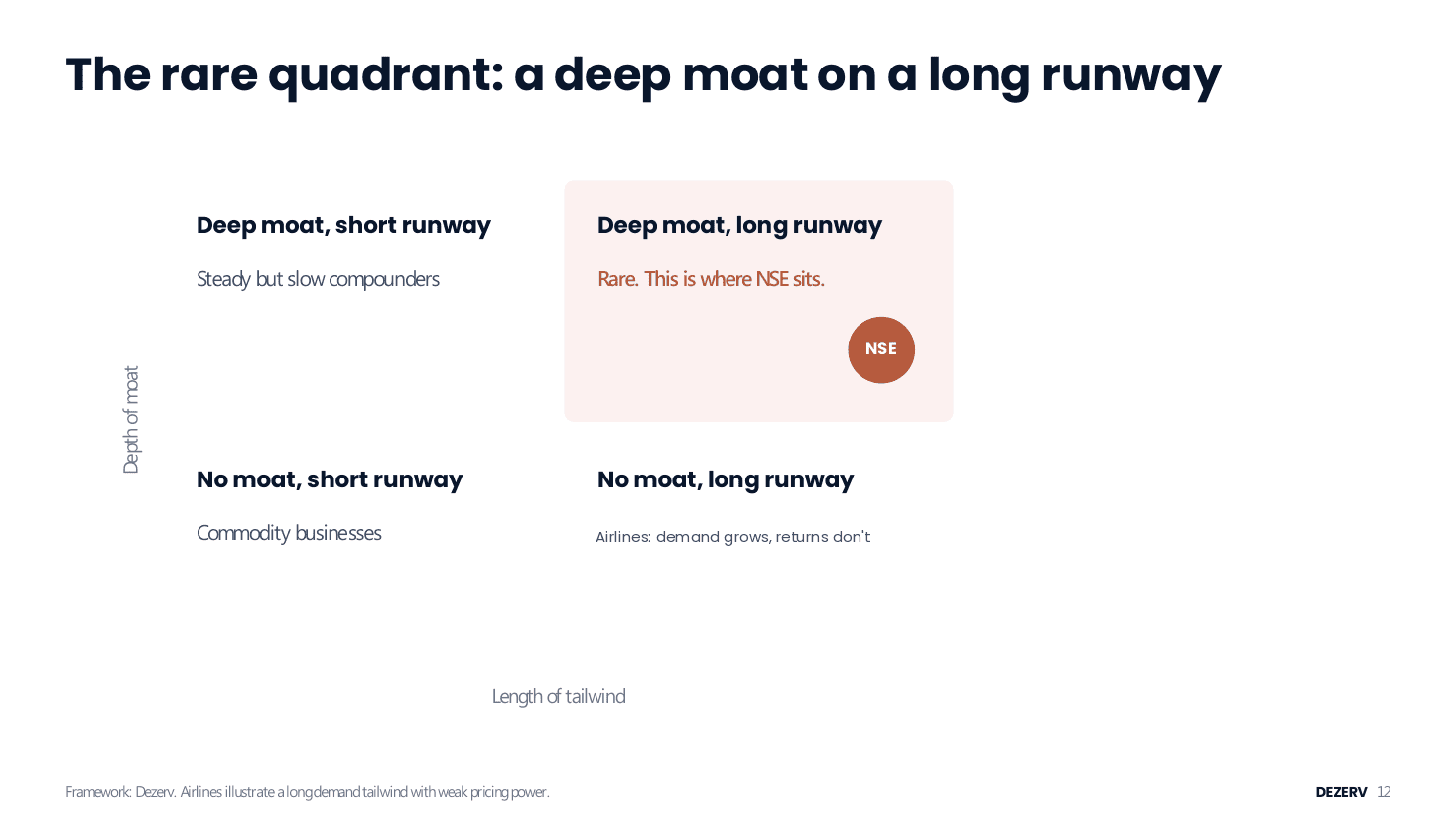
That growth opportunity comes partly from the financialisation of Indian savings.
Financial assets accounted for about 39% of household savings in FY12 and around 46% by FY24, according to NSE's offer documents. Seth also pointed out during the webinar that fixed deposits have fallen from around 58% to 33% of the financial-savings pool.
So there are two shifts happening: a larger share of household savings is moving into financial assets, and within those assets, more money is finding its way into markets.
Investor participation shows how quickly this has accelerated.
NSE took 14 years to reach its first crore registered investors. It crossed 13 crore unique registered investors in April 2026, up from around 4 crore in March 2021. NSE says each incremental crore now takes roughly six to eight months. (NSE India Archives)
There is another growth driver built into the business. NSE earns transaction charges linked to trading activity and value. So as markets grow and participation increases, transaction income can rise with them.
There are also areas that could become more important over time. NSE already has a dominant position in India's IFSC derivatives market through GIFT City, operates hundreds of indices, earns from thousands of listed companies and has a growing colocation business.
At the same time, transaction charges still contribute the majority of operating revenue. So NSE may increasingly look like a broader market-infrastructure company, but trading remains the engine today.
What the investor who bought early saw, and says now
Between 2017 and 2020, while at IIFL Asset Management, Seth committed about ₹2,500 crore to NSE through IIFL’s pre-IPO funds.
The timing looked terrible.
The IPO had been shelved, the colocation investigation had no clear end in sight, and early foreign investors were looking for exits.
But when Seth spoke to those sellers, he found something important: many were not selling because their view of NSE's underlying business had deteriorated. They had already made substantial gains and were tired of defending a controversial unlisted holding at investment-committee meetings.
Price was the other part of the opportunity.
Seth's recollection was that many Indian sectors at the time traded at significant premiums to comparable global companies, while NSE traded at a discount to global exchanges.
He therefore underwrote roughly 15% growth, along with some scope for valuation re-rating, and hoped for an 18–20% compounded outcome.
What he did not build into the base case was the post-Covid boom in options trading. Options eventually grew to around 60% of NSE's income, giving the business an additional growth engine he had not originally underwritten.
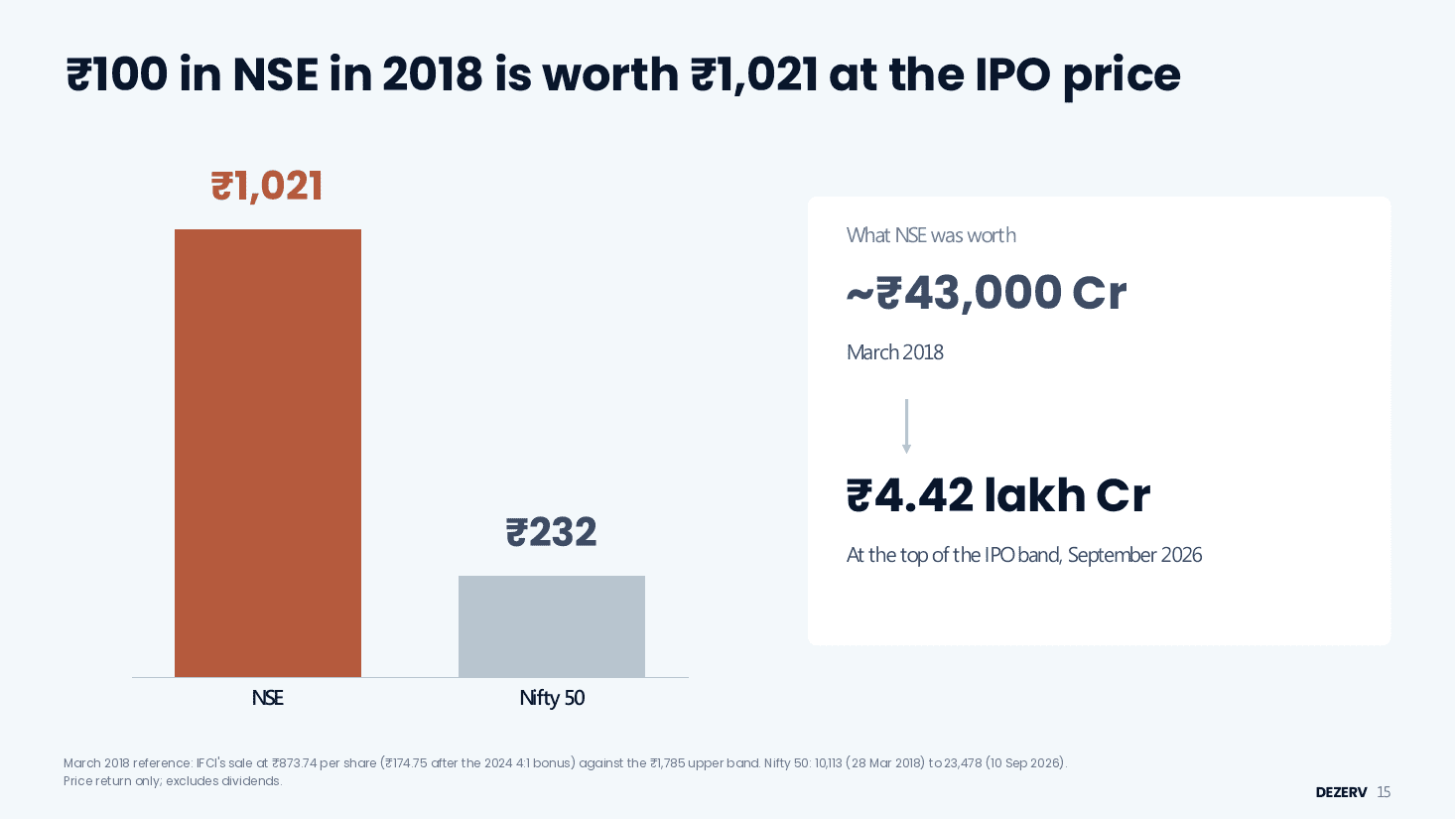
The change since then is not just in the size of the business. It is also in the price investors are now being asked to pay for it.
His 2017 thesis, re-marked at today's price
| 2017 thesis | What 2026 shows |
| Price: Attractive valuation, large margin of safety | Value up about 10x since 2018; now ~43x trailing earnings |
| Moat: Near monopoly, 93%+ market share | 93% of cash, 99.8% of futures; options contested by BSE |
| Economics: High margins, 35%+ RoE | ₹55 of every ₹100 of income is profit; FY26 profit fell 15.5% |
| Runway: Financialisation of savings | 4 crore investors in 2021, 13 crore in 2026 |
Three parts of the original thesis have largely held up or strengthened: the moat, the economics and the runway. The part that has changed completely is the price.
Is the NSE IPO expensive?
At ₹1,785 per share, NSE is valued at roughly 43x its FY26 profit of ₹10,302 crore.
Whether that looks expensive depends heavily on what you compare it with.
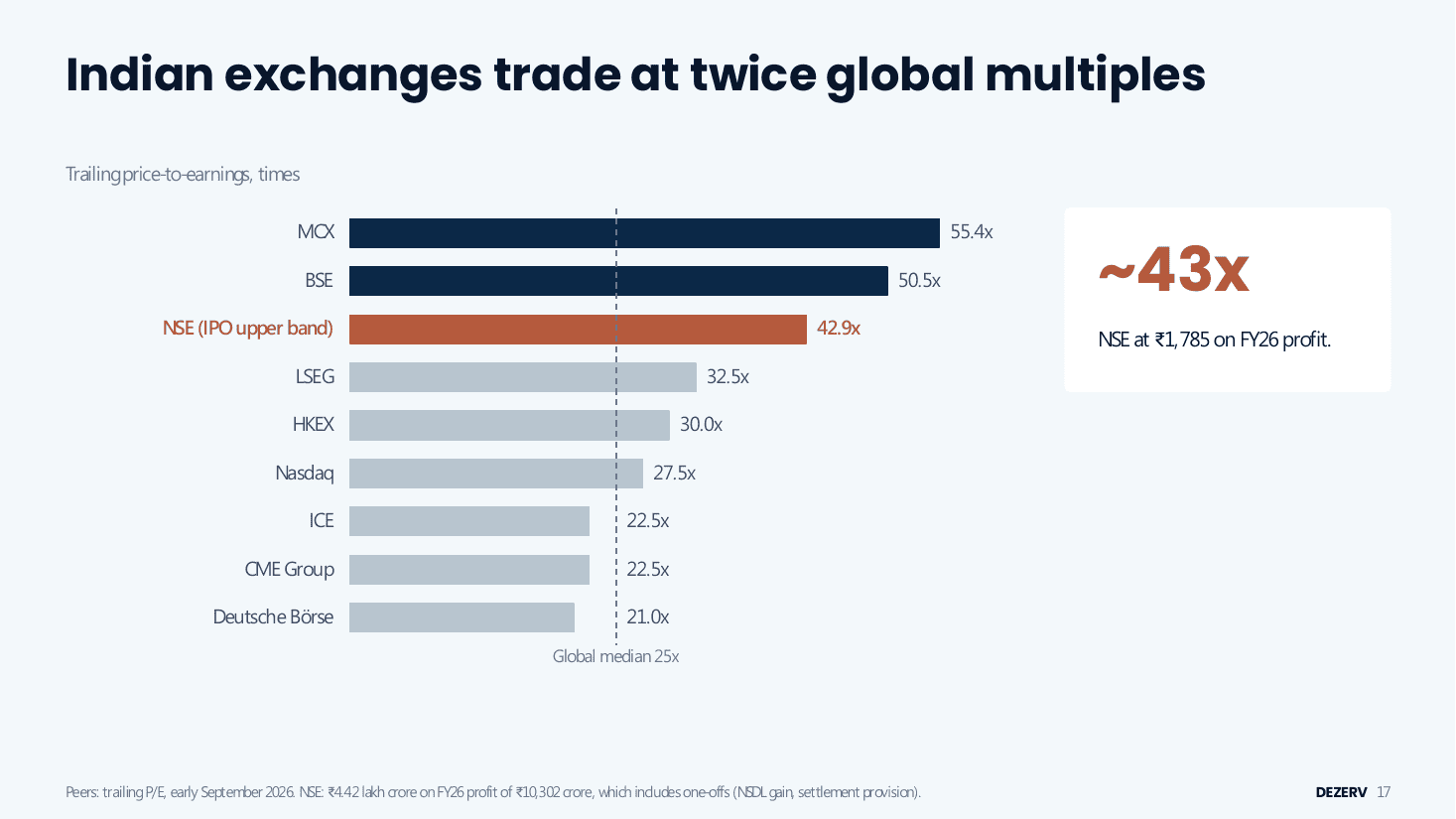
Against Indian listed exchanges, NSE is the cheaper one. BSE and MCX trade at higher trailing earnings multiples.
Against the developed-market exchanges in our comparison, however, NSE is considerably more expensive.
Seth's argument for some premium rests on profitability. Indian exchanges generate significantly higher returns on equity than many global peers. A business that can earn more on the capital it employs can reasonably trade at a higher multiple.
But that does not automatically make NSE cheap.
His overall reading during the webinar was that NSE looked fairly priced rather than cheap at the IPO valuation.
There is also a reason NSE trades below BSE and MCX. If BSE's market-share gains were to moderate, the valuation gap with Indian peers could narrow. Conversely, continued market-share gains could support the existing valuation differential.
Over a three- to five-year horizon, the assessment was for returns broadly in line with, or modestly ahead of, the market, without relying on further multiple expansion and allowing for some valuation compression.
Those are his views as an investor in the company, shared on a Dezerv platform, and not a projection by Dezerv.
One number is also easy to miss: FY26 profit fell 15.5%, although the figure includes one-off items including an NSDL stake gain and a settlement provision.
Paying 43x earnings in a year when reported profit declined is a different proposition from paying the same multiple during a clean period of earnings growth.
What could go wrong?
Regulation. Options are NSE's largest source of income, and SEBI has introduced several measures aimed at reducing excessive speculation in derivatives. With roughly ₹60 of every ₹100 of NSE's income linked to options, changes to derivatives activity can have a meaningful impact on earnings.
Seth's view was that further regulatory curbs are a more important risk to watch than the arrival of another exchange.
Revenue concentration. Options powered a large part of NSE's recent growth, but that also means the business has become more dependent on one segment. The greater that concentration becomes, the more material one regulatory or market change can be to the income statement.
The lock-in cliff. Most pre-IPO shareholders who are not selling through the OFS face a six-month lock-in after listing, taking them to around March 2027. A large pool of shares will therefore become eligible for sale at around the same time.
That does not automatically mean they will all be sold. NSE already had an active unlisted market, so shareholders were not completely without liquidity before the IPO. Several large investors also reduced how much stock they were selling in the IPO. (Reuters)
How much selling actually happens after the lock-in ends will ultimately depend on where the stock is trading then.
Trading activity itself. NSE's economics are closely tied to market activity. A prolonged period of weaker turnover, lower derivatives volumes or subdued participation will feed through to transaction income.
Five questions before any IPO or pre-IPO bet
The webinar closed with a framework that applies far beyond NSE, drawn from Seth's experience in pre-IPO investing and the questions Dezerv Co-founder Vaibhav Porwal uses while evaluating the category.
- Is it a good business without the IPO? Judge the company as though it may never list. Seth's NSE investment worked because the underlying thesis did not depend on a particular listing date.
- Are you being paid for the illiquidity? Compare the valuation with listed alternatives. If a pre-IPO company is already more expensive than comparable listed businesses, you may be accepting less liquidity without being compensated for it.
- What if the IPO is late? NSE is an extreme example. Its listing took close to a decade from its first serious attempt. An expected IPO date should never become the investment thesis.
- Can you sit through the lock-in? Pre-IPO investors may not be able to sell immediately after listing. The investment therefore has to make sense even if the share price moves materially before the stock becomes saleable.
- Is the category proven? For newer sectors, separate the growth of the category from the economics of the company. A rapidly growing market does not automatically mean every business within it will create shareholder value.
One audience question deserves the last word.
Could NSE make up 70% of an equity portfolio?
Vaibhav's answer, from a wealth-management perspective, was no.
The reason has little to do with whether NSE is a good business. At that level of concentration, a risk specific to one company becomes a risk to the investor's entire financial plan.
A great business can still become a poor portfolio decision if too much depends on it.
The exchange lists on 24 September and bidding closes on the 21st. What the unlisted market space says in between can change every day.
Whether NSE is a great business, and whether that business is worth the price being asked for it, is the more useful question.
For the full hour behind this article, including the audience questions on lock-ins, valuations and pre-IPO investing, watch the Decipher with Dezerv webinar recording.
Key takeaways
- The NSE IPO runs from 17–21 September at ₹1,700–1,785 per share. The ₹22,562 crore issue is entirely an offer for sale, so NSE itself raises no fresh capital.NSE offer documents
- NSE earns across several layers of India's capital-market infrastructure: trading, clearing, listings, indices, market data and colocation.
- Options contribute around ₹60 of every ₹100 of income, making derivatives regulation and trading activity particularly important risks.
- NSE's biggest moat is liquidity. Traders attract liquidity, and deeper liquidity attracts more traders, making the advantage difficult to replicate.
- NSE's registered investor base crossed 13 crore in April 2026, up sharply from 4 crore in March 2021. (NSE India Archives)
- Much of Seth's original investment thesis on the business has held up. The biggest change is valuation: what was once available at a discount to global exchanges is now priced at roughly 43x trailing earnings.
- At the IPO price, NSE is cheaper than BSE and MCX but substantially more expensive than the developed-market exchange median in our comparison.
- However strong the company, business quality does not remove portfolio concentration risk.
Frequently Asked Questions
When does the NSE IPO open and close?
Bidding runs from 17 to 21 September 2026, with anchor investors bidding on 16 September. The price band is ₹1,700–1,785 per share and the minimum lot is eight shares, or ₹14,280 at the upper end of the band. Allotment is expected on 22 September and listing on 24 September 2026 on BSE.NSE offer documents
Why is NSE listing on BSE and not on itself?
An exchange cannot supervise trading in its own shares, so NSE cannot list on its own platform. Its shares will therefore trade on BSE.
Is the NSE IPO an offer for sale or a fresh issue?
It is entirely an offer for sale by existing shareholders. NSE is not issuing fresh shares and receives none of the IPO proceeds. (Reuters)
How does NSE make money?
NSE earns from transaction charges, clearing and settlement, listing fees, index licensing, market data and colocation infrastructure. Transaction-related income remains dominant, with options alone contributing around 60% of income in FY26.
How does NSE's valuation compare with other exchanges?
At the upper end of the price band, NSE is valued at roughly 43x FY26 earnings.
That is below the multiples for BSE and MCX used in our webinar analysis, but well above the roughly 25x median for the developed-market exchanges in our comparison.
Part of the premium can be explained by NSE's profitability and returns on equity. The more difficult question is how much of that business quality is already reflected in the IPO price.
Disclaimer:
Dezerv Investments Private Limited is a Portfolio Manager with SEBI Registration no. INP000007377. Dezerv Distribution Services Private Limited is a distributor bearing AMFI Registration No. 248439 and APMI Registration No. 00615.Dezerv Distribution Services Private Limited is a distributor bearing AMFI Registration No. 248439 and APMI Registration No. 00615.
This document is based on and adapted from the views and opinions expressed during a webinar and are solely those of the speaker(s) and do not necessarily reflect the views, opinions or position of Dezerv Investments Private Limited or its affiliates (collectively “Dezerv”). It should not be construed as views, research recommendations or investment recommendations of Dezerv and are as on the date of this communication and are based on information considered relevant at that time. Views are subject to change without notice and there is no obligation to update them.
Past performance is not indicative of future performance. Investment in the securities market is subject to market risks, read all scheme related documents carefully. Investors should independently evaluate the risks and suitability of any investment and consult their financial, legal or tax advisers, as appropriate, before making any investment decision.
Any reference to a company, product, service, trademark or brand is for identification or informational purposes only and does not imply any endorsement, sponsorship or affiliation unless expressly stated otherwise.
Conflict / Interest Disclosure: The speaker and/or Dezerv, including any fund, portfolio or account managed or advised by it, may have transacted in or may hold securities referred to herein and may transact in or hold such securities in the future. Such holdings or transactions may give rise to an actual or potential conflict of interest.
The information presented herein may be based on sources believed to be reliable; however, no representation or warranty is made as to its accuracy, completeness or currency. This communication is for informational and educational purposes only and is not intended to constitute a complete analysis or the sole basis for any investment decision. Neither the speaker nor Dezerv accepts liability for any loss arising from reliance on this document.


