Five years before retirement, investment returns are only part of what needs attention. Some apparently administrative decisions become much harder to sort out once work has ended or the family needs the money urgently.
In March 2026, SEBI published a sample of the demat accounts opened in India during 2025. In January, 70.7% of new account holders had opted out of naming any nominee, and by November and December the share was above 82% (SEBI consultation paper, 17 March, 2026). Those investors had the form in front of them on the day they signed up. The accounts holding most of a 55-year-old's savings were opened years earlier, and the name on them decides who reaches the money first. Which other decisions in the last five working years run on a clock like that?
Insurance, debt, portfolio withdrawals and family access have their own deadlines too. The last five working years are a chance to identify which decisions cannot safely wait until retirement.
In short
The five years before retirement call for five separate decisions, and they do not all start on the same day. Two run on deadlines you do not control, so begin them at once: buy enough health cover while you are still insurable, and review and update nominations for your demat accounts and mutual fund folios in accordance with SEBI’s revised rules, effective 1 September 2026, which permit up to three nominees per account or folio. Debt, portfolio allocation, and retirement income depend on one another, so address them together.Term life cover is the one policy that usually winds down in this window.
Table of contents
Which decisions can wait, and which cannot
The last five working years are the only stretch of a career with both a salary and time to spare. The salary absorbs a mistake. The time lets a portfolio change shape gradually.
Most pre-retirement advice folds this window into a single question: is the corpus big enough? Sizing it matters, and it is its own exercise, with its own assumptions about inflation and longevity, which a retirement calculator lets you test.
A correctly sized corpus can still come apart in ordinary ways. A hospital bill can outrun the sum insured, or a market fall can land in the very first year the household starts selling units to pay its bills.
Two of the five decisions have deadlines that someone else sets. Health cover depends on what an insurer will still offer at your age, and a nomination, which takes an afternoon, decides who can claim each account. Neither waits on anything else on the list.
The other three feed each other. Whether to prepay a home loan depends on how much cash the income plan needs within reach. The income plan depends on how the portfolio is arranged.
Rearranging holdings or making withdrawals may involve sales or redemptions that realise capital gains or losses. Tax sequencing therefore matters to both. Work them out together, with one set of numbers open on the table.
Charlie Munger put the habit that suits this window plainly. He wrote it to Wesco Financial's shareholders in his letter for 1989:
"…long-term advantage people like us have gotten by trying to be consistently not stupid, instead of trying to be very intelligent."
— Charlie Munger, letter to Wesco Financial shareholders, Wesco 1989 annual report, dated 5 March, 1990 (Quote Investigator, 2025)
Most mistakes in this window are of that kind. They are avoidable, and each is cheapest to fix five years out.
Health and term cover: the deadline your health sets
Health insurance is the cover to enlarge in these years. The reason to start early is underwriting.
The Insurance Regulatory and Development Authority of India (IRDAI) requires insurers to offer health cover for all age groups (IRDAI product regulations, 2024). A proposal made at 58, though, is assessed on five more years of medical history than one made at 53, and a new policy begins its own waiting periods.
Buying after the employer plan ends, and what that costs, is covered in health cover before 60 for early retirees. Before then, two generic moves matter:
- Raise the base sum insured, and consider a super top-up, a layer of cover that pays only once the year's claims cross a chosen threshold, so it carries the very large bill without duplicating the base policy.
- Keep a personal policy in force before the group policy lapses. Cover that depends on employment ends with it, and the gap between the two is when a claim is hardest to place.
Watch out
Propose critical-illness cover at the same time. It pays a lump sum when a listed illness is diagnosed, which a hospital policy does not, and it is underwritten on the same medical history.
Term life cover runs the other way. A pure term policy replaces income for the people who depend on it, and once the loans are cleared and the corpus can support a surviving spouse, there is little income left for it to replace.
When that point arrives is a household judgement. It is worth reaching before the salary stops, since after that date the premium comes out of the corpus too.
Nominations, a will and access
Nominations are the fastest task on this list. The SEBI sample suggests they are also the most skipped.
Since 1 September, 2026 you can name up to three nominees on a demat account or mutual fund folio, with a percentage share for each or an equal split by default (SEBI circular, 29 May, 2026).
The circular applies to existing accounts as well as new ones. A new single-holder account now comes with a nomination unless the investor formally files an opt-out.
| Demat accounts opened in 2025 | Opted out of nomination | One nominee | Two nominees | Three nominees |
|---|---|---|---|---|
| January | 70.7% | 28.3% | 0.8% | 0.2% |
| April | 75.9% | 23.2% | 0.7% | 0.1% |
| July | 78.0% | 21.5% | 0.4% | 0.1% |
| October | 77.4% | 22.2% | 0.4% | 0.0% |
| December | 82.1% | 17.6% | 0.3% | 0.0% |
Source: SEBI, consultation paper on modified norms for nomination in demat accounts and mutual fund folios, 17 March, 2026, Table 1 (sample data; December as of 26 December, 2025). Selected months shown; rows may not add to 100% because of rounding.
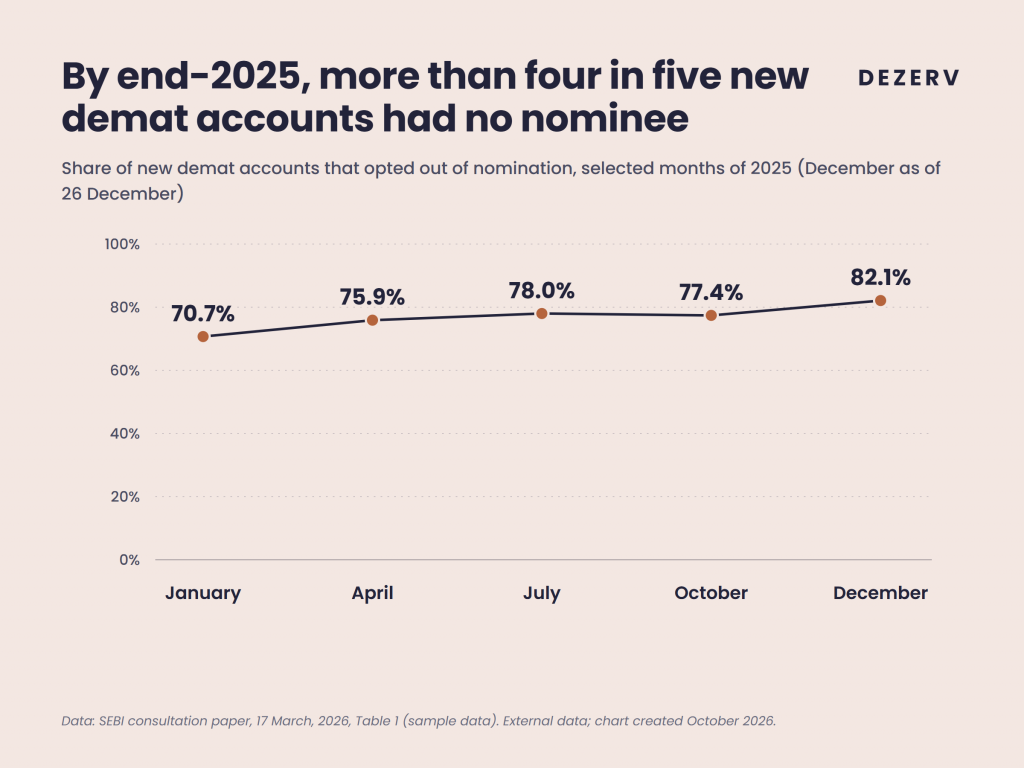
By December 2025, more than four in five new demat accounts in the sample carried no nominee at all. SEBI's January 2025 circular had raised the limit from three nominees to ten (SEBI consultation paper). In the sample, almost nobody used even three.
The May 2026 circular set the limit back at three. Banks, by comparison, have allowed up to four nominees on a deposit since 1 November, 2025 under the Banking Laws (Amendment) Act, 2025 (Ministry of Finance, via PIB, 23 October, 2025).
Walk through every folio, demat account, deposit and insurance policy, and check that each one names the person you would choose today. A nominee on a demat account or folio receives the holdings so they can be passed on, while the will, or the law of succession where there is no will, decides who finally owns them.
Insurance nominations and the will
Life insurance is the exception still being argued over. Under the Insurance Act, 1938, a spouse, parent or child named as nominee can be entitled to keep the claim as its owner rather than hold it for the heirs. Courts have read the provision in different ways, so keep the policy nominations and the will pointing at the same people.
Registering a will is optional under the Registration Act, 1908. The mechanics of drafting one are in how to create a will.
SEBI's own opt-out form warns that without a nomination, heirs may need further legal or court documents, and that long-unclaimed holdings may go to the Investor Education and Protection Fund Authority. Heirs also have to know the holdings exist. Keep one document where a spouse can find it, listing every account, folio, insurer and locker, and who holds the paperwork.
Debt: clear the expensive loans while the salary pays
A loan's equated monthly instalment (EMI) is a fixed claim on an income that is about to become variable. Carried into retirement, it takes the first slice of every withdrawal, in a strong market year and a weak one alike.
Work through it in this order:
- Revolving credit-card balances and personal loans first, in the first year of the window. They carry the highest rates and have no asset behind them.
- Car and consumer loans next. Their tenures are short, so let them run off, and buy the next car with cash if the purchase falls in the last two working years.
- The home loan lasts, as a deliberate decision.
Under the default new tax regime, interest on a self-occupied home loan earns no deduction at all. Under the old regime, qualifying interest may be deductible up to ₹2 lakh a year, or ₹30,000 in certain cases, subject to the applicable conditions (Income-tax Act, 2025). Whether the tax saving favours keeping the loan depends on the household.
The common advice is to be debt-free on the day you retire. Followed blindly, it costs liquidity, because prepaying moves cash into the walls of a house in the same years the portfolio needs a buffer of two to three years' spending.
So test the prepayment against the buffer. If closing the loan still leaves a full emergency fund and that buffer intact, close it while the salary is still arriving. If it would hollow out the buffer, keep the EMI and budget it into the income plan.
The portfolio: match each rupee to the year it is needed
Move the money you will spend in the next few years out of equity before you retire. Leave the money for year 11 onwards invested for growth. The risk this guards against is a market fall in the first years of retirement.
For thirty years, a market fall helped. Every dip was a cheaper purchase for a salary still buying units. Once units are being sold to pay bills, a fall early in retirement forces sales at low prices, and those units are gone before the recovery comes. That is sequence-of-returns risk.
FundsIndia's published analysis of historical Nifty 50 TRI rolling returns, using Ace MF data from June 1999 through January 2026, found negative one-year returns in about 23% of the observed windows and no negative seven-year window in that sample. These results depend on the rolling-window method and are not a guarantee of future returns. Source: FundsIndia historical rolling-return research (February 2026)
| Holding period | Average return a year | Worst window | Windows negative | Windows above 10% a year |
|---|---|---|---|---|
| 1 year | 16% | −55% | 23% | 56% |
| 3 years | 15% | −15% | 6% | 69% |
| 5 years | 15% | −1% | 0.1% | 75% |
| 7 years | 15% | +5% | 0% | 85% |
| 10 years | 14% | +5% | 0% | 85% |
Source: NSE index data (niftyindices.com), Nifty 50 Total Return Index, rolling windows from 30 June, 1999 to 30 June, 2026; a third-party computation on the index series, not Dezerv research. Past performance does not indicate future returns and may or may not be sustained in the future.
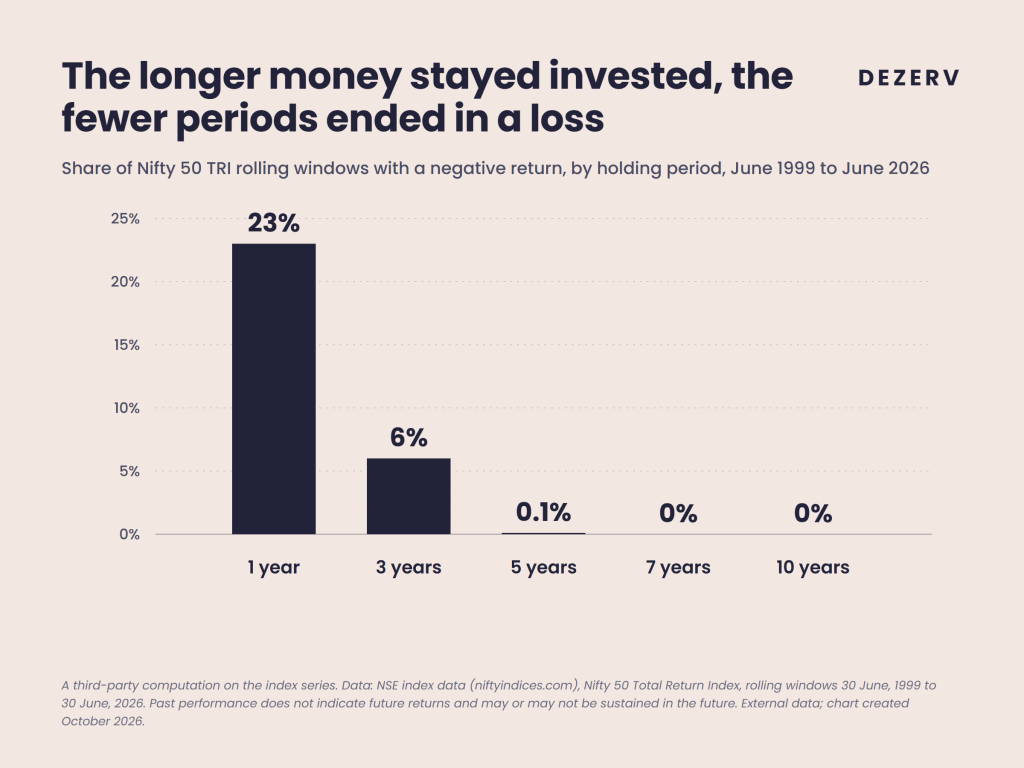
The longer the money stayed invested, the smaller the share of windows that ended in a loss. Money the household will spend in the next two or three years has no place in that first row. Money that will sit untouched for a decade belongs in the bottom rows, where this index has no negative period on record.
Deposits alone do not solve it either. Moving everything into them removes the first risk and takes on another: a corpus earning less than the household's own inflation for decades.
Three blocks by year of need
A practical structure splits the corpus by when each rupee is needed:
- Near-term, the next two to three years of spending: cash, liquid funds and short-duration debt funds. This block pays the bills, so a bad market year forces no sale elsewhere.
- Medium-term, to about year 10: high-quality debt and, for those eligible, the Senior Citizens' Savings Scheme (SCSS), at 8.2% for October to December 2026 (Central Bank of India, SCSS rates; Department of Economic Affairs, 30 September, 2026, via Taxguru). This block refills the near-term one.
- Long-term, beyond year 10: growth assets such as equity, left to compound.
SCSS caps deposits at ₹30 lakh per individual, a limit raised from ₹15 lakh by the Senior Citizens' Savings (Amendment) Scheme, 2023 (31 March, 2023).
Eligibility normally starts at age 60. Eligible retired civilian employees aged 55 or more but below 60 may open an account within three months of receiving their retirement benefits, subject to the scheme conditions (a Department of Posts order of November 2023). A reader five years out cannot use it yet, but can plan the medium block around it.
Make the shift across the five years in several steps. Spreading it out averages the prices at which you sell and buy, and spreads the capital gains across tax years, which the next section takes up.
The income: from a lump sum to a monthly payment
Plan the income before the exit date: decide how much of the NPS corpus to take as a lump sum, settle the provident fund and set up a monthly withdrawal from the near-term block. A household spends by the month. A corpus arrives as one lump that has to be turned into something that pays like a salary did.
NPS at exit
For a voluntary non-employment-linked NPS subscriber, the 15-year subscription condition may permit a normal exit before age 60. This provision does not apply to NPS subscribed to on account of employment, including corporate NPS, which follows the applicable age-60 or superannuation exit conditions. At an eligible non-government normal exit, up to 80% may be withdrawn with at least 20% annuitised, subject to the applicable tax treatment. Government-sector normal exits generally retain the 60/40 split.
For most normal-exit categories, a corpus up to ₹8 lakh can be withdrawn in full; above ₹8 lakh and up to ₹12 lakh, up to ₹6 lakh may be taken as a lump sum and the rest through systematic unit redemption over at least six years, or an annuity. Separate rules, including full withdrawal up to ₹12 lakh, apply to eligible All Citizen Model subscribers who joined after age 60.
Withdrawal can be deferred up to age 85 (PFRDA amendment regulations, effective 16 December, 2025).
The tax law did not move with the withdrawal limit. Only 60% of the corpus is tax-free: the Income-tax Act, 2025 exempts the NPS lump sum up to that share and no further.
A non-government subscriber who takes 80% therefore pays slab-rate tax on the slice between 60% and 80%, and the annuity is taxed as income each year it pays out, because the Act counts both as income. How much to take, and how much to annuitise, is worked through in NPS at 60: withdrawal and annuity.
Provident fund, gratuity and leave encashment
Gratuity and leave encashment are exempt only up to a cap for most private-sector employees, while the Employees' Provident Fund (EPF) balance turns on five years of continuous service under the Income-tax Act, 2025.
EPF interest credited after you stop working can be taxed. A Bengaluru bench of the Income Tax Appellate Tribunal held, in a 2017 order under the old 1961 Act, that interest accruing after retirement falls outside the exemption. The current rules and caps are in tax on retirement benefits.
Decide before the exit date whether the EPF balance is withdrawn or left for a while. The Employees' Provident Fund Organisation (EPFO) says an account turns inoperative, and stops earning interest, 36 months after retirement at 55 or later (EPFO FAQs).
The SWP and the order of withdrawals
A Systematic Withdrawal Plan (SWP) is a standing instruction to a mutual fund to redeem a fixed rupee amount at a set frequency; set on a debt fund in the near-term block, it pays out like a salary.
The long-term block is never drawn on directly. In good years it refills the medium block through rebalancing.
Long-term capital gains on listed equity and equity mutual funds are taxed at 12.5% on gains above ₹1.25 lakh in a tax year, under the long-term capital gains rule of the Income-tax Act, 2025.
Booking up to ₹1.25 lakh of gains each tax year saves at most ₹15,625 of tax per person before surcharge and cess, a small lever on a ₹5 crore corpus. The larger lever is the order in which the pots are drawn, which is far easier to plan while a salary still sets your slab and the exit date is known.
A sample scenario: ₹5 crore and ₹20 lakh a year
| Block | Amount | Spending it covers | Held in |
|---|---|---|---|
| Near-term | ₹50 lakh | about 2.5 years | cash, liquid and short-duration debt funds |
| Medium-term | ₹1.5 crore | about 7.5 more years, to year 10 | high-quality debt; SCSS up to ₹30 lakh per eligible individual |
| Long-term | ₹3 crore | year 11 onwards | growth assets such as equity funds |
| Total | ₹5 crore |
- Starting withdrawal rate: ₹20 lakh ÷ ₹5 crore = 4.0% a year.
- SCSS interest on the ₹30 lakh maximum at 8.2%: ₹2.46 lakh a year, which the block arithmetic above leaves out as a cushion.
A sample scenario, not a forecast or guarantee of returns. Assumptions: a ₹5 crore corpus at retirement; ₹20 lakh of annual spending, held flat in today's rupees (no inflation, no return on any block, so the two are taken to offset); spending paid by SWP from the near-term block and refilled from the medium block; SCSS at the 8.2% rate for deposits made in October to December 2026 (Central Bank of India); the government notifies the rate quarterly. Your own figures will differ.
Running this structure means rebalancing the blocks and sequencing the withdrawals every year for the rest of your life. Some households run it all themselves. Others hand the investing itself, including the rebalancing of the blocks it holds, to a portfolio manager; a portfolio management service (PMS) is one route for that.
With ₹5 crore set aside for retirement, the next question is how that money should be managed as your financial priorities change. Dezerv’s PMS offers professional management across asset classes, primarily through mutual funds, with investment decisions guided by the chosen portfolio mandate. The standard minimum is ₹50 lakh, subject to regulatory exceptions. Market risks remain, while fees and withdrawal terms depend on the investment approach.
The five-year timeline
Read the rows as a calendar and the columns as workstreams running side by side.
| Window | Cover | Estate | Debt | Portfolio | Income |
|---|---|---|---|---|---|
| 5 years out | Enlarge health cover; add a super top-up | Refresh every nomination; draft the will | Clear credit-card balances and personal loans | Begin shifting towards the three-block shape | Map every income source: EPF, NPS, gratuity, deposits |
| 3 years out | Confirm a personal health policy is in force | Finalise the will (registration optional) | Decide the home-loan path | Build the near-term block of two to three years' spending | Decide the NPS lump sum and annuity split |
| 1 year out | Settle critical-illness cover while insurable | Compile the single access document | Clear any remaining car or consumer loans | Blocks in place; rebalancing only | Set up the SWP; plan which tax year each large sale falls in |
| At exit | Let term cover lapse once the corpus can support a survivor | Confirm a spouse can reach every account | Carry only cheap, secured debt, if any | Stop adding; begin withdrawals | First withdrawal from the near-term block |
Source: editorial guide, October 2026. A guide to sequencing; the rates and rules behind it carry their own sources in the sections above.
This calendar assumes a salaried exit you can see coming five years ahead, and it fits less well for someone leaving early through a voluntary retirement scheme, or a business owner with no fixed last day.
Both have fewer years for the same work, so the rows compress while every column still needs doing.
Key takeaways
- The five years before retirement hold five decisions; cover and nominations run on deadlines, while debt, portfolio and income are settled together.
- Buy health and critical-illness cover while you are still insurable; term cover can lapse once the corpus can support a survivor.
- Since 1 September, 2026, a demat account or mutual fund folio takes up to three nominees, and SEBI's 2025 sample found most new accounts had none.
- Clear expensive unsecured debt first; close the home loan only if your cash buffer survives it.
- Hold two to three years of spending outside equity, keep money for year 11 onwards invested for growth, and draw income by SWP from the near-term block.
Frequently Asked Questions
What should I do five years before retirement?
Start the two decisions with outside deadlines straight away: buy enough health and critical-illness cover while you are still insurable, and refresh the nomination on every demat account, folio, deposit and policy. Then work through the three that depend on each other: clear expensive debt, reshape the portfolio so the next two to three years of spending sit outside equity, and design how the corpus will pay a monthly income, including the NPS split and the order of withdrawals.
Should I pay off my home loan before I retire?
Only if closing it still leaves a full emergency fund and two to three years of spending in cash and short-term debt. The default new tax regime generally provides no deduction for interest on a self-occupied home. Under the old regime, qualifying interest may be deductible up to ₹2 lakh annually, or ₹30,000 in some cases, depending on statutory conditions. Include the actual tax benefit when weighing prepayment. If prepaying would empty your buffer, keep the EMI and budget it into the income plan.
How should I change my investments in the last five years before retirement?
Change the shape gradually across the five years. Hold the next two to three years of spending in cash, liquid and short-duration debt funds, keep a medium block in high-quality debt (and SCSS once eligible) to refill it, and leave money for year 11 onwards in growth assets. In the FundsIndia historical Nifty 50 TRI sample through January 2026, roughly 23% of one-year windows had negative returns while none of the observed seven-year windows did. The sample cannot rule out losses in a future seven-year period. Past performance does not indicate future returns and may or may not be sustained in the future.
Do I still need life insurance after I retire?
Usually not a pure term plan. Term cover replaces your income for people who depend on it, so once the loans are cleared and the corpus can support a surviving spouse, there is little left for it to replace. Health cover works the other way: enlarge it before you retire and keep it continuous, because a new policy bought later is underwritten on an older age and a longer medical record.
What should I do with my nominations before I retire?
Start in the first year of the window, because a nomination takes an afternoon and decides who can claim each account. Check every demat account, mutual fund folio, deposit and insurance policy, and make sure each names the person you would choose today, with a percentage share for each nominee if you want an unequal split. Then point the will at the same people, and keep one document listing every account so your heirs know the holdings exist.
Can I invest in the Senior Citizens' Savings Scheme before 60?
Yes, in some cases. Eligible retired civilian employees aged 55 or more but below 60 may open an SCSS account within three months of receiving their retirement benefits, subject to the scheme conditions. Separate eligibility provisions apply to retired defence personnel aged 50 or above. The maximum deposit is ₹30 lakh per individual. The rate was 8.2% for deposits made in October to December 2026 (Central Bank of India), and the government notifies it quarterly.
Disclaimer
Dezerv Investments Private Limited is a SEBI-registered Portfolio Manager (Registration No. INP000007377). Distribution services are offered by Dezerv Distribution Services Private Limited, a wholly owned subsidiary of Dezerv Investments Private Limited, under AMFI Registration No. ARN-248439 and APMI Registration No. APRN-00615. This article is intended solely for general educational and informational purposes and should not be construed as personalised investment, retirement planning, financial, tax, insurance or legal advice, or as a recommendation, offer or solicitation to invest in any security, financial product or investment strategy. Readers are advised to consult their financial, tax, insurance and legal advisors before making decisions based on the information provided herein.
The information relating to retirement planning, health and life insurance, nominations, estate planning, loans, asset allocation, withdrawal strategies, taxation, NPS, EPF and other retirement benefits is based on publicly available information and the sources cited in this article. Illustrative calculations, portfolio allocations, historical market data, assumed returns and withdrawal scenarios are for explanatory purposes only and do not guarantee future returns or outcomes. Actual outcomes may vary depending on individual circumstances, policy terms, applicable laws and regulations, tax treatment, investment performance, inflation and prevailing market conditions. This article is not a complete disclosure of every material fact, term or condition.
Investment in the securities market is subject to market risks. Please read all related documents carefully before investing. Past performance may or may not be sustained in the future.