Early retirement can end two things at once: your salary and the employer health cover you may have relied on for years. Replacing the policy is not always as simple as choosing a similar sum insured.
A health insurer in India may make a new customer wait up to 36 months before it pays for a condition the customer already has (Insurance Regulatory and Development Authority of India, IRDAI, 2024). Most salaried people never meet that wait, because the office group policy is the only cover they have needed.
Someone leaving at 50 with a pre-existing condition may therefore face a waiting period precisely when their employer cover has ended. Understanding that gap before the last working day can be more valuable than comparing premiums only after resigning.
In short
Employer group health cover ends with your employment, so an early retiree pays for their own cover from the last working day, often for a spouse and parents. Health insurance products must be offered across age groups, but acceptance, premiums and terms depend on underwriting. A disclosed pre-existing condition may be subject to a waiting period of up to 36 months under the applicable rules. A retail policy bought three to five years before you leave, and renewed without a break, serves those waits while the salary still pays. A liquid medical buffer can cover costs insurance excludes, reduces or has not yet reimbursed. In IRDAI's 2024–25 aggregate figures, about 71% of claimed rupees had been paid by the reporting date, while the remaining share included disallowed, repudiated and pending claims.
Table of contents
What happens to employer health insurance when you retire early
Employer group health cover is a benefit of employment, so it ends when the employment does, usually on the last working day or at the end of the notice period.
The employer holds the policy. You are a member of its group.
Some employers extend cover to retirees or arrange a conversion route. Read those terms before resigning, because they differ by company.
For someone retiring at 60 the gap is short. A FIRE retiree, short for Financial Independence, Retire Early, faces a longer one, and so does anyone pushed out at 48 by an involuntary IT exit. For them it spans the bridge years, the decade or more before the age at which they expected to stop working.
A family floater through the office typically covers a spouse and children, and some employers let staff add dependent parents, so everyone on the card loses cover on the same day. A long career break opens the same gap, which is why buying personal cover first sits among the money mistakes to avoid before a sabbatical.
The parents on the office policy
Parents are the hardest people in the household to re-insure. A 50-year-old's parents are often in their mid-70s or older, and may well have a diagnosis or two on file.
Insurers must offer health products for all age groups and may design plans specifically for senior citizens. Each must also run a separate channel for senior citizens' claims and grievances (IRDAI (Insurance Products) Regulations, 2024).
Access does not remove the waits. A new policy for a 77-year-old with diabetes can still exclude that condition for up to 36 months. It may also carry a co-payment or a sub-limit, listed in the Customer Information Sheet that comes with every policy (IRDAI Master Circular on Health Insurance Business, 29 May, 2024).
If they are on your office floater today, their policy needs the earliest start date in the family, so price a separate senior-citizen policy for them now. The group cover then still pays for anything that happens during their waiting period, and that wait passes while you are still drawing a salary.
Steps 1 to 3: when to buy, so the waiting periods end before you leave
The waiting periods on a retail health policy run only while that policy is in force, so start them while an employer still covers you. Three rules in IRDAI's 2024 product regulations set the timetable:
- A pre-existing disease (PED) is a condition diagnosed or treated in the 36 months before a policy starts, and a policy can exclude it for up to 36 months of continuous cover.
- A specific waiting period for listed diseases or treatments also runs for up to 36 months from the start of the policy.
- After 60 continuous months of cover, the moratorium, an insurer cannot contest a claim for non-disclosure or misrepresentation except for established fraud.
Once you hold the policy, an insurer cannot refuse a renewal because you made claims. It cannot call for fresh medical tests at renewal when the sum insured is unchanged, and any renewal loading, the extra premium an insurer may add at renewal, is set for its whole portfolio, never for one policyholder's claims.
A policy bought at 45 is therefore renewed at 55, at the same sum insured, without being underwritten again. The insurer does not reassess your health and re-price the risk.
For an exit planned at 50, the rules give three steps:
- Buy a retail indemnity policy, one that reimburses the hospital bill, in your own name three to five years before the exit.
- Renew it within the grace period every year.
- Raise the sum insured while you are still healthy.
| When (exit planned at 50) | Step | The rule behind it |
|---|---|---|
| Now, if parents are on the office floater | Price a separate senior-citizen policy for them | Their PED wait of up to 36 months runs while group cover still pays |
| Age 45, five years out | 1. Buy a retail indemnity policy in your own name, alongside the office cover; add any fixed-benefit cover (Step 6) at the same time | The 60-month moratorium completes by the last working day; a benefit-based policy carries the same PED wait |
| Age 47, three years out at the latest | 1. The same steps, if they have not been taken | PED and specific waits of up to 36 months clear while the salary still pays |
| Every renewal | 2. Renew within the grace period | 15 days for monthly premiums and 30 days for the rest, with every credit kept |
| Age 48 to 49 | 3. Raise the sum insured while you are still healthy | Only the increase is underwritten, and its own 60-month moratorium runs from the date of the increase (product regulations and Master Circular) |
| Final year | 4. Ask the group insurer about migration | Credits move only up to the old sum insured |
| Notice period | 5 and 6. Read the policy terms; fund the medical buffer | The terms decide what is paid (IRDAI Annual Report 2024-25) |
A sample timeline for an exit planned at 50, not a recommendation of any product, insurer or sum insured. The rules come from the IRDAI (Insurance Products) Regulations, 2024 (Gazette of India, 22 March, 2024, in force from 1 April, 2024) and the IRDAI Master Circular on Health Insurance Business of 29 May, 2024, as of October 2026. Source: the regulations cited above.
Watch out
A renewal paid after the grace period counts as a break in policy. The waiting periods and the moratorium can then start again from zero, at an older age and with a longer medical file.
The case for not paying twice
Holding a retail policy for five years alongside office cover means paying for insurance you mostly do not use. A household that stays healthy until the exit, and can buy at standard rates the week after, saves five years of premiums.
That saving depends on nothing changing in between. Suppose a diagnosis arrives at 48: the policy bought at 50 can then exclude that condition for up to 36 months, load the premium for it, or do both, in the years when no employer is paying and the household has the least room to absorb a bill.
The duplicate premium is the price of removing that risk. Whether it is worth paying depends on how comfortably your savings could fund three years of treatment for an excluded condition.
"It does not matter how frequently something succeeds if failure is too costly to bear."
— Nassim Nicholas Taleb, Fooled by Randomness (2001), opening of Part I (publisher's excerpt, Random House edition, 2005)
Step 4: migrate or port the office plan
Migration and portability are the two regulated routes for carrying credits out of an existing health policy, and the 2024 regulations define them separately:
| Route | What moves, and where | Open to group members? | Limits |
|---|---|---|---|
| Migration | Credits for PED and specific waiting periods, to another policy with the same insurer | Yes, named in the definition | Up to the old sum insured and benefits; the insurer may underwrite you if you have not been continuously covered for 36 months |
| Portability | The same credits, to a different insurer | Yes, allowed "irrespective of individual or group policy" | Up to the old sum insured and benefits; subject to the new insurer's board-approved underwriting policy |
Source: IRDAI (Insurance Products) Regulations, 2024, as of October 2026. Ported and migrated credits also count towards the 60-month moratorium (IRDAI Master Circular on Health Insurance Business, 29 May, 2024).
The group route is worth one conversation with HR a year before you leave. Ask whether the group's insurer offers migration to an individual product, at what sum insured, and whether it will underwrite you.
Treat the answer as a supplement to a retail policy that has already served its waits.
Step 5: check what a policy leaves unpaid
A health policy pays hospital bills within its terms. IRDAI's own annual data shows how much of the money claimed those terms leave behind.
In 2024-25, general and health insurers settled 3.26 crore health claims and paid ₹94,248 crore, an average of ₹28,910 per claim (IRDAI Annual Report 2024-25, published 30 December, 2025).
| How health claims ended, 2024-25 | Amount (₹ crore) | Share of rupees claimed | Share of claims by number |
|---|---|---|---|
| Paid | 94,248 | 71.1% | 87.5% |
| Disallowed under the policy's terms and conditions | 18,521 | 14.0% | not counted separately |
| Repudiated | 11,412 | 8.6% | 7.9% |
| Pending at 31 March, 2025 | 8,307 | 6.3% | 4.6% |
| Total, including claims pending at the start of the year | 1,32,488 | 100% | 100% (372.58 lakh claims) |
Source: IRDAI Annual Report 2024-25, Table I.29 and para I.6.5.5; general and health insurers; excludes personal accident and travel cover. Amounts rounded to the nearest ₹1 crore and shares to one decimal place. External data; table created October 2026.
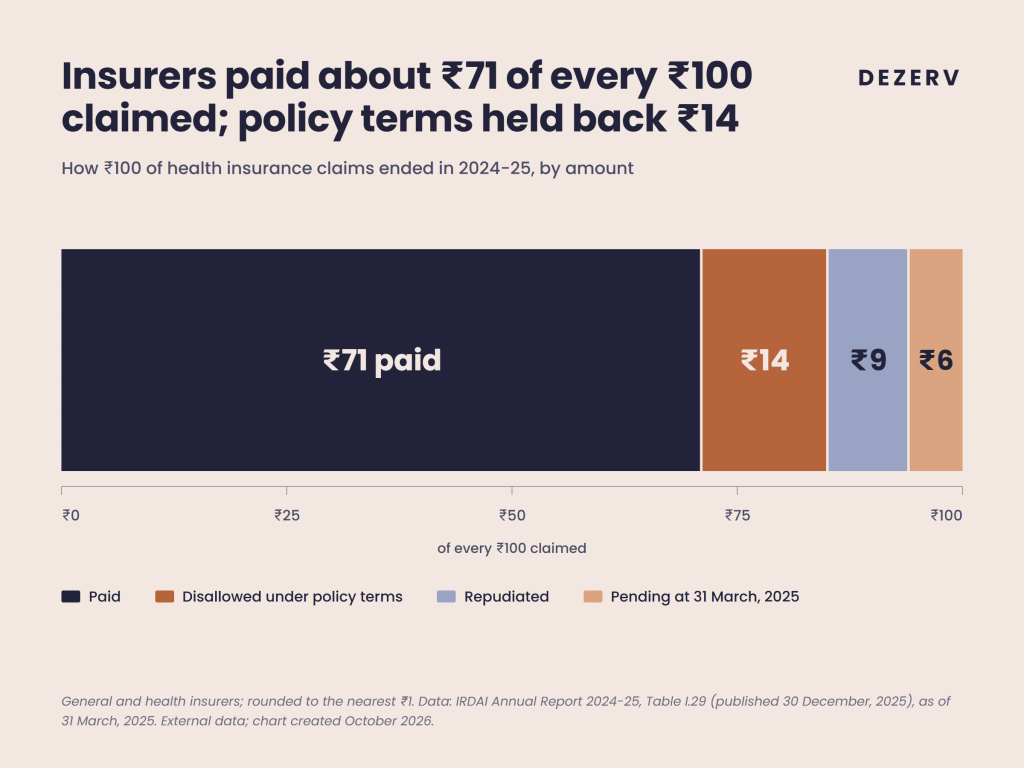
In rupees, insurers paid about ₹71 of every ₹100 claimed. Another ₹14 was disallowed under the terms and conditions of the policy contract, which is where clauses such as sub-limits and co-payments bite, and close to ₹9 was repudiated outright, so a large sum insured on its own does not settle what a hospital stay will cost the household.
A super top-up raises the ceiling on a policy at a low premium. It pays once your total hospital claims in a policy year cross a chosen deductible, so it ignores the small claims and catches the large one, while a regular top-up applies its deductible to each claim separately.
Where a super top-up falls short
The super top-up works on the size of the bill. Deductions under policy terms sit inside each bill, so a sub-limit or co-payment in the top-up's own wording still cuts what it pays above the deductible. The deductible also resets every policy year, so a long illness that runs across two policy years has to clear it twice.
Read the top-up's Customer Information Sheet as closely as the base policy's. The right deductible and layering for your health and city are questions for a licensed insurance advisor.
Step 6: fixed-benefit cover and a ring-fenced buffer
A hospital policy reimburses what the hospital charges, while a benefit-based policy pays a fixed amount when a listed event occurs (IRDAI, 2024). Critical-illness cover is the common benefit form. It pays a lump sum on diagnosis of a covered illness, after which the policy can end.
For an early retiree that lump sum pays for what a hospital policy leaves out, such as home nursing or travel for treatment.
The SRP (survival, replacement, protection) framework in "How long can you survive without money?" (Dezerv blog, 2 April, 2026) calls this the protection number, the gap one event could open, and fixes it mainly through life and critical-illness cover. Whether a term plan is still needed after the exit is a separate decision, covered in the five-year checklist before retirement.
The medical buffer
For what neither policy pays, Sandeep Jethwani, Dezerv's co-founder, described a dedicated medical corpus in his responses to Mint (March 2026). It sits in liquid or arbitrage funds, which are at the low end of SEBI's riskometer.
The corpus stays apart from lifestyle spending. It pays only for premiums, hospital bills and whatever insurance rejects.
The three-layer withdrawal framework in "What if you outlive your retirement corpus?" (Dezerv blog, 8 May, 2026) puts the emergency part of that money in Layer 2, the buffer for costs you cannot plan, and its rule is that Layer 3, the equity, is never the source for a hospital bill.
Sizing the buffer is a household calculation. The Dezerv retirement calculator takes your expenses and an inflation rate as inputs, so you can run the medical budget on its own at a higher rate than the rest.
Two readers can skip most of this sequence: a retiree whose former employer covers them for life, and one whose savings could pay for an excluded illness outright without strain. For everyone else leaving work before 60, the retail policy comes first and the resignation letter follows it.
Key takeaways
- Group health cover ends with employment, for everyone on the office policy, so an early retiree pays for cover through the bridge years to 60 and beyond.
- IRDAI caps waiting periods for pre-existing diseases and listed treatments at 36 months, and after 60 continuous months no claim can be contested for non-disclosure except for fraud; a retail policy bought three to five years before the exit has served its waits by the last working day.
- Parents are the hardest to re-insure; give them their own policy while the office cover still backs them.
- Migration (same insurer) and portability (a new insurer) both carry credits out of a group policy, up to the old sum insured and subject to underwriting.
- Insurers paid about ₹71 of every ₹100 claimed in 2024-25; fixed-benefit cover and a liquid medical buffer are for the rest.
Frequently Asked Questions
Does employer health insurance continue after I retire early?
Usually not. Employer group health cover is a benefit of employment and normally ends on the last working day or at the end of the notice period, for you and for any spouse, children or parents on the same policy. Some employers extend cover to retirees or offer a conversion route, so read those terms before resigning. Otherwise, have a retail policy in your own name in force before you leave, ideally three to five years before, so its waiting periods have run out.
Can I move my group health cover into an individual policy?
Yes, within limits. IRDAI's 2024 product regulations let group members migrate to another policy with the same insurer, carrying credits for pre-existing diseases and specific waiting periods, and they allow porting to a different insurer from a group or an individual policy. Both routes carry credits only up to the old sum insured and both are subject to underwriting; on migration, the insurer may underwrite you if you have been continuously covered for less than 36 months.
How long is the waiting period for pre-existing diseases in health insurance?
At most 36 months of continuous cover. Since 1 April, 2024, IRDAI's product regulations cap the waiting period for disclosed pre-existing diseases at 36 months, and define a pre-existing disease as one diagnosed or treated within the 36 months before the policy starts. Specific waiting periods for listed treatments are also capped at 36 months. Insurers may offer shorter waits, and the clocks keep running only while the policy is renewed without a break.
Can an insurer refuse to renew my health policy because I made a claim?
No. Under IRDAI's 2024 regulations, a general or health insurer cannot deny renewal because of claims in earlier years; renewal can be refused only for established fraud, non-disclosure or misrepresentation, or if the product is withdrawn, in which case you are offered migration. The insurer also cannot call for fresh medical tests at renewal when the sum insured is unchanged, and any renewal loading is set for its whole portfolio of policies.
How much of a health insurance claim do insurers actually pay?
In 2024-25, Indian general and health insurers paid about 71% of the rupees claimed and settled 87.5% of claims by number, according to the IRDAI Annual Report 2024-25. About 14% of the amount claimed was disallowed under policy terms, 8.6% was repudiated and 6.3% was still pending at 31 March, 2025. The average amount paid per claim was ₹28,910. Clauses such as sub-limits and co-payments are one reason a cash buffer still matters alongside a policy.
Disclaimer
Dezerv Investments Private Limited is a SEBI-registered Portfolio Manager (Registration No. INP000007377). Distribution services are offered by Dezerv Distribution Services Private Limited, a wholly owned subsidiary of Dezerv Investments Private Limited, under AMFI Registration No. ARN-248439 and APMI Registration No. APRN-00615. This article is intended solely for general educational and informational purposes and should not be construed as personalised financial, insurance, tax or legal advice, or as a recommendation, offer or solicitation to purchase any insurance policy, security or financial product. Readers are advised to consult a qualified insurance advisor or relevant professional before making decisions based on the information provided herein.
The regulatory information, statistics, historical data and illustrative calculations in this article are based on the sources cited and are for general informational purposes only. Regulatory provisions and insurance terms may change, and the availability, coverage, premiums, waiting periods, exclusions and claim settlements of insurance policies may vary depending on the insurer, policy terms, underwriting and individual circumstances. The claim statistics cited are based on published aggregate data and may not reflect the experience of any individual policyholder. Illustrative examples and calculations are not guarantees of future outcomes. Actual healthcare expenses and insurance benefits may vary depending on individual health conditions, medical inflation, policy terms, applicable regulations and prevailing market conditions. This article is not a complete disclosure of every material fact, term or condition.
Investment in the securities market is subject to market risks. Please read all related documents carefully before investing. Past performance may or may not be sustained in the future.