For couples, a retirement plan is often built around two people living on one pool of assets. But it also has to work when only one person is left to locate the accounts, access the cash and make decisions.
RBI provides a simplified deceased-depositor claim process for ordinary commercial-bank deposits below ₹15 lakh, or a higher threshold fixed by the bank, even when no nominee is registered. Conditions apply, including no will, competing claim or restraining court order, and prescribed claimant documents are still required. Where a valid nominee or survivorship instruction exists, a separate claims route applies regardless of balance; larger or disputed claims may require additional succession evidence. Source: RBI Commercial Banks – Responsible Business Conduct Directions (2025)
That is not only a legal-paperwork concern. The survivor may also need to keep expenses paid while sorting out an estate. The first practical question is whether both spouses know where the money is and what would happen to it after the first death.
In short
The retirement conversation that matters most for a couple is about who can reach, own and run the money after the first death. Before the last salary, document every account and how its income is drawn, consider appropriate survivorship instructions for essential bank accounts, keep nominations current and make a will. For bank deposits, paying the nominee or survivor settles the bank's obligation without extinguishing legal heirs' rights. Transmission and beneficial ownership of jointly held securities depend on the account structure and applicable succession law. Build the plan around the spouse likely to live longer, usually the wife, and around whichever of you handles the money less.
Table of contents
Could your spouse find the money and run it?
Picture the week after a death in a household where one spouse ran every investment. The survivor must first list each bank account, fund folio, demat account, policy and locker, and then get past logins that are often tied to a phone number belonging to the person who died.
Finding the money is the easier half. Running it means placing a redemption, knowing which withdrawal pays the society maintenance and on what date, renewing the health cover, judging whether equity has drifted too high, and knowing whom to ring when a form comes back rejected.
So the document worth writing is an operating note. For each holding it records the institution, whether it is single or joint, the nominee, how income is drawn from it and the next decision due. It also names one person the survivor can call: a grown child, the family's chartered accountant or a relationship manager.
A useful test is to hand the note over for a month while the spouse who runs the money stays out of it. Every question that comes back marks a gap.
Revise the note after any change of bank, phone number or nominee, and at least once a year.
"I take care of my money, I should not expect money to take care of me."
— Swarup Mohanty, CEO, Mirae Asset Investment Managers (India), in an interview with The Finance Story (18 July, 2022)
What joint names and nominees decide
Joint names and nominees decide who collects a bank balance, demat holding or fund folio after a death, and how quickly. Who finally owns it is settled separately.
| Asset and how it is held | Who collects | Papers the survivor files | Timeline or limit |
|---|---|---|---|
| Bank account, joint "either or survivor" | Surviving holder | Claim form, death certificate, survivor's identity proof; no succession certificate | Bank settles within 15 calendar days of complete papers |
| Bank account, one name, nominee registered | Nominee | The same three documents | Same 15 days |
| Bank account, one name, no nominee | Legal heirs | Claim form, death certificate, indemnity, heirs' consent, a legal heir certificate or a declaration | Simplified route up to ₹15 lakh (₹5 lakh at co-operative banks); above it, a succession certificate, a legal heir certificate or a sworn affidavit, and the bank may also ask for a surety bond |
| Demat account, joint | Surviving holder | Transmission form, notarised death certificate | Processed by the depository participant |
| Demat account or fund folio, one name, nominee registered | Nominee (up to three from 1 September, 2026) | Transmission form, certified death certificate; no will or succession certificate | Processed by the depository participant or fund registrar |
| Demat account or fund folio, one name, no nominee | Legal heirs | Transmission form plus a succession certificate, probate or letters of administration | The slowest route |
| Life insurance, spouse, parent or child as nominee | Nominee, as owner under the Insurance Act (courts have read it differently) | Insurer's claim papers | Set by the insurer |
Source: RBI deceased-claims directions (26 September, 2025, in force at all banks by 31 March, 2026), NSDL, transmission; SEBI nomination circular (29 May, 2026); Insurance Act, 1938. As of October 2026.
A slow claim now costs the bank. Where it misses the 15 days through its own fault, the RBI directions make it pay interest of at least the Bank Rate plus 4% for the delay.
From 1 September, 2026, a SEBI circular of 29 May, 2026 caps nominees at three per demat account or folio, existing ones too, and splits the holding equally unless the form says otherwise. Nomination is optional on joint holdings, and changing it needs every joint holder's signature. The form also has optional boxes for each nominee's phone and email.
Collecting the money and owning it
The RBI directions make a surviving joint holder or nominee acknowledge receiving a bank balance "as a trustee of the legal heirs".
For shares and demat holdings, the Supreme Court said in December 2023 that "nomination process therefore does not override the succession laws" (Shakti Yezdani v. Jayanand Jayant Salgaonkar, 14 December, 2023). Who finally keeps the money follows the will, or succession law where there is none.
Life insurance runs the other way. Under the Insurance Act, 1938, a nominee who is the policyholder's spouse, child or parent takes the policy money as its owner. Courts have read the rule in different ways.
Watch out
Joint names and nominations decide how fast the money moves. A will decides where it ends up, so all three should point the same way, and legal advice is worth paying for wherever they cannot.
The income that changes at the first death
Survivor-income design is arranging a couple's income so it holds up at the first death. Retirement income usually arrives in several streams.
A single-life pension or annuity stops with the person named on it (a return-of-purchase-price plan hands the capital, not the income, to the nominee). A joint-life annuity pays less each month than a single-life one and keeps paying the survivor, in full or in part depending on the option, so the choice between them belongs to both spouses.
Interest on deposits in one name keeps accruing. Nobody can draw it until the claim is settled.
A systematic withdrawal plan (SWP) on a jointly held folio is the least disrupted stream, provided the payout bank account is joint too.
Even so, the fund house must record the death. At some fund houses a transmission opens a new folio and ends the SWP on the old one, so the survivor has to register it again (Quantum Mutual Fund, note on transmission).
The bills fall far less than the income. Maintenance and health cover cost a widow much the same as a couple.
| Income stream | Both alive | First weeks after the death | Once claims are settled |
|---|---|---|---|
| Single-life annuity, husband the annuitant | ₹40,000 | ₹0 | ₹0 |
| SWP on a joint folio, paid into a joint bank account | ₹70,000 | ₹0 to ₹70,000, until re-registered | ₹70,000 |
| Deposit interest, deposits in the husband's name alone | ₹40,000 | ₹0, unreachable | ₹40,000 |
| Monthly income | ₹1,50,000 | ₹0 to ₹70,000 | ₹1,10,000 |
| Monthly need | ₹1,50,000 | About ₹1,20,000 | About ₹1,20,000 |
| Shortfall | None | About ₹50,000 to ₹1,20,000 | About ₹10,000 |
A sample scenario, not a forecast or guarantee of returns. Assumptions: a couple needing ₹1.5 lakh a month; the husband dies first and is the annuitant on a life-only annuity with no return of purchase price, and the sole holder of the deposits; the SWP folio and its payout account are joint; the widow's monthly need is about 80% of the couple's. Source: editorial sample scenario, October 2026.
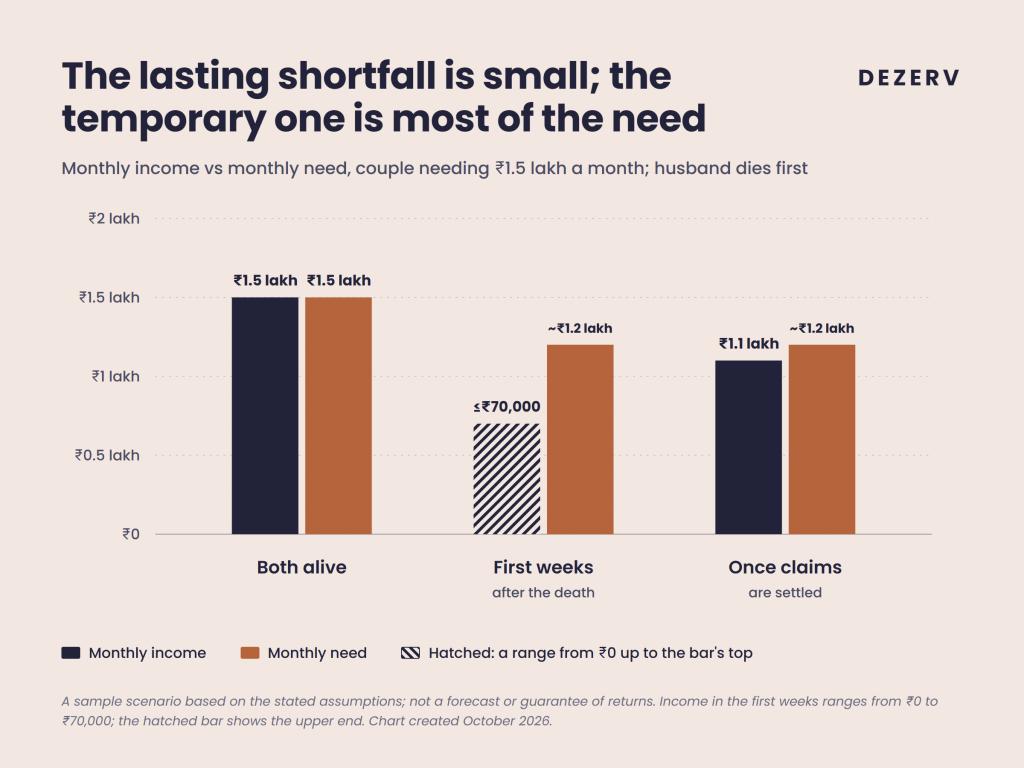
The annuity's ₹40,000 is gone for good. The need falls by about ₹30,000, so a lasting shortfall of about ₹10,000 a month remains. That gap needs a decision before retirement: a joint-life annuity, a larger joint portfolio, rental income, or a pension of her own.
The bigger gap is temporary, and it arrives first. Until the claims are settled and the SWP runs again, the widow could have nothing coming in against a need of ₹1.2 lakh. Three months of that need, about ₹3.6 lakh, kept liquid in a joint account would carry her through in this example.
Why the plan usually has to work for her
At 60, an Indian woman can expect to live about 19.8 more years and a man about 17.5, according to the Registrar General's Sample Registration System life tables for 2020-24, published in May 2026. A gap of 2.3 years sounds small.
Among Indians aged 60 and above in 2017-18, 54% of women were widowed against 16.5% of men (India Ageing Report 2023, 26 September, 2023).
| Age group | Women widowed | Men widowed |
|---|---|---|
| 60-69 | 40.8% | 10.6% |
| 70-79 | 67.8% | 20.1% |
| 80 and above | 86.6% | 36.9% |
| All aged 60 and above | 54.0% | 16.5% |
Source: Longitudinal Ageing Study in India, Wave 1 (2017-18), as reported in the India Ageing Report 2023, Figure 2.14. Data as of 2017-18.
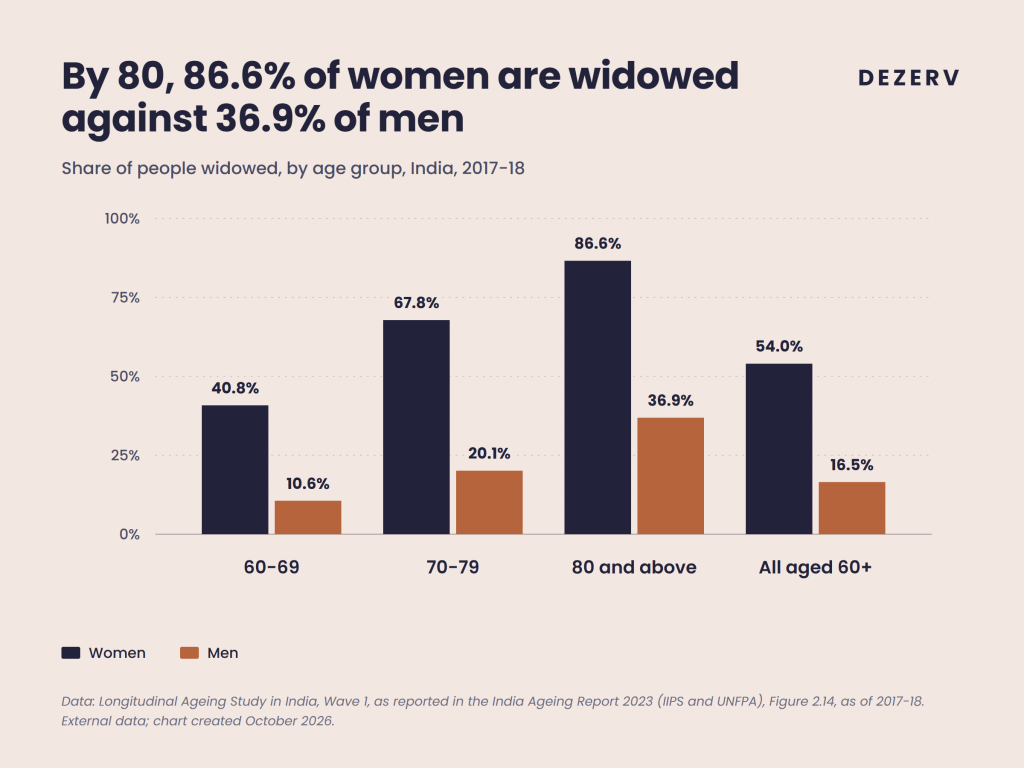
Past 80, 86.6% of women were widowed against 36.9% of men.
The same report notes that older women in India are more likely to depend on their spouses for financial security. For most couples, then, the plan's horizon is the wife's lifetime. It has to be one she can run alone at 80, on a corpus that lasts to the longer-lived spouse's likely age rather than to the couple's average.
When joint names and joint-life are the wrong call
These defaults assume a first marriage in which the spouse is also the main heir.
Blended families are the first exception. Where children from an earlier marriage are among the heirs, an "either or survivor" account still sends the balance to the surviving spouse first, and because that spouse collects as a trustee for the legal heirs, the children keep their claim and the dispute can end up in court.
In these families a precise will, with nominations that match it, carries more weight than joint names do.
A single-life annuity can be the better buy when the other spouse already has her own pension or a larger portfolio. It pays more each month for the same purchase price.
The gender default also fails where the wife runs the money. Men are widowed less often, yet in the same survey one in six men aged 60 and above, and more than a third past 80, were widowers. Build the plan for whichever spouse is less involved with the money.
Handing over the running of it
Some couples decide the survivor should not be running a portfolio alone at 75, and hand the day-to-day work to a grown child or to a professional manager.
A portfolio management service (PMS) is one such arrangement. Dezerv Investments Private Limited offers Portfolio Management Services (PMS) that provide exposure to relevant asset classes, primarily through underlying mutual funds, in accordance with each investment approach's mandate. The minimum investment amount for PMS is ₹50 lakh, subject to applicable regulatory requirements and the terms of the relevant service. Investments are subject to market risks, and returns are not guaranteed.
This conversation matters least for a couple who already share the running of their money.
Everyone else gains from finishing it while both of you are well and a salary is still coming in. After that come two practical questions: how to turn the corpus into a steady monthly income, and whether it lasts to the survivor's likely age, which a retirement calculator can test.
Key takeaways
- Write one operating note for the survivor: every holding, its nominee, how its income is drawn, the next decision due and whom to call. Revise it every year.
- A bank account with a valid nominee or survivorship instruction generally follows a separate deceased-claim route, without the simplified-claim amount threshold. Under RBI rules banks must settle qualifying claims within 15 calendar days after receiving all required documents; a single-name account without nomination may require additional claimant evidence, particularly for higher-value or disputed claims.
- From 1 September, 2026, a demat account or fund folio can carry up to three nominees; reviewing them is one item on the checklist for the five years before retirement.
- For bank deposits, payment to a nominee or survivor does not by itself settle legal heirs’ ultimate rights. Securities transmission and beneficial ownership depend on holding arrangements and succession law. Life-insurance nominations may operate differently for close family beneficiaries, subject to the applicable law and policy facts. Keep a will consistent with both.
- At the first death a single-life annuity stops paying for good, while single-name deposits and an SWP can pause for weeks, so keep a few months of the survivor's need liquid in a joint account.
- Plan around the spouse likely to live longer, usually the wife, and around whichever of you handles the money less.
Frequently Asked Questions
Should retirement assets be held in single or joint names?
For bank accounts, joint "either or survivor" holding is usually the fastest route: the survivor claims on a claim form, the death certificate and identity proof, and RBI rules give the bank 15 calendar days from complete papers. Joint demat accounts and fund folios pass to the survivor by transmission. Joint holding speeds access but does not settle who finally owns the money, so couples with children from an earlier marriage may prefer single names with matching nominees and a will.
What is survivor-income design?
Survivor-income design is arranging a couple's retirement income so it holds up when one partner dies. Some streams, such as a single-life annuity, stop paying at the first death; others, such as interest on single-name deposits or an SWP that has to be re-registered, pause for weeks. The design maps each stream, holds income assets and the payout account jointly, chooses survivor benefits where a product offers them, and keeps a few months of the survivor's need in liquid form.
Does naming my spouse as nominee mean they inherit the assets?
Usually not, for bank and securities accounts. The RBI's 2025 claim rules say a nominee or survivor receives a bank balance as a trustee of the legal heirs, and the Supreme Court held in December 2023 that nomination of shares and demat holdings does not override succession law. Life insurance is the exception: under the Insurance Act, 1938, a nominee who is the policyholder's spouse, child or parent takes the policy money as its owner, though courts have read the rule in different ways.
Why does a couple's retirement plan need to focus on the wife?
Women in India outlive men. At 60 a woman can expect about 19.8 more years against 17.5 for a man (SRS life tables, 2020-24), and in 2017-18, 54% of women aged 60 and above were widowed against 16.5% of men, rising to 86.6% against 36.9% past 80 (India Ageing Report 2023). The plan's horizon is usually her lifetime, so it has to be one she can run alone. Where the wife manages the money, build it for the husband instead.
What should a surviving spouse do in the first weeks after a death?
Claim first on whatever pays the bills. A joint bank account or one with a nominee needs a claim form, the death certificate and identity proof, and RBI rules give the bank 15 calendar days from complete papers. Then file transmission for demat accounts and fund folios, and re-register any SWP that stopped when the units moved to a new folio. A few months of spending kept liquid in a joint account covers the wait.
Disclaimer
Dezerv Investments Private Limited is a SEBI-registered Portfolio Manager (Registration No. INP000007377). Distribution services are offered by Dezerv Distribution Services Private Limited, a wholly owned subsidiary of Dezerv Investments Private Limited, under AMFI Registration No. ARN-248439 and APMI Registration No. APRN-00615. This article is intended solely for general educational and informational purposes and should not be construed as personalised investment, financial planning, tax or legal advice, or as a recommendation, offer or solicitation to invest in any security, financial product or investment strategy. Readers are advised to consult their financial, legal or tax advisor, as appropriate, before making decisions based on the information provided herein.
The regulatory provisions, statistics, historical data and illustrative calculations in this article are based on the sources cited and are provided for general informational purposes only. The examples relating to retirement income, asset transmission and survivor-income planning are illustrative and depend on the assumptions stated. Actual outcomes may vary depending on individual circumstances, applicable laws, succession arrangements, account structures, product terms, investment performance, taxes and prevailing market, economic and regulatory conditions. This article is not a complete disclosure of every material fact, term or condition.
Investment in the securities market is subject to market risks. Please read all related documents carefully before investing. Past performance may or may not be sustained in the future.