"Live on the dividends and never sell a share" is one of the oldest retirement plans. Whether it can carry a retirement turns on one number, the yield. On the yield NSE Indices reported for 30 September, 2026, ₹1 crore in the Nifty 50 pays about ₹1.22 lakh a year, a monthly equivalent of a little over ₹10,000, paid as boards declare it.
A retiree who needs ₹1 lakh a month would need close to ₹10 crore in that index (a sample scenario). So what does the plan see that the yield does not?
In short
A dividend portfolio can supply part of a retirement income, rarely all of it: the Nifty 50 yielded 1.22% on 30 September, 2026, so ₹1 crore pays about ₹1.22 lakh a year. In tax year 2026-27, dividends are taxed at your slab with 10% deducted at source, while a systematic withdrawal plan (SWP) is taxed only on the gain in each withdrawal. An international dividend study reported a 14.3% decline in aggregate Indian dividends measured in US dollars in 2020; this is not an estimate of every investor’s rupee income. Unless a pension already pays the essentials, treat dividends as one slice of income and draw the rest through an SWP.
Table of contents
The dream: live on the dividends, never sell a share
A dividend portfolio for retirement income is a set of shares or equity funds chosen for the cash they pay out, held to spend the payouts and never sell the holdings. The appeal is that the share count never falls, no sale has to be timed, and the money arrives like a pension.
The plan skips one fact. All else equal, a company’s share value adjusts for the dividend when it trades ex-dividend, although the actual market price also reflects other developments, so a dividend is your own capital arriving in cash, not a bonus. NSE publishes a Total Returns version of the Nifty 50 for that reason: price and dividend are two halves of one return (NSE Indices, 30 September, 2026).
A fund's payout works the same way. That is why SEBI renamed the dividend option to Income Distribution cum Capital Withdrawal (IDCW), a cousin the SWP guide warns retirees against. Whether a return reaches you as price or as dividend is a question of tax and convenience, since the total return funds the retirement either way.
What Indian indices actually yield
The Nifty 50 carried a dividend yield of 1.22% on 30 September, 2026, with a price-to-earnings ratio (P/E) of 19.36 and a price-to-book ratio (P/B) of 2.78 (NSE Indices), while the Nifty Dividend Opportunities 50 yielded 2.37% (NSE Indices); it must include the 25 highest-yielding of the 300 largest and most-traded companies, and caps any one stock at 10%.
The 15-stock Nifty High Dividend Yield 15 yielded 5.38% (NSE Indices), but it was launched only that same day, with a history calculated back to April 2005.
| Index (30 September, 2026) | Dividend yield | ₹1 crore pays a year | Corpus for ₹1 lakh a month |
|---|---|---|---|
| Nifty 50 | 1.22% | ₹1.22 lakh | ₹9.84 crore |
| Nifty Dividend Opportunities 50 | 2.37% | ₹2.37 lakh | ₹5.06 crore |
| Nifty High Dividend Yield 15 | 5.38% | ₹5.38 lakh | ₹2.23 crore |
A sample scenario, not a forecast or guarantee of returns: each corpus is ₹12 lakh a year (a monthly equivalent of ₹1 lakh; dividends are not paid monthly) divided by the index's trailing dividend yield, before tax, with the yield held constant. A yield is the past twelve months' dividends divided by today's price; it describes last year, not next year's income. Source: NSE Indices factsheets (Nifty 50, Nifty Dividend Opportunities 50, Nifty High Dividend Yield 15), 30 September, 2026.
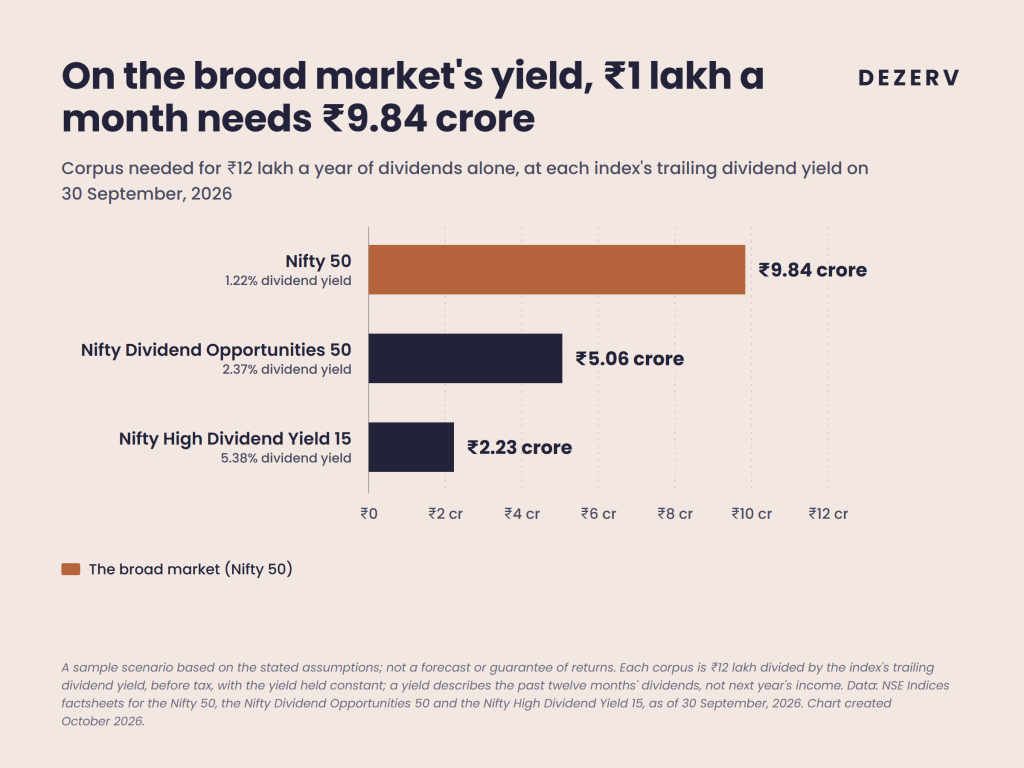
On the broad market, dividends alone fund about a tenth of a ₹1 lakh-a-month plan.
How dividends are taxed, against an SWP
A dividend is added to your total income and taxed at your slab under the Income-tax Act, 2025, in force since 1 April, 2026. Under the default regime, 30% applies above ₹24 lakh, and the company deducts 10% at source unless the year's dividends from it are ₹10,000 or less and paid other than in cash.
An SWP redemption is a sale, so only the gain inside it is taxed.
For an equity-oriented fund that is 12.5% on long-term gains once the year's total passes ₹1.25 lakh (Income-tax Act, 2025), with nothing deducted at source for a resident. Holding periods and unit order are in the SWP guide.
Put both routes on a ₹1 crore portfolio that must produce ₹6 lakh a year:
| Route | Assumption | Tax in the year | In hand |
|---|---|---|---|
| Dividends | taxed at the 30% slab | ₹1,87,200 | ₹4,12,800 |
| Dividends | taxed at a flat 20% rate | ₹1,24,800 | ₹4,75,200 |
| Dividends | taxed at a flat 10% rate | ₹62,400 | ₹5,37,600 |
| SWP from an equity fund | 30% of each withdrawal is gain | ₹7,150 | ₹5,92,850 |
| SWP from an equity fund | 50% of each withdrawal is gain | ₹22,750 | ₹5,77,250 |
| SWP from an equity fund | 70% of each withdrawal is gain | ₹38,350 | ₹5,61,650 |
A sample scenario, not a forecast or guarantee of returns. ₹6 lakh is drawn in the tax year from a ₹1 crore holding. The dividend rows assume a 6% yield, above any of the three index yields shown earlier; they compare the tax on ₹6 lakh of income, whatever the corpus that produces it. Dividend rows: other income already fills the lower slabs, so the dividend is taxed at the rate shown plus 4% cess; total income is below ₹50 lakh, so no surcharge (above ₹50 lakh a surcharge applies, capped at 15% on dividends and long-term gains under the Finance Act, 2026). SWP rows: units held over twelve months; the gain share is (value minus cost) divided by value for the units redeemed first; no other long-term gains in the year; the first ₹1.25 lakh of gain is exempt, the rest taxed at 12.5% plus cess. Rules as in the Income-tax Act, 2025; the treatment depends on individual circumstances and may change.
The flat 20% and 10% rows apply one rate to the whole dividend, so both understate the tax: a ₹6 lakh dividend spills into higher bands. From the foot of the 20% band the tax is ₹1,35,200; from the foot of the 10% band it is ₹93,600, because the income also loses the rebate.
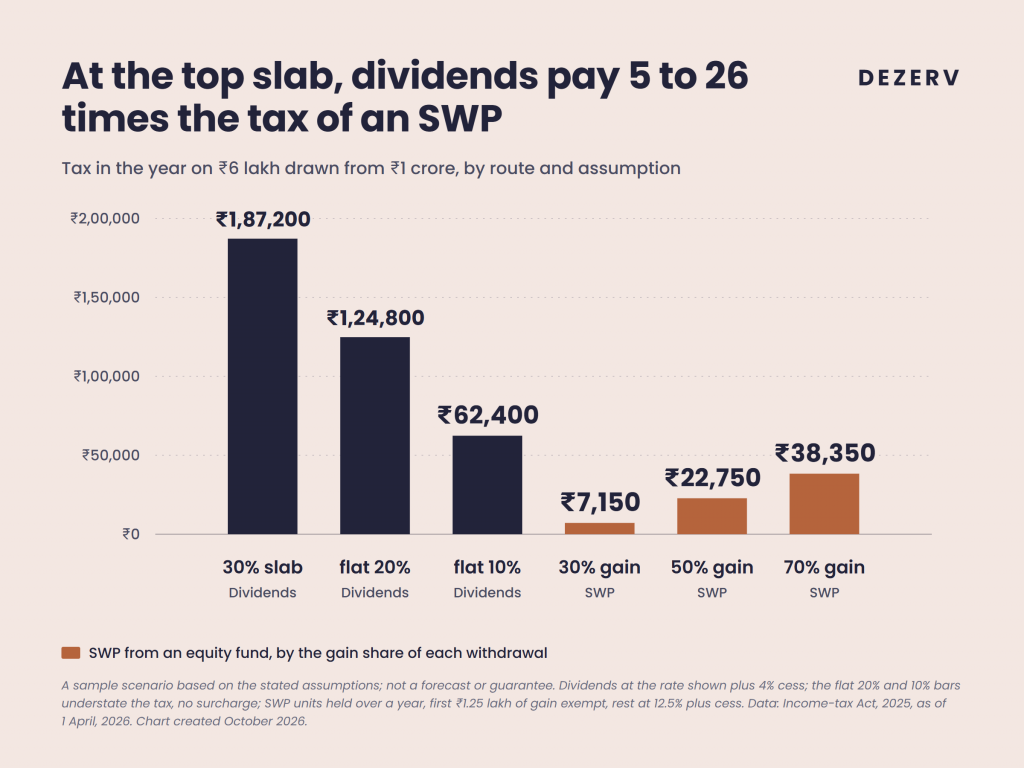
In this 30%-slab illustration, the dividend receipt incurs about 26 times the immediate tax on an equal cash withdrawal through an equity-oriented SWP in which 30% is gain, and it hands ₹60,000 of that to the tax department in advance, through deduction at source; that gap comes from the base, the whole payout against the gain inside a withdrawal, before it comes from the rate. The SWP is partly a redemption of invested capital, not an equal amount of investment earnings, and it reduces the units remaining in the fund. The available ₹1.25 lakh aggregate equity-gains threshold is assumed unused by other transactions.
Tax deferral may still affect cash-flow timing where a redemption gain is taxed at slab, as for units meeting the specified-mutual-fund provisions, but the total after-tax outcome depends on the fund classification and withdrawal history, and widens above ₹50 lakh of income, where a surcharge applies. It closes at the other end: a retiree whose dividends and other slab income stay within ₹12 lakh pays no tax after the rebate and gets the 10% deducted at source refunded.
Annuity tax sits in SWP vs annuity vs dividends; other receipts in how retirement benefits are taxed.
Dividends get cut when you need them most
During the COVID-19 period, RBI prohibited commercial and cooperative banks from paying dividends on equity shares out of profits for the financial year ended 31 March 2020 (RBI circular RBI/2020-21/75, 4 December 2020, following its April 2020 advisory). Banks sit in financial services, 37.45% of the Nifty 50 on 30 September, 2026 (NSE Indices), and a retiree living on their dividends lost that income by regulation. Source: RBI dividend circular, 4 December 2020
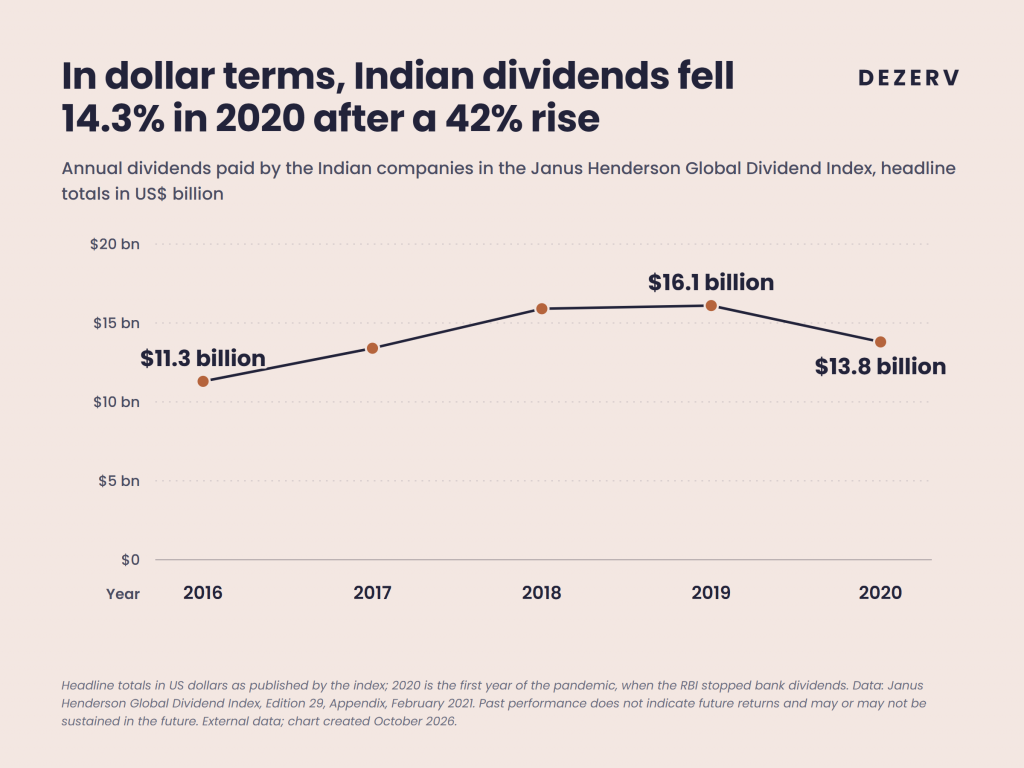
The cuts ran wider than banks: Indian companies in the Janus Henderson Global Dividend Index paid $13.8 billion in 2020 against $16.1 billion in 2019, a fall of 14.3% in aggregate headline US-dollar terms, influenced by the study’s coverage and currency movements, not a measure of every Indian shareholder’s rupee dividend (Janus Henderson, Edition 29, February 2021). Payouts had risen 42% in the three years before. Globally, one company in eight cancelled its dividend and one in five cut it between April and December 2020.
| Year | India dividends (US$ billion) |
|---|---|
| 2016 | 11.3 |
| 2017 | 13.4 |
| 2018 | 15.9 |
| 2019 | 16.1 |
| 2020 | 13.8 |
Annual dividends paid by the Indian companies in the Janus Henderson Global Dividend Index, headline totals in US dollars. Source: Janus Henderson Global Dividend Index, Edition 29, Appendix, February 2021.
For a retiree, 2020 was sequence-of-returns risk arriving through the income line. An SWP keeps drawing the amount you set, by selling more units.
A ₹1 crore portfolio on a 5.38% yield pays ₹5.38 lakh a year; a hypothetical 14.3% decline in its own rupee payout would remove about ₹77,000; the cited 14.3% aggregate US-dollar fall does not show that individual portfolios experienced this same percentage, with no notice and no appeal, in the months the portfolio's value fell (a sample scenario, not a forecast or guarantee).
The yield trap, and the concentration it hides
A dividend yield rises in two ways: the payout grows, or the price falls.
A 7% yield on a large company can be the second, the market pricing a cut before the board announces it.
Hartford Funds' 2026 study of US dividend data to 31 December, 2025 finds that stocks in the highest quintile of dividend yield have historically underperformed* those in the second quintile (Hartford Funds); its authors tell investors to treat yield as one consideration among several. India's new high-yield index shows what a pure yield screen buys.
Past performance does not indicate future returns and may or may not be sustained in the future.
The Nifty High Dividend Yield 15 held 44.28% of its weight in Oil, Gas and Consumable Fuels and 15.28% in Financial Services on 30 September, 2026, at a P/B of 1.43 against 2.78 for the Nifty 50 (NSE Indices), so a retiree who buys the yield has bought one sector's fortunes with 15 stocks.
"Heads, I win; tails, I don't lose much!"
— Mohnish Pabrai, investor and author, The Dhandho Investor, chapter 1 (Wiley, 2007)
A yield trap inverts Pabrai's test for a bet worth making: heads, you collect a few extra percentage points of income. Tails, the dividend is cut and the capital that paid it is marked down in the same quarter.
There is a running cost too. A book of 15 to 50 dividend-paying companies has to be checked every quarter, company by company, for whether each payout still holds. At 75 that is a second job.
The dividend-growth school, stated fairly
The strongest case for dividends is a long-run one. Going back to 1960, 85%* of the cumulative total return of the S&P 500 can be attributed to reinvested dividends and compounding (Hartford Funds, 2026, data to 31 December, 2025). Companies that grew or started dividends have historically returned more*, with less volatility, than those that held or cut them.
The Indian numbers give the school some support. Over the five years to 30 September, 2026, the total-return Nifty Dividend Opportunities 50 compounded at 10.19%* a year against 6.38%* for the Nifty 50's, and over the previous year it fell 5.71%* against 7.09%* (NSE Indices). Since inception, from base dates twelve years apart, they are level at 12.05%* and 12.12%*.
Past performance does not indicate future returns and may or may not be sustained in the future.
The 85% assumes every dividend was reinvested, put back to work for sixty-five years.
So the strongest argument for dividends is an argument for a dividend-tilted holding inside a total-return portfolio, and it says nothing for living off the payouts. The Dividend Opportunities 50's 50-stock, 10%-capped construction is also easier to hold through a fund than to copy stock by stock.
Where dividends do belong: a slice of the replacement ratio
Dezerv co-founder Sandeep Jethwani's SRP framework asks a family to know three numbers: Survival, Replacement and Protection.
The replacement number is his target: by 55 the portfolio can generate about 70% of the household's expenses without a salary, through dividends, rental yield from real estate investment trusts (REITs) and SWPs; dividends are one named source of three, and the slice that arrives without a decision.
Take a household that budgets ₹12 lakh a year and holds ₹3 crore in a broad-market equity portfolio:
| Source of the ₹12 lakh | Annual amount | Share of the budget |
|---|---|---|
| Dividends at the Nifty 50's 1.22% yield | ₹3.66 lakh | 30% |
| SWP and debt interest | ₹8.34 lakh | 70% |
A sample scenario, not a forecast or guarantee of returns: ₹3 crore multiplied by the Nifty 50's trailing dividend yield of 1.22% on 30 September, 2026 (NSE Indices), before tax; the balance is drawn by SWP and from interest on a debt layer whose size is not modelled here.
That 30% has a real job. In a year like 2020 it may shrink.
What remains still arrives without a sale, so the income plan as a whole forces fewer decisions in a falling market. Stretching the slice further takes either a bigger corpus or a narrower, higher-yield book, and each brings back the tax and concentration costs set out above.
A better design: total return plus an SWP
The design that uses dividends without depending on them is a diversified growth portfolio of equity funds alongside a debt layer, in which dividends are reinvested inside the funds and a fixed monthly sum is drawn out by SWP.
Mohnish Pabrai made a similar point about building the portfolio in a 2025 interview. There is no need to find the next great stock, he argued, because a broad index, bought steadily, does the work (The Diary of a CEO, 21 August, 2025), a view the concentration data above is consistent with.
Dezerv co-founder Vaibhav Porwal made the tax side of this case to Money9, in an undated interview republished on dezerv.in (page metadata 21 May, 2022): recurring payouts and the tax on them leak value from the corpus, so the growth option is better (dezerv.in media). The piece names an SWP as the more tax-efficient way to draw an income.
The answer changes in three cases. Where a pension or annuity already pays the essentials, a dividend cut trims only discretionary spending; where the corpus is several times the need, the yield can cover spending with room for a cut; and within the ₹12 lakh rebate limit the tax case for an SWP all but disappears.
For anyone else, a dividend is a sale too, made quietly through the price, and at most tax rates the visible sale is the cheaper one. To see what a 30% dividend slice and an SWP do to your own corpus, run the numbers in the Dezerv retirement calculator and change the yield assumption first.
Key takeaways
- Size a dividend plan by yield first: at the Nifty 50's 1.22% on 30 September, 2026, ₹12 lakh a year needs ₹9.84 crore (sample scenario on NSE Indices yields).
- Above the ₹12 lakh rebate limit, an SWP is the cheaper way to draw income: at the 30% slab, ₹6 lakh of dividends pays ₹1,87,200 of tax against ₹7,150 for withdrawals that are 30% gain (sample scenario). This is a comparison of taxation on cash received, not equivalent earnings; an SWP redeems fund units and may draw down invested capital.
- Keep essential spending off the dividend line unless a pension or annuity already covers it: Indian payouts fell 14.3% in dollar terms in 2020.
- Read a high yield as a reason to check the payout: the highest-yield quintile has historically underperformed* the second, and India's 15-stock high-yield index carries 44% of its weight in one sector.
- Treat dividends as a slice: about 30% of a ₹12 lakh budget on ₹3 crore at the broad-market yield (sample scenario).
Past performance does not indicate future returns and may or may not be sustained in the future.
Frequently Asked Questions
Can you live on dividends in retirement in India?
Only with a far larger corpus than most plans assume. The Nifty 50 yielded 1.22% on 30 September, 2026 (NSE Indices), so ₹1 crore pays about ₹1.22 lakh a year and ₹1 lakh a month would need about ₹9.84 crore in that index (a sample scenario, not a forecast). Narrowing to high-yield stocks raises the yield but concentrates the portfolio and exposes it to cuts, as 2020 showed. Dividends work as one slice of a retirement income, with the balance drawn by SWP.
How are dividends taxed in India in 2026?
Dividends are added to your total income and taxed at your slab under the Income-tax Act, 2025, which has applied since 1 April, 2026; under the default regime the 30% rate applies above ₹24 lakh of total income. The paying company deducts 10% at source unless your dividends from it in the tax year are ₹10,000 or less and paid other than in cash. Only interest paid to earn the dividend, up to 20% of it, can be deducted. Tax treatment depends on individual circumstances and may change.
Is an SWP better than dividends for retirement income?
For most retirees above the ₹12 lakh rebate limit, yes, because of the tax base. An SWP redemption is taxed only on the gain inside it, at 12.5% above ₹1.25 lakh a year of long-term gains for an equity-oriented fund, while the whole of a dividend is taxed at slab. On ₹6 lakh drawn at the 30% slab, dividends pay ₹1,87,200 of tax against ₹7,150 for an SWP whose withdrawals are 30% gain (a sample scenario, not a forecast). Within the rebate limit the gap can vanish. Tax treatment depends on individual circumstances and may change.
How much money do you need to live on dividends in India?
Divide the annual income you need by the dividend yield of the portfolio. At the Nifty 50's 1.22% yield on 30 September, 2026, ₹12 lakh a year needs ₹9.84 crore; at the Nifty Dividend Opportunities 50's 2.37%, ₹5.06 crore; at the 15-stock Nifty High Dividend Yield 15's 5.38%, ₹2.23 crore (a sample scenario on NSE Indices yields, before tax, not a forecast). The higher the yield you reach for, the smaller and more concentrated the portfolio that provides it.
Are high-dividend stocks safe for retirees?
Not in the way the word suggests. A high yield often means the price has fallen because the market expects a cut, and Hartford Funds' 2026 study of US data finds the highest-yield quintile has historically underperformed* the second. India's Nifty High Dividend Yield 15 held 44.28% of its weight in Oil, Gas and Consumable Fuels on 30 September, 2026 (NSE Indices), and in 2020 the RBI stopped all bank dividends. A diversified portfolio with an SWP carries less of that concentration risk. Past performance does not indicate future returns and may or may not be sustained in the future.
Disclaimer
Dezerv Investments Private Limited is a SEBI-registered Portfolio Manager (Registration No. INP000007377). Distribution services are offered by Dezerv Distribution Services Private Limited, a wholly owned subsidiary of Dezerv Investments Private Limited, under AMFI Registration No. ARN-248439 and APMI Registration No. APRN-00615. This article is intended solely for general educational and informational purposes and should not be construed as personalised investment, financial planning, tax or legal advice, or as a recommendation, offer or solicitation to invest in any security, financial product or investment strategy. Readers are advised to consult their financial, tax and legal advisors before making financial or property-related decisions.
The dividend yields, corpus requirements, tax comparisons, withdrawal illustrations and historical performance data discussed in this article are based on the sources, dates and assumptions stated and are illustrative only. They do not represent guaranteed returns, future dividend payouts or assured retirement income. Actual dividends, investment returns and tax liabilities may vary depending on market conditions, the investor’s portfolio, applicable tax laws and individual circumstances. This article is not a complete disclosure of every material fact, term or condition.
Investment in the securities market is subject to market risks. Please read all related documents carefully before investing. Past performance may or may not be sustained in the future.