After 60 the health premium keeps climbing on its own. The regulator limits the climb, but only so far.
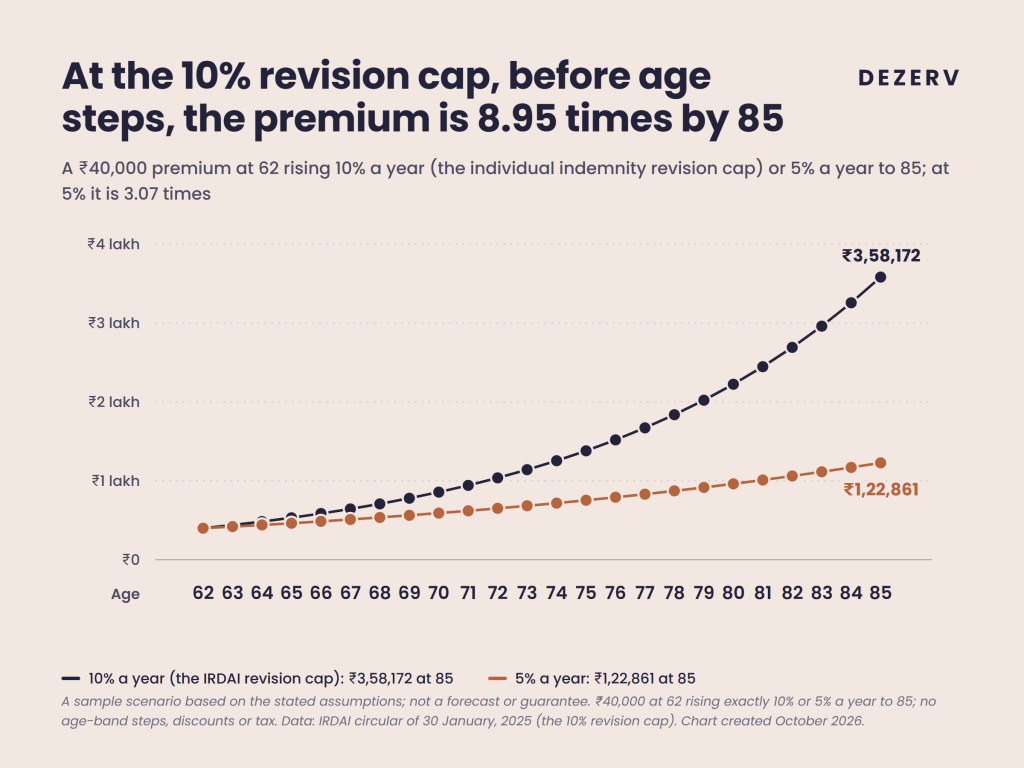
Since its January 2025 rule, a senior's premium rates on an individual indemnity policy cannot be revised by more than 10% a year without consulting it first. Even at that cap, before any age-band step, a ₹40,000 premium at 62 becomes ₹3.58 lakh at 85, or ₹35.4 lakh over 24 years for ₹25 lakh of cover (a sample scenario, method below).
With a few crore saved, why not keep that money and pay the hospital directly? The answer starts with how premiums are priced.
In short
For most affluent households after 60 the answer is both: an indemnity policy whose waiting periods have run, for the hospital bill that can reach tens of lakhs, and a medical corpus for the co-payments, sub-limits and premiums themselves. IRDAI’s 2024–25 data shows approximately ₹78 of claims incurred per ₹100 of net earned individual health-insurance premium, an aggregate industry ratio that does not estimate an individual retiree’s expected bills or self-insurance savings. Pure self-insurance fits only a household whose liquid corpus could absorb a ₹46 lakh to ₹90 lakh bill late in life (a sample scenario) and still pay for living.
Table of contents
Why premiums jump after 60
A health premium is priced for an age band. Public rate charts run in bands, 55 to 60, 61 to 65, and each band costs more because its members claim more often and for larger sums (New India Assurance premium chart, effective 1 November, 2024). Your own claims are not supposed to move your price.
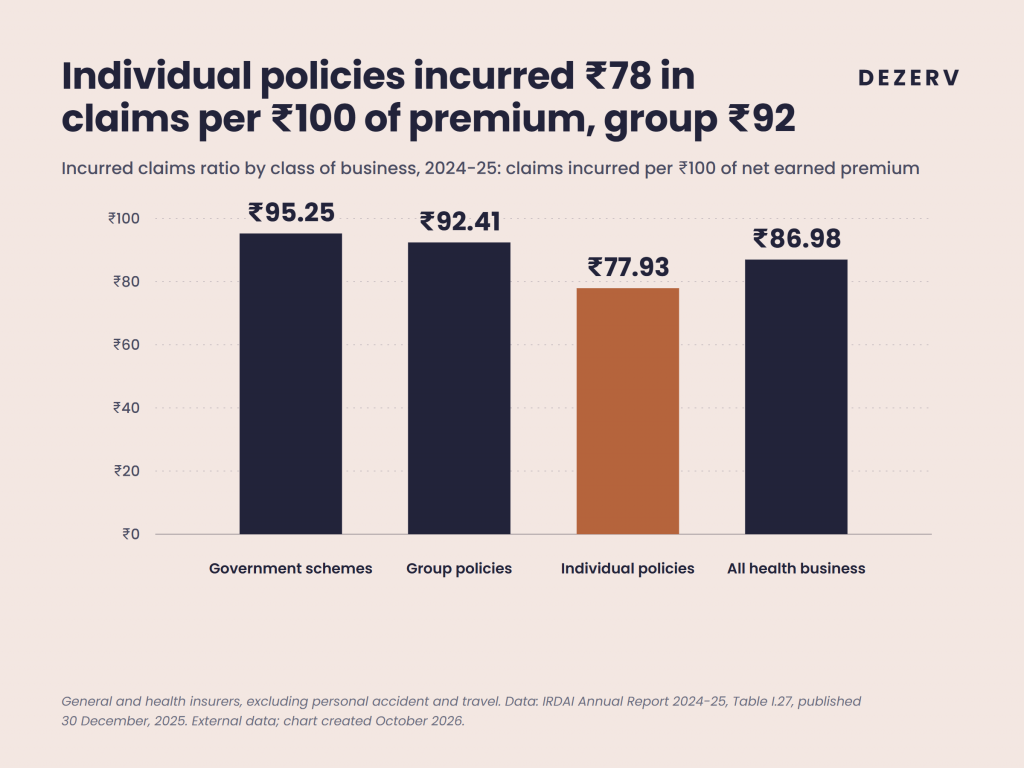
Under the IRDAI (Insurance Products) Regulations, 2024, renewal loadings are set for the insurer's whole portfolio, never for one policyholder's claims, so a 70-year-old pays the cost of every 70-year-old in the pool. On individual business, insurers incurred ₹77.93 in claims for every ₹100 of net earned premium in 2024-25, against ₹92.41 on group business (IRDAI Annual Report 2024-25, Table I.27).
The difference cannot be treated as an individual policyholder’s savings from self-insurance: pooled claims, expenses, risk profiles and timing vary across products and ages.
| Class of health business | Claims incurred per ₹100 of net earned premium, 2024-25 | Same, 2023-24 |
|---|---|---|
| Government schemes | 95.25 | 115.28 |
| Group policies | 92.41 | 93.75 |
| Individual policies | 77.93 | 75.06 |
| All health business | 86.98 | 88.15 |
Source: IRDAI Annual Report 2024-25, Table I.27 (incurred claims ratio, general and health insurers, excluding personal accident and travel), published 30 December, 2025. External data; table created October 2026.
The IRDAI rules that change the maths after 60
| Rule | What it says | Where it is written |
|---|---|---|
| The 10% cap | No revision of a senior citizen's premium on an individual indemnity policy by more than 10% a year to the existing rate chart; a larger increase, or withdrawing the product, needs prior consultation with IRDAI | Circular of 30 January, 2025, recorded in the Annual Report 2024-25 |
| No age bar | Insurers must offer products that cater to all age groups and endeavour to cover people with all existing conditions | Products Regulations, 2024, the product-design rules for health products |
| The clocks and renewal | 36-month waits and the 60-month moratorium (how the clocks run); no re-underwriting at renewal unless the sum insured rises | Products Regulations, 2024; Master Circular of 29 May, 2024 |
| Cashless timelines | A cashless request is decided within one hour; final discharge authorisation within three hours, with any delay cost borne by the insurer | Master Circular, the cashless and discharge rules |
| A senior citizens' channel | Every insurer runs a separate channel for senior citizens' claims and grievances, listed on its website | Products Regulations, 2024, the special provision for senior citizens |
Source: IRDAI texts as linked, read 15 October, 2026. The regulations took effect on 1 April, 2024; the premium circular on 30 January, 2025.
IRDAI’s January 2025 circular requires prior consultation before an insurer revises the existing premium rate chart for qualifying senior-citizen individual indemnity health products by more than 10% in a year. It is not an unconditional cap on any individual renewal premium; age-band steps can apply under the existing chart, so a 66-year-old may pay the next age-band rate even without a general change to the rate chart: on New India's chart, a 2.5% loading on the 61-to-65 premium for every year past 65.
The waiting periods and the moratorium cut the other way: they belong to the policy you already hold. One bought at 50 and renewed without a break would ordinarily have completed its applicable pre-existing-disease and specified-treatment waiting periods by 62 and benefits from the 60-month moratorium on contesting claims for non-disclosure or misrepresentation (other than established fraud, subject to the rules for enhanced sums insured); permanent exclusions, co-payments, deductibles and other policy terms can still apply; one bought fresh at 62 restarts both clocks with a longer medical file.
What ₹25 lakh of cover costs at 62, 70 and 78
Public rate cards are the only price evidence that is not a quote. One senior-citizen product priced ₹25 lakh of individual cover at ₹35,985 a year at 61 and 68, before tax, with a 30% co-payment on every claim (Star Health, 2021 filing); New India's chart of 1 November, 2024 prices ₹15 lakh above a ₹5 lakh threshold at ₹14,740 for ages 61 to 65, before GST.
Both are dated filings, so read them as the shape of the market; a live quote at your age will differ. Since 22 September, 2025, individual health policies carry no GST (Department of Financial Services), so the pre-tax figure is now the price.
The table starts from ₹40,000 at 62, the Star card's ₹35,985 rounded up about 11% for revisions since 2021 (an assumption, not a quote). It then rises 10% a year, an illustrative annual increase, independent of the IRDAI prior-consultation threshold and before any age-band step, so a steep path rather than an expectation, or 5%, half the cap: premium at age A = ₹40,000 × (1 + rate)^(A − 62), summed over 24 premiums.
Age-band steps come on top and are left out, because charts differ: the Star card priced 61 and 68 the same.
| Age | Premium at 10% a year (₹) | Premium at 5% a year (₹) |
|---|---|---|
| 62 | 40,000 | 40,000 |
| 65 | 53,240 | 46,305 |
| 70 | 85,744 | 59,098 |
| 75 | 1,38,091 | 75,426 |
| 78 | 1,83,799 | 87,315 |
| 80 | 2,22,397 | 96,265 |
| 85 | 3,58,172 | 1,22,861 |
| Total paid, 62 to 85 (24 premiums) | 35,39,893 | 17,80,080 |
A sample scenario on a ₹40,000 annual premium at 62 (from a 2021 Star Health filing, rounded up) rising exactly 10% or 5% a year to 85; no age-band steps, no change in sum insured, no discounts, no tax; not a forecast or guarantee. October 2026.
Over 23 years, 10% a year multiplies anything by 8.95. This compounding example shows how repeated increases can affect affordability; the 10% rate is an assumption, not an insurer quotation or a guaranteed regulatory ceiling.
The self-fund alternative: what the corpus has to carry
A household that self-funds medical costs avoids paying premiums but also assumes the full risk of large and repeated claims; the aggregate claims ratio does not calculate its savings. Put the same 24 premiums into a medical corpus earning 4.85% after tax, what today's 7.05% (indicative) on an SBI five-year senior-citizen deposit leaves at the 30% slab, and on the 10% path it holds ₹54.8 lakh at 85 (a sample scenario that assumes the rate survives every renewal).
What the corpus takes on is the tail. The table inflates a ₹10 lakh hospital bill at an assumed 10% a year, just below the 11.5% rise in employer medical-plan costs in India that Aon projects for 2026.
| Age | A ₹10 lakh bill of today, at 10% a year (₹) | Corpus from redirected premiums at 4.85%, 10% path (₹) |
|---|---|---|
| 62 | 10,00,000 | 41,940 |
| 70 | 21,43,589 | 6,73,036 |
| 78 | 45,94,973 | 22,94,471 |
| 85 | 89,54,302 | 54,83,480 |
A sample scenario, not a forecast or guarantee. Hospital costs assumed to rise 10% a year; the premiums from the 10% path invested at the start of each year at 4.85% after tax, valued at the end of each age shown. The 4.85% is what the 7.05% SBI pays a senior citizen on a five-year deposit before tax (card effective 15 December, 2025, indicative, not guaranteed) leaves after the 30% slab and 4% cess (other income assumed to keep the household in that slab), held constant for 24 years although deposit rates reset at each renewal. October 2026.
The corpus is thinnest when cover would have been cheap, never catches the bill at 85, and pays once; a policy's ₹25 lakh returns yearly.
The pure self-insurer answers that a policy pays less than it promises: in 2024-25 insurers paid about ₹71 of every ₹100 claimed and disallowed ₹14 under policy terms (IRDAI Annual Report 2024-25, Table I.29, which counts cash paid out, a stricter test than the incurred ratio above). It is a fair point against relying on cover alone.
Saurabh Mukherjea, investor and author, argues from the other end: buy ample life and medical cover before investing, because medical inflation of 10 to 15% a year is already here and cover is cheapest bought young (Figuring Out, 11 October, 2026; his figure). At 62 the cheap years are gone, yet his inflation point still argues for cover.
Watch out
A corpus earmarked for hospital bills and then spent on a renovation or a wedding is not a medical corpus. The self-insurer's whole plan rests on that money being untouchable for anything else.
The decision table: insure, self-insure, or both
Three facts decide it: a policy whose clocks have run, cover at standard rates, and a corpus that could absorb the late-life bill.
| Your situation at 60 or later | What tends to fit | Why |
|---|---|---|
| An old policy, renewed without a break, waits and moratorium complete | Both: keep the policy, add a corpus | The credits cannot be bought back; a fresh policy restarts 36-month waits with an older medical file |
| No cover, insurable at standard rates, liquid corpus too small to absorb the ₹46 lakh to ₹90 lakh bill (sample scenario above) twice | Both: buy an indemnity policy now, hold a corpus sized for the first three years' exclusions | Waits run only while a policy is in force; the corpus covers what is excluded until they end |
| No cover, offered only with loadings or exclusions | Both, weighted to the corpus | The policy still carries the un-excluded tail; the corpus is sized for the excluded condition |
| Cover declined outright | Self-insure by necessity, and re-apply yearly | Insurers must offer products for all ages and endeavour to cover all conditions; underwriting changes |
| Liquid corpus large enough to absorb a ₹90 lakh bill at 85 and still pay for living | Self-insure is arithmetically open; most households still keep a base policy | The cashless network, the one-hour authorisation and the three-hour discharge rule buy convenience a corpus cannot |
| Parents insured on a child's money | Both, with the child paying the premium | The child's payment carries its own deduction in the old regime; the corpus sits in the parent's name |
A decision framework, not a recommendation of any product, insurer or sum insured. The ₹46 lakh and ₹90 lakh bills come from the sample scenario above. October 2026.
Insure the bill you could not pay twice, and self-fund the bill you would rather not claim; most affluent households have one of the first kind.
Super top-up, portability and the sub-limit traps
A super top-up pays once a policy year's hospital bills cross a deductible (where it falls short), so it stacks cheaply over a base policy or the corpus: New India's chart prices ₹22 lakh above an ₹8 lakh threshold at ₹16,390 for a 61- to 65-year-old (1 November, 2024, before GST).
Sub-limits are where the self-funder is still needed. In the 2021 filing above, every admissible claim carried a 30% co-payment at ₹15 to 25 lakh of cover, and room rent was capped at ₹10,000 a day. On those terms a ₹20 lakh bill leaves ₹6 lakh with the household before any room-rent proportion is applied.
Read the Customer Information Sheet for the co-payment, room-rent and disease-wise sub-limit rows before comparing premiums. Larger rows are often what makes a senior product cheaper.
Portability and migration carry credits up to the old sum insured. After 60, port for better terms, never with a gap: a break restarts the waits.
The couple and the 75-plus problem
A family floater gives a couple one sum insured between them at a discount; the 2021 filing priced two ₹25 lakh individual covers at ₹71,970 and a floater at ₹61,175, a ₹10,795 saving that buys shared exposure: one hospitalisation can use most of the sum before the second person falls ill in the same year.
Separate policies may preserve independent sums insured; a floater may cost less. The better choice depends on ages, medical underwriting, restoration features, policy terms and both spouses’ risks. Survivor coverage depends on the policy’s contractual conditions.
Renewal cannot be refused for claims, and the policy carries a nomination (Master Circular, 29 May, 2024). The survivor often does not know where the documents are.
At 78 the question changes. It is who produces the card at the admissions desk at two in the morning.
The one-hour and three-hour rules help only if someone can start the clock, so the household needs one sheet that lists:
- the insurer and the policy number;
- the insurer's senior citizens' channel;
- the third-party administrator (TPA);
- the Customer Information Sheet;
- the account that holds the corpus.
That corpus has an address in Sandeep Jethwani's layered structure: in his 8 May, 2026 essay, Dezerv's co-founder puts a medical emergency in the second layer. In answers to Mint in March 2026 he described holding that money in liquid or arbitrage funds, apart from lifestyle money, with a super top-up and a critical-illness lump-sum policy as the insurance layers alongside it.
Tax: a deduction in the old regime, none in the new
The Income-tax Act, 2025 keeps the premium deduction only for a taxpayer who opts out of the default regime.
| Who pays, and for whom | Old-regime deduction (a tax year) | Condition |
|---|---|---|
| A senior citizen, for self or spouse | Up to ₹50,000 | Premium or preventive check-up (check-ups up to ₹5,000 within the limit) |
| A senior citizen with no policy | Up to ₹50,000 of medical expenditure | Allowed only where no premium is paid for that person |
| An adult child, for a parent aged 60 or more | A separate ₹50,000 | On top of the child's own family limit |
| Anyone, under the default regime | Nil | The default regime is computed without this deduction |
Source: Income-tax Act, 2025, the health-insurance deduction and the default-regime computation, read 15 October, 2026. A senior citizen is a resident aged 60 or more at any time in the tax year.
For a household whose other income keeps it in the 30% slab, the deduction on a ₹40,000 premium is worth ₹12,000 a year before surcharge and cess, ₹15,000 at the ₹50,000 limit (a sample scenario): material against that premium, noise against ₹3.58 lakh at 85. The medical-expenditure route, the self-funder's small consolation, is lost the year a premium is paid.
This piece is not for a household with cover declined and a corpus short of that bill; they need a ring-fenced corpus first. Everyone else can set the income side in retirement income planning, run medical costs at their own inflation in the Dezerv retirement calculator and size both halves: cover for the large bill, a corpus for the rest.
Key takeaways
- IRDAI requires prior consultation for annual revisions above 10% to the relevant existing premium rate chart; it is not an unconditional individual premium cap. At an assumed 10% annual rise, ₹40,000 at 62 becomes about ₹3.58 lakh at 85 (a hypothetical illustration).
- Individual health-insurance business incurred claims of approximately ₹77.93 per ₹100 of net earned premium in 2024–25 (IRDAI). The industry ratio does not estimate a particular household’s medical risk or savings from self-insurance.
- A continuously renewed policy may have completed relevant waiting periods and the 60-month moratorium, making continuity valuable; permanent exclusions, co-payments and other conditions may still apply.
- For most affluent households the answer is both: insure the bill you could not pay twice, self-fund the co-payments, sub-limits and recurring costs.
- The ₹50,000 premium deduction survives only in the old regime under the Income-tax Act, 2025; the default regime gives nothing.
Frequently Asked Questions
Is health insurance worth it after 60 if I have a large corpus?
Usually yes, as one half of a pair. IRDAI's 2024-25 data shows insurers incurred ₹78 in claims for every ₹100 of individual premium, but that aggregate claims ratio does not measure any individual’s savings from self-insuring. Against that, a ₹10 lakh hospital bill of today grows to roughly ₹46 lakh by 78 and ₹90 lakh by 85 if costs rise 10% a year (a sample scenario, not a forecast), and a policy's cover is available again every year while a corpus pays once.
Can an insurer raise my premium every year after 60?
Yes. IRDAI’s 30 January 2025 circular requires prior consultation before raising the existing premium rate chart of a qualifying senior-citizen individual indemnity health product by more than 10% in a year or withdrawing the product; this is not an unconditional cap on the premium payable by an individual policyholder. Moving into an older age band on the same chart is separate from that revision. Renewal loadings must be set for the insurer's whole portfolio, and renewal cannot be refused because you claimed. IRDAI senior-citizen premium circular (30 January 2025): https://irdai.gov.in/circulars
Can a medical corpus replace health insurance after 60?
It can replace the parts a policy does not pay: co-payments, room-rent sub-limits, outpatient and recurring costs, and the premiums themselves. It struggles to replace the catastrophic tail, because the corpus is thinnest in the early years and a late-life bill compounds faster than a conservative corpus grows. The practical design is a policy for the large bill and a ring-fenced corpus for everything else; Dezerv co-founder Sandeep Jethwani has described holding that corpus in liquid or arbitrage funds.
Should a couple over 60 buy a family floater or two separate policies?
A floater gives both spouses one shared sum insured at a discount; in one 2021 filing two ₹25 lakh individual covers cost ₹71,970 and the floater ₹61,175. The saving comes with shared exposure: one hospitalisation can use most of the sum before the second person falls ill in the same year. Separate policies may preserve independent sums insured, while a floater can be more economical. Compare ages, underwriting, restoration benefits, coverage terms and the treatment of survivor coverage under the specific contract.
Is the health-insurance premium deductible under the new tax regime?
No. Under the Income-tax Act, 2025, in force from 1 April, 2026, the default regime is computed without the health-insurance deduction. A taxpayer who opts out can deduct up to ₹50,000 of premium for a senior citizen, up to ₹50,000 of medical expenditure where no premium is paid for that person, and a separate ₹50,000 when an adult child pays a senior-citizen parent's premium. At the 30% slab a full ₹50,000 deduction is worth ₹15,000 a year (a sample scenario).
Disclaimer
Dezerv Investments Private Limited is a SEBI-registered Portfolio Manager (Registration No. INP000007377). Distribution services are offered by Dezerv Distribution Services Private Limited, a wholly owned subsidiary of Dezerv Investments Private Limited, under AMFI Registration No. ARN-248439 and APMI Registration No. APRN-00615. This article is intended solely for general educational and informational purposes and should not be construed as personalised investment, financial planning, tax or legal advice, or as a recommendation, offer or solicitation to invest in any security, financial product or investment strategy. Readers are advised to consult their financial, tax and legal advisors before making insurance, financial or investment decisions.
The premium projections, medical-cost estimates, corpus calculations, tax illustrations and insurance comparisons discussed in this article are based on the sources, dates and assumptions stated and are illustrative only. They do not represent actual insurer quotations, guaranteed premium increases, future medical costs or assured investment returns. Actual premiums, policy benefits, coverage, waiting periods, exclusions, co-payments and tax treatment may vary depending on the insurer, policy terms, applicable laws and individual circumstances. Self-funding medical expenses involves the risk of substantial and recurring healthcare costs, while health insurance may not cover all expenses. This article is not a complete disclosure of every material fact, term or condition.
Investment in the securities market is subject to market risks. Please read all related documents carefully before investing. Past performance may or may not be sustained in the future.