The engine that turns a corpus into a paycheque decides what survives tax, what a spouse receives after the first death and what heirs inherit.
On headline numbers the annuity wins. At age 60, applying the annual payout rate from LIC's August 2025 Jeevan Akshay-VII ₹10 lakh single-life brochure illustration pro rata to ₹1 crore produces ₹8.61 lakh a year. This is a hypothetical scale-up for comparison, not a verified insurer quote for a ₹1 crore purchase; actual payouts depend on the plan option, ages, payment frequency and quote date. A mutual fund drawn at 6%, above what a 30-year draw sustains, pays ₹6 lakh, and can run out.
Both are mostly your own money coming back; only one leaves the rest yours. After tax and after a death, the engines rank differently.
In short
A Systematic Withdrawal Plan (SWP) offers control over withdrawals and may tax only the gain component of each redemption, though the units can be depleted. An annuity pays a contractual income for life, with tax generally charged on the payout; benefits after death depend on the particular option, including joint-life or return-of-purchase-price terms. Dividend income depends on company decisions and prevailing yields. These mechanisms differ in liquidity, inflation exposure, risks and what may remain for beneficiaries.
Table of contents
The three engines, in one sentence each
A Systematic Withdrawal Plan (SWP) is a standing instruction to a mutual fund to redeem a fixed sum into your bank account every month, selling units at that day's net asset value while the rest stays invested.
An annuity is a contract with a life insurer: you pay a lump sum once, and it pays a fixed income for life, pooling buyers so that those who die early fund those who live long.
A dividend income stream is what shares, or an index fund tracking them, pay out of company profits, in amounts and on dates the companies decide.
The master comparison table
| Criterion | SWP from a mutual fund | Annuity from a life insurer | Dividends from shares | Interest from deposits and bonds |
|---|---|---|---|---|
| Certainty of income | None by contract: paid while units remain; a long fall plus a high draw can exhaust them | Contractual, for life, backed by the insurer; the rate is fixed on the day you buy | Set by company boards each year; cut in bad years | Fixed for the term; reset at each renewal |
| Inflation protection | Whatever you set: the draw can rise each year if the corpus can carry it | A level rupee amount in the standard option | Payouts tend to grow with profits over decades, on no schedule | A level amount until renewal, at whatever rate then prevails |
| Tax (tax year 2026-27) | Only the gain in each withdrawal: 12.5% on long-term equity gains above ₹1.25 lakh a year, 20% if sold within 12 months; debt-fund gains at slab, still on the gain only | Every rupee at slab: an 8.61% quote is 5.92% after a 30% slab plus cess | Every rupee at slab, with 10% deducted at source once a company pays you over ₹10,000 in a year | Every rupee at slab, with tax deducted at source above a threshold |
| Liquidity | Change or stop the draw any month; redeem the rest any day, with an exit load only inside the fund's exit-load period | A 30-day free-look window after purchase; then the capital stays with the insurer | Shares sell in a day, at that day's price | Deposits can usually be broken early at a penalty; some schemes and bonds lock in for years |
| What passes to heirs | The remaining units, at market value | Nothing on a single-life annuity; the purchase price, not grown, on the return-of-purchase-price option; the survivor's income on a joint-life option | The shares, at market value | The principal, at face value |
| Behaviour risk | Highest: the draw can be raised, stopped or abandoned in a fall | Lowest: nothing can be sold in a panic | High: yield-chasing and concentration | Low: nothing to sell in a fall; the risk is renewal at a lower rate |
Tax rows per the Income-tax Act, 2025 and the Finance Act, 2026, tax year 2026-27; treatment depends on individual circumstances and may change. Annuity options and the free-look window per the IRDAI Master Circular on Life Insurance Products, June 2024. Annuity rates throughout are one like-for-like set, the example in LIC's Jeevan Akshay-VII brochure of 20 August, 2025, an immediate annuity, for the same buyer (aged 60, paying ₹10 lakh, paid yearly): 8.61% life only (Option A), 6.40% life with return of purchase price (Option F) and 7.96% joint life with 50% to a spouse aged 55 (Option H). The ₹10 lakh brochure illustrations are scaled pro rata to ₹1 crore for comparison only, not verified ₹1 crore insurer quotations; actual payout amounts vary with purchase-size bands, contract option and quotation date; monthly payment is quoted at its own rate; the plan's terms are in LIC's policy document. As of 15 October, 2026. LIC Jeevan Akshay-VII August 2025 brochure: https://www.licindia.in/documents/20121/1319704/LIC_Jeevan%2BAkshay%2BVII_Sales%2BBrochure_4%2Binch%2Bx%2B9%2Binch_Eng%2B_20082025.pdf/a60cff7b-f584-69bb-0b6e-0e5fe4b351a0?t=1755707362869 Insurer brochure, 20 August 2025: https://www.licindia.in/documents/20121/1319704/LIC_Jeevan%2BAkshay%2BVII_Sales%2BBrochure_4%2Binch%2Bx%2B9%2Binch_Eng%2B_20082025.pdf/a60cff7b-f584-69bb-0b6e-0e5fe4b351a0?t=1755707362869
An annuity offers contractual longevity protection and may reduce the need to manage investments. An SWP allows more control over the amount and timing of withdrawals and can be tax-efficient when a smaller portion of each redemption is a taxable gain, but its income depends on the remaining corpus. Dividends are discretionary and may fluctuate. Neither the tax advantage nor the appropriate mix is universal: it depends on fund classification, other income, product terms and retirement needs.
Tax: what ₹1 crore pays in year one
The law taxes the three on different bases: an SWP on gain, an annuity and a dividend on the whole payout; the Income-tax Act, 2025 taxes long-term gains on equity shares and equity-oriented fund units at 12.5% after the first ₹1.25 lakh in a tax year, and at 20% if the units were held 12 months or less.
An annuity is income at your slab rate in the year it is paid, and so is a dividend, with 10% deducted at source once a company has paid you more than ₹10,000; on one ₹1 crore corpus at the top slab, that difference in base is worth about ₹2.6 lakh of tax in the first year.
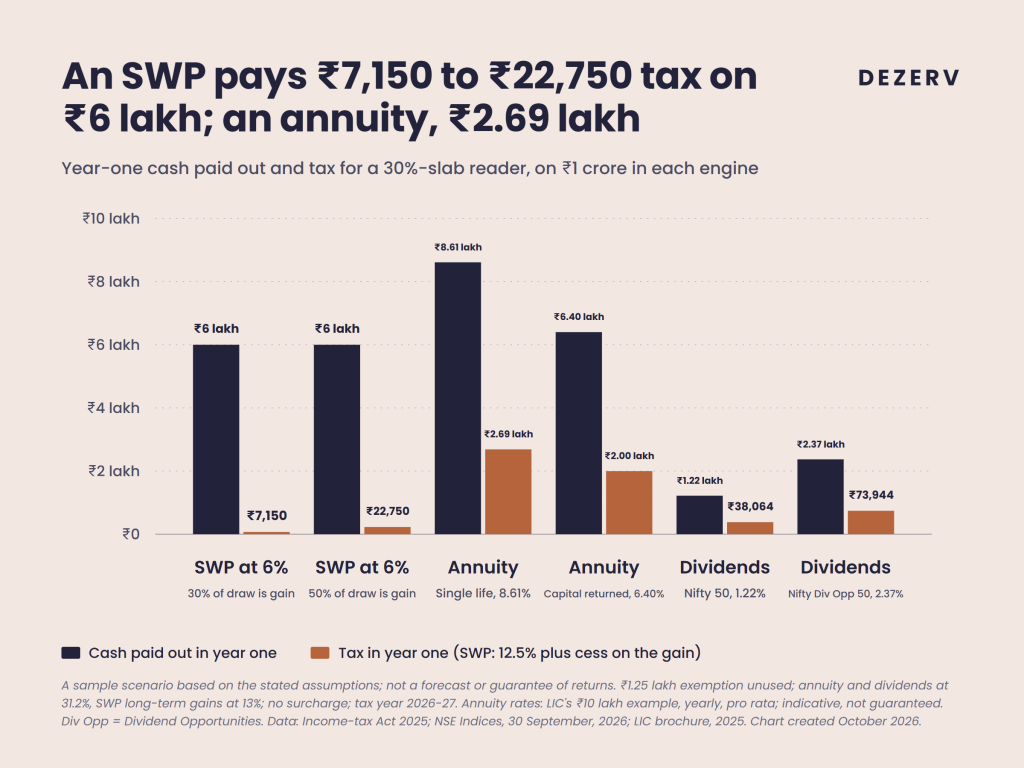
| Engine on ₹1 crore | Cash paid out | Taxable amount | Tax in year one (30%-slab reader; SWP gains at 12.5% plus cess) | Kept after tax |
|---|---|---|---|---|
| SWP at 6%, units bought at ₹70 lakh (30% of each withdrawal is gain) | ₹6,00,000 | ₹55,000 | ₹7,150 | ₹5,92,850 |
| SWP at 6%, units bought at ₹50 lakh (50% gain) | ₹6,00,000 | ₹1,75,000 | ₹22,750 | ₹5,77,250 |
| Annuity, single life at 60 (8.61%) | ₹8,61,000 | ₹8,61,000 | ₹2,68,632 | ₹5,92,368 |
| Annuity, single life with return of purchase price at 60 (6.40%) | ₹6,40,000 | ₹6,40,000 | ₹1,99,680 | ₹4,40,320 |
| Dividends at the Nifty 50 yield (1.22%) | ₹1,22,000 | ₹1,22,000 | ₹38,064 | ₹83,936 |
| Dividends at the Nifty Dividend Opportunities 50 yield (2.37%) | ₹2,37,000 | ₹2,37,000 | ₹73,944 | ₹1,63,056 |
A sample scenario, not a forecast or guarantee of returns. Assumptions:
- The engines are compared on the same ₹1 crore, not the same income. Units held over 12 months, with the ₹1.25 lakh exemption unused elsewhere; tax year 2026-27 rules, which may change.
- Annuity and dividends at a marginal rate of 31.2% (the 30% slab plus 4% cess, no surcharge), because other income fills the lower slabs; SWP gains at 13% (12.5% plus cess). At a flat 20.8% (the 20% slab plus cess; a simplification, since that band is only ₹4 lakh wide and part of an annuity this size would fall in other slabs) the annuity tax is ₹1,79,088 single life and ₹1,33,120 with return of purchase price.
- At ₹3 crore the gap scales: the same 6% draw and 30% gain share pays ₹53,950 of tax on ₹18 lakh of SWP income, against ₹8,05,896 on a ₹25.83 lakh single-life annuity at 31.2%.
- Annuity rates are the like-for-like set in the note under the comparison table, scaled hypothetically to ₹1 crore; this is not a verified quotation for a ₹1 crore purchase, and actual pricing, eligibility and payout frequency must be confirmed with the insurer (LIC brochure, 20 August, 2025, yearly mode); yields from the NSE Indices factsheets, 30 September, 2026.
The annuity pays out the most and keeps no more. Its 8.61% (indicative, not guaranteed) is 5.92% after tax at the top slab, level with the first SWP row, and the return-of-purchase-price option 4.40%. The SWP in the first row keeps 98.8% of what it pays, while dividends at the Nifty 50 yield, taxed like the annuity, pay a fifth of what the SWP draws.
Why the SWP pays so little
An SWP withdrawal is a sale of units, so tax falls only on the gain inside it. On a corpus moved in near retirement, that gain starts small. A debt fund keeps that gain-only base, at slab; the dividend option, Income Distribution cum Capital Withdrawal (IDCW), loses it. The SWP guide covers unit order and holding period.
Above ₹50 lakh of income a surcharge applies; the Finance Act, 2026 caps it at 15% on dividends and capital gains, against up to 25% on slab income.
Watch out
The annuity's 8.61% (indicative, not guaranteed) spends your capital over your expected lifetime; the SWP's 6% comes out of a corpus that remains yours.
Certainty: what an annuity insures that an SWP cannot
An SWP has no contract behind it. The fund pays while units exist.
Units sold in an early fall never recover: sequence-of-returns risk, which can sink a draw that would last 30 years in a calm decade.
An annuity removes both risks: the insurer bears the market and your longevity, so live to 72 or 102 and the payment arrives, for as long as the insurer stands. IRDAI's master circular lists the "guaranteed for life annuity options" insurers may offer, among them a life annuity, one returning the purchase price, and joint-life versions paying the spouse 100%, 50% or another share.
This is the economists' case for annuities, and it is stronger than the SWP case usually admits. Moshe Milevsky, then an associate professor of finance at York University's Schulich School of Business, made it for anyone with a defined-contribution (DC) plan, meaning a corpus built without an employer's pension promise.
"If you have a DC plan and you are close to retirement, you should consider buying an annuity."
— Moshe A. Milevsky, Schulich School of Business, York University (CFA Society Toronto, The Analyst, 18 August, 2020)
He added that longevity alone should not decide it: ask what you will be doing at 95, whether you will still want to run a portfolio, and whether dementia runs in the family; for a retiree who expects not to want that job at 95, putting the income on autopilot is the case for buying.
What the annuity does not insure is purchasing power: the standard option pays the same rupees in year 20 as in year 1. At an assumed 6% inflation, the upper edge of the RBI's 2–6% tolerance band, a level ₹1 lakh a month buys about ₹55,800 of today's goods after 10 years and ₹31,200 after 20 (a sample scenario, not a forecast or guarantee).
The survivor question
For a couple the engine choice is also a widowhood choice. A single-life annuity dies with the annuitant.
A joint-life annuity pays 7.96% against 8.61% single life for the same buyer (indicative; a spouse aged 55 in the example, and the spouse's age moves it), then half to the spouse after the buyer's death: a small price for income that outlasts the first death.
An SWP hands the survivor the whole corpus: more money and more responsibility. If one partner never managed it, that is the plan's weakest point.
Flexibility and legacy: what an SWP keeps
The draw can rise with inflation, fall in a bad year, pause after a windfall, or stop, and the capital can be redeemed within days.
After an annuity's 30-day free-look window from receipt of the policy document (IRDAI, June 2024), the purchase price belongs to the insurer. Under an SWP, only the units and value actually remaining at death are available for transmission under applicable law; an annuity’s post-death benefit depends on the purchased contract, including any joint-life, guaranteed-period or return-of-purchase-price provisions. A single-life, no-return option ordinarily ends at death.
Flexibility is also the SWP's weakness, because every option it keeps is an option to make a mistake. The draw that can rise in a good year tends to rise, and the one that can stop in a fall is often stopped near the bottom, a mistake an annuity rules out because it cannot be sold at all.
The cost of that timing has been measured. Morningstar's Mind the Gap 2026 study found that the average dollar in US funds earned 8.7%* a year over the ten years to 31 December, 2025, against the funds' own 9.9%*, a 1.2-point yearly gap the study traces to when investors bought and sold (Morningstar, 6 August, 2026).
Past performance does not indicate future returns and may or may not be sustained in the future.
Dezerv's view (co-founder Sandeep Jethwani, Business Standard, 31 July, 2026) ranks that behaviour second of three ways an all-market-linked retirement fails. Sequence risk comes first, a missing income floor third.
Can dividends be the engine?
The dream is to live on dividends and never touch capital. The arithmetic puts that dream near ₹5 crore.
At the Nifty 50's 1.22% yield (NSE Indices, 30 September, 2026), ₹6 lakh a year needs about ₹4.92 crore of index; even the Nifty Dividend Opportunities 50, built to hold higher payers, yields 2.37% (NSE Indices), so the same income needs about ₹2.53 crore (a sample scenario, not a forecast or guarantee).
Every rupee is then taxed at slab, so a 30%-slab retiree keeps 68.8% of a dividend against 98.8% of the first SWP withdrawal above, and boards set the payout, cutting it in the years a retiree needs it most. Dividends belong inside the income an SWP portfolio throws off; where a dividend slice fits is its own piece.
Combining engines: a floor and an upside
No single engine does every job. The practical design uses more than one.
Sandeep Jethwani's framing in that Business Standard piece splits the budget in two: non-negotiables (utilities, insurance, basic healthcare) are paid from a low-volatility fixed-income floor, and lifestyle spending by an SWP from the equity and hybrid corpus, rebalanced between them. The three-layer withdrawal structure is one way to organise it: the SWP pays planned spending, and growth assets refill it.
Sizing the annuity slice
How large a slice, if any, is the core of whether to annuitise at all, sizing method included. Jethwani's Business Standard piece caps it at the after-tax gap between essentials and lifelong income; it can reasonably be larger with no pension, a dependent spouse or a record of selling in falls, and nil where a pension covers essentials.
Take ₹10 lakh of essentials, no pension and no other income: the rebate leaves the annuity untaxed, and it needs about ₹1.16 crore at 8.61% life only; beside ₹24 lakh to ₹35 lakh of other income, taxed at 31.2%, the annuity must pay ₹14.53 lakh and costs ₹1.69 crore.
Same essentials, ₹53 lakh more capital. The tax beside an annuity sets its size.
A sample scenario, not a forecast or guarantee: tax year 2026-27 default-regime slabs and rebate (Income Tax Department, rebate), 4% cess, no surcharge (total income under ₹50 lakh); annuity rates as in the note under the comparison table, applied pro rata. Government schemes, floating-rate bonds and short-duration debt funds can fund the floor without an annuity; the income-planning hub sets out the menu.
The upside layer
Everything above the floor is the upside layer the SWP draws from; setting it up is the SWP guide's job.
Dezerv does not sell insurance; the annuity is bought from an insurer. Size the floor first in the Dezerv retirement calculator.
Which engine for which retiree
| If this describes you | Possible income approach to examine | Annuity slice | Dividends |
|---|---|---|---|
| ₹2 crore or more, a pension or a working spouse, comfortable watching markets | SWP from a hybrid and equity corpus, at a draw the corpus can carry | None, or a small joint-life policy for essentials | Counted inside the SWP |
| ₹1 to 3 crore, no pension, essentials are most of the budget | SWP for spending above a fixed-income floor | The after-tax essential shortfall, joint life if married | None |
| One partner manages everything, the other would rather not | SWP, with the floor documented and automated | Larger: an income on autopilot for the survivor | None |
| A history of selling in falls | SWP with the draw fixed in writing and reviewed once a year | Larger, for the behavioural insurance | None |
| Heirs are the priority and essentials are covered for life | SWP | None | Whatever the portfolio pays |
An educational decision table, not a personal recommendation; the thresholds are judgement calls anchored to the sample scenarios in this article, not rules.
An annuity bought at 60 subsidises the pool's longer-lived members when its buyer has a short life expectancy or heirs who need the capital; on top of a large pension, it buys insurance already owned.
An SWP run by someone who raises the draw every good year and stops it in every fall depends on a discipline its owner has already shown they lack; for that reader, an annuity slice does the job the discipline cannot. A dividend portfolio as the whole paycheque suits almost no one with less than ₹5 crore.
Key takeaways
- An SWP is taxed on the gain in each withdrawal, 12.5% on long-term equity gains above ₹1.25 lakh a year: a 6% draw on ₹1 crore paid ₹7,150 to ₹22,750 of tax in the sample scenario, against ₹2.69 lakh on an 8.61% single-life annuity at the 30% slab (a brochure rate on ₹10 lakh, paid yearly, scaled pro rata; indicative, not a forecast or guarantee).
- An annuity is the only engine with a contract behind it: it insures against outliving your money and against your own panic, at the price of a level income, capital locked away and nothing for heirs on a single-life option.
- Dividends at the Nifty 50's 1.22% yield (30 September, 2026) need about ₹4.92 crore to produce ₹6 lakh a year, taxed at slab with 10% deducted at source; below that, a slice of the paycheque rather than the engine.
- A common design is a fixed-income floor for essentials, an annuity for at most the after-tax shortfall (more with no pension or a spouse who depends on the income) and an SWP above it; a pension covering essentials removes the annuity, and for a couple it is a joint-life question.
Frequently Asked Questions
Which is more tax-efficient, an SWP or an annuity?
An equity-oriented fund SWP can be relatively tax-efficient when only a limited portion of a redemption is gain, but it does not always win on tax. A qualifying long-term equity gain may be taxed at 12.5% above the aggregate ₹1.25 lakh annual threshold, whereas an annuity payout is generally taxed at slab rates. In the article’s ₹1 crore cash-receipt illustration, ₹6 lakh of SWP redemptions produces ₹7,150–₹22,750 of tax, compared with about ₹2.69 lakh on a hypothetical ₹8.61 lakh single-life annuity payout obtained by scaling a ₹10 lakh LIC brochure example pro rata. Those are different payout amounts and product economics, not identical investment earnings. Actual tax depends on fund classification and individual circumstances.
What certainty does an annuity give that an SWP cannot?
A contract. The insurer pays the agreed amount for as long as you live, whatever markets do, and a joint-life option keeps paying your spouse after you. An SWP pays only while units remain; a deep fall early in retirement, with withdrawals continuing, can exhaust the corpus. The annuity does not insure purchasing power: the standard option pays the same rupees in year 20 as in year 1.
Can an SWP and an annuity be combined?
Yes, and for many affluent retirees it is the sturdier design. Fund essential spending from a fixed-income floor, with an annuity covering at most the after-tax gap between essentials and lifelong income (more with no pension or a spouse who depends on the income), and run an SWP from the equity and hybrid corpus above it. In a sample scenario, ₹10 lakh of essentials with no other income needs about ₹1.16 crore at an 8.61% life-only rate (a brochure rate on ₹10 lakh, scaled pro rata; indicative, not guaranteed); beside ₹24 lakh of other income, about ₹1.69 crore.
Can you live on dividends in retirement?
Rarely, at Indian yields. The Nifty 50 yielded 1.22% as on 30 September, 2026, so ₹6 lakh a year of dividends needs about ₹4.92 crore of index, and the Nifty Dividend Opportunities 50's 2.37% yield still needs about ₹2.53 crore (a sample scenario). Under tax year 2026-27 rules, dividends are taxed at slab with 10% deducted at source above ₹10,000 from a company, and boards cut them in bad years. They work as part of a portfolio's income, counted inside an SWP, not as the paycheque.
What happens to my annuity when I die?
It depends on the option you bought. A single-life annuity stops at your death and nothing is returned. A life annuity with return of purchase price pays a lower income and returns the original purchase price, without growth, to your nominee. A joint-life annuity continues to your spouse after your death at 100%, 50% or another share the policy sets, for life. Under an SWP, by contrast, the remaining units pass to your nominees at market value.
Disclaimer
Dezerv Investments Private Limited is a SEBI-registered Portfolio Manager (Registration No. INP000007377). Distribution services are offered by Dezerv Distribution Services Private Limited, a wholly owned subsidiary of Dezerv Investments Private Limited, under AMFI Registration No. ARN-248439 and APMI Registration No. APRN-00615. This article is intended solely for general educational and informational purposes and should not be construed as personalised investment, financial planning, tax or legal advice, or as a recommendation, offer or solicitation to invest in any security, financial product or investment strategy. Readers are advised to consult their financial advisor before making investment decisions based on the information provided herein.
The illustrations, calculations, assumed annuity payout rates, dividend yields, withdrawal amounts, tax comparisons and other information relating to SWPs, annuities, dividends and retirement income planning are based on the assumptions stated and sources cited in this article. Illustrative scenarios are not forecasts or guarantees of returns or income. Actual outcomes may vary depending on market conditions, investment performance, the sequence of returns, applicable taxes, costs, product terms, insurer conditions and individual circumstances. This article is not a complete disclosure of every material fact, term or condition.
Investment in the securities market is subject to market risks. Please read all related documents carefully before investing. Past performance may or may not be sustained in the future.