Most searches for the best pension plan start with the insurer. Yet much of what you are paid is set by the contract you choose: whose life it covers, whether the capital comes back, whether the income rises.
The Life Insurance Corporation of India's (LIC) Jeevan Akshay-VII brochure dated 20 August 2025 illustrates annual payments for a ₹10 lakh purchase at age 60 of ₹63,300 to ₹86,100, by option alone. That gap of more than a third, at one insurer, is the buyer's to control, so it pays to know what an annuity is before comparing who sells it.
In short
An annuity can insure against the financial risk of living longer than a portfolio can support: a lump sum is exchanged for contractual income for life, with payout and survivor terms depending on the chosen option. The LIC rates cited here are historical brochure illustrations, not current quotations. Individual annuity taxation and any GST treatment depend on the actual contract and applicable law. Under the NPS rules effective in October 2026, eligible All Citizen and Corporate Sector normal exits generally require a minimum 20% annuity for larger corpuses, while Government Sector normal exits generally require a minimum 40%; smaller corpuses and other exit categories have different options.
Table of contents
What an annuity actually is
An annuity is a contract in which you pay a life insurer a lump sum, the purchase price, and it pays you a fixed sum for life. Indian insurers sell it as a pension plan, immediate or deferred.
Under the Insurance Act, granting annuities on human life is life insurance business. The product is insurance, not an investment.
The insurer pools thousands of lives, so those who die early pay for those who live long, and no buyer can outlive the income while the insurer can pay.
The backstop is the solvency regime of the Insurance Regulatory and Development Authority of India (IRDAI), which applies to every life insurer. Under the LIC Act the Central Government guarantees the sums assured on LIC's policies; whether a statutory guarantee stands behind a particular insurer's annuity payouts is a question to put to that insurer in writing.
Judged as an investment, with the capital returned at death, the payout runs about a point below a long government bond's: LIC's standard product at 6.23% in its brochure example (single life, ₹10 lakh at 60, yearly) against 7.38% on the 10-year government bond on 15 October, 2026 (CCIL; indicative, not guaranteed; the dates differ, and the rate is fixed on the day you buy).
Judged as insurance against a 95th birthday, it does what no bond or fund can. The real question is how much essential spending it should carry for life.
Annuities are a small, growing corner of Indian insurance: the annuity segment brought in ₹38,926 crore of premium in 2024-25, up from ₹36,378 crore in 2023-24 (IRDAI Annual Report 2024-25, Table I.9).
| Segment, 2024-25 | Premium underwritten (₹ crore) | Share of total |
|---|---|---|
| Life | 7,15,056.32 | 80.73% |
| Pension | 1,28,238.32 | 14.48% |
| Annuity | 38,926.48 | 4.39% |
| Health and others | 3,550.61 | 0.40% |
| Total | 8,85,771.73 | 100% |
Source: IRDAI Annual Report 2024-25, Table I.9, dated 30 December, 2025; shares computed from the table.
The buyer's map: four choices that set the payout
Four choices, made once and never reversed, set what an annuity pays, and inside one insurer's price list they move it by more than a third.
| Choice | The options | What it changes |
|---|---|---|
| When the income starts | Immediate (within a year of purchase) or deferred (buy at 55, income from 60; a wait of 1 to 5 years in the published deferred plan) | A deferred plan earns a higher rate for the wait and carries a death benefit during it |
| Whose life it covers | Single life, or joint life with 50% or 100% of the income continuing to the survivor | Joint life pays less because the insurer expects to pay for longer |
| What happens to the capital | Without return of purchase price (income stops at death) or with return to the nominee | Return of capital costs about 2.2 percentage points of yield a year (Option A against F) |
| Whether the income rises | Level for life, or rising 3% a year, simple, on the starting amount | The rising option starts lower and overtakes the life-only Option A in about year 10 |
Options as described in the LIC Jeevan Akshay-VII and New Jeevan Shanti brochures (August 2025), used as product data only; figures from the ₹10 lakh, age-60, yearly example below.
One brochure, ten options, one ₹10 lakh purchase at 60, paid yearly:
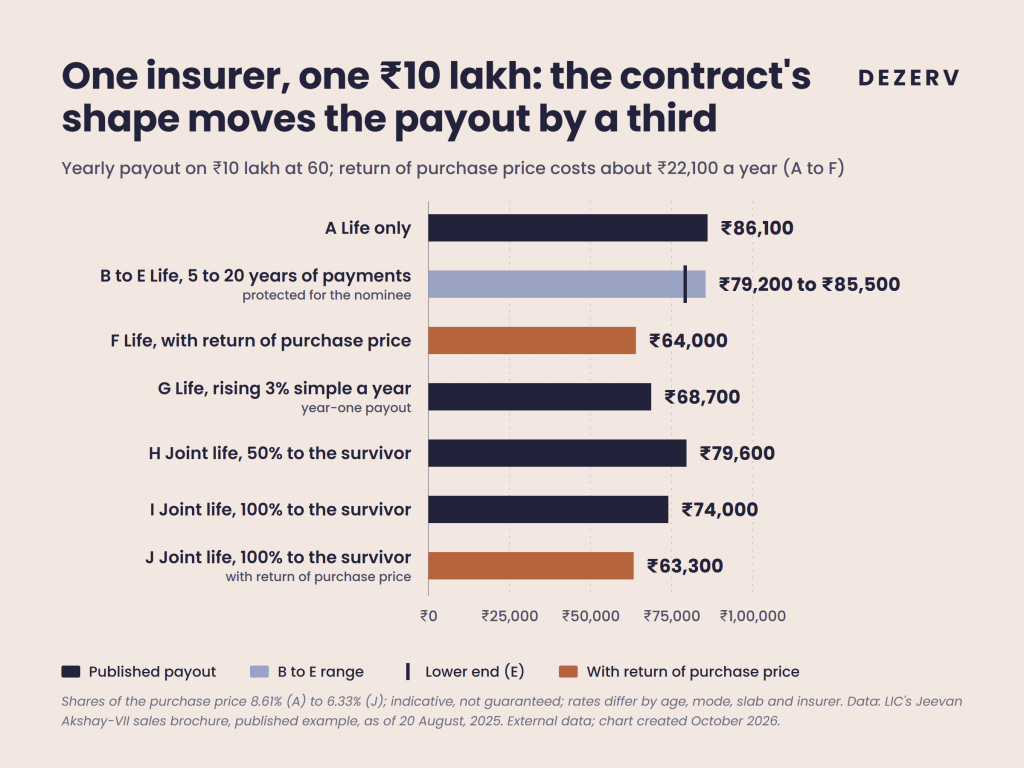
| Option in the brochure | Annual payout on ₹10 lakh (₹) | As a share of the purchase price |
|---|---|---|
| A: life only | 86,100 | 8.61% |
| B to E: life, with 5 / 10 / 15 / 20 years of payments protected for the nominee | 85,500 / 84,000 / 81,800 / 79,200 | 8.55% to 7.92% |
| F: life, with return of purchase price | 64,000 | 6.40% |
| G: life, rising 3% simple a year | 68,700 in year one | 6.87%, rising |
| H: joint life, 50% to the survivor | 79,600 | 7.96% |
| I: joint life, 100% to the survivor | 74,000 | 7.40% |
| J: joint life, 100% to the survivor, with return of purchase price | 63,300 | 6.33% |
Source: LIC's Jeevan Akshay-VII sales brochure, 20 August, 2025: ₹10 lakh excluding taxes, annuitant aged 60, yearly mode, secondary annuitant aged 55. Percentages are payout divided by purchase price; historical illustrative brochure terms, not current quotations or verified payouts for other purchase amounts; indicative, not guaranteed; rates differ by age, mode, purchase-price slab and insurer. Monthly mode pays less: instalments start a month after purchase, not a year, and the larger-purchase addition is ₹3.20 per ₹1,000 against ₹3.40 yearly (₹10–25 lakh slab); no monthly example is printed.
Read the table from the bottom up. The buyer who wants the capital back for the children and the spouse covered at 100% accepts ₹63,300 a year. The buyer who wants neither gets ₹86,100. The difference, ₹22,800 a year for life, is the price of the two promises most Indian buyers ask for.
Why payouts sit near 6 to 7%, and what slab tax does to them
With capital returned at death the insurer is in effect holding long bonds, and the standard immediate annuity shows the result in LIC's version: a 60-year-old's ₹10 lakh buys ₹62,300 a year single life or ₹61,600 joint life, paid yearly, both returning the purchase price (LIC's Saral Pension brochure; 6.23% and 6.16% before tax; indicative, not guaranteed).
The Income-tax Act, 2025 treats pension from an insurer's annuity plan as income of the year it is received. Nothing exempts it: the whole payout, capital portion included, is taxed at your slab rate.
What that means for a buyer who wants ₹6 lakh a year, a monthly equivalent of ₹50,000:
| To receive ₹6 lakh a year, pre-tax | Payout rate in the published example | Purchase price needed |
|---|---|---|
| Life only (Option A) | 8.61% | about ₹69.7 lakh |
| Life, with return of purchase price (Option F) | 6.40% | about ₹93.8 lakh |
| Joint life, 100% to survivor, with return of purchase price (Option J) | 6.33% | about ₹94.8 lakh |
| Standard product, single life with return (Saral Pension I) | 6.23% | about ₹96.3 lakh |
A sample scenario, not a forecast or guarantee of income: ₹6 lakh divided by each published rate from the LIC brochures above (indicative, not guaranteed), for a 60-year-old, yearly mode; the historic ₹10 lakh brochure-example rates are extrapolated for calculation and are not verified quotes for the larger purchases, and a purchase this size falls in a higher purchase-price slab, which both brochures reward with a higher rate, so the price actually needed is somewhat lower; monthly payment, at its lower rate (note under the options table), needs somewhat more. At a 20% slab the ₹6 lakh nets about ₹4.8 lakh (a monthly equivalent of ₹40,000); at 30%, about ₹4.2 lakh (₹35,000), taxed at the marginal rate, assuming other income already places the whole payout in that band; before cess and surcharge.
Watch out
In the published plan, buying online raises the tabular rate by 2% of itself (purchase price under ₹10 lakh) or 2.5% (₹10 lakh and above), so the ₹86,100 Option A example gains roughly ₹2,100 a year, not ₹25,000, and larger purchase prices earn a separate addition to the rate. Two quotes for the same option can differ for reasons that have nothing to do with the insurer's strength.
GST on the purchase: the position after 22 September, 2025
Until 21 September, 2025, an immediate annuity carried 18% GST on 10% of the single premium, or 1.8% of the purchase price, under the Central Goods and Services Tax (CGST) valuation rules, so on a ₹1 crore purchase that was ₹1.8 lakh gone before the first payout.
From 22 September, 2025, GST on all individual life and individual health insurance policies was cut from 18% to nil, under notification 16/2025-Central Tax (Rate) of 17 September, 2025. Group policies stay at 18% (Department of Financial Services). The notification's exemption entry covers life insurance business an insurer provides to an insured who is not a group.
That reading rests on the entry's wording and the Insurance Act's definition; the government's explainer names "life" and "health" policies and does not list annuities or pension plans by name, so before you sign, ask for the premium receipt to show the GST line at zero. If an insurer still charges it on a pension plan, ask under which entry.
The NPS floor: 20% or 40%, and the default annuity
The first annuity an NPS subscriber buys is often compulsory, sized by sector under the exit regulations of the Pension Fund Regulatory and Development Authority (PFRDA), amended from 16 December, 2025.
- Eligible All Citizen Model and Corporate Sector subscribers at qualifying normal exit may generally take up to 80% as a lump sum and must ordinarily use at least 20% to purchase an annuity, subject to prescribed smaller-corpus options. The 15-year normal-exit eligibility route applies to qualifying All Citizen subscriptions, not automatically to Corporate accounts, where employment-linked retirement or superannuation conditions matter. The income-tax exemption is separate from withdrawal eligibility: permission to take up to 80% does not make the entire amount tax-free, and the applicable lump-sum exemption is generally up to 60% of pension wealth on qualifying exit.
- Government subscribers must still annuitise at least 40% and may take up to 60%.
- The rules also include different options for smaller corpuses, and resignation or other premature exits have separate conditions; in certain premature exits, at least 80% may have to purchase an annuity. The available choice must be checked against the subscriber model, exit event and accumulated pension wealth rather than assuming the same rule applies in every case.
On a ₹2 crore corpus, at LIC's standard-product rates, before tax:
| Sector | Compulsory annuity purchase | Yearly payout | Monthly equivalent |
|---|---|---|---|
| Eligible All Citizen / Corporate normal exit (at least 20%) | ₹40 lakh | about ₹2.49 lakh | about ₹20,767 |
| Government (at least 40%) | ₹80 lakh | about ₹4.93 lakh | about ₹41,067 |
A sample scenario, not a forecast or guarantee of income: the compulsory share of a ₹2 crore corpus multiplied by LIC's Saral Pension rates with return of purchase price (single life 6.23% for the non-government row; joint life 6.16%, the government default's shape, for the government row; yearly mode; indicative, not guaranteed), before tax; the ₹10 lakh example rates are used unchanged, though purchases this size fall in a higher purchase-price slab that earns a somewhat higher rate.
For government subscribers the regulations prescribe a default contract: income for the life of the subscriber and spouse, with the purchase price returned, and the rate on that purchase can differ too: LIC's Jeevan Akshay-VII raises its tabular rate by 3% of itself for NPS subscribers, against 2% to 2.5% for online buyers (brochure, August 2025).
Whether to take the extra 20% in cash or let it buy a larger pension is its own decision, worked through in NPS withdrawal at 60.
When an annuity earns a slice of a large corpus
The case for buying one at all rests on a fact no portfolio can change: nobody knows how long they will live, and a couple must fund whichever of them lives longer, which may be past 90, and an annuity moves that uncertainty off your balance sheet and onto the insurer's.
Why so few people buy one, and how to size it from the after-tax gap between essential spending and lifelong income, is covered in should you annuitise at retirement? This guide takes that gap as given.
Zvi Bodie of Boston University, asked by a 69-year-old American reader, answered with a question.
"why not annuitize some or even all the funds currently in stocks and mutual funds?"
— Zvi Bodie, professor of finance, Boston University (PBS NewsHour, 17 October, 2011)
His answer pointed to inflation-protected lifetime income, which the LIC products cited here do not offer, so here the share worth insuring depends on the household: it grows with no pension, good health or long-lived parents, a spouse who depends on the income, no heirs who need the capital, or a wish for income that never depends on markets.
It shrinks, often to nothing, when a pension already covers essentials, heirs need the capital, health points to a shorter retirement, or the corpus dwarfs essential spending.
Age moves it too: published rates rise with entry age, so a contract bought after 65 or 70 buys more income per rupee and leaves inflation fewer years to work.
When it does not: inflation, the one-way door, legacy
Harsh Roongta argued in a Business Standard column on 9 February, 2025 that insurers back fixed-for-life payouts with safe but low-yielding government bonds, so the pension "will not keep pace with inflation" (Business Standard). His worked case: ₹40 lakh buys ₹22,000 a month with the corpus returned, and at 6% inflation that is worth about ₹5,000 in today's money over a long retirement.
Sivananth Ramachandran made a related point for the CFA Institute in April 2020. Indian annuity rates were then barely above long sovereign-bond yields, and with most buyers choosing joint life with return of premium, the product is "in effect, a bond" (CFA Institute).
On the arithmetic both are right: a level ₹64,000 a year keeps ₹35,737 of today's purchasing power after ten years at 6% inflation and ₹14,912 after 25, and the rising option only slows the slide. An affluent household's costs can climb faster: employer medical-plan costs in India are projected to rise 11.5% in 2026 (Aon), against headline CPI of 5.54% in September 2026 (MoSPI, provisional).
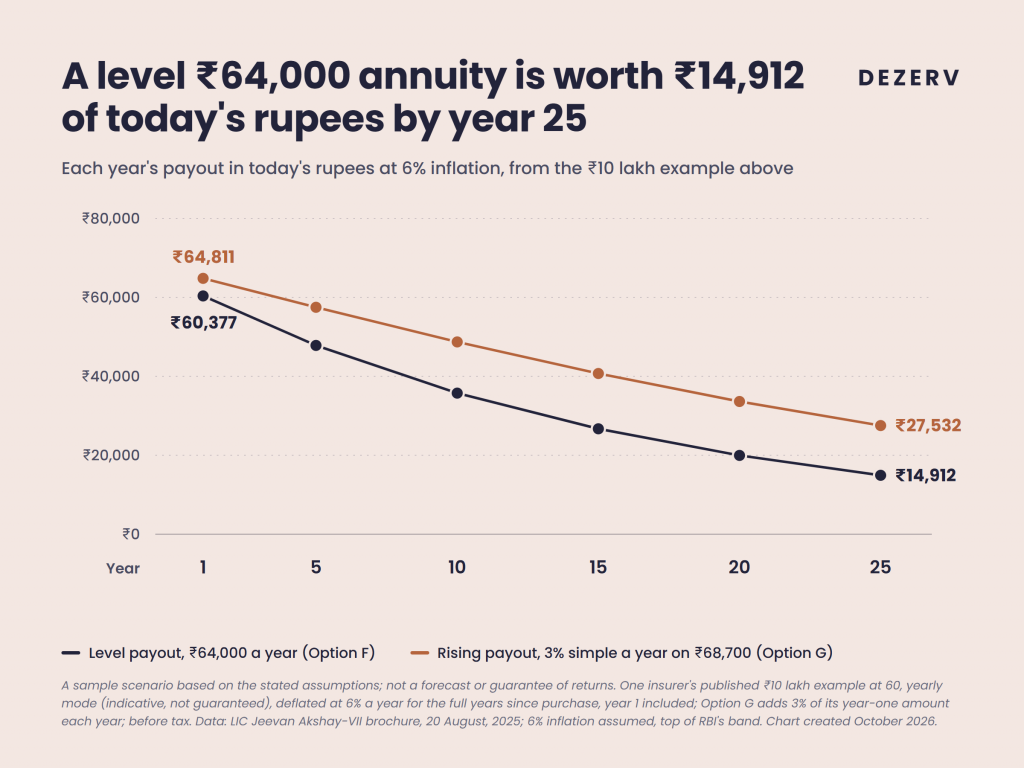
| Year | Level payout (Option F), nominal | In today's rupees at 6% | Rising payout (Option G), nominal | In today's rupees at 6% |
|---|---|---|---|---|
| 1 | 64,000 | 60,377 | 68,700 | 64,811 |
| 5 | 64,000 | 47,825 | 76,944 | 57,497 |
| 10 | 64,000 | 35,737 | 87,249 | 48,719 |
| 15 | 64,000 | 26,705 | 97,554 | 40,706 |
| 20 | 64,000 | 19,956 | 1,07,859 | 33,631 |
| 25 | 64,000 | 14,912 | 1,18,164 | 27,532 |
A sample scenario, not a forecast or guarantee: the two payouts from the LIC Jeevan Akshay-VII example above (₹10 lakh, age 60, yearly mode), deflated at a flat 6% a year, the top of the RBI's inflation tolerance band; Option G rises by 3% of its first-year amount for each completed year; each year's payout is deflated for the full years since purchase, year 1 included, because the yearly cheque arrives at the end of the year.
The door is also one-way, as the annuitisation guide sets out. For an NPS annuity the PFRDA's rule allows no cancellation after the free-look period, the standard product permits surrender only on a specified critical illness, and the brochure says the option, once chosen, cannot be altered.
None of the LIC options cited here is indexed to inflation, so the Indian product works best as a floor beside an invested corpus.
How to compare offers without a ranking: five questions
If you search for "best performing pension companies" it bring up pages that rank insurers. An annuity has no performance to rank (a market-linked deferred pension plan does have fund returns, but this guide is about the annuity that pays the income). The payout is set by contract on the day you buy, and the insurer's investment skill afterwards changes nothing you receive.
Compare offers on these five questions instead.
- Same shape, same rate? Put every quote on the same option (immediate or deferred, single or joint, with or without return of purchase price, level or rising) and the same payout frequency before you look at the number. A higher figure on a different shape is not a better offer.
- What does the survivor get, in rupees, the month after you die? A 50% continuation on ₹79,600 (Option H) and a 100% continuation on ₹74,000 (Option I) are different promises to the same spouse.
- What does the nominee get, and when? Return of purchase price, the balance of a protected period, or nothing; and whether the death benefit can be taken as a lump sum or must be annuitised again.
- What is the payout after the tax on your return? Two retirees with the same quote keep different amounts; the one already in the 30% slab keeps ₹7 of every ₹10 before cess, which changes how much floor the annuity covers.
- Would slices suit you better than one purchase? Rates rise with entry age. Buying a third at 62, a third at 67 and a third at 72 averages the rate and keeps capital in your hands longer; the later rates are unknown today, so a buyer who wants the income fixed now may prefer one purchase.
Worth knowing
The IRDAI standard immediate annuity carries identical terms across every insurer, so for that product the only variable left is the rate. It is the cleanest benchmark to hold any other quote against.
Pension plan, NPS, or a self-built floor
Three tools can put a floor under essential spending: an insurer's pension plan, the NPS annuity you must buy anyway, or your own floor of Senior Citizens Savings Scheme (SCSS) deposits and bonds you can sell.
| Criterion | Insurer's pension plan | NPS annuity (the compulsory slice) | Self-built floor (SCSS, government bonds, a short ladder) |
|---|---|---|---|
| Certainty of income | Fixed in rupees for life by contract | Fixed in rupees for life by contract | Depends on reinvestment at each maturity |
| Inflation | Level, or a 3% simple step-up at a lower start | Level, or what the chosen provider offers | You can raise the draw, at the cost of capital |
| Tax on the income | Slab, on the whole payout | Slab, on the whole payout | Slab on interest; senior-citizen reliefs in the old regime only |
| Tax or cost on the way in | No GST on an individual life policy since 22 September, 2025; annuities count as life insurance business, so the receipt should show nil | No tax on the purchase itself (buying the annuity from the corpus is not income under the Income-tax Act, 2025); only cash taken beyond 60% is taxed | Account and transaction costs only |
| Liquidity | None after the free-look period | None | High for bonds, which can be sold; SCSS runs five years, with a deduction for closing early |
| What passes to heirs | Purchase price, only if you paid for that option | As per the option chosen | Everything that is left |
| Caps | None | At least 20% for eligible All Citizen / Corporate normal exits; 40% for Government Sector normal exits (larger corpuses); separate eligibility and small-corpus rules of the corpus | SCSS ₹30 lakh per person at 8.2% from 1 July, 2026 (indicative, not guaranteed); bonds uncapped |
Terms as published by the insurer and regulator sources cited above; SCSS per Central Bank of India, read 15 October, 2026. How senior citizens can earn regular income walks through the self-built instruments.
Each row suits a different household. A couple with a large corpus, heirs and a ladder to run will usually annuitise little, late, or nothing.
A single retiree with no pension and no heirs may buy more, without return of purchase price, because that is where the insurance is cheapest. Annuitising everything is the hardest case to make: a level income against three decades of inflation is a floor that sinks, though it gets easier with age or with a corpus small beside essential spending.
Whatever slice goes to the insurer, the rest of the corpus still has to do the growing and the inflation-fighting, inside a layered withdrawal structure. The three income engines, a systematic withdrawal plan (SWP), an annuity and dividends, are compared in SWP vs annuity vs dividends. The overall plan sits in the retirement income planning hub.
Enter your essential monthly spending, age and other lifetime income in the Dezerv retirement calculator; the gap it shows caps any annuity, and the conditions above set the share to insure.
Key takeaways
- There is no "best performing" annuity provider to rank: the payout is fixed by contract, so compare quotes on the same shape, payout mode and date, after tax.
- Capital back for the nominee plus 100% to the spouse costs ₹22,800 a year for life on ₹10 lakh at 60, yearly mode, in LIC's published example (Option J against A; indicative, not guaranteed).
- On a purchase made after 22 September, 2025, the receipt should show no GST, where it used to cost 1.8% of the price.
- At a non-government NPS exit, settle the optional 20% first, then choose the annuity's shape; a government subscriber annuitises at least 40%.
- A level ₹64,000 a year (Option F) is worth ₹14,912 of today's rupees after 25 years at 6% inflation (sample scenario); pension, health, a dependent spouse and heirs decide how much of the floor to annuitise.
Frequently Asked Questions
Which is the best retirement pension plan in India?
No insurer can be ranked on annuity performance: the payout is fixed by contract on the day you buy. The best plan is the contract shape that fits the income floor you need: single or joint life, with or without return of purchase price, level or rising. Compare quotes on the same shape and after tax, hold them against the IRDAI standard immediate annuity, which carries identical terms at every insurer, and, unless fixing the income today matters most, consider buying later and in slices.
What is the difference between a pension plan and an annuity?
In India the terms overlap. An annuity is the contract itself: a lump sum paid to a life insurer in exchange for a fixed income for life. A pension plan is how insurers sell an annuity, or the savings that later buy one: immediate (income within a year) or deferred (income one to five years later in the published plans). Both insure against outliving your money. An annuity is not an investment (a market-linked deferred plan earns fund returns only until it buys one), and the payout is taxed at your slab rate.
Should I choose an annuity with or without return of purchase price?
With return of purchase price the capital goes to your nominee at death, and the price is a lower payout: ₹64,000 against ₹86,100 a year on a ₹10 lakh purchase at 60, yearly mode, in one insurer's published example (LIC brochure, August 2025; indicative, not guaranteed). Choose return of capital when heirs, or a surviving spouse, need that money back; if the goal is the cheapest insurance against living long, life only pays more for the same price.
Is there GST on annuity or pension plan premiums now?
From 22 September, 2025, GST on all individual life insurance policies was cut from 18% to nil under notification 16/2025-Central Tax (Rate), per the Department of Financial Services. Before that an immediate annuity paid 1.8% of the purchase price (18% on 10% of the premium). The government's explainer names life and health policies without listing annuities, so ask for the premium receipt to show the GST line at zero before you sign.
How much of my NPS corpus must go into an annuity?
At qualifying normal exit under the PFRDA amendments effective from 16 December 2025, eligible All Citizen and Corporate Sector subscribers may generally receive up to 80% of accumulated pension wealth as a lump sum and must ordinarily put at least 20% into an annuity. Government Sector normal exits generally retain an up-to-60% lump sum and minimum 40% annuity for larger corpuses. Small-corpus options and premature-exit requirements differ. The 15-year eligibility route concerns qualifying All Citizen subscriptions; Corporate subscribers must consider employment-linked retirement or superannuation conditions. The allowable lump sum and its tax-exempt portion are not the same: the applicable tax exemption generally extends to only up to 60% of pension wealth on qualifying exit.
Why are annuity rates in India only around 6 to 7%?
Because, with the purchase price returned at death, the insurer is in effect running a long government-bond portfolio, so the payout settles a little below long bond yields: LIC's standard immediate annuity pays a 60-year-old 6.23% (single life, capital returned, ₹10 lakh, yearly mode; Saral Pension brochure; indicative, not guaranteed) against 7.38% on the 10-year government bond on 15 October, 2026 (CCIL). Rates are higher without return of capital, at older ages and for larger or online purchases, and the payout is taxed at your slab rate.
Disclaimer
Dezerv Investments Private Limited is a SEBI-registered Portfolio Manager (Registration No. INP000007377). Distribution services are offered by Dezerv Distribution Services Private Limited, a wholly owned subsidiary of Dezerv Investments Private Limited, under AMFI Registration No. ARN-248439 and APMI Registration No. APRN-00615. This article is intended solely for general educational and informational purposes and should not be construed as personalised investment, financial planning, tax or legal advice, or as a recommendation, offer or solicitation to invest in any security, financial product or investment strategy. Readers are advised to consult their financial advisor before making investment decisions based on the information provided herein.
The annuity options, payout rates, tax calculations, NPS withdrawal rules and illustrations discussed in this article are based on the sources and assumptions cited and are for informational purposes only. Historical brochure rates are not current quotations or guarantees of future income. Actual payouts, tax liability and benefits depend on the insurer's terms, the annuity option selected, individual circumstances and applicable laws, which may change. Annuities involve contractual restrictions, limited liquidity and inflation risk. Readers should review the relevant policy documents and regulatory requirements and consult their financial, tax and legal advisors before making decisions. This article is not a complete disclosure of every material fact, term or condition.
Investment in the securities market is subject to market risks. Please read all related documents carefully before investing. Past performance may or may not be sustained in the future.