In July 2025, Tata Consultancy Services (TCS) said about 2% of its global workforce would leave within the year, primarily from its middle and senior grades (Business Today, 28 July, 2025). That came to roughly 12,000 people.
Its chief executive ruled out artificial intelligence as the reason and put the cuts down to skills (People Matters, 27 July, 2025).
For an engineer who expected to keep earning through their fifties, losing a job at 48 can change the entire financial plan. How do you fund the years between your last salary and the retirement you had planned?
In short
No official statistic says Indian IT careers end at 45, but the 2025 TCS cuts were aimed mainly at middle and senior grades, and a forced exit in the late 40s works like an early retirement with earning years still ahead. The first money to plan is a bridge fund, held in cash and liquid instruments: runway for household costs until a second income starts, plus a top-up for the years that income falls short. For a sample household spending ₹1.5 lakh a month, the bridge comes to ₹42 lakh, about 6% of a no-income corpus to age 90, and ₹94 lakh if the new income takes three years to start and then falls ₹8 lakh a year short for five.
Table of contents
What the 2025 cuts showed, and what they did not
No government or industry body publishes a figure showing that Indian software careers end at 45.
The line that travelled furthest came from a LinkedIn post after the announcement. It was one wealth advisor's warning: "45 is the new 60" (Business Today, 28 July, 2025).
What TCS said
TCS made a narrower claim in its own statement. It described a journey to become "a future-ready organisation" and listed "deploying AI at scale for our clients and ourselves" among the steps.
Business Today put the exits at 12,261 employees (Business Today, 28 July, 2025).
TCS closed March 2026, the end of the year the cuts were meant to cover, with 584,519 employees (TCS results press release, filed with NSE, 9 April, 2026), 23,460 fewer than a year earlier (Business Today, 15 April, 2026). Its human resources head said the decline was not due to the previous year's restructuring.
Where the risk sits
In 2018, well before the TCS cuts, Tech Mahindra had already cut the retirement age from 58 to 55 for its "U" band (People Matters, 5 October, 2018). The cut applied only to U-band employees with fewer than seven years at the company.
Business Today's report on the advisor's post (28 July, 2025) placed the 2025 cuts among mid and senior staff, especially in legacy technologies, non-client-facing roles and project management. An engineer whose last decade was spent on one of those older stacks is the reader with most to plan for.
When a technology career depends on a narrowing set of skills
Some software roles depend closely on technical skills that change quickly. When demand for an older stack falls, a particular role can disappear, though other technology careers value management experience, domain knowledge and relationships. The useful distinction is within technology careers: how portable the skills are, and how readily they can support new employment or consulting work.
| Illustrative technology-career situation | Potential source of vulnerability | Possible transferable strengths | Questions for a second-income plan |
|---|---|---|---|
| Role centred on a legacy software stack | Demand for the specific technology may decline | Domain knowledge and migration experience | Which adjacent roles value the existing experience? |
| Specialist in actively used technologies | New technology or projects can still disrupt demand | Current technical capabilities and delivery record | How quickly could skills be adapted for another employer? |
| Technology manager or product leader | Leadership roles may be fewer during restructuring | Teams, clients, business judgement and cross-functional experience | Would consulting, product or operations work be viable? |
| Independent technology consultant | Project pipeline and client budgets may fluctuate | Client relationships and experience solving specialised problems | How long might it take to rebuild dependable revenue? |
Illustrative technology-career situations, not a population dataset or measured prediction of when careers end. Actual outcomes depend on skills, industry, employer and individual circumstances.
Two people earning the same amount at 40 may have very different options after a job loss at 48. This is an illustration of skill portability and re-entry risk, not evidence that one profession has a universally shorter career.
The savings rate and the second-career plan both have to allow for that shorter run.
Many engineers never meet this curve at all. Those who move into management, architecture or product roles are often paid for experience into their fifties, and plenty finish a full career with one employer.
Treat the exit as early retirement, with earning years left
For planning purposes, a layoff at 48 deserves the arithmetic of an early retirement.
The salary that funded everything may never return at the same level. Yet a 48-year-old usually has a decade or more of some earning ability left, so the plan does not have to fund forty years of living costs from a standing start.
A full "Financial Independence, Retire Early" (FIRE) corpus is the lump sum that lets a household never work again. After a forced exit at 48, it answers a question most households do not yet face, and the first number to solve is the stretch between the exit and a stable second income.
The inflation and longevity case for a large corpus still governs the money set aside for later life, and the Dezerv retirement calculator sizes that figure with every assumption shown.
Where working years remain, the catch-up maths at 45 runs alongside. An employer exit also ends group health cover, which opens a health-cover gap before 60 for the household to insure on its own, and where it comes with a voluntary-retirement payout, the tax on a VRS package decides how much of that payout reaches the bridge.
The bridge fund: runway plus a shortfall top-up
A bridge fund is cash and near-cash set aside to cover household costs from an involuntary exit until a new income is stable. It is kept apart from the retirement corpus. Its job is to stop long-term investments being sold at a bad moment.
Three things size it: the household's monthly running cost, how long a second income takes to arrive, and how far short of those costs it then falls.
| Component | Assumption | Amount |
|---|---|---|
| Runway | 18 months of household costs at ₹1.5 lakh a month, before any new income | ₹27 lakh |
| Shortfall top-up | Second income falls ₹5 lakh a year short of household costs (₹18 lakh a year) for three years | ₹15 lakh |
| Bridge target | Covers four and a half years, from 48 to about 52 and a half | ₹42 lakh |
A sample scenario, not a forecast or guarantee of returns. Assumptions: exit at 48; household running cost ₹1.5 lakh a month (₹18 lakh a year), held flat in today's rupees; the buffer sits in cash and liquid instruments and earns no return above inflation (a 0% real return); no severance, VRS or other payout counted.
Set against a full corpus, the base-case bridge is small, about 6% of it. Under a simplified assumption of constant real spending of ₹18 lakh annually, zero real return and no other income, that household would need ₹7.56 crore to fund 42 years from age 48 to 90, before any additional provision for unexpected costs. For a household still drawing a senior salary, the bridge can be built in a few disciplined years.
Watch out
Because a bridge must be accessible when spending arises, it should not depend on selling equity at a favourable price. Cash and suitable short-duration instruments may be considered, while recognising their credit, liquidity and interest-rate risks.
When the comeback is slow
The ₹42 lakh assumes a second income within 18 months and a modest shortfall after that.
| Scenario | Runway | Shortfall top-up | Bridge | Years covered | Share of the ₹7.56 crore no-income corpus |
|---|---|---|---|---|---|
| Base: new income after 18 months, ₹5 lakh a year short for 3 years | ₹27 lakh | ₹15 lakh | ₹42 lakh | 4.5 | 5.6% |
| Slow: new income after 3 years, ₹8 lakh a year short for 5 years | ₹54 lakh | ₹40 lakh | ₹94 lakh | 8 | 12.4% |
A sample scenario, not a forecast or guarantee of returns. Same basis as the table above: ₹1.5 lakh a month in today's rupees, 0% real return, no payout counted; the corpus is ₹18 lakh a year from 48 to 90 with no income. At a 2% real return every figure falls (the base bridge to about ₹41 lakh, the corpus to about ₹5.1 crore), and the bridge's share rises to about 8% in the base case and 17% in the slow one, because the corpus has the longest horizon.
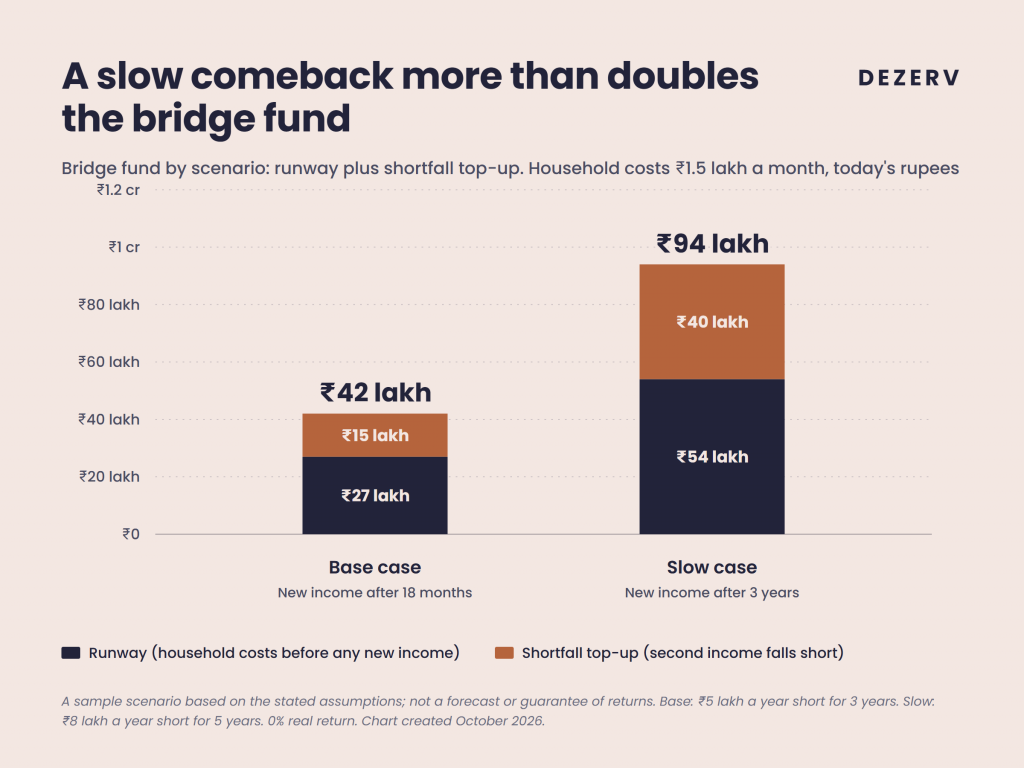
Stretching both assumptions more than doubles the bridge, from ₹42 lakh to ₹94 lakh. Re-entry is the least predictable part of a mid-career exit.
The Periodic Labour Force Survey from the Ministry of Statistics and Programme Implementation (MoSPI) put unemployment among people with at least secondary education at 6.5% in 2025 (MoSPI, PLFS Annual Report 2025 press note, 27 March, 2026), though the same press note carries no figure for how long a laid-off professional in their late forties takes to find comparable work.
So the household's own guess about the comeback sets the bridge size. A cautious plan sizes for the ₹94 lakh case.
Building the second income while the first still pays
A bridge fund buys time, and it stops shrinking only when a second income covers household costs. For a senior engineer on an older stack, that income usually comes from work outside the old stack.
The common routes are independent consulting in a domain known in depth, a smaller company that pays for seniority, teaching and corporate training, or an advisory role that sells judgement over current code.
Few of these will match the old salary in the first year. The sample scenarios assume the second income has closed the gap to household costs by the time the bridge runs out, four and a half years in the base case and eight in the slow one; if it has not, the bridge needs to be larger.
Timing is the lever the household controls most directly. New skills and the first consulting clients are both easier to build while a salary is still being paid; in the sample household, each month a second income starts earlier takes up to ₹1.5 lakh off the runway.
"The long term is a series of things that you do right in the short run."
— Manish Chokhani, investor, speaking at the Morningstar Investment Conference 2021 (Morningstar India, 4 April, 2022)
Who manages the money behind the bridge
Once the bridge and the second-income plan exist, the rest of the money still needs looking after: the long-term investments the bridge was built to protect.
Some households run that allocation themselves. Others hand the day-to-day decisions to a professional.
A portfolio management service (PMS) is one route for those who delegate.
Dezerv Investments Private Limited offers Portfolio Management Services (PMS) that provide exposure to relevant asset classes, primarily through underlying mutual funds, in accordance with each investment approach's mandate. The minimum investment amount for PMS is ₹50 lakh, subject to applicable regulatory requirements and the terms of the relevant service. Investments are subject to market risks, and returns are not guaranteed.
The ₹42 lakh bridge falls below the ordinary ₹50 lakh initial minimum for non-exempt PMS clients. But entry eligibility does not determine what suits short-term spending: liquidity, potential value changes, costs and withdrawal conditions are more important. Consider PMS separately for long-term assets only where the mandate and terms are suitable.
Running your own allocation is a sound answer if you have the time and enjoy it. How to choose the right wealth manager sets out the trade-off for anyone weighing both routes.
If your employer still offers a long career track, or your savings already cover the slow case, this plan is not yours. Everyone else starts with one number, the household's monthly running cost; the bridge, and the size of the slow case, follow from it.
Key takeaways
- No official statistic says Indian IT careers end at 45; the 2025 TCS cuts were aimed mainly at middle and senior grades, and its chief executive said they were not because of AI.
- Technology workers whose roles rely heavily on changing technical skills may face an unexpected mid-career employment interruption. A forced exit in the late 40s can resemble early retirement financially, even though opportunities to earn income may remain.
- Plan a bridge fund before a full FIRE corpus: runway for household costs plus a top-up for the years a second income falls short.
- In the sample household spending ₹1.5 lakh a month, the bridge is ₹42 lakh, about 6% of a no-income corpus to 90, and ₹94 lakh if the new income takes three years to start and then falls ₹8 lakh a year short for five.
- Keep the bridge readily accessible in suitably liquid, relatively lower-risk instruments, recognising their own risks. Conventional PMS has a general ₹50 lakh minimum for non-exempt clients; its suitability for longer-term investments depends on the strategy and terms, not the threshold alone.
Frequently Asked Questions
Is it true that Indian IT careers end at 45?
No official statistic says so. The line "45 is the new 60" came from a wealth advisor's LinkedIn post after TCS said in July 2025 that about 2% of its workforce, primarily in the middle and senior grades, would leave within the year. Some companies lowered retirement ages earlier: Tech Mahindra cut the retirement age from 58 to 55 in 2018 for "U"-band employees with under seven years' service. Treat an early exit as a real risk to plan for, concentrated in mid and senior roles on older technology.
How big should a bridge fund be?
Size it from your own monthly running cost and how long a second income would take to arrive and stabilise. In the article's sample scenario, a household spending ₹1.5 lakh a month needs 18 months of runway (₹27 lakh) plus ₹15 lakh to cover a second income that falls ₹5 lakh a year short for three years: ₹42 lakh in all. If the new income takes three years and falls ₹8 lakh a year short for five, the bridge rises to ₹94 lakh. Your figure will differ.
Should I build a full FIRE corpus instead of a bridge fund?
It is usually the wrong first priority after a forced exit. A full FIRE corpus assumes you never earn again, which at 48 is usually not the case. In the sample scenario, the same household would need ₹7.56 crore with no income from 48 to 90, against a ₹42 lakh bridge. The bridge protects your long-term investments while a second income is rebuilt, and the long-term corpus keeps growing in parallel.
Where should a bridge fund be kept?
For a bridge needed within the next few years, prioritise accessible cash and suitable lower-duration instruments rather than depending on equity market prices when withdrawals are due. These instruments also carry risks, including credit and interest-rate risk. An actively withdrawn short-term bridge may also be a poor fit for PMS strategies because liquidity requirements, investment risk and charges need to match the spending horizon; the conventional initial minimum is generally ₹50 lakh for non-exempt clients, with exceptions for qualifying accredited investors.
How is a bridge fund different from an emergency fund?
An emergency fund covers a few months of shocks while your main income continues. A bridge fund assumes the main income may not return at the same level, so it is larger and adds a top-up for the years a second income falls short of household costs. It is sized for a career transition lasting several years, not for a temporary disruption.
Disclaimer
Dezerv Investments Private Limited is a SEBI-registered Portfolio Manager (Registration No. INP000007377). Distribution services are offered by Dezerv Distribution Services Private Limited, a wholly owned subsidiary of Dezerv Investments Private Limited, under AMFI Registration No. ARN-248439 and APMI Registration No. APRN-00615. This article is intended solely for general educational and informational purposes and should not be construed as personalised investment, financial planning, tax or legal advice, or as a recommendation, offer or solicitation to invest in any security, financial product or investment strategy. Readers are advised to consult their financial advisor before making financial or investment decisions based on the information provided herein.
The statistics, historical data and calculations in this article are based on the sources cited and are for general informational purposes only. The bridge fund amounts, retirement corpus estimates and other financial calculations are illustrative and depend on the assumptions and methodologies stated. They are not forecasts or guarantees of future income, investment returns or retirement outcomes. Actual outcomes may vary depending on individual circumstances, employment prospects, income levels, household expenses, longevity, inflation, healthcare costs, taxes, fees, investment performance and prevailing market, economic and regulatory conditions. This article is not a complete disclosure of every material fact, term or condition.
Investment in the securities market is subject to market risks. Please read all related documents carefully before investing. Past performance may or may not be sustained in the future.