At 45, the phrase “I’ll start next year” carries a different financial cost than it did at 25. There may still be 15 strong earning years ahead, but there is much less time to spread the savings required.
Take a household that spends ₹2 lakh a month and has saved nothing for retirement. Starting at 46 instead of 45 adds about ₹85,000 to the monthly investment it needs to stop work at 60. Waiting until 50 more than doubles the figure (a sample scenario, worked through below).
That is why catching up needs a calculation of contributions and working years before it needs a search for higher investment returns. The article starts with the amount required, then tests which levers can realistically change it.
In short
Retirement at 60 may remain achievable for someone starting at 45, but the required monthly investment depends on spending, available surplus and the ability to maintain contributions. In a sample scenario, a household spending ₹50,000 a month needs about ₹5 crore at 60 and roughly ₹1.1 lakh invested every month from 45; a household spending ₹2 lakh needs about ₹26 crore and ₹5.8 lakh a month. Raising the investment 10% every year cuts the starting amount by about 43%, while two extra points of return and two extra working years each cut it by only 15–18%. Dezerv's retirement calculator runs the same arithmetic on your own numbers.
Table of contents
How much a 45-year-old needs at 60
A retirement target at 45 starts from what the household spends today. Everything else is arithmetic on that number. Carry that monthly spending forward to 60 at the household's own inflation rate, then hold 30 years of it to age 90, which assumes the portfolio earns about what inflation takes away once the salary stops.
Inflation matters as much as today’s spending. Households with different mixes of healthcare, staff, education, travel and housing costs can face different future spending paths. The 9% assumption used below is a sensitivity test for one illustrative affluent household, not an official inflation measure or a prediction.
The table uses that 9% for the ₹2 lakh household. It assumes 7% for a ₹50,000 household with a cheaper basket, and 10% at ₹5 lakh.
What a 45-year-old starting from zero needs to retire at 60 (a sample scenario)
| Monthly spending today | Inflation assumed to 60 | Monthly spending at 60 | Corpus needed at 60 | Monthly investment from 45 |
|---|---|---|---|---|
| ₹50,000 | 7% | ≈ ₹1.4 lakh | ≈ ₹5.0 crore | ≈ ₹1.1 lakh |
| ₹2 lakh | 9% | ≈ ₹7.3 lakh | ≈ ₹26.2 crore | ≈ ₹5.8 lakh |
| ₹5 lakh | 10% | ≈ ₹20.9 lakh | ≈ ₹75.2 crore | ≈ ₹16.5 lakh |
A sample scenario, not a forecast or a guarantee of returns, and not personalised advice. Assumptions: age 45, retirement at 60, plan to age 90; corpus = 30 × the annual spending at 60, so in-retirement returns are assumed to match inflation; nothing saved at 45; a level monthly investment earning 11% a year, applied as 11%/12 a month and invested at the end of each month (about 11.6% effective); pre-tax. The 9% rate is a hypothetical planning assumption for sensitivity analysis; it is not an externally observed inflation rate.
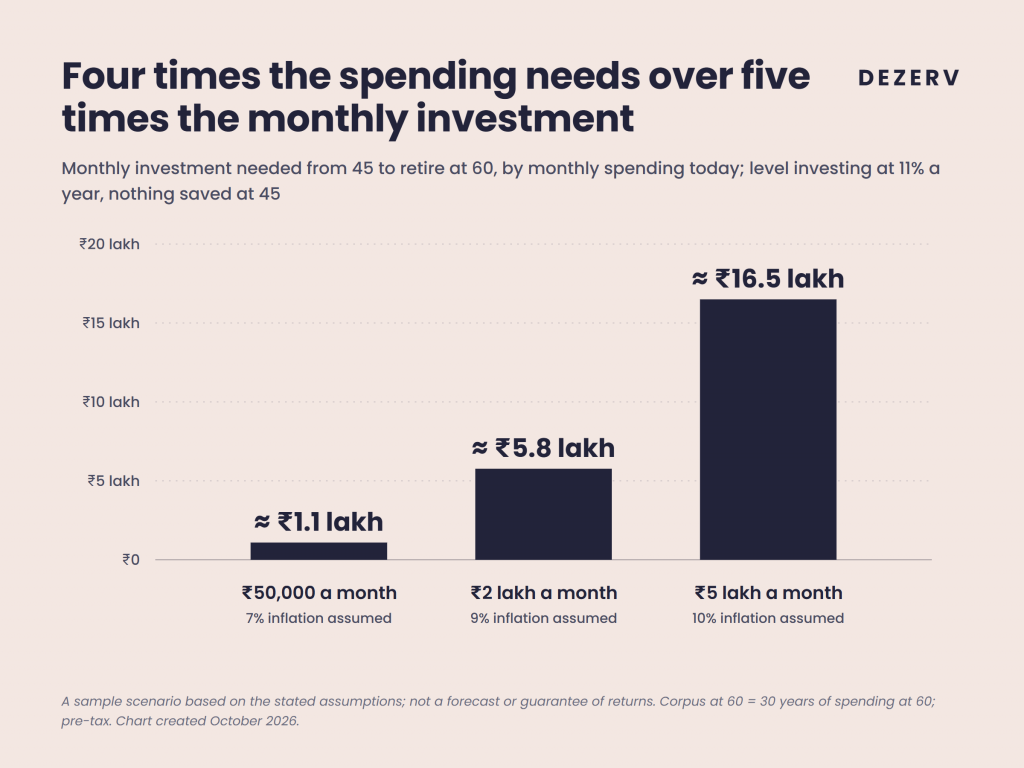
A ₹5 crore corpus fits the ₹50,000 household almost to the rupee, yet it covers under six years of the ₹2 lakh household's spending at 60. The ₹5 lakh row asks the household to invest more than three times its monthly spending, every month, for fifteen years.
At that level the target itself has to move.
Money already saved shortens every row. At the same 11% assumption, each ₹10 lakh invested today grows to about ₹52 lakh by 60, and that comes straight off the corpus the monthly plan has to build. By the same arithmetic, the ₹26.2 crore target equals about ₹5.1 crore invested today, and ₹75.2 crore about ₹14.5 crore.
The 4% rule gives a smaller number
The 4% rule comes from William Bengen's study of US markets from 1926, published in the Journal of Financial Planning in October 1994. In his data, a 4% first-year withdrawal, raised each year for inflation, never emptied a half-stocks, half-Treasury-notes portfolio in under 33 years (Bengen, reprinted by the Financial Planning Association).
Size the corpus at 25 times the first year's spending and the targets fall to about ₹4.1 crore and ₹21.9 crore, roughly a sixth below the 30-year method.
The gap is one assumption: the 4% route expects the portfolio to keep beating inflation through retirement, as US portfolios did in Bengen's data, while the 30-year method gives it no real return at all. That makes the 30-year figure the cautious one.
Which one to plan on depends on how far your own spending inflation runs ahead of what the portfolio can earn.
Five levers, measured in one unit
Each lever is measured in one unit: the monthly investment it takes, starting at 45, to reach that household's own target.
The monthly investment needed from 45, lever by lever (a sample scenario)
| Lever | The change | ₹50,000 household | ₹2 lakh household | Change vs base case |
|---|---|---|---|---|
| Base case | Retire at 60, level investment, 11% a year | ₹1.1 lakh | ₹5.8 lakh | — |
| Step up the investment | Raise it 10% every year | starts at ₹62,000 | starts at ₹3.3 lakh | −43% at the start |
| Spend less after 60 | Retirement lifestyle 25% below today's | ₹82,000 | ₹4.3 lakh | −25% |
| Earn two points more | 13% a year instead of 11% | ₹90,000 | ₹4.8 lakh | −17% |
| Work to 62 | Two more years of investing, two fewer years to fund | ₹90,000 | ₹4.9 lakh | −18% / −15% |
| Consulting covers 60 to 62 | Investing stops at 60, withdrawals start at 62 | ₹94,000 | ₹5.1 lakh | −14% / −11% |
| Start a year later | Begin at 46 | ₹1.3 lakh | ₹6.6 lakh | +15% |
A sample scenario, not a forecast or a guarantee of returns. Same method and assumptions as the table above (7% inflation for the ₹50,000 household, 9% for the ₹2 lakh household; 30 years funded from 60, or 28 years from 62). Where two percentages appear, the first is the ₹50,000 household and the second the ₹2 lakh household. The step-up row shows the first year's monthly amount.
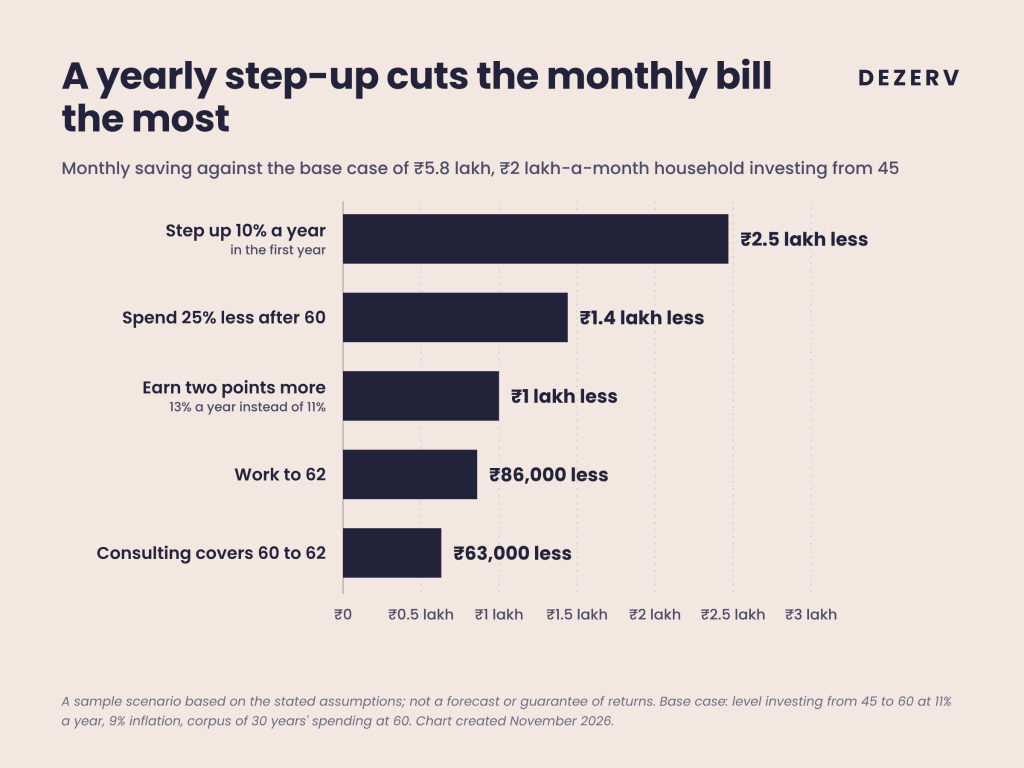
The step-up wins by a distance. It tracks the way salaries move. The first year's bill falls from ₹5.8 lakh a month to ₹3.3 lakh, and the larger amounts arrive later, out of raises. Over fifteen years it does put in more rupees, about ₹12.6 crore against ₹10.4 crore for the level plan in the ₹2 lakh case.
The step-up overtakes the level amount in its seventh year, at 51.
Spending less after 60 works on the target itself. Every other lever then has less to carry.
For the ₹2 lakh household, two extra points of return cut the bill by 17% and two extra working years by 15%. For the ₹50,000 household the order flips, 17% against 18%, because its lower inflation makes the extra two years of spending cheaper to fund.
Delay works in the opposite direction. A single year of it costs about 15%, which is roughly what two extra years at work save.
Why two more points of return is the weak lever
On paper, a 13% return and two more years at work do roughly the same job.
Staying until 62, or planning a smaller retirement budget, is the household's call. A 13% return is an outcome. The market delivers it or withholds it, and reaching for it usually means a heavier tilt to equity and to smaller, more volatile companies.
That volatility does its worst damage near the finish. A deep fall at 58, with the whole corpus exposed, costs far more than the same fall at 46, a pattern set out in the piece on sequence-of-returns risk.
The return therefore belongs in the plan as a conservative input. If the sums close only at 14% or 15%, the repair belongs on the levers you control.
"No one knows where the market will go. But what you can do in that market is in your control."
— Nilesh Shah, Managing Director, Kotak Mahindra Asset Management Company, in an interview with ANI (The Tribune, 22 April, 2026)
If work ends before 60
A 45-year-old's catch-up plan assumes a salary. A layoff or a health event can end the high-earning years well before 60, a risk the piece on forced early retirement in IT careers works through for technology professionals. Run the ₹2 lakh household through an exit at 55.
Its corpus now has to fund 35 years instead of 30, and it has had ten years to build instead of fifteen.
On the plan sized for 60, the portfolio holds about ₹12.5 crore at 55 against roughly ₹19.9 crore needed, about 63% of the new target. That is a gap of about ₹7.4 crore.
Covering an exit at 55 from the start would have taken about ₹9.2 lakh a month rather than ₹5.8 lakh (a sample scenario on the same assumptions).
The step-up stops when the salary does. From then on the spending lever carries most of the weight, and sizing the retirement lifestyle while there are earning years left to adjust costs far less than discovering the shortfall at 56.
Tax: keeping more of each rupee you add
For a late starter in the top bracket, the vehicle decides how much of each added rupee is left to compound.
Equity held for the long term
Equity held for more than 12 months is taxed lightly. Gains above ₹1.25 lakh a year on listed shares and equity mutual funds pay 12.5% under the long-term capital gains rule of the Income-tax Act, 2025.
Sell within 12 months and the rate is 20%, the Act's short-term rate for listed equity (Income Tax Department, tax year 2026-27; rates unchanged by Budget 2026). A portfolio that is traded often pays the higher rate on more of its gains, which is one more reason a catch-up plan is built to hold.
NPS: the deduction and the exit
The National Pension System, known as NPS, gives a deduction on the way in. Under the new tax regime, the employer's contribution of up to 14% of salary is deductible under the NPS deduction rules of the Income-tax Act, 2025, while the extra ₹50,000 deduction on your own contribution is available only under the old regime.
The NPS exit rules depend on the type of subscription. Eligible voluntary non-employment-linked subscribers can use the 15-year normal-exit route; that route does not apply to corporate or other employment-linked subscriptions. Normal exit at age 60 or superannuation remains relevant under the applicable scheme. Eligible non-government subscribers may then withdraw up to 80%, with at least 20% directed to an annuity; the lump-sum tax exemption remains limited to 60% of the corpus.
Government employees keep the older split of up to 60% as a lump sum and at least 40% in an annuity (PFRDA, Exits and Withdrawals Regulations, as amended effective 16 December, 2025). That split did not move in the December 2025 amendment.
Only 60% of the corpus is tax-free: the Income-tax Act, 2025 exempts the NPS lump sum up to that share. A non-government subscriber who takes 80% keeps only three-quarters of it tax-free and pays slab-rate tax on the slice between 60% and 80%. The annuity income is taxed at slab every year it arrives.
Small balances follow their own bands. Under the usual normal-exit provisions, a corpus up to ₹8 lakh can be withdrawn in full; above ₹8 lakh and up to ₹12 lakh, up to ₹6 lakh can come as a lump sum, with the rest drawn through systematic unit redemption over at least six years or an annuity. Eligible All Citizen Model subscribers who joined after age 60 have separate small-corpus rules, including full withdrawal up to ₹12 lakh. Withdrawal can also be deferred up to age 85.
Watch out
Someone who opens an NPS account at 45 reaches the 15-year mark at 60. Leaving before that point, other than on superannuation, counts as a premature exit, and at least 80% of the corpus must then buy an annuity, with at most 20% as a lump sum.
For a late starter, that makes the NPS a useful deduction and a poor home for the bulk of a catch-up corpus. The full exit rules sit in the guide to NPS withdrawals at 60.
Running the portfolio yourself, or handing it over
Running a catch-up portfolio is steady work. It means choosing funds, rebalancing each year, moving toward debt as 60 approaches and managing tax across accounts. A late starter in a demanding job often has the money and not the hours.
Either route can work if the routine happens on schedule. Missed routine shows up as a timing cost. Over the ten years to 31 December, 2025, the average dollar in US mutual funds and exchange-traded funds earned about 1.2 percentage points a year less than the funds it sat in, because of when investors bought and sold.*
In allocation funds, which hold stocks and bonds together and rebalance inside the fund, the gap was about 0.7 points (Morningstar, Mind the Gap 2026, 6 August, 2026).*
Morningstar's own takeaway favours funds that automate routine tasks such as rebalancing. The study covers US investors only.
*Past performance does not indicate future returns and may or may not be sustained in the future.
The other trade-offs between doing it yourself and delegating are laid out in how to choose the right wealth manager.
One delegated route is a portfolio management service (PMS). Dezerv runs PMS strategies that can invest across equity, debt, real estate and infrastructure investment trusts (REITs and InvITs), and gold and silver. Dezerv Investments Private Limited offers Portfolio Management Services (PMS) that provide exposure to relevant asset classes, primarily through underlying mutual funds, in accordance with each investment approach's mandate. The minimum investment amount for PMS is ₹50 lakh, subject to applicable regulatory requirements and the terms of the relevant service. Investments are subject to market risks, and returns are not guaranteed.
In this sample scenario, the ₹2 lakh household would cross ₹50 lakh after about nine months of investing, while the ₹50,000 household would take a little over three years. Until it does, the ordinary ₹50 lakh PMS route would not fit that household if it does not qualify for an applicable exemption.
What to give up first
Lifestyle inflation goes first: the bigger car and the upgraded flat that tend to follow each raise.
The 10% step-up is the same decision seen from the portfolio's side. If the next raise and bonus reach the investment account before the household budget, the step-up comes out of money the household was not yet spending.
A few extra working years come next, full-time or as consulting.
Consulting income that covers the bills from 60 to 62 still cuts the ₹2 lakh household's monthly bill by 11%, even with no new investing after 60. For the ₹50,000 household the cut is 14%.
The retirement lifestyle itself comes last, sized down early and on purpose where the first two are out of reach. A higher-return fund does not appear on the list.
The model behind this analysis holds the return at 11% pre-tax every year, a little below the 12.1% a year the Nifty 50 Total Return Index has compounded since its inception (NSE Indices factsheet, 30 September, 2026).*
*Past performance does not indicate future returns and may or may not be sustained in the future.
A portfolio that moves toward debt as 60 approaches would earn less than that flat 11%. The model also ignores tax on withdrawals and any bad run of markets during the build. Each would raise the monthly figure. It assumes no real return after 60, which errs the other way: any real return would shrink the target.
This arithmetic matters less for two readers: someone who already holds a corpus close to their target at 45, and someone whose spending after 60 will be met by a pension. For everyone else, the first number to pin down is the household's own monthly spending, which the retirement calculator carries forward to 60.
Key takeaways
- The target follows spending: in a sample scenario, about ₹5 crore at 60 for a ₹50,000-a-month household and about ₹26 crore for a ₹2 lakh household, starting from zero at 45, which takes roughly ₹1.1 lakh and ₹5.8 lakh a month at an assumed 11%, pre-tax.
- Strongest lever: in the same sample scenario, a 10% yearly step-up cuts the starting amount by about 43%; spending 25% less after 60 cuts it by 25%.
- Return and time are close: in the sample scenario, two extra points of return and two extra working years each cut the bill by 15–18%, but only the working years are your decision.
- Delay is expensive: in the sample scenario, each year of waiting adds about 15% to the monthly amount.
- NPS: non-government subscribers can take up to 80% at normal exit, but only 60% is tax-free, and an exit before the trigger forces at least 80% into an annuity.
Frequently Asked Questions
Is it too late to start saving for retirement at 45?
No. A 45-year-old with nothing saved still has 15 years to 60, and the gap is mainly a monthly-investment problem. In a sample scenario at an assumed 11% return, a household spending ₹50,000 a month today needs about ₹1.1 lakh a month to build roughly ₹5 crore by 60. The larger risk is waiting: each year of delay adds about 15% to the monthly amount needed.
How much should I invest every month from 45 to retire at 60?
It depends on what you spend. In a sample scenario that carries today's spending to 60 and funds 30 years of it, a ₹50,000-a-month household needs about ₹5 crore and ₹1.1 lakh a month, a ₹2 lakh household about ₹26.2 crore and ₹5.8 lakh a month, and a ₹5 lakh household about ₹75.2 crore and ₹16.5 lakh a month. These assume 11% a year, level investing and no tax; a 10% yearly step-up lowers the starting amount by about 43%.
Should I take more risk to catch up on retirement savings?
Usually not as the main fix. In a sample scenario, two extra points of return a year cut the monthly investment needed by about 17%, close to what two more working years achieve, but the return is not in your control and a heavier equity tilt raises the damage a late-career fall can do. Raising the investment 10% a year, or planning to spend less in retirement, cuts the bill by more.
Is NPS a good way to catch up on retirement savings at 45?
NPS may offer tax benefits depending on the tax regime, subscriber category and whether contributions are personal or made by an employer; its withdrawal and annuitisation rules also matter when choosing a catch-up vehicle. Non-government subscribers can take up to 80% of the corpus as a lump sum at normal exit, with at least 20% buying an annuity, but only 60% is tax-free under the Income-tax Act, 2025, so the slice between 60% and 80% and the annuity income are taxed at slab. Someone who opens an account at 45 and leaves before 60, other than on superannuation, makes a premature exit, which requires at least 80% to buy an annuity.
Does the 4% rule work for retirement in India?
Use it as a reference point. The 4% rule comes from William Bengen's 1994 study of US markets, in which a 4% first-year withdrawal, raised each year for inflation, lasted at least 33 years in every historical case he tested. It implies a corpus of 25 times the first year's spending, about a sixth below a method that assumes no return above inflation in retirement. Indian inflation and returns differ, so it is worth running both numbers.
Disclaimer
Dezerv Investments Private Limited is a SEBI-registered Portfolio Manager (Registration No. INP000007377). Distribution services are offered by Dezerv Distribution Services Private Limited, a wholly owned subsidiary of Dezerv Investments Private Limited, under AMFI Registration No. ARN-248439 and APMI Registration No. APRN-00615. This article is intended solely for general educational and informational purposes and should not be construed as personalised investment, financial planning, tax or legal advice, or as a recommendation, offer or solicitation to invest in any security, financial product or investment strategy. Readers are advised to consult their financial advisor before making investment decisions based on the information provided herein.
The statistics, historical data, and calculations are based on the sources cited and the assumptions and methodologies described. Retirement corpus estimates, monthly investment requirements, inflation rates, assumed returns, withdrawal rates and comparisons of investment strategies are illustrative only and are not forecasts, guarantees of returns or assurances of retirement outcomes. Actual outcomes may vary depending on individual circumstances, retirement duration, longevity, inflation, spending patterns, investment performance, market volatility, taxes, fees and prevailing economic and regulatory conditions. This article is not a complete disclosure of every material fact, term or condition.
Investment in the securities market is subject to market risks. Please read all related documents carefully before investing. Past performance may or may not be sustained in the future.