
Property rent and fixed deposits can feel like the foundations of a secure retirement, especially when they have worked for families for decades. The real test is what those assets pay after costs, taxes and changing living expenses.
Mumbai's gross rental yield was 3.9% in Q1 2025, according to the Magicbricks Rent Index (Outlook Money, May 2025). At that rate, a hypothetical ₹2 crore flat would earn about ₹7.8 lakh a year, or ₹65,000 a month, before vacancy, maintenance and tax. to a hypothetical ₹2 crore flat gives about ₹7.8 lakh annually, or ₹65,000 a month, in gross rental-equivalent income before vacancy, maintenance and tax.
That rent can support retirement, but it is not a guaranteed pension and may change once vacancies, maintenance and taxes are accounted for. Several other familiar retirement assumptions look different once the numbers behind them are examined.
In short
Five retirement beliefs common among affluent Indians come out weaker once each is checked against an Indian number. Urban households spend about 60% of their budget on non-food items, and only a few of those lines, such as the commute and school fees, stop at 60. A let flat in four large cities yields 3.7% to 4.2% before costs (Magicbricks, Q1 2025), and a fixed deposit taxed at the top slab can earn less than retail inflation. The last two beliefs meet a country that is aging fast: India's 80-plus population is projected to grow about 279% by 2050, and a 2018–20 nationwide study estimated dementia prevalence at 7.4% among Indians aged 60 and older, with meaningful differences across groups.
Table of contents
| Belief | What the data shows | When the belief still holds | The number to check for yourself |
|---|---|---|---|
| Spending halves after 60 | Non-food items are about 60% of urban household spending (Ministry of Statistics and Programme Implementation, MoSPI, 2023-24) | Your biggest costs were tied to work, such as a long commute or a city flat taken for the job | This year's spending, line by line |
| Rent is a pension | Gross yields of 3.7% to 4.2% in four large cities, before costs (Magicbricks, Q1 2025) | The flat is owned outright, let to a long-term tenant, and is one income source among several | Last year's rent after maintenance, tax and vacancy, as a % of the flat's value |
| The children will look after us | The 80-plus population is projected to grow about 279% from 2022 to 2050 (United Nations Population Fund, UNFPA, 2023) | The arrangement is explicit, agreed and does not depend on monthly cash | How many years your own corpus pays for without family help |
| A fixed deposit is safe | Insurance covers ₹5 lakh per depositor per bank (Deposit Insurance and Credit Guarantee Corporation, DICGC); a 7% deposit nets 4.27% to 4.82% at the 30% slab | The money will be spent within a few years and is spread across banks | The share of your deposits above ₹5 lakh at any one bank |
| I will always manage my own money | About 7.4% of Indians over 60 live with dementia (Longitudinal Ageing Study in India data, 2023) | Someone you trust already has written authority and a list of your accounts | How many accounts, funds and logins your portfolio needs |
Sources: MoSPI HCES 2023-24 (27 December, 2024); Magicbricks via Outlook Money (May 2025) and Business Standard (November 2024); UNFPA India Ageing Report 2023; DICGC; Lee and others, Alzheimer's & Dementia, 2023. Each sourced cell is as of the date shown; the after-tax deposit range is a sample scenario, not a forecast or guarantee.
Myth 1: spending halves after 60
Spending does not halve at retirement, because only a few lines of an urban budget stop with the salary.
The commute ends, and sooner or later so do the children's school fees, yet travel, domestic help, the car and the club membership all carry on after the last salary credit.
For scale, non-food items made up about 60% of average monthly spending per person in urban India in 2023-24, according to MoSPI's Household Consumption Expenditure Survey (MoSPI, December 2024). Conveyance, clothing, durable goods and entertainment lead that share, with rent alone at around 7%. Conveyance is the largest, and the daily commute is only one part of it.
Healthcare moves the other way from the commute. Since January 2025, an insurer that wants to raise an over-60 policyholder's individual health premium by more than 10% in a year must first consult the Insurance Regulatory and Development Authority of India (IRDAI, January 2025).
Watch out
A retirement budget built by halving today's spending understates the corpus before any other assumption is made. List each line instead, and give healthcare and household staff their own rates of increase. Whether a given corpus then covers the budget is a separate question, which can you retire on ₹1 crore tests for one common figure.
The belief does hold for some households. Where the large costs were tied to work, such as a long daily commute or a city flat rented for the job, retirement can bring a real fall, especially with a move to a smaller city. Even then the drop sits in a handful of lines.
Write those lines down and put the total into a retirement calculator.
Myth 2: rent from a second flat is a pension
A tenant's monthly transfer feels like a salary that never retires. As for income, though, it is thin.
The feeling still puts a let flat at the centre of many affluent retirement plans. Gross rental yields in four large cities ranged from 3.7% in Hyderabad to 4.2% in Ahmedabad in Q1 2025, according to the Magicbricks Rent Index (Outlook Money, May 2025). The 13-city average a few months earlier was 3.62% (Business Standard, November 2024).
| City | Gross yield, Q1 2025 | Rent a year on a ₹2 crore flat | Rent a month |
|---|---|---|---|
| Hyderabad | 3.7% | ₹7.4 lakh | ≈ ₹61,700 |
| Bengaluru | 3.8% | ₹7.6 lakh | ≈ ₹63,300 |
| Mumbai | 3.9% | ₹7.8 lakh | ₹65,000 |
| Ahmedabad | 4.2% | ₹8.4 lakh | ₹70,000 |
Yields: Magicbricks Rent Index, Q1 2025, via Outlook Money (5 May, 2025). Rent figures are a sample scenario, not a forecast or guarantee: ₹2 crore × the city's gross yield, before maintenance, property tax, repairs, vacancy and tax on the rent.
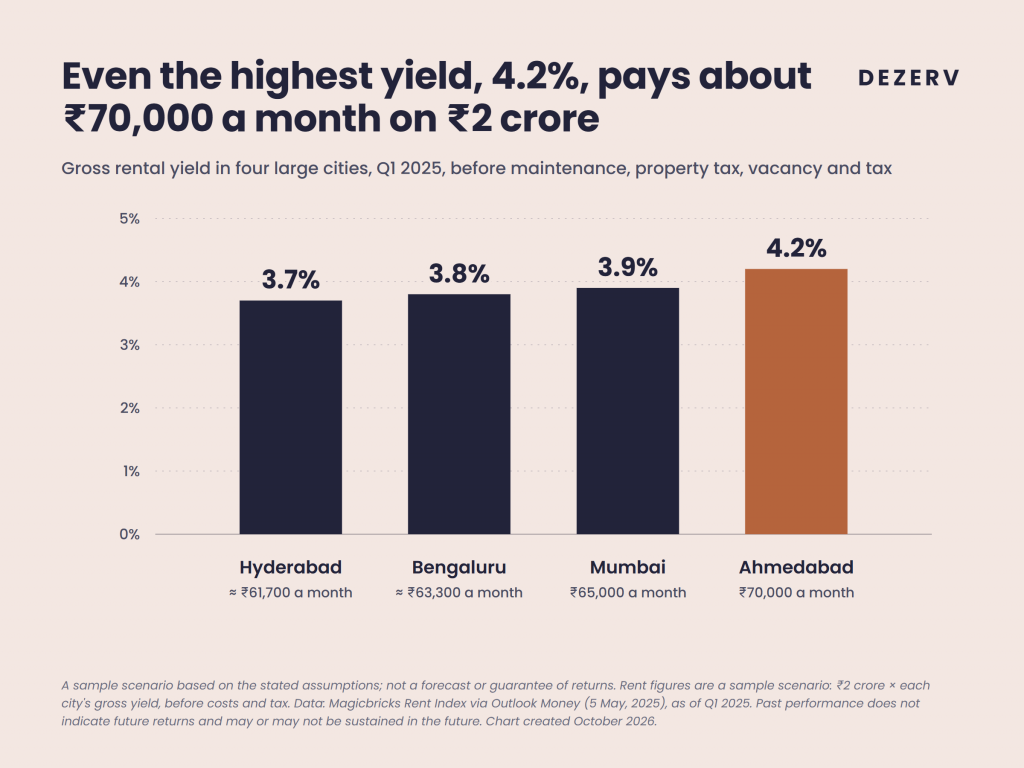
Every figure in that table is gross. Maintenance, property tax, repairs and a vacant quarter all come out before the money reaches the owner, and the rent is then taxed as income. Access to money is the larger problem. A pension arrives in small, regular amounts. A flat can only be sold whole, and a sale can take months.
A flat owned outright and let to a long-term tenant still pays an income that tends to move with market rents over the years, which a level annuity does not. As one layer of retirement income it earns its place. The trouble starts when it has to carry the whole retirement.
Families who want property income without that concentration can hold it through real estate investment trusts (REITs), listed trusts that own rent-paying property and whose units trade on the exchanges in small lots, as our explainer on owning real estate without buying property sets out.
Myth 3: the children will look after us
Family support still works when both generations have agreed to it. Living together, or a family business that keeps paying a parent, can be a sound part of a retirement.
The fragile version is monthly cash that nobody has discussed. It gets harder to count on as each older Indian has fewer younger workers behind them.
In 2021 India had 16 people aged 60 and over for every 100 of working age, an old-age dependency ratio that the India Ageing Report 2023 of the United Nations Population Fund expects to keep rising (UNFPA, India Ageing Report 2023, September 2023). A higher ratio, the report notes, means more demand for care from the immediate family.
The report projects the over-60 share of the population to double to more than 20% by 2050, with the group aged 80 and over growing faster still, by about 279% between 2022 and 2050. Already, 18.7% of older Indians live without any income. Those are national figures, and an affluent family is far from the average household.
Even in affluent families, children in their forties are often paying for their own children's education and their own home in the same years a parent's care costs peak.
That squeeze is usually called the sandwich generation. Monthly cash for a parent competes with every one of those bills.
A retirement funded from its own corpus, with family help as a bonus, does not need the next generation's finances to go to plan.
Myth 4: a fixed deposit is the safe part
A fixed deposit's value does not move with the stock market. That is why it feels like the safest home for a retirement corpus.
It is still exposed to three other risks: the bank, the tax on its interest and the rate at renewal. If a bank fails, the Deposit Insurance and Credit Guarantee Corporation (DICGC) covers up to ₹5 lakh per depositor per bank, interest included, and deposits held in the same capacity at different branches count as one (DICGC).
More banks keep more of the money inside that cover. Split ₹2 crore across just two and ₹1.9 crore sits above it.
Deposit interest is taxed at your slab rate every year. At higher incomes, surcharge and cess come on top.
| Total income for the year (new regime) | Tax on the interest (30% slab, surcharge, 4% cess) | 7% deposit after tax |
|---|---|---|
| ₹24 lakh to ₹50 lakh | 31.2% | 4.82% |
| ₹50 lakh to ₹1 crore | 34.32% | 4.60% |
| ₹1 crore to ₹2 crore | 35.88% | 4.49% |
| Above ₹2 crore | 39.0% | 4.27% |
A sample scenario, not a forecast or guarantee. Assumptions: a 7% pre-tax deposit rate; new-regime 30% slab above ₹24 lakh (Income-tax Act, 2025); surcharge of 10%, 15% and 25% above ₹50 lakh, ₹1 crore and ₹2 crore, and 4% cess, for tax year 2026-27 (Finance Bill 2026); marginal relief ignored.
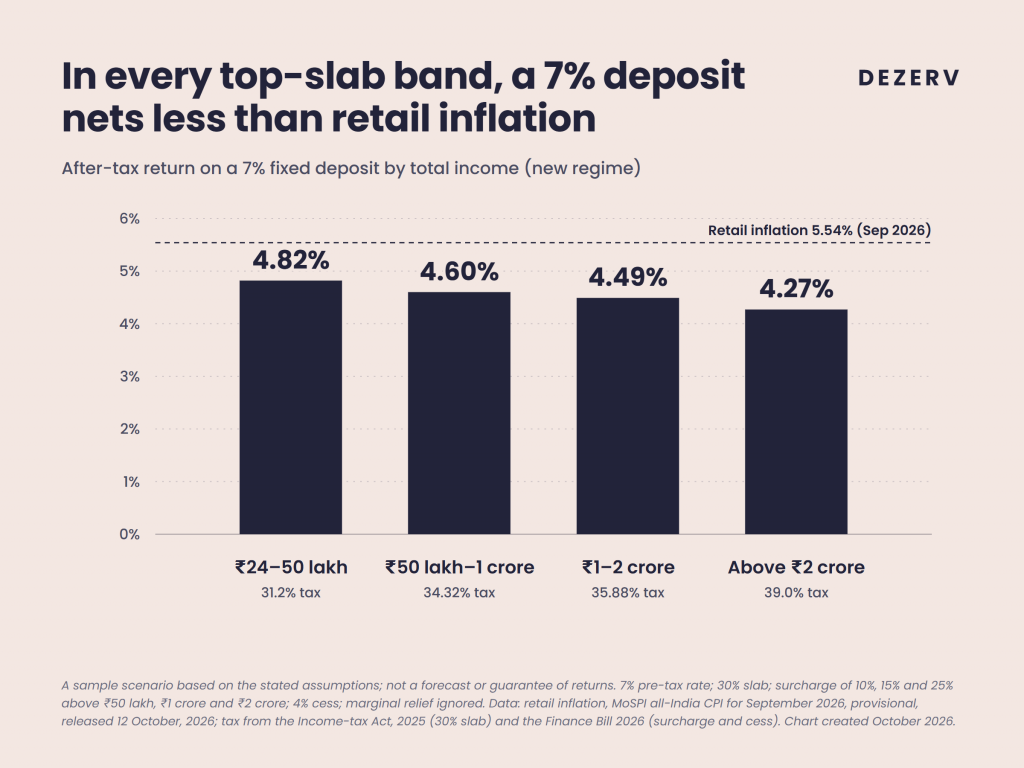
Every row sits below the 5.54% retail inflation MoSPI reported for September 2026 (MoSPI, 12 October, 2026). A deposit held at those rates loses purchasing power after tax, and in the ₹1 crore to ₹2 crore band the shortfall is about one percentage point a year.
A deposit fixes its rate only until it matures. At renewal it rolls over at whatever the bank offers that week.
Where deposits still earn their place
Deposits still do one job well, which is holding money you will spend soon.
A ladder of deposits maturing in successive years lines each maturity up with a year of spending and spreads the renewal risk, and the same idea works with bonds, as our guide to bond investment strategies shows. How much of a 25-year corpus belongs outside deposits altogether is a separate allocation decision, with its own trade-off between steadiness and growth.
Myth 5: I will run my own money for as long as I live
Many affluent retirees built their wealth by managing it themselves. Few of their plans allow for the years when that may no longer be possible.
An estimated 7.4% of Indians aged 60 and over, about 8.8 million people, live with dementia, based on a nationwide Longitudinal Ageing Study in India sample collected in 2018–20 (Lee et al., Alzheimer's & Dementia, 2023). The study estimated prevalence in the population aged 60+, not any particular individual's likelihood of developing dementia. The study found prevalence rising with age and higher among women. Source: Lee et al., original dementia study (2023)
Plenty of investors run their own portfolios well into their eighties. Handing over control early has costs of its own. The aim is a handover that sits ready for the day it is needed. Decades of good results can make even that feel unnecessary, and markets have a long habit of humbling that kind of confidence.
"The stock market is the greatest humiliator out there."
— Vishal Khandelwal, founder of an investment-education platform, interviewed by Morningstar India (Morningstar India, 16 November, 2023)
A portfolio spread across two dozen funds and four bank accounts asks a lot of the person running it. The load grows heavier every year. Preparation works best while the owner is still well enough to do it:
- Simplify: fewer accounts and fewer funds mean fewer passwords and fewer decisions for whoever takes over.
- Nominate: check that every demat account, mutual fund folio, deposit and policy names the people you intend; the current limits on nominees are in our five-year pre-retirement checklist.
- List: one document that records every account and policy, with a hint for each login, kept where the person who will need it can find it.
- Authorise: decide who will act if you cannot, whether family or a professional, and put that authority in writing, for example through a power of attorney, while you are able to sign it. A spouse taking over the money is covered in our piece on the retirement conversation couples should have.
Delegating to a portfolio manager
A portfolio management service (PMS) is one way to pass day-to-day management to a professional: a SEBI-registered portfolio manager runs the portfolio under a written agreement with you. Dezerv Investments Private Limited offers Portfolio Management Services (PMS) that provide exposure to relevant asset classes, primarily through underlying mutual funds, in accordance with each investment approach's mandate. The minimum investment amount for PMS is ₹50 lakh, subject to applicable regulatory requirements and the terms of the relevant service. Investments are subject to market risks, and returns are not guaranteed.
Whoever takes over, the handover goes most smoothly when it is arranged while you can still choose who it is.
Key takeaways
- Spending: non-food items are about 60% of urban household spending, and only a few of those lines, such as the commute and school fees, stop at 60, so build the retirement budget line by line.
- Rent: gross yields of 3.7% to 4.2% in four large cities (Magicbricks, Q1 2025) shrink further after costs and tax, and a flat cannot be sold in parts; treat it as one income layer among several.
- Family: India's 80-plus population is set to grow about 279% by 2050; a retirement funded from its own corpus does not depend on the next generation's finances.
- Deposits: insurance covers ₹5 lakh per depositor per bank, and at the 30% slab a 7% deposit nets 4.27% to 4.82%, below September 2026 retail inflation of 5.54%.
- Capacity: about 7.4% of Indians over 60 live with dementia; simplify holdings, update nominations and put written authority in place early.
Frequently Asked Questions
Do living expenses really fall after retirement?
Some costs fall, such as commuting and work clothing, but most of the budget continues. Non-food items made up about 60% of urban household spending in 2023-24 (MoSPI), and most of them, including travel and domestic help, continue after 60. Healthcare tends to rise with age, and from January 2025 insurers must consult IRDAI before raising a senior citizen's individual health premium by more than 10% in a year. A realistic plan builds the budget line by line.
Is rental income a reliable pension in India?
It is a modest income. Gross rental yields in four large Indian cities ranged from 3.7% to 4.2% (Magicbricks, Q1 2025), so a ₹2 crore flat pays roughly ₹7.4 lakh to ₹8.4 lakh a year before maintenance, property tax, vacancy and tax. A flat also cannot be sold in parts when cash is needed. Rent works best as one income layer among several, and listed REITs offer property income in smaller, tradable units.
Will my children be able to support me in old age?
It is riskier to rely on than it was. India's population aged 60 and over is projected to double its share to more than 20% by 2050, and the 80-plus group to grow about 279% between 2022 and 2050 (UNFPA, 2023). Adult children often carry their own children's education and home loans in the same years. A retirement funded from its own corpus, with family help treated as a bonus, is the sturdier design.
Are fixed deposits safe for a retirement corpus?
A fixed deposit's value does not move with markets, yet three risks remain. DICGC insurance covers only ₹5 lakh per depositor per bank, interest is taxed at the slab rate every year, and the rate resets at renewal. At the 30% slab with surcharge and cess, a 7% deposit nets about 4.27% to 4.82%, below September 2026 retail inflation of 5.54% (a sample scenario). Deposits suit money due to be spent within a few years.
How can retirees prepare for a time when they cannot manage their own money?
Start while you are well. An estimated 7.4% of Indians over 60 live with dementia (Longitudinal Ageing Study in India data, 2023), so simplify holdings into fewer accounts and funds, and keep a single list of every account and policy. Check that every nomination names the people you intend. Decide who will act for you, and put that authority in writing, for example through a power of attorney, while you can still sign it.
Disclaimer
Dezerv Investments Private Limited is a SEBI-registered Portfolio Manager (Registration No. INP000007377). Distribution services are offered by Dezerv Distribution Services Private Limited, a wholly owned subsidiary of Dezerv Investments Private Limited, under AMFI Registration No. ARN-248439 and APMI Registration No. APRN-00615. This article is intended solely for general educational and informational purposes and should not be construed as personalised investment, financial planning, tax or legal advice, or as a recommendation, offer or solicitation to invest in any security, financial product or investment strategy. Readers are advised to consult their financial advisor before making investment decisions based on the information provided herein.
The statistics, data and calculations in this article are based on the sources cited and are for general informational purposes only. Illustrative calculations are based on stated assumptions and are not forecasts or guarantees of future income, returns or retirement outcomes. Actual outcomes may vary depending on individual circumstances, taxes, inflation, healthcare costs, investment performance and prevailing market, economic and regulatory conditions. The information is based on data available as of the dates indicated and may change over time.
Investment in the securities market is subject to market risks. Please read all related documents carefully before investing. Past performance may or may not be sustained in the future.