For a retiree living off a corpus, how each payment is taxed, and which pot it comes from, decides how long the money lasts. Tax shows the difference first.
Draw ₹1 lakh a month from a mutual fund you bought a year ago and your tax return counts about ₹7,400 of each withdrawal as income (assumed 8% growth; a sample scenario), while the same ₹1 lakh drawn as interest on a fixed deposit (FD) counts in full.
That slice grows every year, and the design around it decides whether the withdrawal still pays at 90. It rests on one fact: an SWP payment is a sale of units.
In short
A systematic withdrawal plan (SWP) redeems a chosen amount from mutual funds periodically. Tax generally applies to the taxable gain inside each redemption, not the entire cash received. In a sample comparison, ₹12 lakh a year of equity-fund SWP redemptions produces tax of nil in year one and ₹67,500 in year ten, while ₹12 lakh of FD interest produces ₹3.74 lakh of tax at a 30% marginal rate plus cess (tax year 2026–27 assumptions). This compares taxation of two ways of receiving cash, not equal investment returns: the SWP includes withdrawals of capital and can reduce the remaining corpus; the FD example pays interest without withdrawing its deposit principal. The risks and future corpus values therefore differ.
Table of contents
What an SWP is, and why "best SWP plan" is the wrong question
A systematic withdrawal plan is an instruction to a mutual fund to sell units worth a fixed rupee amount on a chosen date every month and credit the proceeds to your bank account, so each payment is a redemption and is taxed as one. You set the amount and the date, and can change or stop both at any time.
Fund houses commonly offer two versions. A fixed-amount SWP sells however many units ₹1 lakh needs, so the payout is steady and the unit count falls faster in a down market. A fixed-unit SWP sells the same number of units each month, so the payout moves with the net asset value (NAV). Retirees paying bills usually want the first.
Most pages ranking for "best SWP plan for retired person" answer with schemes and last year's returns.
A ranking that will look different next year is no basis for a 30-year income, so this guide stops at categories. The useful answer is a structure: which categories do which job, how much to draw, what refills the account, and what to do in a bad year.
How an SWP is taxed against FD interest: the rupee gap
Fixed-deposit interest is income. All of it is added to your total income and taxed at your slab rate, which under the new regime of the Income-tax Act, 2025 runs from nil up to ₹4 lakh to 30% above ₹24 lakh. A rebate takes the tax to nil for a resident whose total income is within ₹12 lakh.
A bank deducts tax at source once a senior citizen's interest from it crosses ₹1 lakh in a tax year (Income-tax Act, 2025).
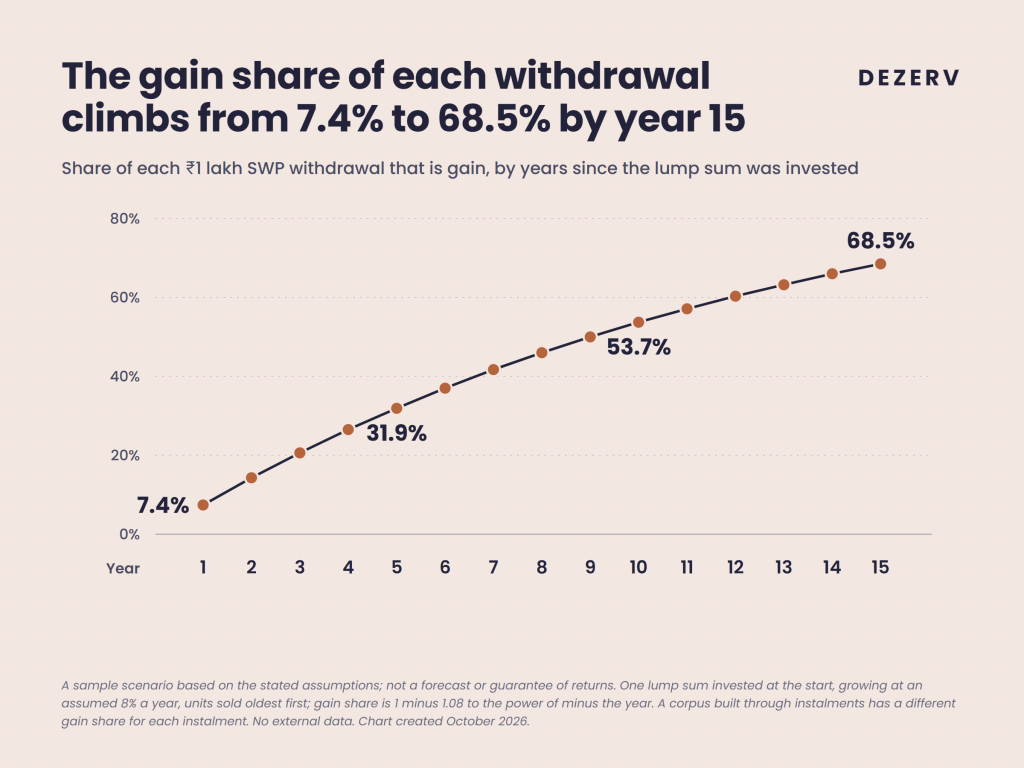
An SWP withdrawal is a sale of units, so only the gain inside it is taxed: units bought a year ago in a fund that grew 8% make about ₹7,400 of each ₹1 lakh gain (a sample scenario). The other ₹92,600 is your own capital coming back.
The gain share rises every year as the units you sell age.
| Years since the lump sum was invested | Share of each withdrawal that is gain | Gain in a ₹1 lakh withdrawal |
|---|---|---|
| 1 | 7.4% | ₹7,407 |
| 3 | 20.6% | ₹20,617 |
| 5 | 31.9% | ₹31,942 |
| 10 | 53.7% | ₹53,681 |
| 15 | 68.5% | ₹68,476 |
A sample scenario, not a forecast or guarantee of returns: one lump sum invested at the start, growing at an assumed 8% a year (between the bond and equity index returns cited in the rate section), units sold oldest first. Year 1 means units held just over 12 months. A corpus built through instalments has a different gain share for each instalment. Tax year 2026-27 rules; tax treatment depends on individual circumstances and may change.
Which rate applies to the gain
An equity-oriented fund is one the Act defines as holding at least 65% in listed Indian shares; its units pay 12.5% on long-term gains above ₹1.25 lakh a year once they are more than 12 months old, and 20% before that.
Debt funds work differently. A fund the Act calls a specified mutual fund, one holding more than 65% in debt and money-market instruments, counts every gain on units bought on or after 1 April, 2023 as short-term and taxes it at your slab, however long you hold.
An SWP's tax over ten years, against FD interest
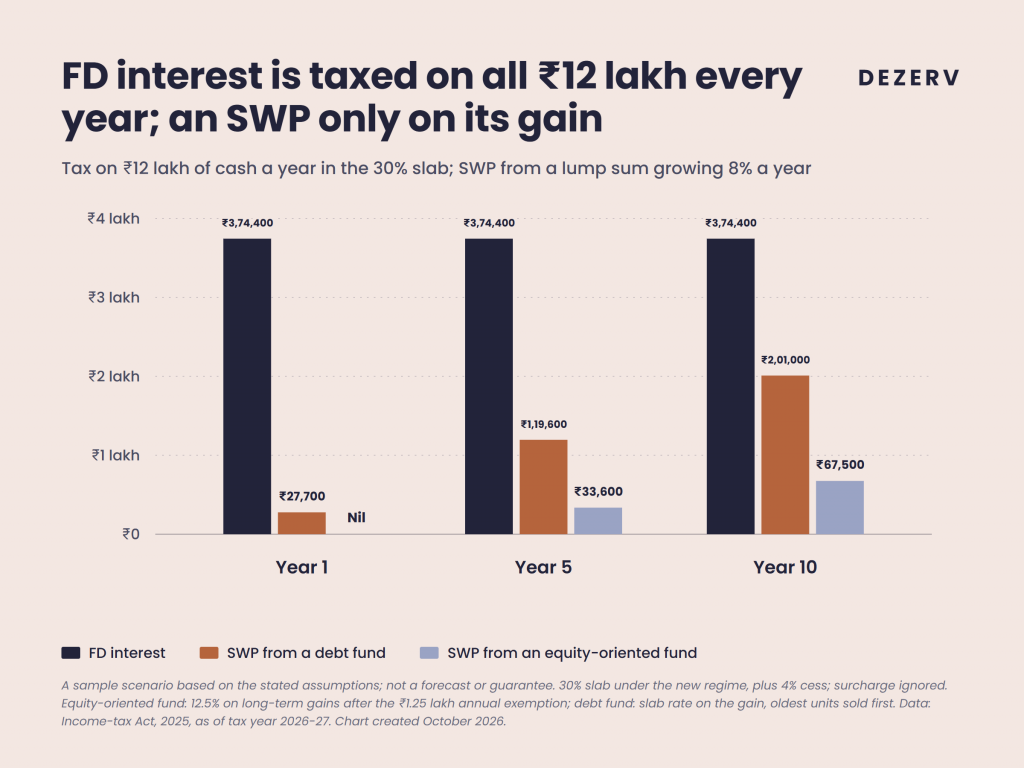
Take a retiree already in the 30% slab from other income who needs ₹12 lakh of cash a year.
| Year of withdrawal | FD interest, ₹12 lakh | SWP from a debt fund, ₹12 lakh | SWP from an equity-oriented fund, ₹12 lakh |
|---|---|---|---|
| Year 1 | ₹3,74,400 | ₹27,700 | Nil |
| Year 5 | ₹3,74,400 | ₹1,19,600 | ₹33,600 |
| Year 10 | ₹3,74,400 | ₹2,01,000 | ₹67,500 |
A sample tax-on-cash-receipts comparison, not a like-for-like investment-return comparison or a forecast. An SWP partly redeems invested capital; FD interest does not reduce the original deposit principal. Tax on ₹12 lakh of cash in hand each year for a resident in the 30% slab under the new regime, plus 4% cess; surcharge ignored. The SWP columns assume one lump sum growing at 8% a year, oldest units sold first, so the gain share is the table above; the equity-oriented column applies 12.5% after the ₹1.25 lakh annual exemption. Rates per the Income-tax Act, 2025, tax year 2026-27; tax treatment depends on individual circumstances and may change.
The debt-fund SWP is taxed at the same slab rate as the FD, yet incurs less tax on the illustrated ₹12 lakh cash receipt in year five because the taxable amount is only the gain component. This does not establish lower total tax or better post-tax investment performance.
And the equity-oriented SWP pays nothing in year 1, because the gain sits inside the ₹1.25 lakh exemption, which resets every tax year.
The illustrated cash-receipt tax difference narrows as the gain share increases; the ultimate lifetime tax and investment outcomes are not compared here. Even at year 15, with two-thirds of each withdrawal counted as gain, a debt-fund SWP is taxed on ₹8.2 lakh of the ₹12 lakh against the FD's full ₹12 lakh, about ₹2.56 lakh of tax against ₹3.74 lakh (same sample scenario).
Surcharge widens the gap for larger incomes: on these equity gains it is capped at 15% under the Finance Act, 2026, while slab income carries the full surcharge.
Watch out
An FD carries no market risk and a mutual fund does, so the table says nothing about which is safer. How an SWP's tax and certainty compare with an annuity's and with dividends is the subject of SWP vs annuity vs dividends.
Which fund categories suit an SWP, and why
SEBI redrew the fund categories on 26 February, 2026. Every scheme must now sit inside one of them (SEBI circular).
A retiree choosing an SWP fund is choosing a category, which fixes how much of the money is in shares and which tax regime the withdrawals fall under.
| Category (SEBI, February 2026) | What the rules require | Tax regime on withdrawal | Job in an SWP structure |
|---|---|---|---|
| Liquid fund | Debt and money-market paper maturing within 91 days | Gain at slab | The first six to twelve months of withdrawals |
| Short term fund | Portfolio Macaulay duration of 1 to 3 years | Gain at slab | Months 12 to 24 of the bridge |
| Corporate bond fund | At least 80% in bonds rated AA+ and above | Gain at slab | Bridge, where a longer accrual horizon is acceptable |
| Conservative hybrid fund | Equity 10 to 25%, debt 75 to 90% | Gain at slab (debt above 65%) | A steadier SWP source than pure debt, same tax |
| Income plus arbitrage fund of funds | Up to 65% in debt-oriented schemes, the balance in arbitrage schemes | If it stays under 65% in debt schemes: long-term gains at 12.5% after 24 months | Bridge money at a lower tax rate, if held two years first |
| Equity savings fund | At least 65% equity, net unhedged equity 15 to 40%, at least 10% debt | Usually equity-oriented: 12.5% after 12 months, above ₹1.25 lakh | The lowest-volatility equity-taxed SWP source |
| Balanced advantage fund (dynamic asset allocation) | Equity and debt managed dynamically; no fixed band | Depends on how it is run; the scheme information document (SID) states it | A long-horizon SWP source that trims equity itself |
| Aggressive hybrid fund | Equity 65 to 80%, debt 20 to 35% | Equity-oriented | The growth layer, drawn from only to refill |
Category rules per the SEBI circular of 26 February, 2026; tax regime per the Income-tax Act, 2025 (the 65% debt and 65% equity tests; a fund that is neither equity-oriented nor specified is long-term after 24 months). Whether a given scheme is equity-oriented depends on its actual holdings, which the scheme information document states. Tax year 2026-27 rules; tax treatment depends on individual circumstances and may change. Categories only; no scheme is being recommended.
One ladder: money needed within two years sits in liquid and short-term debt, where the slab rate falls on a tiny gain and the price barely moves. Years three to ten sit in equity savings or balanced advantage funds, taxed at 12.5% but with a NAV that can drop; money not needed for a decade stays in the growth layer.
Feroze Azeez, a wealth-management executive, put it more bluntly on a personal-finance show (8 October, 2025): long-horizon money belongs in equity, and short-term money in a debt-plus-arbitrage fund, since the 2023 change left pure debt funds taxed as short-term for good.
The first point is fair for the growth layer. It does not justify an all-equity SWP.
Vaibhav Porwal's House View letter of 7 October, 2026 points the same way on fixed income: short duration, earning accrual, which is Dezerv's positioning rather than a recommendation.
Setting the rate: the corpus that supports ₹1 lakh a month
Three inputs decide which corpus supports ₹1 lakh a month: the return earned, how fast the withdrawal rises, and how long it must last.
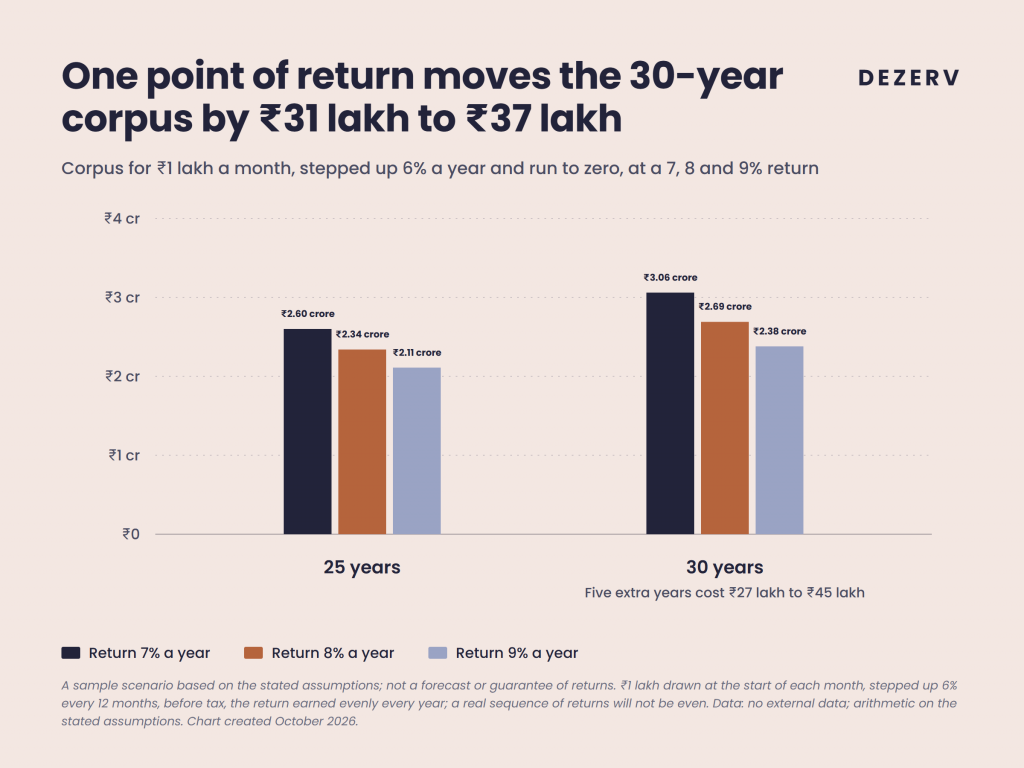
| Horizon | Return 7% a year | Return 8% a year | Return 9% a year |
|---|---|---|---|
| 25 years | ₹2.60 crore (first-year draw 4.6%) | ₹2.34 crore (5.1%) | ₹2.11 crore (5.7%) |
| 30 years | ₹3.06 crore (3.9%) | ₹2.69 crore (4.5%) | ₹2.38 crore (5.0%) |
A sample scenario, not a forecast or guarantee of returns. ₹1 lakh withdrawn at the start of each month, stepped up 6% every 12 months, the corpus run to zero at the end of the horizon, before tax, with the return earned evenly every year. The percentage is the first year's ₹12 lakh as a share of the corpus. The 7 to 9% range is an assumption, not a promise, and a real sequence of returns will not be even. The 6% step-up sits above September 2026's 5.54% retail inflation (MoSPI) and the 5.75% a year consumer prices averaged from 2012-13 to 2024-25 (RBI Handbook of Statistics, Table 236).
For scale, the Nifty 50 Total Return Index compounded 12.0%* a year over the 20 years to 30 June, 2026 (NSE index data), and a blended low-duration and corporate bond fund index 7.6%* (Ace MF data; a paid database with no public page).
Past performance does not indicate future returns and may or may not be sustained in the future.
At a 6% step-up, a first-year draw near 4% of the corpus is what a 30-year retirement at a 7% return can carry; on ₹3 crore, ₹1 lakh a month is exactly 4%. A draw above 5% needs a higher return or a shorter horizon, unless a pension or annuity already pays part of the bills and the SWP pays for spending that can wait.
Dhirendra Kumar, chief executive of Value Research, gave a subscriber the same caution when asked about running an SWP from a small-cap-heavy portfolio.
"However, I'm not suggesting withdrawing 10 per cent annually; in fact, I usually recommend being more conservative in the initial years."
— Dhirendra Kumar, CEO, Value Research, Ask Value Research (Value Research Online, 5 December, 2024)
The 6% step-up assumption does the most work. India's consumer price index ran above 9% in both 2012-13 and 2013-14 (RBI Handbook of Statistics, Table 236), and at a 9% step-up the 30-year corpus at 7% grows from ₹3.06 crore to about ₹4.62 crore (a sample scenario). Even a 7% step-up cuts the 30-year first-year draw to about 3.4%.
The safe withdrawal rate for India explains why 4% is not universal and how the rate should flex; for your own numbers, use the Dezerv retirement calculator.
The refill and rebalancing rule
An SWP sells units every month without asking, so it needs a rule for where the money comes from. Here it draws from a bridge of two years' withdrawals in liquid and short-term debt, which a growth layer of equity-oriented funds refills; the three-layer withdrawal structure sets out the full layering, the buffer and how to size each layer.
Once a year, if the growth layer is above its target share, sell enough of it to bring the bridge back to 24 months of withdrawals, which on ₹1 lakh a month, stepped up 6% a year, is about ₹24.7 lakh when first built and ₹26.2 lakh at the first yearly refill (a sample scenario).
If it is below, let the bridge run down; after a fall, refill only once equity regains its last-refill level. Two years is this article's sizing assumption: the three-layer structure holds seven to ten years in debt because its first layer pays the whole planned draw, while here years three to ten sit in equity-savings and balanced-advantage funds.
Index history backs two years only so far: from 1999 to 2020 the Nifty 50 Total Return index had four stretches below an earlier year-end peak, three of two year-ends or fewer, the worst (2000 to 2002) three (NSE Indices). Two years covers a typical fall, not the worst: a high draw rate or no other income argues for more, a pension covering the essentials for less.
Rebalancing is the same action seen from the other side. Selling growth to refill the bridge trims equity after a good run and leaves it alone after a bad one, and a yearly date is enough; a monthly check turns a rule into a habit of tinkering.
Sequencing: which account to draw first
Which account the SWP draws from decides the tax bill and the damage a bad year does. The order changes with the year.
| Situation | Draw first | Then | Leave alone |
|---|---|---|---|
| Normal year, growth layer above its target share | The bridge (liquid, short-term debt) | Refill the bridge from the growth layer at the yearly review | Nothing; the review does the selling |
| Falling market, growth layer below its target share | The bridge | The debt side of any hybrid fund; the buffer stays for shocks | The growth layer, until equity is back to its level at the last refill |
| Every tax year, regardless | Enough long-term equity-oriented gains to use the ₹1.25 lakh exemption | Debt-fund units, whose gain is taxed at slab | Units bought within the last 12 months |
Most retirees skip the third row. The ₹1.25 lakh exemption lapses if unused.
So even in a year when the bridge covers every bill, selling equity-oriented units that carry ₹1.25 lakh of gain and buying them back costs no capital-gains tax, resets the purchase price higher and restarts the 12-month clock on the new units, and over a decade that lowers the gain share in every later withdrawal.
Units sold at the bottom of a fall miss the recovery. Sequence-of-returns risk shows what that cost on the Nifty 50 total return index from 2008 to 2017.
Common SWP mistakes
- Running the SWP from an all-equity fund. It is the most tax-efficient version on paper and the most fragile in a fall, because every monthly sale in a falling market is a forced sale. It holds up only where a pension or other income already pays the essentials and the SWP funds spending that can pause in a fall.
- Starting within 12 months of buying an equity-oriented fund. Gains on units held 12 months or less are taxed at 20% rather than 12.5%, and many equity schemes charge an exit load inside the first year; the scheme information document states both. Buy a year before you need the income.
- Starting the SWP in a drawdown with no bridge. The first two years of withdrawals decide more than any later decision.
- Choosing the income distribution cum capital withdrawal (IDCW) option because it feels like income. It is the same money, paid from the NAV and taxed at slab on the whole payout.
- Assuming a debt fund gets the equity rate. A fund holding more than 65% in debt is a specified fund; its gains are taxed at your slab however long you hold, though still only on the gain.
- Never revisiting the amount. A fixed-amount SWP set at 60 and left alone is a pay cut every year the step-up is missed, and a drain on the corpus every year the market makes it too large.
Setting up the SWP: the step-by-step checklist
- Fix the monthly number and its step-up. Write down the first year's withdrawal and the annual increase you will apply, with inflation measured on your own basket.
- Size the corpus and the first-year rate. Use the table above or the calculator; for a 30-year horizon, a first-year draw near 4% if spending rises 6% a year and nearer 3.4% at 7%, higher only with a clear reason.
- Build the bridge first. Put 24 months of withdrawals into liquid and short-term debt funds before the SWP starts. The simplest version is a few months of expenses in a bank account; two years in funds is the fuller form.
- Choose categories by job, not by last year's return. Bridge in liquid, short-term and corporate bond funds; the SWP source in equity savings or balanced advantage; the growth layer in aggressive hybrid or equity funds. Check in each scheme information document whether the scheme is run as equity-oriented.
- Buy the growth option. Not the IDCW option, for the reason in the mistakes above.
- Check the holding period before starting. Where cash needs permit, holding equity-oriented units for more than 12 months before the first SWP may qualify gains for long-term treatment and help avoid applicable early exit loads. Earlier withdrawals remain possible, subject to the scheme terms and tax consequences.
- Register the SWP. One instruction per fund, for the fixed amount, on a date a few days after any pension or rent credits, into the bank account the household runs on. Point it at the bridge fund, which the growth layer refills.
- Diarise one review a year. On that date: step up the amount, refill the bridge if the growth layer is above its target share (after a fall, once equity regains its last-refill level), consider the unused portion of the aggregate ₹1.25 lakh annual long-term equity-gains threshold, and check that no scheme has drifted out of its category.
A retiree who does these eight things has a better answer to "which SWP plan" than any list of funds, because the plan survives the fund being replaced. Retirement income planning shows how it fits with pension, interest and an annuity.
Key takeaways
- An SWP is taxed only on the gain inside each withdrawal, which may mean lower tax on an illustrated cash withdrawal than tax on an equal amount of FD interest. These are not equal economic returns: SWP receipts include returned capital, and mutual funds carry market risks that differ from FDs.
- The taxed share grows every year, from about 7% to about 54% by year ten at an assumed 8%, but stays below the FD's 100%.
- Choose fund categories by job: debt for the two-year bridge, equity savings or balanced advantage as the SWP source, aggressive hybrid and equity for growth.
- For 30 years, ₹1 lakh a month rising 6% a year needs ₹2.38 crore to ₹3.06 crore at 9% to 7% (sample scenario).
- Refill the bridge according to the portfolio review rule. When scheduling equity-oriented redemptions, consider any unused portion of the aggregate ₹1.25 lakh annual long-term equity-gains threshold after other relevant gains; the threshold is not a separate yearly allowance for each fund.
Frequently Asked Questions
What SWP rate is safe for a retiree?
No single rate is safe in every market, but the arithmetic gives a starting point. ₹1 lakh a month rising 6% a year lasts 30 years on about ₹3.06 crore at a 7% return, which makes the first year's ₹12 lakh a 3.9% draw; at 9% the same income needs ₹2.38 crore, a 5% draw (sample scenario, not a forecast or guarantee). For 30 years, a first-year draw near 4% is a starting point when spending rises 6% a year, nearer 3.4% at 7%, reviewed every year and cut after a bad year.
How is an SWP taxed compared with FD interest?
FD interest is added to income and taxed at slab, up to 30% under the new regime. An SWP is a sale of units, so only the gain inside each withdrawal is taxed: 12.5% on long-term gains above ₹1.25 lakh a year for an equity-oriented fund, 20% if held 12 months or less, and slab for a fund holding more than 65% in debt (tax year 2026-27 rules, which may change). Sample scenario: in the 30% slab, ₹12 lakh a year costs ₹3.74 lakh as FD interest, nil to ₹67,500 as an equity-oriented SWP.
Which corpus supports ₹1 lakh a month?
It depends on the return, the step-up and the horizon. With ₹1 lakh a month rising 6% a year and the corpus run to zero, 30 years needs ₹3.06 crore at 7%, ₹2.69 crore at 8% and ₹2.38 crore at 9% (sample scenario, not a forecast or guarantee); the rate section gives 25 years. A 9% step-up, a pace India's CPI exceeded in both 2012-13 and 2013-14, needs about ₹4.62 crore over 30 years at 7%.
Is a debt-fund SWP still better than an FD after the 2023 tax change?
Not necessarily. For an SWP from a fund covered by the specified-mutual-fund provisions, taxable gains are generally treated as short-term and taxed at the applicable rate. Unlike periodic FD interest, an SWP usually recognises taxable gain only when units are redeemed, and each redemption may include a return of capital. Whether this results in greater overall tax efficiency depends on acquisition dates, fund classification, realised gains, withdrawal pattern, fees and the investor’s wider tax position. Debt funds also carry market and credit risks that differ from FD risks.
Which type of mutual fund is best for an SWP?
A ladder of categories, not one scheme. Under SEBI's February 2026 categories, liquid and short-term debt funds hold the first two years of withdrawals; equity savings and balanced advantage funds, when run as equity-oriented, cover years three to ten; aggressive hybrid and equity funds form the growth layer that refills the bridge. The scheme information document shows whether a scheme is run as equity-oriented.
When should an SWP start after investing?
An SWP may begin when the scheme permits redemptions and the investor needs cash. Where circumstances permit, holding equity-oriented units for more than 12 months before redemption can allow eligible gains to receive long-term capital-gains treatment; some schemes also levy first-year exit loads. Withdrawals within 12 months are still possible, subject to scheme terms and the applicable tax treatment. Review the scheme information document before scheduling the first payment.
Disclaimer
Dezerv Investments Private Limited is a SEBI-registered Portfolio Manager (Registration No. INP000007377). Distribution services are offered by Dezerv Distribution Services Private Limited, a wholly owned subsidiary of Dezerv Investments Private Limited, under AMFI Registration No. ARN-248439 and APMI Registration No. APRN-00615. This article is intended solely for general educational and informational purposes and should not be construed as personalised investment, financial planning, tax or legal advice, or as a recommendation, offer or solicitation to invest in any security, financial product or investment strategy. Readers are advised to consult their financial advisor before making investment decisions based on the information provided herein.
The tax comparisons, withdrawal calculations, corpus estimates and illustrations discussed in this article are based on stated assumptions and the sources cited herein and are provided for illustrative purposes only. They are not forecasts or guarantees of investment performance, tax savings or the sustainability of retirement income. Actual outcomes may vary depending on market conditions, returns, inflation, costs, taxes and withdrawal patterns. Tax laws and regulatory provisions may change from time to time. The fund categories and withdrawal structures discussed are for general information only and do not constitute a recommendation of any particular scheme. This article is not a complete disclosure of every material fact, term or condition Please refer to the relevant disclosure documents, client agreements and scheme information documents for applicable risks and terms.
Investment in the securities market is subject to market risks. Please read all related documents carefully before investing. Past performance may or may not be sustained in the future.