For most retirees over 60, the dependable part of the income starts in the government's savings schemes, and the ₹30 lakh ceiling on the Senior Citizens' Savings Scheme looks like the reason a large corpus has to leave them for yield elsewhere.
The ceiling is real: a couple with ₹2 crore fills every capped scheme with ₹78 lakh and still holds ₹1.22 crore.
Yet that ₹1.22 crore has a government-backed home with no ceiling at all. Put it there and, at today's rates, the full ₹2 crore yields a monthly equivalent of about ₹1.34 lakh*, potentially with no final income-tax liability after each spouse’s individual rebate, if two eligible resident spouses genuinely own equal shares of the instruments and have no other taxable income; the interest itself is taxable. So the cap is not what pushes the money out.
What does is easier to see with each scheme's limits side by side, starting with where each one stops.
In short
The Senior Citizens' Savings Scheme (SCSS) takes ₹30 lakh per person at 8.2% and the Post Office Monthly Income Scheme (POMIS) ₹9 lakh at 7.4%: ₹78 lakh a couple, a monthly equivalent of about ₹52,100 before tax (October–December 2026 rates). Uncapped RBI floating-rate bonds pay 8.05% (July–December 2026), so the ₹2 crore illustration may produce no final income-tax liability after each spouse's rebate, if eligible resident spouses genuinely own half each and the other income and rebate conditions are satisfied; the interest remains taxable (a sample scenario).* The rest leaves because that income stays level as costs rise. A common order: a cash buffer, a bond ladder, REITs and InvITs, gold and equity.
*A sample scenario at the rates notified for October–December 2026 (SCSS, POMIS) and July–December 2026 (RBI bonds) and the Income-tax Act, 2025; two senior citizens, income split equally, no other income; not a forecast or guarantee. New-deposit rates are renotified quarterly and the bond coupon resets half-yearly; beyond their notified period they are indicative, not guaranteed.
Table of contents
The government-backed floor and where each scheme stops
The income floor is the part of a retirement corpus held in instruments backed by the government, bought for a payout the government sets; for a resident over 60, four schemes make up that floor, and each stops at a different point.
| Scheme | Rate, October–December 2026 | Ceiling | Term | Paid | Status |
|---|---|---|---|---|---|
| Senior Citizens' Savings Scheme (SCSS) | 8.2% a year | ₹30 lakh per person, across all accounts | 5 years, extendable in 3-year blocks | Quarterly | Open |
| Post Office Monthly Income Scheme (POMIS) | 7.4% a year | ₹9 lakh single, ₹15 lakh joint | 5 years | Monthly | Open |
| RBI Floating Rate Savings Bonds, 2020 (Taxable) | 8.05% for July–December 2026 | None | 7 years | Half-yearly, 1 January and 1 July | Open |
| Pradhan Mantri Vaya Vandana Yojana (PMVVY) | Pension rate fixed at purchase | ₹15 lakh per person | Fixed at purchase | Pension | Closed to new buyers since 31 March, 2023 |
Rates are the figures notified for the period shown. SCSS and POMIS rates are renotified quarterly for new deposits, and an open account keeps its opening rate for the five-year term; the RBI bond coupon resets half-yearly. For any later period they are indicative, not guaranteed. Sources: SCSS per Central Bank of India and India Post; POMIS rate and ceilings per India Post and the opening-rate rule per the POMIS scheme rules, the ceilings as raised in the Budget Speech 2023-24, paras 109–110; RBI bond rate per the RBI release of 1 July, 2026 and terms per the RBI release of 26 June, 2020; PMVVY ceiling per the Budget Speech 2018-19, closure per LIC's withdrawn-plans list and the Cabinet decision of 20 May, 2020. Read on 15 and 16 October, 2026.
The Department of Economic Affairs renotifies the SCSS and POMIS rates for new deposits each quarter (National Savings Institute). An SCSS account already open keeps the rate it started with, while the RBI bond coupon is the National Savings Certificate rate plus 35 basis points, reset every 1 January and 1 July (RBI circular, June 2020).
PMVVY's closure matters: it fixed a pension rate for the whole policy, exactly what a floor needs, and nothing listed now does.
How much a couple can park in the capped schemes
The SCSS ceiling applies per person: each spouse over 60 can hold ₹30 lakh, and POMIS ₹9 lakh each in single accounts, so a couple's capped floor is ₹78 lakh.
| Per person | Per couple | |
|---|---|---|
| SCSS at ₹30 lakh, 8.2% | ₹2,46,000 a year | ₹4,92,000 a year |
| POMIS at ₹9 lakh (single account), 7.4% | ₹66,600 a year | ₹1,33,200 a year |
| Capped schemes, total deposit | ₹39 lakh | ₹78 lakh |
| Interest before tax, a year | ₹3,12,600 | ₹6,25,200 |
| Monthly equivalent, before tax | ₹26,050 | ₹52,100 |
A sample scenario, not a forecast or guarantee of returns. Assumptions: both spouses eligible, each holding one SCSS account at the ceiling and one single POMIS account at the ceiling, at the rates notified for October–December 2026 (Central Bank of India; India Post). A joint POMIS account is capped at ₹15 lakh instead. The monthly figure is an average: only POMIS pays monthly (₹11,100 for the couple); SCSS pays quarterly (₹1,23,000 a quarter).
Watch out
An SCSS account opened jointly with a spouse counts entirely against the first holder's ₹30 lakh (Central Bank of India). A couple that wants ₹60 lakh in the scheme opens two accounts, one in each name.
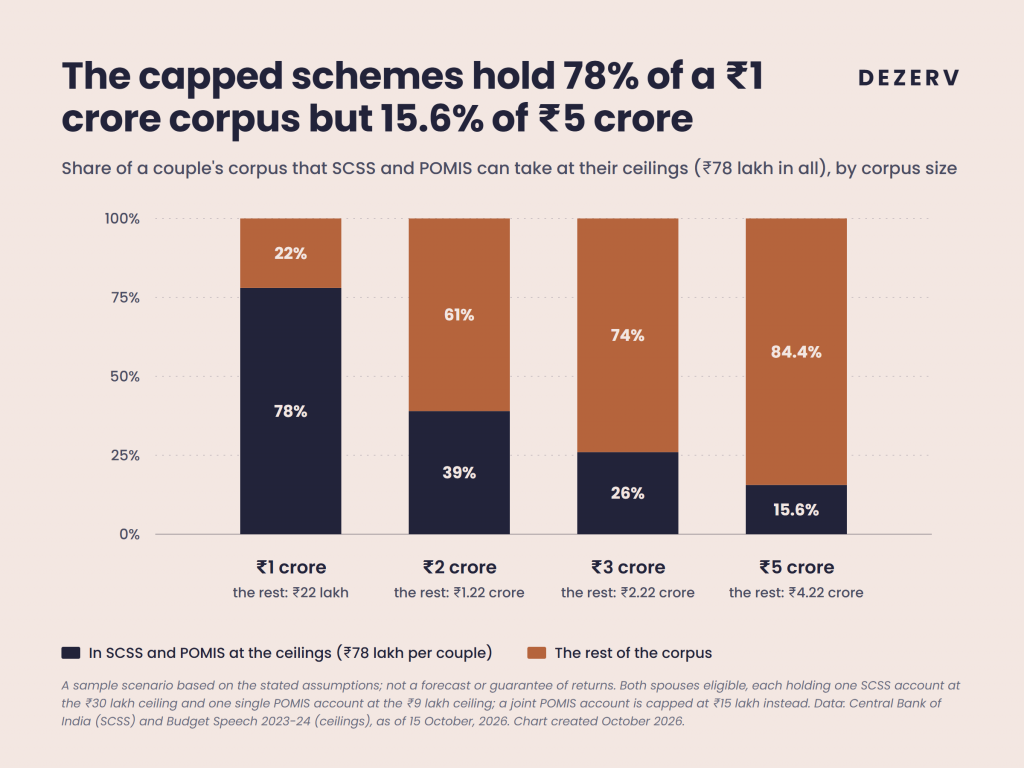
Against a ₹1 crore corpus, ₹78 lakh is most of the money; against ₹2 crore it is 39%, and against ₹5 crore under a sixth.
The ceiling binds long before the corpus does.
| Corpus (couple) | In SCSS and POMIS at the ceilings | Share of corpus | The rest |
|---|---|---|---|
| ₹1 crore | ₹78 lakh | 78% | ₹22 lakh |
| ₹2 crore | ₹78 lakh | 39% | ₹1.22 crore |
| ₹3 crore | ₹78 lakh | 26% | ₹2.22 crore |
| ₹5 crore | ₹78 lakh | 15.6% | ₹4.22 crore |
A sample scenario, not a forecast or guarantee. Ceilings per the Budget Speech 2023-24, paras 109–110.
What the floor pays after tax, ₹1 crore to ₹5 crore
All four schemes' interest is taxed at the holder's slab rate.
The Income-tax Act, 2025, in force since 1 April, 2026, charges nothing under its default regime on the first ₹4 lakh, then 5% to ₹8 lakh and 10% to ₹12 lakh, and a rebate of up to ₹60,000 wipes out the tax where total income is ₹12 lakh or less.
The illustrative nil final tax arises only where eligible resident spouses beneficially own and are assessed separately on their respective interest, have no other taxable income and satisfy the individual rebate rules. The interest itself remains taxable; joint-account status alone does not determine its ownership for income-tax purposes.
| Corpus | In the capped schemes | In RBI floating-rate bonds | Interest a year, before tax | Illustrative final income tax after individual rebate | After tax, monthly equivalent |
|---|---|---|---|---|---|
| ₹1 crore (one person) | ₹39 lakh | ₹61 lakh | ₹8,03,650 | Nil | ₹66,971 |
| ₹2 crore (couple) | ₹78 lakh | ₹1.22 crore | ₹16,07,300 | Nil | ₹1,33,942 |
| ₹3 crore (couple) | ₹78 lakh | ₹2.22 crore | ₹24,12,300 | ₹12,792 | ₹1,99,959 |
| ₹5 crore (couple) | ₹78 lakh | ₹4.22 crore | ₹40,22,300 | ₹4,21,798 | ₹3,00,042 |
A sample scenario, not a forecast or guarantee of returns. Assumptions: SCSS 8.2%, POMIS 7.4% and RBI floating-rate bonds 8.05% as notified for the periods shown, every ceiling filled and the balance in the bonds; one or two resident senior citizens with no other income, a couple each assessed on half the interest, under the default regime of the Income-tax Act, 2025 (slab table, ₹60,000 rebate with marginal relief, 4% cess, the rates for the 2026-27 tax year); year-one interest only. Rates are indicative for later periods, not guaranteed, and tax rules can change.
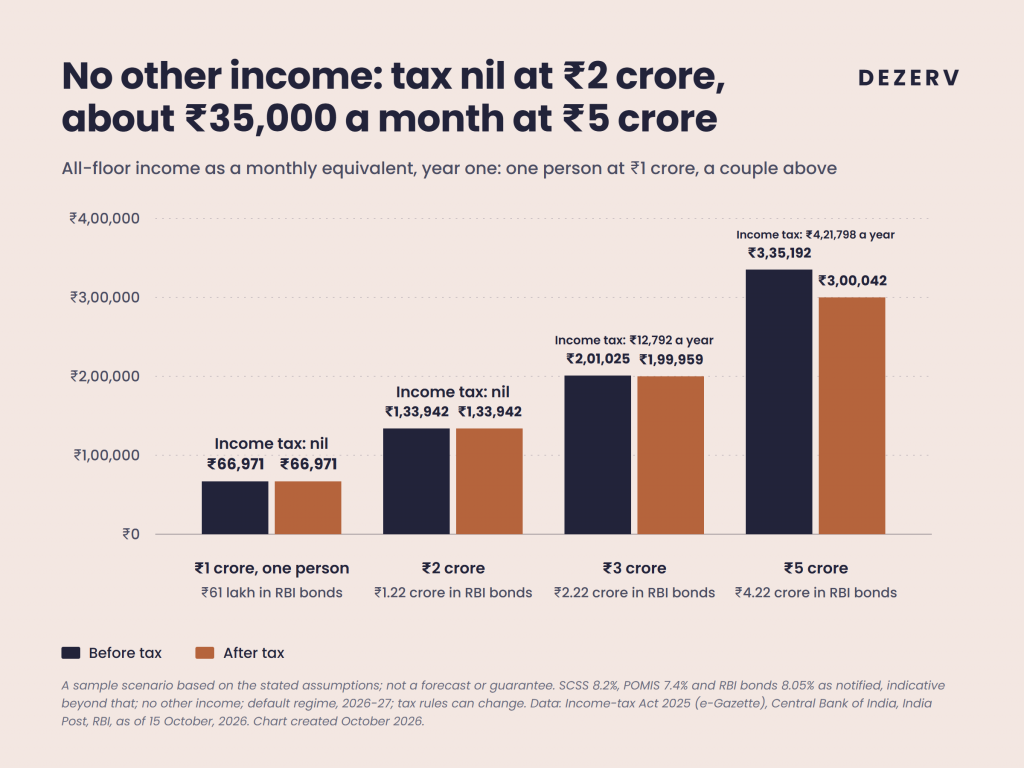
The nil rows hold only while the floor is the household's only income: at ₹2 crore each spouse has about ₹8.04 lakh of interest, leaving roughly ₹3.96 lakh of room under the ₹12 lakh rebate line, the same as one person at ₹1 crore.
Add ₹6 lakh each of pension, rent or other interest, after their own deductions, and the couple's tax goes from nil to about ₹1.88 lakh a year; with no other income, tax bites only past ₹12 lakh of interest each, and at ₹5 crore the couple keeps 7.2% of the corpus, against 8% before tax (a sample scenario).
Three reliefs for people over 60 sit in the Act's old regime: the first ₹3 lakh of income is untaxed (₹5 lakh from age 80), up to ₹50,000 of deposit interest is deductible, and an SCSS deposit counts inside the ₹1.5 lakh savings deduction in the year it is made (Income-tax Act, 2025; Finance Act, 2026).
The default regime is still cheaper for this couple at every size: at ₹5 crore, about ₹3.1 lakh less in the deposit year and ₹4.1 lakh a year after (a sample scenario).
Banks and post offices deduct tax at source on interest above ₹1 lakh a year for a senior citizen (Income-tax Act, 2025), and a full SCSS account earns ₹2.46 lakh, so TDS applies unless the holder files Form 121, which replaced Form 15H from 1 April, 2026, for a year whose tax works out to nil.
What an all-floor ₹2 crore buys, and what it gives up
The case for leaving everything in the floor is strong. Every rupee is backed by the Government of India, and a bank deposit offers less: the Deposit Insurance and Credit Guarantee Corporation (DICGC) insures only ₹5 lakh per depositor per bank, principal and interest together.
SCSS pays 8.2% on deposits opened this quarter, the income arrives on fixed dates, it does not move with the market, and at ₹2 crore the couple keeps all of it while the floor is its only income (the sample scenario above). What the floor cannot do is grow.
A ₹2 crore floor is still ₹2 crore in year fifteen, and even if rates held, its ₹1.34 lakh monthly equivalent stays ₹1.34 lakh.
At 6% a year of cost growth, the top of the RBI's inflation tolerance band, it buys about ₹75,000 of today's goods in year ten and ₹56,000 in year fifteen (a sample scenario). For an affluent household costs climb faster, as how long a retirement corpus lasts shows at 9% lifestyle inflation, and the de-risking trap makes the case against an all-deposit portfolio.
At 9% a year the same payment buys about ₹57,000 in year ten and ₹37,000 in year fifteen (a sample scenario). The 9% is an assumption, not a measured rate: headline CPI was 5.54% in September 2026 (MoSPI), employer medical-plan costs in India are projected to rise 11.5% in 2026 (Aon), and CPI inflation ran above 9% in both 2012-13 and 2013-14 (RBI Handbook of Statistics, Table 236).
The second cost the floor charges is access. The uncapped instrument runs seven years.
An investor aged 60 to 70 can encash only after six, losing half the last six months' interest (RBI; SBI): about ₹2 lakh on ₹1 crore today. There is no investment ceiling, but these bonds should not be confused with a cash reserve: they have a contractual tenure and restricted premature encashment.
The third is the coupon itself. Government policy sets every rate on the floor, so the "fixed" income moves at every reset and renewal, up in some years and down in others; today's rates are a starting point, not a rate for a twenty-five-year retirement.
The floor is sized to the spending that must arrive whatever happens, not to the corpus, the rule Christine Benz, Morningstar's director of personal finance and retirement planning, puts in bucket terms.
"The Bucket concept is anchored on the basic premise that assets needed to fund near-term living expenses ought to remain in cash, dinky yields, and all."
— Christine Benz, Morningstar, "The Bucket Approach to Building a Retirement Portfolio" (Morningstar, 19 March, 2025)
Laddering the floor so nothing matures in the same year
Reinvestment risk is the chance that a deposit matures when rates are lower than the ones it was earning.
Every scheme on the floor carries it. The money comes back at maturity and goes out again at that day's rate.
| Instrument | Term | Early exit | At maturity |
|---|---|---|---|
| SCSS | 5 years | Before one year, no interest (any paid is recovered from the deposit); 1.5% of the deposit deducted if closed before two years; 1% before five | Extend in three-year blocks at the rate applicable on the maturity date, or withdraw |
| POMIS | 5 years | No closure in year one; 2% of the deposit deducted if closed before three years, 1% after | Withdraw at five years (no extension); open a fresh account at the then rate |
| RBI floating-rate bonds | 7 years | Age 60–70 after six years, 70–80 after five, 80 and over after four; penalty half the last six months' interest | Repaid at par; the coupon has already reset every six months |
Terms per Central Bank of India (SCSS), India Post (POMIS), the RBI release of 26 June, 2020 and SBI's RBI Bonds page (bond holding periods by age). Read 15 and 16 October, 2026.
A ladder staggers the start dates so that only a slice of the floor rolls over in any one year: a couple might open their two SCSS accounts a year apart, buy the bonds in two or three tranches across different half-years, and start POMIS in a third year.
The bonds' coupon resets on the same 1 January and 1 July for every holder, whatever the purchase date, so staggering them spreads maturities, not rates; only the SCSS and POMIS accounts reprice at rollover, one account at a time, never the whole ₹78 lakh at once.
The ladder also solves the access problem: with a tranche maturing every year or two from year five, a slice keeps coming back at par without a penalty, and that is the money a medical bill or a house repair draws on, before a bond is broken or a fund is sold.
Senior citizen investment options beyond the floor, ₹1 crore to ₹5 crore
For a couple with ₹2 crore the order matters more than the products, which where to invest after retirement and bonds for retirement income lay out. A common order: two years of spending in cash; the capped schemes; five to seven years of spending in RBI bonds and a government and AAA-rated ladder; REITs, InvITs and gold; then a small equity sleeve. The floor never grows.
A single senior takes the ₹61 lakh left through the same steps. Those year counts are an assumption. The ladder sits on top of the capped schemes' income, so it runs shorter than the seven to ten years the three-layer withdrawal structure sizes for the planned draw from debt; a pension, an annuity or a surplus corpus shortens it.
Vaibhav Porwal's House View letter of 7 October, 2026 holds REITs and InvITs for income and gold near a tenth, as Dezerv's positioning, not a recommendation for any reader. As separate holdings, the order is ten or more accounts, each with its own statement and maturity, for a household nearing 70: a case for simplicity.
A managed fixed-income approach may be considered by an eligible investor, subject to the permitted holdings, liquidity, credit and market risks, charges and withdrawal provisions in its current approved disclosure document and client agreement. The minimum is ₹50 lakh per client (accredited investors exempt); the single senior's ₹61 lakh clears it only by putting most of the remainder in one account. Dezerv PMS disclosure, 29 September 2026: https://d21ldyuk035o7q.cloudfront.net/pdf/Disclosure_Doc.pdf
Applicable strategy-specific fees, any early-withdrawal charges and other terms are in the disclosure document; underlying fund costs and exit loads fall on the client, and market risk stays.
Retirement income planning turns this into a thirty-year paycheque; the Dezerv retirement calculator tests a split.
Four mistakes with the floor
- Treating the ceiling as the strategy. Filling SCSS and stopping leaves ₹1.22 crore of a ₹2 crore corpus parked by default, usually in whatever the bank offered that week.
- Ignoring tax from about ₹5 crore. With each spouse past ₹20 lakh of interest, as at ₹5 crore, each extra rupee of coupon is taxed at 25–30% plus cess, while long-term equity gains are taxed at 12.5% above ₹1.25 lakh a year under the Income-tax Act, 2025, the 2026-27 tax-year rate; tax rules can change.
- Letting TDS run when the tax is nil. File Form 121 with each bank and post office at the start of the tax year, or wait a year for the refund. The RBI bonds' receiving bank deducts tax at source on their interest too (SBI).
- Chasing a higher "safe" rate. Anything paying well above the sovereign schemes is carrying credit risk, whether it says so or not.
Key takeaways
- The capped schemes hold ₹39 lakh per person and ₹78 lakh per couple, a monthly equivalent of about ₹52,100 before tax at October–December 2026 rates (renotified quarterly; indicative, not guaranteed).
- Uncapped RBI floating-rate bonds (8.05%, July–December 2026) let a ₹2 crore couple stay all-government, untaxed under the default regime only while each spouse's other income stays below about ₹4 lakh (sample scenario, not a forecast or guarantee).
- The floor's income is level, its capital never grows, its rates reset, and the bonds lock money in for four to six years.
- Ladder the floor, then place the rest, commonly a cash buffer, a bond ladder, income assets, gold and a small equity sleeve.
- PMVVY closed on 31 March, 2023, and nothing has replaced its rate fixed for the whole term.
Frequently Asked Questions
Is the SCSS limit of ₹30 lakh per person or per couple?
Per person. The ₹30 lakh ceiling applies across all SCSS accounts held by one individual, and each spouse over 60 can hold ₹30 lakh in their own name, so a couple can place ₹60 lakh. A joint account may be opened only with a spouse, and the whole deposit counts against the first holder's limit, so a couple seeking ₹60 lakh opens two separate accounts (Central Bank of India SCSS page, read 15 October, 2026).
What are the investment options for a senior citizen with ₹1 crore once SCSS and POMIS are full?
For one person the capped schemes take ₹39 lakh. The remaining ₹61 lakh has an uncapped government-backed option in RBI Floating Rate Savings Bonds, which pay 8.05% for July–December 2026 (indicative, not guaranteed; reset every six months) but cannot be encashed by a 60-year-old for six years. A common split for the rest is a cash buffer, a short bond ladder, income assets such as REITs and a small equity sleeve, so that part of the corpus keeps growing while the floor pays the bills.
Is SCSS interest taxable, and is TDS deducted?
Yes. SCSS interest is taxed at the holder's slab rate; under the default regime of the Income-tax Act, 2025, a rebate removes the tax where total income, including any pension, rent or other interest, is ₹12 lakh or less. Banks and post offices deduct tax at source once a senior citizen's interest from that payer passes ₹1 lakh a year, so a full ₹30 lakh account (₹2.46 lakh of interest) faces TDS unless Form 121 is filed for a year whose tax is nil.
Is PMVVY still open?
No. LIC lists Pradhan Mantri Vaya Vandana Yojana (plan 856) among plans withdrawn in the financial year 2022-23, and the last date to buy was 31 March, 2023. Policies bought before then continue to maturity. No scheme with a pension rate fixed at purchase for the whole term has replaced it; SCSS and POMIS fix a rate for five years at opening and the RBI bond coupon resets every six months.
What happens when an SCSS account matures after five years?
The holder can withdraw the deposit or extend the account in blocks of three years. An extended account earns the SCSS rate applicable on the date of maturity, not the rate at which it was opened, which is the reinvestment risk the scheme carries. Opening a couple's two accounts a year apart means the two maturities, and the two repricings, fall in different years.
Disclaimer.
Dezerv Investments Private Limited is a SEBI-registered Portfolio Manager (Registration No. INP000007377). Distribution services are offered by Dezerv Distribution Services Private Limited, a wholly owned subsidiary of Dezerv Investments Private Limited, under AMFI Registration No. ARN-248439 and APMI Registration No. APRN-00615. This article is intended solely for general educational and informational purposes and should not be construed as personalised investment, financial planning, tax or legal advice, or as a recommendation, offer or solicitation to invest in any security, financial product or investment strategy. Readers are advised to consult their financial advisor before making investment decisions based on the information provided herein.
The interest rates, scheme limits, tax calculations, income estimates and portfolio scenarios discussed in this article are illustrative, based on the assumptions and sources cited, and do not constitute forecasts or guarantees of returns or income. Actual returns and tax liability depend on prevailing rates, applicable laws, individual circumstances and other sources of income. Government-backed instruments and other investments are subject to their respective terms, liquidity restrictions and risks. Interest rates, tax provisions and regulatory requirements may change. This article is not a complete disclosure of every material fact, term or condition.
Investment in the securities market is subject to market risks. Please read all related documents carefully before investing. Past performance may or may not be sustained in the future.