When several retirement benefits arrive around the same time, it can feel sensible either to invest them immediately or to leave everything untouched. Neither approach resolves the different deadlines and tax rules attached to each payment.
If you retire at 55 or later and leave your provident fund unclaimed, the Employees' Provident Fund Organisation (EPFO) keeps crediting interest on it for another 36 months. That looks like a comfortable place to leave a crore while you think.
On a tax tribunal's reading, the tax on that interest changed on the day your salary stopped.
That EPF question is only one of the decisions in the first 90 days. Gratuity, leave encashment and superannuation can arrive on different schedules. Sorting urgent actions from decisions that can wait is the first job.
In short
Your Employees' Provident Fund (EPF), gratuity, superannuation, leave encashment and any National Pension System, known as NPS, balance arrive as separate payouts with separate deadlines: gratuity within 30 days of becoming payable, a complete EPF claim within 20 days. In the first 90 days, park the money in a liquid or overnight fund while the claims and the tax are settled, and leave the near-irreversible annuity decision for last. Then invest the corpus in order of when you will need it, because research on lump sums shows that waiting has a cost.
Table of contents
What lands, and on whose clock
The table covers a private-sector employee retiring in tax year 2026-27.
| Payout | Who pays, and by when | Tax position (Income-tax Act, 2025) | The decision it poses |
|---|---|---|---|
| EPF | EPFO, on your claim; a complete claim is to be settled within 20 days (EPF Scheme, 1952) | Eligible accumulated balance generally exempt after qualifying service or an applicable exception. Interest credited after employment ends requires separate tax consideration; case law has treated it as taxable in particular circumstances. | Keep it for a while, or claim it now |
| Gratuity | Your employer, within 30 days of it becoming payable, with interest if late (Code on Social Security, 2020) | For qualifying non-government employees, the gratuity deduction depends on the applicable formula, amount received and overall ₹20 lakh ceiling; government employees are treated differently. | Where to park it |
| Superannuation (approved fund) | The fund's trustees, under the fund's rules | Commuted lump sum on retirement exempt; the pension from the rest is taxed as income | How much to commute, or whether to move it to NPS |
| Leave encashment | Your employer, under its leave policy | Deductible from salary up to ₹25 lakh | Where to park it |
| NPS (if held) | Paid out under the exit rules of the Pension Fund Regulatory and Development Authority (PFRDA), on a normal exit or a later deferred date | Only 60% of the corpus is tax-free | How much to annuitise, and when |
Source: Income-tax Act, 2025, its salary deductions for retirement benefits, its list of exempt income and its provident fund rules; Code on Social Security, 2020, its rule on paying gratuity; the EPF Scheme, 1952 on the 20-day EPF settlement period (Business Today, 11 September, 2026); PFRDA exit regulations, as amended 16 December, 2025; all as of October 2026. Government employees are fully exempt on gratuity and leave encashment at retirement.
Gratuity under the Code on Social Security
Gratuity moved to a new law on 21 November, 2025, when the Code on Social Security, 2020 replaced the Payment of Gratuity Act, 1972.
The Code also widens the wage base. Where allowances outside basic pay and dearness allowance exceed half your total pay, the excess is added back to wages before gratuity is worked out (the Code's definition of wages). For anyone whose basic pay was a small slice of the package, that means a larger gratuity than the old formula gave.
The tax caps did not move.
The ₹20 lakh and ₹25 lakh figures were set by notifications under the repealed 1961 Act and continue under the new Act's savings clause. No fresh notification under the 2025 Act had been found by October 2026. How much of a large gratuity or leave cheque clears its cap is worked through in the tax on each retirement benefit.
Superannuation: commute it, or move it to NPS
An approved superannuation fund lets you take part of the corpus in cash at retirement, in place of the pension it would otherwise buy. That commuted amount is excluded from income, while the annuity bought with the rest is taxed every year it pays.
The fund's own rules decide how much you can commute.
The same exemption also covers a tax-free transfer of the balance into your NPS account. And while you worked, the employer's contributions to the fund counted, with its PF and NPS contributions, towards the ₹7.5 lakh-a-year limit above which they were taxed as a perquisite under the Income-tax Act, 2025.
Week one: sort the decisions by whether you can undo them
The sales calls start within a few days. When a large sum lands in a retired person's account, a bank's limited-period bond and an insurer's pension plan usually arrive first, and each asks for a decision you cannot easily reverse, in the week you are least ready to make it.
| Decision | Can you undo it? | When to act |
|---|---|---|
| Claim the EPF, collect gratuity and leave encashment | No; statutory deadlines | In the first weeks, against the deadlines in the table above |
| Tax paperwork, including Form 39 if you claim the arrears relief the Income-tax Act allows on a large gratuity | No; return deadline | By the return due date for tax year 2026-27 |
| Buying an annuity | No | Last: see the annuity section |
| Investing the corpus for the long term | Yes, fully | Within the 90 days, once the rows above are settled |
Source: Code on Social Security, 2020, its rule on paying gratuity; EPF Scheme, 1952 (Business Today, 11 September, 2026); Income-tax Act, 2025, its relief for salary arrears and gratuity, and Income-tax Rules, 2026, Form 39; as of October 2026.
Where to park the money meanwhile
For the parking itself, two mutual fund categories are built for money you will need within weeks. A liquid fund holds debt and money-market securities maturing within 91 days, and an overnight fund holds securities maturing in one day (SEBI circular, 6 October, 2017).
Neither fund is a bank deposit. Both carry the market risk of any debt fund, which shrinks as maturities get shorter; check each scheme's riskometer and Scheme Information Document before you park money in it. A sweep-in deposit with your bank does a similar job.
Watch out
Interest on a savings or sweep account is taxed at your slab every year, and a corpus left there for a year loses ground to inflation.
The case for investing at once, and where it leaves the 90 days
Is there a cost to keeping your retirement payout aside while you decide what to do with it?
Vanguard studied what happened when investors invested a lump sum immediately rather than spreading the investment over several months. Across international markets between 1976 and 2022, investing immediately produced better results more often than waiting.
| Comparison (wealth after one year, rolling periods) | How often the first strategy came out ahead |
|---|---|
| Lump sum vs three monthly instalments, global equities (MSCI World), 1976–2022 | 68% |
| The same, with interest earned on the cash waiting to be invested (all-equity portfolio) | 65% |
| Lump sum vs six monthly instalments, global equities (MSCI World, US$), 1976–2022 | 72.6% |
| Lump sum vs three monthly instalments, emerging-market equities (MSCI EM), 1988–2022 | 61.6% |
| Three monthly instalments vs keeping the money in cash | 69% |
Source: Vanguard, "Cost averaging: Invest now or temporarily hold your cash?", Megan Finlay and Josef Zorn, February 2023, Figure 2, p.5 and Appendix 1. External, third-party data; figures selected October 2026. Past performance does not indicate future returns and may or may not be sustained in the future.
How much difference did waiting make?
In Vanguard's historical comparisons, investing immediately left a 60% equity, 40% bond portfolio with 1.8% more wealth after a year, on average, than investing over three months. For the all-equity portfolio, the median advantage was 2.2%.
For someone receiving a large retirement payout, these findings highlight the potential cost of delaying investment decisions. But they do not mean every rupee should be invested immediately. Retirement also involves settling taxes, identifying near-term expenses and making decisions, such as purchasing an annuity, that may be difficult to reverse.
The research covers international markets, not Indian equities, and the results cannot be assumed for Indian liquid or debt funds. Vanguard also found that investors particularly concerned about losses may prefer investing gradually over a shorter period.
The practical lesson is to give the money a purpose and a timeline. Keeping it accessible while you settle your retirement finances is one decision. Leaving it in cash indefinitely because you have not decided what to do is another.
Source: Vanguard, Cost averaging: Invest now or temporarily hold your cash?, Megan Finlay and Josef Zorn, February 2023, Figures 2 and 3, page 5, and Appendix 1. Historical international market data. Past performance does not indicate future returns and may or may not be sustained in the future.
"The biggest lesson I've learned in equity investing over the years is that temperament matters more than knowledge."
— S. Naren, Executive Director and Chief Investment Officer, ICICI Prudential AMC, at the Outlook Money 40After40 event (Outlook Money, 7 February, 2025)
EPF: keep the balance for a while, or claim it
The EPF can stay where it is. EPFO credits interest on an unclaimed balance until the account turns inoperative, 36 months after retirement for a member who retires at 55 or later (EPFO FAQ; Business Today, 4 September, 2026). The rate for 2025-26 is 8.25%, ratified by the government in June 2026 (Ujjivan Small Finance Bank, 22 June, 2026).
The provident fund balance is excluded from income once you have five years of continuous service (the recognised provident fund rules of the Income-tax Act, 2025). Service with earlier employers counts if that balance was transferred in.
Tax on interest credited after you leave
The Bangalore bench of the Income Tax Appellate Tribunal held that interest credited after you leave service falls outside the exemption, because the employer-employee link has ended (ACIT v. Dilip Ranjrekar, ITA No. 858/Bang/2016, 10 November, 2017; Taxguru). It is only a tribunal ruling. Whether the tax falls due yearly or only on withdrawal has not been settled.
Since 1 April, 2021, interest on your own contributions above ₹2.5 lakh a year (₹5 lakh where the employer does not contribute) has also been taxable every year. It is now computed under the Income-tax Rules, 2026.
Heavy Voluntary Provident Fund (VPF) top-ups, above ₹2.5 lakh in a year, make the interest on the excess taxable each year.
At the 30% slab plus 4% cess, 8.25% leaves about 5.7% after tax, before any surcharge (a sample scenario, not a forecast). If that beats where the money would otherwise sit, keeping the balance for part of the 36 months is defensible, as long as a claim date sits in your diary.
The annuity decision comes last
An annuity is a contract in which an insurer takes a lump sum and pays you an income for life.
Once bought, it is close to irreversible. That argues for making the decision last. Bought in the first fortnight, an annuity gets sized on guesswork. Bought in month three, it can be sized to the gap between your essential spending and the income you already have, which is how the case for annuitising part of a corpus works it out.
If you hold NPS
For NPS holders, part of the decision is determined by the exit rules. Eligible non-government subscribers at normal exit may take up to 80% as a lump sum and annuitise at least 20%. However, the 15-year normal-exit condition applies only to eligible schemes not subscribed to on account of employment. Corporate and other employment-linked NPS subscribers must check the applicable age-60 or superannuation criteria.
Government employees keep the older split. They may take up to 60% as a lump sum and must put at least 40% into an annuity (PFRDA exit regulations, as amended 16 December, 2025).
For the usual normal-exit categories, a corpus up to ₹8 lakh can be withdrawn in full; above ₹8 lakh and up to ₹12 lakh, up to ₹6 lakh can be taken as a lump sum and the balance through Systematic Unit Redemption over at least six years, or an annuity. Different small-corpus provisions apply to eligible All Citizen Model subscribers who joined after age 60, including full withdrawal up to ₹12 lakh.
Both the lump sum and the annuity purchase can be deferred until 85.
Only 60% of the corpus is tax-free under the Income-tax Act, 2025. A non-government subscriber who takes the full 80% therefore pays slab-rate tax on the slice between 60% and 80%, and the NPS withdrawal and annuity decision sets out that arithmetic.
Investing the lump sum by day 90: an order for the money
With the money parked and the claims settled, fill the nearest need first and the furthest need last.
- Spending for the first three years. Three years of living costs in liquid or short-duration debt, so that a market fall in the first year need not force a sale elsewhere.
- An income floor for years four to ten. Conservative, income-oriented holdings that refill the first bucket as it empties. The mechanics of turning a corpus into a monthly cheque are in how to invest your retirement funds for a monthly income.
- Growth for the years after ten. The balance, in a diversified multi-asset mix. A retirement that starts at 60 can run 25 or 30 years, and this is the money that has to keep pace with prices over that span.
Layers by purpose
Dezerv's published withdrawal framework (Sandeep Jethwani, co-founder, on the Dezerv blog, 8 May, 2026) sorts the same money by purpose rather than by date. One layer pays for planned spending. A second absorbs shocks, and a third, the equity layer, is not drawn on to pay for either.
The time-based order above covers the first and third layers. The second needs carving out on purpose: a separate reserve for a hospital bill or a family emergency, so that an unplanned cost is met from money set aside for it.
| Layer | Amount | How it is sized |
|---|---|---|
| Spending, years 1–3 | ₹30 lakh | 3 years × ₹10 lakh |
| Shock reserve | ₹10 lakh | One year of spending |
| Income floor, years 4–10 | ₹70 lakh | 7 years × ₹10 lakh |
| Growth, year 11 onward | ₹90 lakh | The balance |
| Total | ₹2 crore |
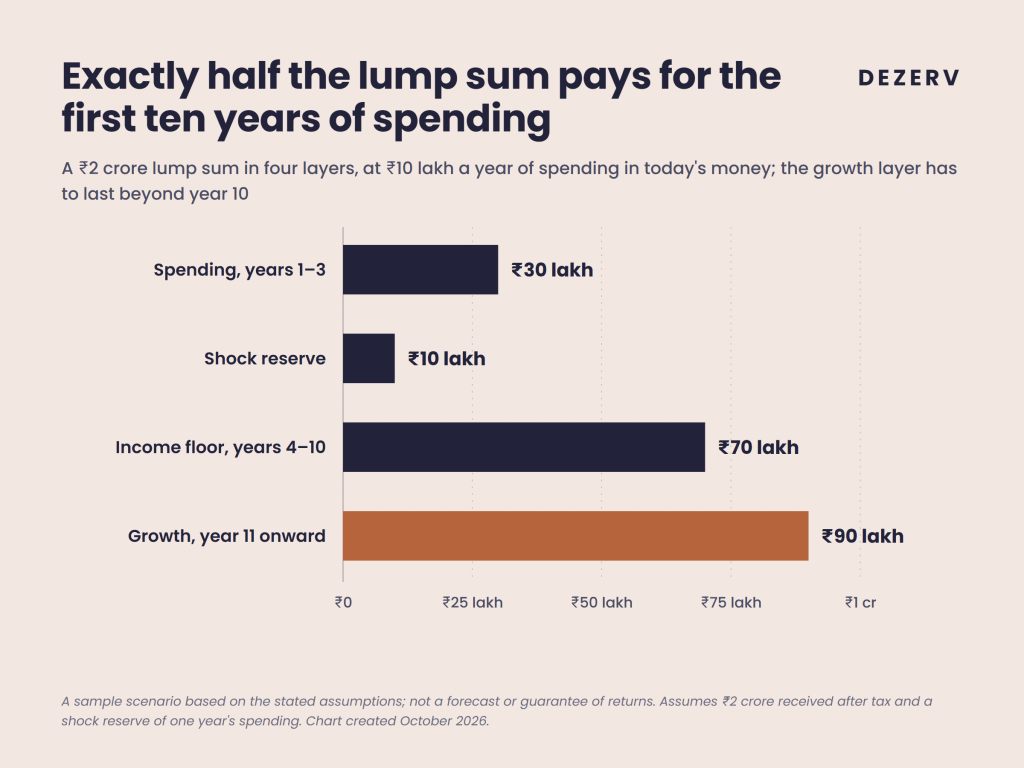
A sample scenario, not a forecast or guarantee of returns. Assumptions: ₹2 crore received after tax; ₹10 lakh a year of spending in today's money; a shock reserve of one year's spending; the spending and income layers earn roughly the inflation rate after tax, so today's-money amounts hold. At 6% inflation the same lifestyle costs about ₹16.9 lakh in year 10, and ten years of spending total about ₹1.32 crore in the rupees of each year. The first-year draw is 5% of the corpus, above the 4% rule of thumb, which is why the growth layer carries no withdrawals.
Delegating the running
Running these layers, refilling the spending layer from the income floor and rebalancing the growth layer, is work that continues for decades. Some retirees would rather delegate it.
Dezerv Investments Private Limited offers Portfolio Management Services (PMS) that provide exposure to relevant asset classes, primarily through underlying mutual funds, in accordance with each investment approach's mandate. The minimum investment amount for PMS is ₹50 lakh, subject to applicable regulatory requirements and the terms of the relevant service. Investments are subject to market risks, and returns are not guaranteed.
The ₹2 crore in this example clears that minimum. A payout below ₹50 lakh would not, and the conventional ₹50 lakh PMS route does not fit it. An account above the minimum can be redeemed in full whenever you need the money, with no lock-in and no exit load on withdrawal.
Its value moves with the markets it holds, so the amount you redeem can be lower than what you put in.
Your own split depends on your spending and your other income. Test the numbers for your case in the retirement corpus calculator, then fix the day on which the parked money gets invested, so that the 90 days do not drift into a year.
Key takeaways
- A retirement payout is four or five separate payments: gratuity is due within 30 days of becoming payable (Code on Social Security, 2020), and EPFO has 20 days to settle a complete claim.
- Gratuity is deductible from salary up to ₹20 lakh and leave encashment up to ₹25 lakh under the Income-tax Act, 2025; a superannuation fund's commuted lump sum is exempt.
- Park the money in a liquid or overnight fund for weeks, and set the date it moves. Vanguard's data shows a lump sum invested at once beat a three-month phase-in about two-thirds of the time (MSCI World, 1976–2022; past performance does not indicate future returns and may or may not be sustained in the future).
- The EPF can earn interest for 36 months after a retirement at 55 or later, but interest credited after you leave service has been held taxable.
- Leave the annuity for last; NPS rules already fix a minimum annuity share by sector.
Frequently Asked Questions
Should I withdraw my entire EPF at retirement or leave it in?
You can leave it for a while, but not indefinitely. An unclaimed balance keeps earning the EPF rate, 8.25% for 2025-26, until the account turns inoperative 36 months after retirement for members who retire at 55 or later. An income-tax tribunal has held that interest credited after you leave service is taxable, so compare the after-tax rate, about 5.7% at the 30% slab plus cess, with your alternatives, and set a date to claim the balance.
What should I do in the first week after retirement?
Sort the decisions by whether you can undo them. File the EPF claim with every document in place and note the date your gratuity falls due, since your employer must pay it within 30 days of it becoming payable and EPFO has 20 days to settle a complete claim. Park the money in a liquid or overnight fund or a sweep-in deposit. Put off any annuity or limited-period product pitched that week: an annuity is close to irreversible and is best sized once your essential spending is mapped.
How soon must my employer pay gratuity, and how long does an EPF claim take?
Under the Code on Social Security, 2020, your employer must pay gratuity within 30 days of the date it becomes payable, and owes simple interest for any delay unless the delay was your fault. For the provident fund, the EPF Scheme, 1952 sets a 20-day period for EPFO to settle a claim that is complete with its documents, so file the claim with every document in place.
Where should I park the lump sum before I invest it?
Somewhere low-risk and quick to reach, for weeks rather than months. Liquid funds hold securities maturing within 91 days and overnight funds hold one-day securities (SEBI circular, 6 October, 2017); a sweep-in deposit does a similar job. Vanguard's research found that a lump sum invested at once beat a three-month phase-in about two-thirds of the time (MSCI World, 1976–2022; past performance does not indicate future returns and may or may not be sustained in the future), so give the parked money a date by which it moves.
How should I invest the lump sum once the claims are settled?
In order of when you will need it. One sample approach puts three years of spending in liquid or short-duration debt, an income floor for years four to ten in conservative, income-oriented holdings, and the balance in a diversified multi-asset mix for the years after ten. A separate shock reserve of about a year's spending covers a hospital bill or a family emergency. Use day 90 as a planning checkpoint: decide what must remain accessible, which payments are still pending and what longer-term amounts are ready to invest. Money left in cash after that date should be a deliberate allocation choice.
Disclaimer
Dezerv Investments Private Limited is a SEBI-registered Portfolio Manager (Registration No. INP000007377). Distribution services are offered by Dezerv Distribution Services Private Limited, a wholly owned subsidiary of Dezerv Investments Private Limited, under AMFI Registration No. ARN-248439 and APMI Registration No. APRN-00615. This article is intended solely for general educational and informational purposes and should not be construed as personalised investment, retirement planning, financial, tax or legal advice, or as a recommendation, offer or solicitation to invest in any security, financial product or investment strategy. Readers are advised to consult their financial, tax and legal advisors before making decisions based on the information provided herein.
The information relating to EPF, gratuity, superannuation, leave encashment, NPS, retirement benefit claims, tax treatment, withdrawal rules and investment strategies is based on publicly available information and the sources cited. Laws, regulatory provisions, tax treatment and scheme rules may change and may vary depending on individual circumstances and eligibility. Actual outcomes may vary depending on individual circumstances, investment performance, inflation, taxes, fees, annuity terms and prevailing market, economic and regulatory conditions. This article is not a complete disclosure of every material fact, term or condition.
Investment in the securities market is subject to market risks. Please read all related documents carefully before investing. Past performance may or may not be sustained in the future.