A salary increase in your 30s often has several destinations before it reaches retirement savings: a home loan, children’s expenses and support for ageing parents. The hardest question is not whether each goal matters, but what to do with the money left over.
Take a 32-year-old with a ₹60 lakh home loan at 8% and ₹50,000 a month to allocate after the EMI. Directing that surplus to the loan can clear it around age 38½ and save roughly ₹44 lakh in interest in the article’s illustration. Investing instead finishes about ₹75 lakh ahead at age 57 if it earns the assumed 11% a year, but the result reverses around an 8.3% investment return against the 8% loan, before individual taxes and risks.
That difference matters: loan-interest savings are relatively predictable, while investment returns are not. The right priority also depends on the other demands on the household’s surplus.
In short
Retirement planning in your 30s involves deciding how one monthly surplus serves a home loan, long-term investing, children and ageing parents. Insurance needs depend on actual financial dependants and liabilities. Investing versus prepaying a loan is not a universal ranking: prepayment reduces a known borrowing cost, while investment returns are uncertain. In the hypothetical comparison here, investing finishes ahead only when the assumed return is sufficiently high relative to the loan rate, before allowing for different taxes and risks. EPF contributes to the stable portion of the retirement savings, but is not automatically enough to fund an affluent retirement.
Table of contents
Four claims on one surplus
Four claims compete for a 30-something's monthly surplus: the home loan, retirement investing, children's costs and ageing parents.
The loan has an EMI date and the school sends a fee notice. Retirement sends neither, so it is the claim most easily postponed.
The sandwich generation is the group paying for ageing parents and dependent children at the same time as it builds its own retirement.
In India that group is getting larger. There were 16 people aged 60 and over for every 100 people aged 15 to 59 in 2021 (India Ageing Report 2023, UNFPA and IIPS, September 2023). The same report projects the over-60 share of the population to rise from 10.5% in 2022 to 20.8% by 2050.
Few of today's parents have a work pension to fall back on. In the report's survey data, 11.7% of men over 60 and 1.7% of women drew a pension from past work (Longitudinal Ageing Study in India, 2017-18, in the India Ageing Report 2023), so a parent's hospital bill is paid from savings or by the family.
That argues for separate pots with separate clocks. A medical buffer for parents has to be liquid today. If their only health cover is a super top-up that pays above ₹5 lakh, the buffer needs at least that ₹5 lakh. Children's education is a dated goal ten to fifteen years away, sometimes priced in dollars.
In a sample scenario, not a forecast, a ₹30 lakh cost in today's money, due in 15 years and rising at an assumed 8% a year, becomes about ₹95 lakh, which a separate SIP of about ₹22,000 a month reaches at an assumed 11% a year, before tax.
Retirement runs for 25 years or more. Five numbers on India's pension system and longevity show how much of it the household has to fund itself.
Funding each goal from its own pot keeps a parent's surgery or a jump in school fees from stopping the retirement SIP.
Protection first, while it is cheap
Protection is the claim that keeps the other three alive if your income stops.
Term insurance pays a fixed sum to your family if you die during the policy term. A working protection number adds your outstanding loans, several years of family expenses and large future costs such as children's education, then subtracts the liquid assets you already hold.
A policy bought at 32 is priced for a 32-year-old. The 20s guide shows how premiums rise with age.
A household that invests first carries the ₹60 lakh loan for the full 20 years, so it needs the larger cover until 52. A household that prepays clears the debt at about 38 and a half and can carry less cover after that. The prepay table below leaves out the premium on that larger cover.
In that table's sample scenario, the premium would have to reach about ₹12,400 a month, every month from 38 and a half to 52, before it closed the ₹75 lakh gap at 11%.
Health cover guards the portfolio from the other side. A base policy with a super top-up for large claims keeps one long hospital stay from draining years of investing. A critical-illness policy generally pays a lump sum when a covered serious condition meets the policy's diagnostic, eligibility and claim requirements, which matters because a serious illness can stop income for a long stretch while the family's costs carry on.
Prepay the home loan or invest? The numbers
Prepaying a home loan saves interest at the loan's rate for as long as that rate holds.
On a floating-rate loan, that rate moves with the lender's external benchmark. State Bank of India, for example, advertised home loans from 7.25% a year with effect from 1 April, 2026 (SBI); what a borrower pays depends on the lender and the credit profile.
The sample scenario below runs both routes on the same cash. Each household starts at 32 owing ₹60 lakh at 8% over 20 years, with an EMI of about ₹50,200, and each also has ₹50,000 a month to spare, so roughly ₹1 lakh a month leaves both accounts for 25 years.
| Age 32 to 57, same ₹1 lakh a month | Invest first | Prepay first |
|---|---|---|
| What happens to the ₹50,000 | Invested every month; EMI paid on schedule | Paid into the loan until it is cleared, then the full ₹1 lakh is invested |
| Loan cleared at | 52 | About 38 and a half |
| Interest paid on the loan | ≈ ₹60.4 lakh | ≈ ₹16.8 lakh |
| Amount invested by 57 | ≈ ₹1.80 crore | ≈ ₹2.24 crore |
| Portfolio at 57, at 11% a year | ≈ ₹7.60 crore | ≈ ₹6.85 crore |
| Portfolio at 57 after 12.5% tax on the gains | ≈ ₹6.87 crore | ≈ ₹6.27 crore |
| Portfolio at 57 before tax, in today's rupees, at 6% general inflation | ≈ ₹1.77 crore | ≈ ₹1.60 crore |
| Portfolio at 57 before tax, in today's rupees, at 9% affluent lifestyle inflation | ≈ ₹88 lakh | ≈ ₹79 lakh |
A sample scenario, not a forecast or guarantee of returns. Assumptions: a ₹60 lakh home loan at 8% a year, held at 8% for the whole term, with 20 years left at age 32 (EMI ≈ ₹50,186); ₹50,000 a month of surplus; money invested at the end of each month at 11% a year (effective annual rate), before tax; once a loan is cleared, the EMI it frees is invested as well; the extra term premium of the invest-first route is left out (the break-even premium above assumes that money would otherwise be invested at the same 11%); the after-tax row applies 12.5% to the whole gain as if it were all sold at 57 and ignores the ₹1.25 lakh annual exemption (Income-tax Act, 2025); today's rupees deflate for 25 years either by 6% a year, as general price inflation, or by 9% a year, a hypothetical 9% affluent-spending inflation stress case, not a measured household inflation rate or a forecast.
Why the gap opens after 38
At about 38 and a half, the prepaying household owns its home outright with nothing invested. The investing household still owes about ₹49.8 lakh but holds about ₹54.6 lakh. On paper, the two are almost level. The ₹75 lakh gap at 57 builds over the next 18 and a half years, as that head start compounds at a rate above the loan's.
John Bogle's second rule for investors names the two forces at work in that table.
"Time is your friend; impulse is your enemy."
— John C. Bogle, The Clash of the Cultures: Investment vs. Speculation (John Wiley & Sons, 2012), rule 2 of his ten rules for investors
Watch out
Both columns assume the ₹50,000 leaves the account every month. Spent instead on a larger car or a costlier holiday, it builds neither a portfolio nor home equity.
When prepaying wins
The result turns on the loan rate against what the invested money earns over the long run. Here the 8% loan stays fixed and only the return moves:
| Assumed return on the invested money | Invest first, at 57 | Prepay first, at 57 | Ahead at 57 |
|---|---|---|---|
| 7% a year | ≈ ₹4.27 crore | ≈ ₹4.47 crore | Prepay first, by ≈ ₹20 lakh |
| 8% a year | ≈ ₹4.91 crore | ≈ ₹4.96 crore | Prepay first, by ≈ ₹5 lakh |
| 9% a year | ≈ ₹5.66 crore | ≈ ₹5.52 crore | Invest first, by ≈ ₹14 lakh |
| 10% a year | ≈ ₹6.55 crore | ≈ ₹6.15 crore | Invest first, by ≈ ₹40 lakh |
| 11% a year | ≈ ₹7.60 crore | ≈ ₹6.85 crore | Invest first, by ≈ ₹75 lakh |
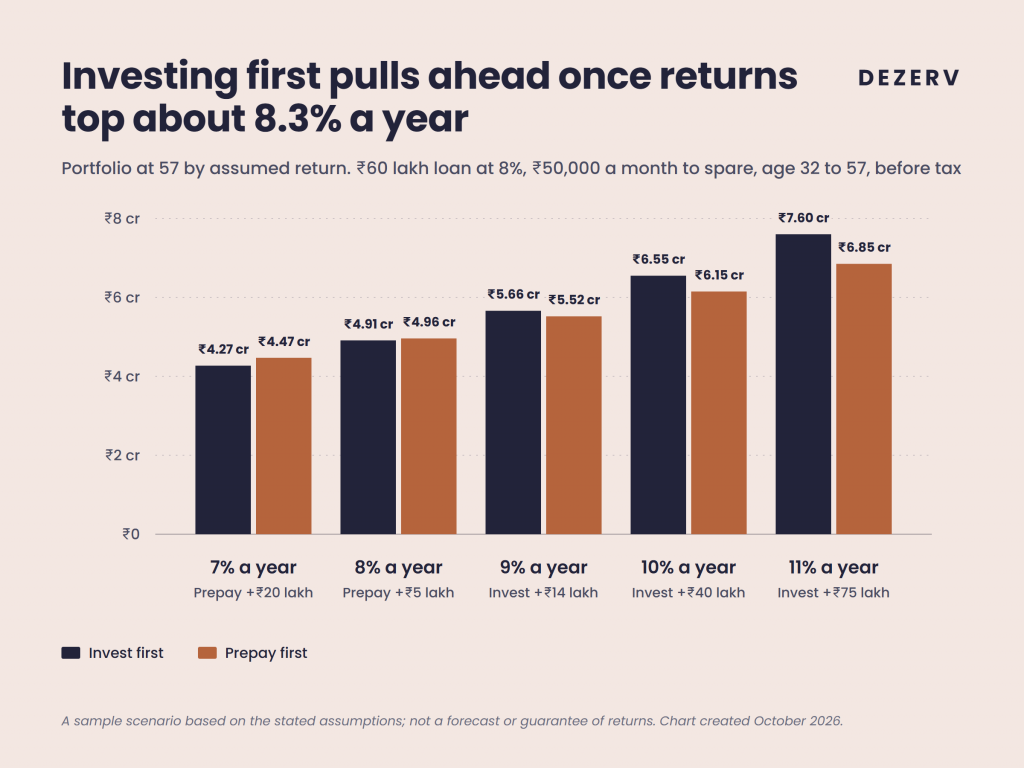
A sample scenario, not a forecast or guarantee of returns. Same assumptions as the table above, before tax; the two routes break even at about 8.3% a year.
For qualifying listed equity shares and units of equity-oriented mutual funds, long-term gains above the aggregate ₹1.25 lakh annual threshold are generally taxed at 12.5%, plus applicable surcharge and cess, subject to statutory conditions. Foreign and unlisted shares may be treated differently under the Income-tax Act, 2025. Interest you avoid paying is never taxed. Before tax, the routes cross at about 8.3%, a shade above the loan rate; on the after-tax row's method, the crossing point rises to about 8.6%.
The tax regime pulls the other way. Under the old regime, interest on a qualifying self-occupied housing loan may be deductible up to ₹2 lakh a year, subject to the conditions for acquisition or construction; in some cases the ceiling is ₹30,000. The actual tax saving depends on eligibility and may change the loan-versus-investment comparison. The default new regime does not allow the corresponding self-occupied-property interest deduction (Income-tax Act, 2025).
Prepaying is the better call when the loan costs more than you can reasonably expect the portfolio to earn, or when the money is needed within a few years. Some households also value being debt-free above any expected spread. No table can price that preference.
In this particular sample scenario, investing the surplus produces the higher ending value only under the stated 11% return assumption. Prepaying the loan offers an interest saving linked to the actual borrowing rate, while investing preserves flexibility but brings market risk. Compare the choices after tax and against the household’s liquidity needs, income security and preference for being debt-free; do not treat the illustration as a universal default.
EPF is the base layer
The Employees' Provident Fund (EPF) is a retirement savings account run by the Employees' Provident Fund Organisation (EPFO). You and your employer pay into it every month.
For 2025-26, the EPFO's Central Board of Trustees recommended 8.25% (PIB, Ministry of Labour and Employment, 2 March, 2026), and the government ratified that rate in June 2026 (Ujjivan Small Finance Bank, 22 June, 2026). The approval to credit it had reached EPFO offices by July 2026 (Business Today, 6 July, 2026).
| EPF on its own, age 32 to 57 | Sample scenario |
|---|---|
| Monthly credit to EPF, your share plus your employer's | ₹24,000 |
| Rate, held at the 2025-26 level | 8.25% a year |
| Period | 25 years, with no increase in contributions |
| Balance at 57 | ≈ ₹2.28 crore |
| The same balance in today's rupees, at 6% general inflation | ≈ ₹53 lakh |
| The same balance in today's rupees, at 9% affluent lifestyle inflation | ≈ ₹26 lakh |
A sample scenario, not a forecast or guarantee. Assumptions: ₹24,000 credited every month; interest at 8.25% a year on the monthly running balance, credited once a year; no withdrawals; the full ₹24,000 reaches EPF (for members of the Employees' Pension Scheme, part of the employer's share goes to that scheme instead, which lowers the balance); today's rupees use the same 6% and 9% rates as the prepay table.
Converted to today's money, as the table's last two rows show, the ₹2.28 crore loses most of its size.
Real contributions rise with salary, which lifts the balance, but the lifestyle the money has to fund rises with salary too. EPF earns a declared rate on what is in effect a fixed-income holding, which makes it the base of a retirement portfolio and leaves the growth to the equity layer on top.
Its tax treatment changes once you stop working. The eligible accumulated balance of a recognised provident fund may qualify for exemption when employment ends, subject to the statutory conditions, including qualifying service or a recognised exception. Interest credited after cessation of employment may have a different tax treatment, depending on the applicable law and facts; it should not automatically be assumed to share the exemption on the eligible accumulated balance. The guide to tax on retirement benefits covers it in detail.
What the retirement money holds, and where EPF fits
Asset allocation is the split of a portfolio across equity, fixed income, gold and other assets (asset allocation).
There is no single asset mix for an investor in their 30s. The proportion held in growth assets and stable assets should reflect the time remaining, income security, other goals and ability to tolerate a market decline. Asset allocation may also need to change as retirement approaches; the purpose here is to explain that trade-off, not prescribe a model portfolio.
EPF forms part of the household’s overall fixed-income exposure, so it should be counted alongside other debt or savings holdings when evaluating the portfolio mix. Its share of the final corpus will depend on contributions, credited interest and how other investments perform.
Review the mix at least once a year. A strong year for one asset pulls the weights away from where they started, so rebalance when the drift is wide enough to justify the tax on the switch.
Dezerv Investments Private Limited offers Portfolio Management Services (PMS) that provide exposure to relevant asset classes, primarily through underlying mutual funds, in accordance with each investment approach's mandate. The minimum investment amount for PMS is ₹50 lakh, subject to applicable regulatory requirements and the terms of the relevant service. Investments are subject to market risks, and returns are not guaranteed.
In the sample scenario, the retirement investments are built through monthly mutual-fund SIPs. A later decision to use the conventional PMS route would depend on meeting its then-applicable eligibility and minimum investment, costs and strategy terms; the investment example should not be read as recommending a particular manager or asset mix.
The order, in four steps
- Put term and health cover in place first, with the term cover sized to the home loan for as long as the loan runs.
- Compare investing the monthly surplus while continuing the scheduled home-loan EMI against using that surplus for prepayment. In this illustration the routes break even at approximately 8.3% annual investment return before tax, or 8.6% under the simplified tax method used here. These are scenario break-even points, not return forecasts or a universal recommendation to invest rather than prepay.
- Count EPF as the fixed-income base, and size the market portfolio's fixed-income share around it.
- Bonuses can be used to prepay debt after accounting for emergency liquidity, upcoming spending, the effective borrowing cost and the uncertainty of investment returns. A higher loan rate can strengthen the case for prepayment.
The order in this article is built for a salaried household with a long, cheap loan.
A business owner with lumpy income, or anyone whose loan rate sits above the return they expect, should rerun the prepay table with their own numbers. The Dezerv retirement calculator then shows what corpus their own spending implies.
Key takeaways
- In your 30s, one surplus feeds four claims: the home loan, retirement investing, children and ageing parents. Give each its own pot so one claim cannot pause another.
- Fund term and health cover first. If you keep the home loan running while you invest, keep the term cover sized to it until the loan ends.
- In the sample scenario, with an 8% loan, investing first finished about ₹75 lakh ahead at 57 when the portfolio earned 11% a year; below about 8.3% a year, prepaying finished ahead.
- Under the old regime, qualifying self-occupied housing-loan interest may receive a deduction of up to ₹2 lakh, or ₹30,000 in some cases; the new regime generally disallows that deduction. For eligible listed equity and equity-oriented mutual funds, long-term gains above the aggregate ₹1.25 lakh annual threshold are generally taxed at 12.5%, subject to conditions. Both rules matter to the net invest-versus-prepay comparison.
- EPF at 8.25% is the fixed-income base: ₹24,000 a month for 25 years comes to about ₹2.28 crore, or about ₹53 lakh in today's money at 6% general inflation and about ₹26 lakh at 9% lifestyle inflation.
Frequently Asked Questions
Are your 30s too late to start retirement planning?
No. Starting at 32 can still leave decades for retirement saving, but a home loan, children’s costs and parental needs may compete for the same income. Establish suitable protection and liquidity first; then compare regular retirement investing with loan repayment using the actual borrowing rate, tax treatment, risk tolerance and the household’s other commitments. There is no universally correct order for every family.
Should I prepay my home loan or invest for retirement?
The result depends on the loan rate, after-tax investment outcome, liquidity needs and the value placed on reducing debt. In this article’s illustration, investing the surplus finishes about ₹75 lakh ahead at age 57 if it achieves the assumed 11% annual return; the prepayment path overtakes it near an 8.3% break-even investment return. Neither the 11% outcome nor the break-even comparison is a forecast. The loan’s interest saving is more predictable than an investment return, and tax treatment can change the ordering.
Is EPF enough for retirement on its own?
For an affluent household, usually not. EPF is a debt-like account that earned a declared 8.25% for 2025-26. In a sample scenario, ₹24,000 a month for 25 years at that rate grows to about ₹2.28 crore, which is about ₹53 lakh in today's money at 6% inflation. That makes EPF a sound fixed-income base, with an equity-oriented portfolio built on top of it for growth.
How much term insurance do I need in my 30s?
A common framework adds your outstanding loans, several years of family expenses and large future costs such as children's education, then subtracts the liquid assets you already hold. If you keep a home loan running while you invest, the cover has to stay sized to that loan until it is repaid. Add health cover with a super top-up, and consider critical-illness cover. This is general education, not a recommendation of any insurer, policy or sum assured.
What asset allocation suits someone in their 30s?
There is no universally suitable equity, debt or gold split for someone in their 30s. Consider earnings stability, near-term commitments, EPF savings, time horizon and capacity to tolerate a drawdown. EPF is part of the stable allocation, not an additional holding to ignore when deciding how much investment risk to take.
Disclaimer
Dezerv Investments Private Limited is a SEBI-registered Portfolio Manager (Registration No. INP000007377). Distribution services are offered by Dezerv Distribution Services Private Limited, a wholly owned subsidiary of Dezerv Investments Private Limited, under AMFI Registration No. ARN-248439 and APMI Registration No. APRN-00615. This article is intended solely for general educational and informational purposes and should not be construed as personalised investment, financial planning, tax or legal advice, or as a recommendation, offer or solicitation to invest in any security, financial product or investment strategy. Readers are advised to consult their financial advisor before making investment decisions based on the information provided herein.
The retirement planning illustrations, home-loan repayment and investment comparisons, projected retirement corpus estimates, EPF calculations, tax examples and retirement calculator outputs discussed herein are illustrative and based on the sources, dates and assumptions referenced. They are not forecasts or guarantees of investment returns, interest savings or future retirement outcomes. Actual outcomes may vary depending on individual circumstances, loan terms and interest rates, investment performance, inflation, taxes, fees, liquidity needs and regulatory changes.
Investment in the securities market is subject to market risks. Please read all related documents carefully before investing. Past performance may or may not be sustained in the future.