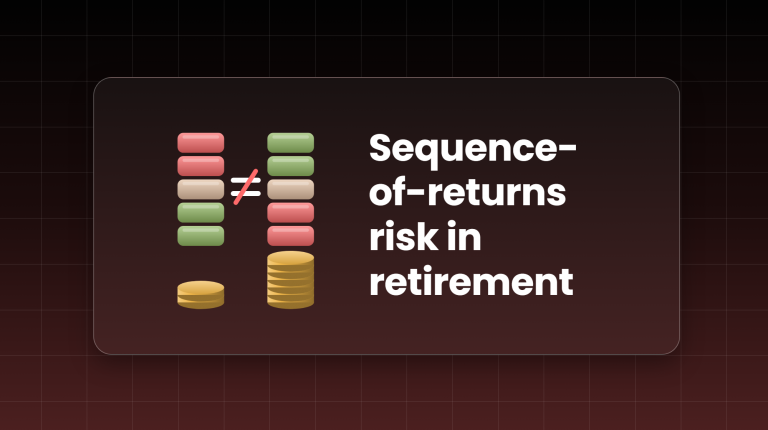
A person retiring at 45 may need a corpus to support withdrawals for roughly 45 years. The order of returns matters because the portfolio has to fund spending even during market declines, and each early withdrawal permanently reduces the capital available for a recovery.
Consider a transparent two-year illustration: ₹6 crore at 45, with ₹21 lakh withdrawn at the start of year one and ₹22.47 lakh at the start of year two. Both market sequences contain a 30% rise and a 30% fall; they differ only in which arrives first. That difference changes the remaining corpus even before the next 43 years of retirement.
Nobody chooses the start year. The rules you retire with can be chosen, beginning with what 45 years does to the draw.
Hypothetical two-year sequence on a ₹6 crore corpus, withdrawals of ₹21 lakh and ₹22.47 lakh at each year’s beginning, and annual returns of +30% and −30% in opposite order. No tax or fees. The examples illustrate sequence risk, not projected market returns.
In short
A 45-year retirement demands a longer income horizon than retirement at 60, magnifying exposure to early losses and inflation. The first decade deserves careful stress-testing; a lower initial withdrawal, flexible spending, a cash bridge and supplementary income may each provide resilience, with costs and limitations of their own.
Table of contents
Why 45 years is a different problem from 25
A 45-year retirement multiplies the first-year draw almost twenty times: at 7% a year, ₹21 lakh in year one becomes ₹4.12 crore in year 45 (×19.6), against ×5.1 over 25 years (a sample scenario, not a forecast or guarantee). The corpus has to grow into that. It stays in growth assets for decades, and that is what exposes it to the order of returns.
The research behind the 4% rule says so: in 1994 William Bengen counselled no more than 4% in the early years, especially for anyone retiring at 60 or younger (Bengen, 1994). Michael Kitces measured which years matter: on US data, the first ten years' real return had a 0.79 correlation with the sustainable withdrawal rate, against 0.21 for the first year and 0.43 for all thirty (kitces.com, 1 October, 2014).
An auditable two-year sequence illustration
With a +30% first year followed by −30%, the corpus finishes year two at approximately ₹5.11 crore. With −30% first and +30% second, it finishes at about ₹4.98 crore. Both paths have the same two market returns, but withdrawals turn the order into a real difference in wealth.
Sample calculation: year-one balance equals (₹6 crore − ₹0.21 crore) multiplied by the first-year return factor. Year two deducts ₹0.2247 crore before applying the second return factor. Both scenarios use the same withdrawal timings and two returns in opposite order; tax and fees are omitted.
Past performance does not indicate future returns and may or may not be sustained in the future.
The difference is a consequence of withdrawing capital during adverse markets. A long retirement gives that effect more time to compound, while the ability to adjust spending or earn supplementary income can alter the result.
The first years cannot be chosen, which is why the starting withdrawal and access to other liquid assets matter. A historical bear market illustrates the possibility of an early fall but is not needed to prove the arithmetic.
Past performance does not indicate future returns and may or may not be sustained in the future.
"…the real problem is not a bad year or two at the beginning of retirement, but a bad decade to start off retirement."
— Michael Kitces, Nerd's Eye View (kitces.com, 1 October, 2014)
A two-year equity-only illustration is deliberately simple. A household may hold debt, gold, pension income and emergency liquidity, all of which affect its need to sell equity. The planning question is how withdrawals are funded when returns arrive badly.
Higher household inflation causes withdrawal amounts to rise faster. A 9% annual increase instead of 7% is therefore a useful stress test, not a prediction of any particular household’s future inflation.
How the two-year illustration was calculated
The example assumes the same starting corpus, the same two withdrawals and the same pair of returns in different order. The arithmetic can be reproduced directly from these inputs:
- Starting corpus: ₹6 crore. Year-one withdrawal: ₹0.21 crore. Year-two withdrawal: ₹0.2247 crore (7% higher).
- Return sequences: Path A earns +30% then −30%; Path B earns −30% then +30%.
- Cash-flow timing: the annual withdrawal occurs at the start of each year, and the remaining corpus earns that year’s return.
- The illustration is entirely hypothetical and does not use an NSE historical portfolio simulation. It excludes tax, costs and rebalancing.
- The remaining 43 years are not projected. A two-year demonstration cannot establish the overall success or failure of a 45-year retirement plan.
- Results should therefore be used to understand sequence risk, not to claim a particular safe withdrawal rate.
What starting withdrawal rates mean over 40 to 50 years
US historical research by Bengen and subsequent authors found that longer horizons and early losses make the first withdrawal rate consequential. The appropriate starting rate in India depends on spending inflation, the market sequence, portfolio design, taxes and the ability to adjust withdrawals.
The two-year arithmetic above demonstrates why a single assumed annual average cannot establish a safe starting rate for a 45-year retirement. A full plan must be tested over its actual intended horizon.
A longer horizon generally leaves less margin for a high starting withdrawal under otherwise comparable assumptions.
The bridge years make it worse
Someone retiring at 45 may need to bridge a substantial period before accessing pension benefits or particular retirement accounts, depending on the scheme and employment history. Under PFRDA’s October 2026 framework, voluntary All Citizen Model subscribers may qualify for normal exit after 15 years of subscription or at 60, whichever is earlier, subject to scheme conditions. Corporate Sector subscribers instead follow employment-linked retirement or superannuation rules; 15 years alone does not universally permit a normal exit, under the Pension Fund Regulatory and Development Authority's amended exit rules of 16 December, 2025. PFRDA amendment explanation (19 December 2025): https://www.pib.gov.in/PressReleasePage.aspx?PRID=2206763 Ministry of Finance NPS clarification: https://www.pib.gov.in/PressReleasePage.aspx?PRID=2206763
An exit before the applicable model-specific normal-exit event is generally premature: under the relevant PFRDA provisions, the ordinary arrangement permits up to 20% lump sum and requires at least 80% annuitisation, with additional options for eligible corpora up to ₹5 lakh. An early retiree should check their own subscriber model and available liquid savings rather than assume all NPS money can be accessed at 45.
Health cover without an employer
Employer cover usually ends on the last working day, and a new retail policy can exclude a pre-existing disease for up to 36 months (IRDAI, 2024), so a policy bought at 45 spends the first three bridge years in that wait. The timetable for cover before 60 sets out when to buy and how to carry the office plan across.
Four defences against an early adverse sequence
A lower first withdrawal, a separate liquid spending bridge, flexible annual spending increases and supplementary work income each address a different part of early-retirement risk. Their combined benefit depends on the actual market path and household cash flows, not a universal rule that any particular pair ensures success.
The underlying economic distinction remains important: a weak market may offer an accumulating saver cheaper investments, whereas someone funding retirement may need to sell assets at depressed prices.
Lower initial withdrawals and greater spending flexibility can help a corpus withstand a market decline, while supplementary income reduces the amount that must be sold. None of these options guarantees a particular retirement age or ending corpus.
A cash bridge reduces the need to liquidate investments during a downturn, but the assets held in cash or short-duration debt forgo some of the upside from any subsequent recovery. That opportunity cost is the price of liquidity.
Past performance does not indicate future returns and may or may not be sustained in the future.
The two-year example deliberately does not forecast an ending balance at age 90. It shows how a poor early sequence changes the starting point for all subsequent withdrawals.
Is returning to paid work a realistic safeguard?
Part-time income or consulting can reduce portfolio withdrawals during a weak market, but future earnings are uncertain, especially in a difficult employment cycle. A retirement plan should remain workable without assuming that a particular income opportunity arrives.
A weak employment market can coincide with investment losses, which is why the plan should not rely on a guaranteed return to consulting or full-time work.
The people a bad decade pushes back to work are the ones least able to find it: TCS's 2025 cuts, about 12,000 jobs and mostly in middle and senior grades (Business Today, 28 July, 2025), show how quickly a profession can stop paying its senior people. Here is what a forced exit at 48 looks like.
Treat income as a target. Build the other three defences as if it will not arrive.
A worked early-retiree plan at 45 with ₹6 crore
The plan is a common variant that draws from the growth layer in normal years; the three-layer structure keeps equity out of spending, with seven to ten years of draws in debt. Here the growth layer also holds debt and gold, so the cash bridge covers only the years after a fall, and other income before 60 would shrink it.
| Layer | What it holds | Size at 45 | The rule |
|---|---|---|---|
| Spending bridge | Cash, deposits and short-duration debt | Three years of draws: ₹67.5 lakh (11% of ₹6 crore) | Spend from it in the year after a losing year; refill from the growth layer at the yearly review when it is above its target share, but after a fall only once equity has recovered its level at the last refill |
| Shock buffer | Liquid holdings beside the bridge | 12 months of expenses: ₹21 lakh (this plan's assumption) | Medical and unplanned costs only |
| Growth layer | A rebalanced blend of equity, debt and gold, not a timid one (the de-risking trap) | The rest: about ₹5.1 crore | Carries 45 years of inflation; sold on a schedule, with the bridge paying after a fall |
| Withdrawal rule | 3.5% to start: ₹21 lakh, ₹1.75 lakh a month | Hold the step-up after a losing year (the skipped rise is not made up); cut to 3% if two of the first three years are negative (a rule of thumb, not tested above) | |
| Income target | Work in years one to ten | ₹9 lakh a year or more | Treated as a target, not a plan input |
| Health cover | Retail policy in force by 42 | So waits of up to 36 months end before the salary does |
Illustrative first-three-year withdrawals starting at ₹21 lakh and rising 7% a year are ₹21 lakh, ₹22.47 lakh and ₹24.04 lakh, totalling ₹67.51 lakh. These are spending requirements, not an investment back-test or a projection of asset returns.
To size your own corpus, draw and retirement age, use the Dezerv retirement calculator.
Who should not retire early on this maths
Early retirement becomes less resilient when high essential spending meets an uncertain market and little access to liquid assets. Consider the following risk characteristics rather than interpreting a historical model as an approval or rejection of retirement.
- A household with a high fixed withdrawal relative to its corpus and no ability to reduce spending after losses.
- A household relying on consulting or employment income that is not contractually committed, without a separate cash reserve.
- A household unable to withstand a large interim equity decline and without a spending bridge in high-quality liquid assets.
- A household whose essential medical expenses could exceed its cover or available emergency liquidity.
The decision to retire early should turn on essential spending, available secure income, access to liquid savings, portfolio risk and spending flexibility, not the strongest or weakest historical market decade alone.
Key takeaways
- At a 7% step-up, a 45-year retirement multiplies the first-year draw ×19.6, against ×5.1 over 25 years (sample scenario).
- A simple two-year example shows that +30% and −30% returns in reverse order produce different outcomes when withdrawals continue. The calculation illustrates sequence risk without claiming a particular Indian retirement failure rate.
- The first decade's real return matters far more than the first year's (Kitces, 2014).
- No constant starting withdrawal percentage is safe in all market paths. Longer horizons and more rigid spending tend to require a larger planning margin.
- A lower initial withdrawal, a separate liquid bridge, flexible annual spending and genuine supplementary income address different parts of the risk; no fixed combination ensures reaching age 90.
Frequently Asked Questions
Why is sequence-of-returns risk worse when you retire early?
Over a 45-year retirement, early market losses interact with regular withdrawals and rising spending. A two-year ₹6 crore example shows that the same +30% and −30% returns can produce different remaining balances merely by arriving in opposite order. This is a reason to design withdrawal rules and liquid reserves before retirement, not evidence of a guaranteed success rate.
How much does the first decade of returns matter?
Michael Kitces’s US retirement research found that the real returns earned in the first ten years are strongly related to the withdrawal rate a portfolio can sustain. This is a finding from US historical analysis, not a measured probability of Indian retirement outcomes. The two-year numerical example above demonstrates the mechanism independently.
What withdrawal rate should an early retiree start with?
An early retiree should test a range of starting withdrawal rates under their intended horizon, inflation, tax and return scenarios. A percentage from a 30-year historical study cannot be assumed safe over 45 years.
How should an early retiree structure the first ten years?
A smaller opening draw, a liquid reserve for essential spending, flexible increases and any realistically reliable income can reduce the need to sell assets after losses. Their appropriate sizes depend on the actual corpus, secure income and risk tolerance, and the combined outcome cannot be guaranteed.
Does retiring early and consulting solve sequence risk?
Consulting income can reduce withdrawals when it arrives, but may disappear precisely when the economy and markets are weak. Treat such earnings as optional support, not as a guaranteed solution to sequence risk.
Disclaimer
Dezerv Investments Private Limited is a SEBI-registered Portfolio Manager (Registration No. INP000007377). Distribution services are offered by Dezerv Distribution Services Private Limited, a wholly owned subsidiary of Dezerv Investments Private Limited, under AMFI Registration No. ARN-248439 and APMI Registration No. APRN-00615. This article is intended solely for general educational and informational purposes and should not be construed as personalised investment, financial planning, tax or legal advice, or as a recommendation, offer or solicitation to invest in any security, financial product or investment strategy. Readers are advised to consult their financial, tax and legal advisors before making investment decisions.
The retirement corpus illustrations, withdrawal calculations, return sequences and planning scenarios discussed in this article are hypothetical and based on the assumptions stated. They are intended to explain sequence-of-returns risk and do not represent forecasts, guaranteed returns or assurances that a retirement corpus will last for a particular period. Actual outcomes may vary depending on market conditions, inflation, taxes, investment costs, withdrawal patterns, healthcare expenses, supplementary income and individual circumstances. This article is not a complete disclosure of every material fact, term or condition.
Investment in the securities market is subject to market risks. Please read all related documents carefully before investing. Past performance may or may not be sustained in the future.