The National Housing Bank's reverse mortgage scheme was written for asset-rich, cash-poor retirees: it turns the house they live in into a monthly income without a sale. For a large home the bank ceilings bind, and a ₹6 crore flat in Mumbai pays its retired owner about ₹28,000* a month for twenty years.
A ₹2.5 crore flat in the same building pays the same ₹28,000, so the extra ₹3.5 crore buys nothing. For one kind of retiree the scheme still works; which kind, and what the ₹6 crore owner does instead, starts with how the loan is built.
*A sample scenario: a ₹2 crore loan ceiling reached at the end of a 20-year tenure, 9.5% a year held fixed, paid monthly with no lump sum; not a forecast or guarantee.
In short
A reverse mortgage in India is a National Housing Bank (NHB) scheme loan paying a homeowner aged 60 or over a monthly sum against a self-occupied house, generally without regular repayments while they continue to occupy the home and comply with loan conditions; settlement may arise upon death, permanent vacation, sale or contractual default. Bank ceilings of ₹25 lakh to ₹2 crore, a ₹50,000 monthly limit and a 20-year tenure cap the payout, so a ₹6 crore flat pays no more than a ₹2.5 crore one. It suits a retiree whose house is most of their wealth; an HNI willing to move, and to carry market risk on the corpus, can draw three to four times as much by downsizing (sample scenario).
Table of contents
How a reverse mortgage works in India
A reverse mortgage loan is a loan in which the lender pays you, in instalments, against a mortgage on the house you live in. It recovers the money, with interest, from selling the house on the last borrower’s death, permanent move-out or sale, or on specified contractual default.
The National Housing Bank designed the Indian scheme in 2007-08 and sets its rules; scheduled banks and housing finance companies lend under it (NHB operational guidelines).
| Rule | What the NHB scheme says |
|---|---|
| Who can borrow | A homeowner aged 60 or over; a couple jointly if one is over 60 and the other at least 55 |
| Which house | Self-acquired, self-occupied, with no other loan on it and at least 20 years of residual life; no commercial property |
| How much | Set by the lender from the property's value, your age and the interest rate; your equity in the house may never fall below 10% |
| How it is paid | Monthly, quarterly, half-yearly or yearly instalments, a lump sum, or a committed line of credit |
| Monthly limit | ₹50,000 |
| Lump-sum limit | Half the eligible loan, up to ₹15 lakh, and only for medical treatment |
| How long | Payments run for at most 20 years; you stay in the house for life |
| Revaluation | At least once every five years; the loan may be revised |
| Repayment | Nothing in your lifetime; interest accrues; the house is sold to settle, or the heirs repay and keep it |
| Shortfall | A no-negative-equity guarantee: you or your estate never owe more than the house realises |
Source: NHB operational guidelines and NHB answers, read 15 October, 2026.
Two rows do most of the work: payments stop after 20 years even if you live on, while interest keeps accruing, and the monthly cheque can never exceed ₹50,000, whatever the house is worth (NHB answers).
Why the lender’s own cap determines the payout
A higher-value home does not necessarily produce a proportionately larger payout because the lender may impose loan limits and other eligibility conditions.
The size, timing and terms of a reverse mortgage depend on the current lender offering and sanctioned agreement. The calculations here deliberately assume loan limits and rates for explanation; they do not claim that any named bank will offer these conditions to every eligible homeowner.
When a lender quotes a ceiling inclusive of interest, the total future balance, not merely the cash disbursed, must fit within that ceiling. A loan quoted on this basis can provide substantially less cash than the numerical ceiling might suggest.
A lender’s ceiling is separate from the National Housing Bank’s framework, and availability and product limits may change over time. It is essential to distinguish an assumed loan limit used for calculation from an enforceable product quotation.
An NHB-commissioned study that compiled bank terms in September 2023 put the top of the market at ₹2 crore, with one lender quoting no ceiling at all (NHB study, 2024, Table 2.2).
What the ceiling pays: a ₹2 crore flat against a ₹6 crore flat
The bank works backwards from the ceiling. It pays a fixed sum every month and charges interest on everything paid so far, and the sum is set so that the total owed reaches the ceiling, or the eligible loan if that is lower, exactly at the end of the tenure.
That is why PNB can publish the result per ₹1 lakh of final loan: ₹501 a month over 10 years, ₹251 over 15 and ₹140 over 20 (PNB Baghban).
On the bank's ₹1 crore ceiling that is ₹50,100, ₹25,100 and ₹14,000 a month. The NHB rule trims the first of those to ₹50,000.
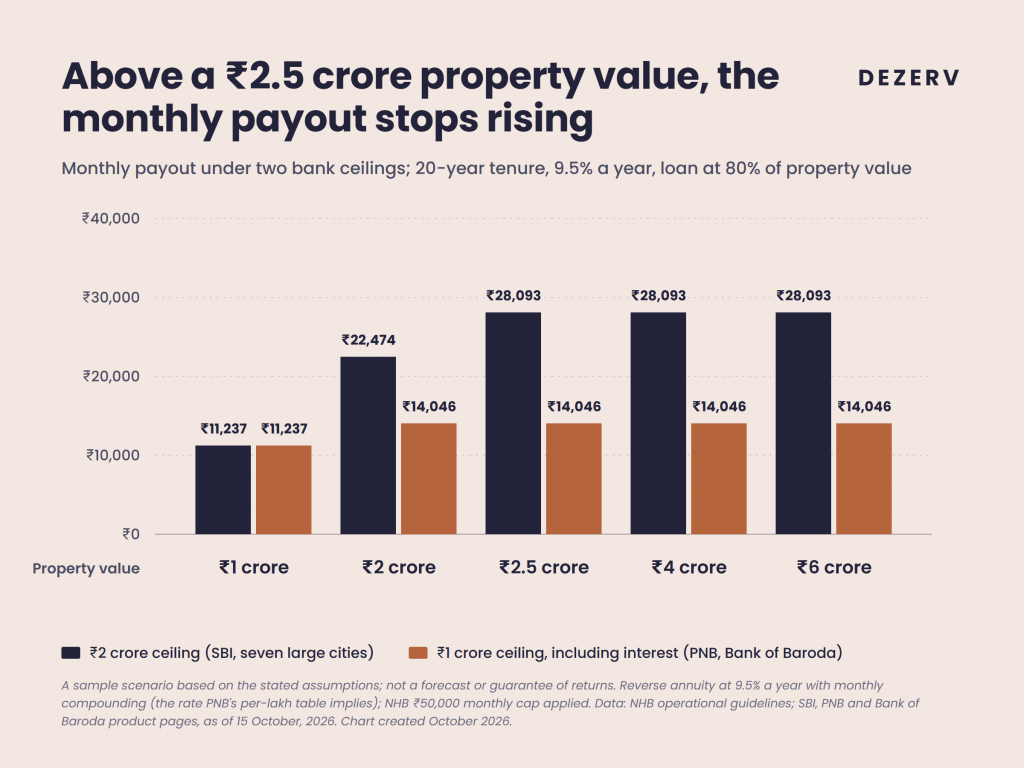
| Property value | Eligible loan at 80% of value | Monthly payout, ₹2 crore ceiling (20 years) | Monthly payout, ₹1 crore ceiling (20 years) |
|---|---|---|---|
| ₹1 crore | ₹80 lakh | ₹11,237 | ₹11,237 |
| ₹2 crore | ₹1.6 crore | ₹22,474 | ₹14,046 |
| ₹2.5 crore | ₹2 crore | ₹28,093 | ₹14,046 |
| ₹4 crore | ₹2 crore (capped) | ₹28,093 | ₹14,046 |
| ₹6 crore | ₹2 crore (capped) | ₹28,093 | ₹14,046 |
A sample scenario, not a forecast or guarantee. Today's valuation, never revised; loan sized at 80% of value (PNB's published 20% margin); a reverse annuity at 9.5% a year with monthly compounding, the rate PNB's per-lakh table implies, held fixed for the 20-year tenure; paid monthly, with no lump sum drawn; the NHB ₹50,000 monthly cap applied. SBI's page does not say whether its ₹2 crore includes interest; the scenario treats it as the total owed at the end of the tenure, as PNB and Bank of Baroda state for theirs. At 20 years the 9.5% scenario gives ₹14,046 on a ₹1 crore ceiling, against ₹14,000 in PNB's own table; the gap is the rounding of the rate. Source: NHB guidelines and the bank pages above, October 2026.
Under a ₹2 crore ceiling the payout stops growing at a property value of ₹2.5 crore; under a ₹1 crore ceiling it stops at ₹1.25 crore, so the ₹6 crore flat's owner receives ₹28,093 a month, a yield of about 0.6% on the home.
Shorten the tenure and the cheque rises, but it stops sooner: at 15 years the ₹2 crore ceiling pays ₹50,000 a month; at 10 years it would exceed the scheme's limit, so ₹50,000 a month is the most an NHB-scheme reverse mortgage pays.
Revaluation lifts the loan only below the ceiling; the rate moves the cheque either way, and lenders price it floating (Bank of Baroda's is repo-linked). Over 20 years the ₹2 crore ceiling pays ₹31,898 a month at 8.5% and ₹24,676 at 10.5%; if 9.5% rose to 10.5% after five years, the instalment would need to fall to about ₹22,300 to stay within the ceiling.
How much of the loan is cash, and how much is interest
The ceiling is the debt at the end of the tenure; PNB's own figures on its ₹1 crore ceiling show how much less reached you in cash.
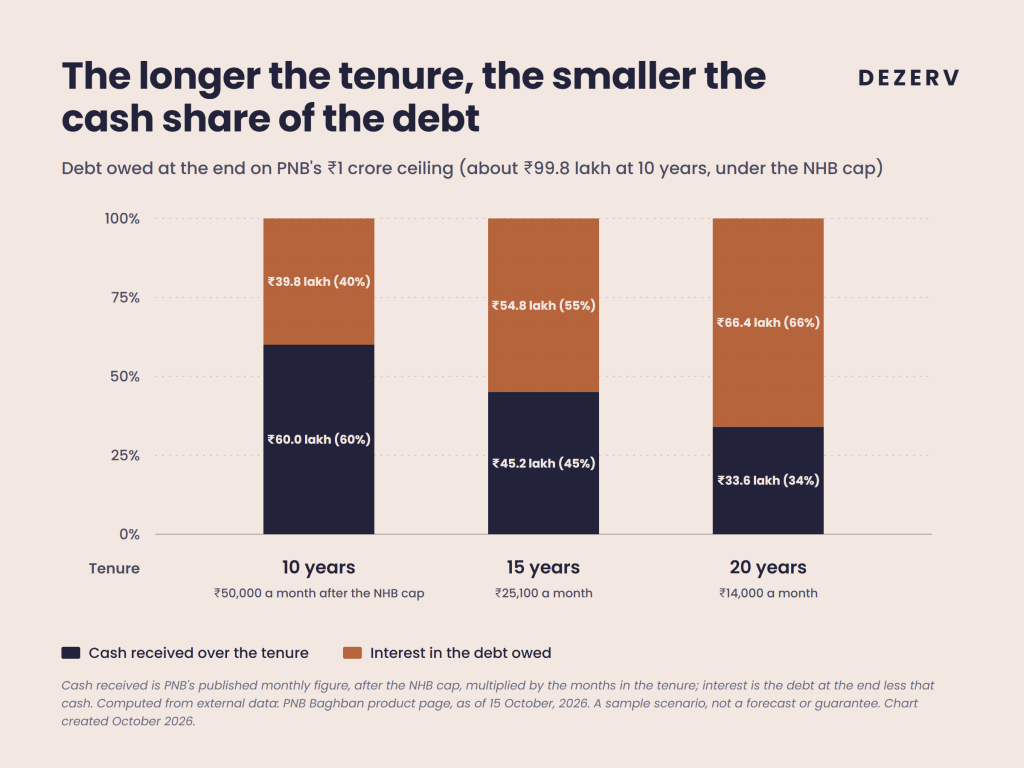
| Tenure | Monthly payout | Cash received over the tenure | Interest in the debt owed at the end |
|---|---|---|---|
| 10 years | ₹50,100 (₹50,000 after the NHB cap) | ₹60.0 lakh (60%) | ₹39.8 lakh (40%) |
| 15 years | ₹25,100 | ₹45.2 lakh (45%) | ₹54.8 lakh (55%) |
| 20 years | ₹14,000 | ₹33.6 lakh (34%) | ₹66.4 lakh (66%) |
The reverse-mortgage illustration assumes a constant 9.5% nominal annual interest rate compounded monthly, fixed monthly instalments, an illustrative loan-balance ceiling and no separate lump-sum advance. Actual lender terms and rate adjustments can differ.
Watch out
On a 20-year reverse mortgage, roughly one rupee in three of what the bank is finally owed is cash you received; the other two, equity your heirs do not get, went to interest.
Is the money taxable?
The instalments are not taxed. Nor does mortgaging the house trigger capital gains tax. Three rules in the Income-tax Act, 2025 (in force since 1 April, 2026) settle it.
The monthly or lump-sum amounts are a loan, and the Act's schedule of incomes left out of total income excludes any amount received as a loan, in a lump sum or in instalments, in a reverse mortgage under a scheme notified by the Central Government, and carries forward the exemption the 1961 Act gave (NHB, About RML).
Mortgaging the house under the notified scheme is not treated as a transfer, so no capital gain arises when the loan starts.
Tax arrives only when the house is sold, by the bank to recover the loan or by the heirs, and that sale is a transfer, taxed as a long-term capital gain at 12.5%, though for a house bought before 23 July, 2024, a resident individual's or HUF's tax is capped at 20% of the gain worked out with indexed cost.
The heirs inherit the original owner's cost, so a house bought cheaply decades ago carries a large deferred gain.
Why almost nobody takes one
No official take-up count is published; the NHB's pages, its 2024 study and parliamentary question files, searched on 15 October, 2026, carry none.
The recent evidence is qualitative, and from NHB itself. In the NHB-commissioned study published in April 2024, a public-sector bank's representative told the focus group that the bank had "not sanctioned a single loan for the past 15-16 months" (NHB study, 2024). The same participant called the product inflexible after revaluation rules tightened.
The structure explains the rest:
- The cheque is small against the house. A ₹1.5 crore home pays about ₹16,900 a month over 20 years in the sample scenario, and over 20 years no ceiling comes near the ₹50,000 scheme cap.
- Two-thirds of a 20-year debt is interest, which the heirs feel as a shrunken estate.
- Payments stop at 20 years. A borrower who starts at 62 and lives to 90 has eight years with no cheque and a loan still compounding.
- The house is revalued at least every five years and the loan can be revised, so the income is not settled for life.
- Many Indian families treat the house as the inheritance, and where children can help, they often do instead.
Who it suits, and why
The case holds for one profile: the retiree, often a widow or widower, whose house is nearly all their wealth, with no heir who needs it. Take a 68-year-old in Nagpur with a ₹1.5 crore house, a small pension and no other assets. Selling would mean leaving the neighbourhood and the hospital she knows.
In a hypothetical ₹1.5 crore accumulated-balance scenario, a 15-year schedule with 9.5% nominal annual interest compounded monthly produces a starting payment of about ₹30,300 a month. This is mathematical illustration rather than a current bank quote.
She keeps the house. She normally makes no scheduled repayments while she occupies the property and meets the loan conditions. Permanent vacation, sale or specified default can cause repayment to become due while she is alive; any no-negative-equity protection is governed by the applicable loan contract.
If the couple borrowed jointly, payments continue to the surviving spouse for the rest of the tenure, and the spouse stays in the house for life (NHB answers).
A committed line of credit, drawn only when needed, keeps interest from accruing on money she hasn't used, and the ₹15 lakh medical lump sum covers a hospitalisation. The risk to plan around is the tenure stop: fifteen years from 68 covers her to 83, and credit held back for later is one way to stretch it.
What happens at death, to the heirs, and at 85
Heirs ordinarily have a right to settle the lender’s outstanding claim and retain the home under the applicable agreement. The period for settlement and subsequent sale rights depend on the contract and governing framework.
If they don't, the bank sells the house, settles the loan and hands any surplus to the heirs.
The mortgage also fences the house while you live. Letting it out, adding a name to the title, taking another loan against it, or giving the interest away by gift or Will are events of default that let the lender call the loan (NHB answers).
A Will can still pass the house, with the loan attached.
Reverse-mortgage agreements generally require the borrower to maintain and insure the home and comply with applicable property-tax, occupancy and lender reporting obligations. Precise documentation requirements depend on the agreement.
The HNI alternative: downsize, or sell and deploy
For a home worth several crore, the alternative is to turn part of the house into a corpus that pays an income. Sold rather than mortgaged, the ₹6 crore flat works out like this.
| Step | ₹ |
|---|---|
| Sale price | 6 crore |
| Purchase cost (bought in 2006-07) | 1.2 crore |
| Capital gain | 4.8 crore |
| Smaller flat bought within two years | 2.5 crore |
| Gain sheltered by the house-reinvestment relief | 2.5 crore |
| Tax on the remaining ₹2.3 crore gain at 12.5% | 28.75 lakh |
| Corpus deployed | 3.21 crore |
| Monthly draw at 3.5% a year | 93,700 |
| Monthly draw at 4% a year | 1.07 lakh |
A sample scenario, not a forecast, guarantee or tax advice. Surcharge, cess, brokerage and the stamp duty on the new flat are left out; for a house bought in 2006-07, the 20%-with-indexation cap (indexed cost about ₹3.8 crore) would take the tax to about nil and lift the deployable corpus to about ₹3.5 crore; the table keeps the 12.5% figure as the conservative case. Source: Income-tax Act, 2025 (house-reinvestment relief, long-term capital gains), October 2026.
The relief covers the gain up to the new house's cost, and the Act counts both that cost and the gain only up to ₹10 crore each, so the shelter scales to an HNI sale. Against ₹28,093 a month from the reverse mortgage, an illustrative first-year withdrawal of 3.5–4% from the deployable corpus is three to four times as much, but is neither contractual income nor a demonstrated sustainable withdrawal rate.
The owner keeps a ₹2.5 crore home with no loan on it, and the heirs inherit the flat and whatever the corpus has not spent.
The comparison is not like for like: the bank's instalment is contractual for its tenure, while the draw carries market risk, and whether 3.5% or 4% holds for thirty years is the subject of the safe withdrawal rate for India. The three-layer withdrawal structure is one way to hold the corpus within the overall income plan.
Selling is not the answer when the owner cannot or will not move, when the family wants the house kept, when no new home is bought within the relief window and the whole gain is taxed, or when nobody will manage the corpus at 85; then a reverse mortgage, or keeping the house, can be the better trade.
Feroze Azeez, a wealth-management executive, made the point on a personal-finance show in June 2026: work out the compounded return of the house your parents live in; it won't be the 15 to 16% people assume. A home is a place to live and a store of value; as a source of monthly income, the tables show, it is poor.
The Dezerv retirement calculator lets you test the corpus, the draw and the horizon.
Choosing between the four routes
| Route | Monthly income on a ₹6 crore home (sample scenario) | What the heirs get | Who it fits |
|---|---|---|---|
| Reverse mortgage | ₹28,093 for 20 years, ₹50,000 for 15 | The home, if retained after settling the outstanding loan, including accrued interest and charges; or any surplus after sale. The debt can increase after payouts stop, subject to loan terms and no-negative-equity protection. | House is most of the wealth; no heir needs it |
| Downsize and deploy | ₹93,700 to ₹1.07 lakh | A ₹2.5 crore flat plus the unspent corpus | Owners willing to move, and to carry market risk on the corpus |
| Sell and rent | Higher still, less the rent | The whole corpus | Owners who want to move cities or be near children |
| Keep, let it, live elsewhere | Thin: large-city gross yields of 3.2% to 4.6% before costs | The house | The second-flat arithmetic and the rental-income myth |
Sample scenarios from the tables above, not a forecast or guarantee; the rental yields are ANAROCK Research's Q2 2026 figures for six large cities, from Delhi to Bengaluru (Business Today, 4 August, 2026), as in the linked second-flat piece.
A reverse-mortgage loan ordinarily becomes due when the last surviving borrower dies, sells the property, permanently vacates it, or triggers a contractual default. Accrued interest and applicable charges form part of the balance settled from the property or by the heirs, subject to the lender’s terms and applicable borrower protections.
- A reverse mortgage pays a homeowner aged 60 or over a monthly sum against a self-occupied house; there are generally no scheduled repayments while the borrower remains eligible, occupies the home and follows the contract; settlement may arise earlier if the property is permanently vacated or sold, or on specified defaults.
- Lenders set loan ceilings, valuation rules, payout structures and documentation requirements within their current offerings. The NHB framework explains the mechanics, but a published ceiling is not a guarantee that a particular bank will sanction the loan or currently offers the same product. The worked illustration below instead uses a clearly assumed balance limit and interest rate.
- Above a property value of about ₹2.5 crore the ceiling sets the cheque: a ₹6 crore flat pays about ₹28,000 a month for 20 years, the same as a ₹2.5 crore flat (sample scenario at 9.5%).
- The instalments are not taxed and the mortgage is not a transfer; capital gains tax falls on the eventual sale, at 12.5% or the 20%-indexed cap for older purchases.
- For an HNI willing to move, downsizing to a ₹2.5 crore flat and deploying about ₹3.2 crore draws three to four times the reverse mortgage, but the draw carries market risk the bank's instalment does not (sample scenario).
Frequently Asked Questions
How does a reverse mortgage work in India?
A homeowner aged 60 or over mortgages a self-occupied house to a bank or housing finance company under the National Housing Bank scheme, and the lender pays monthly instalments, a lump sum or a line of credit for up to 20 years. Normally no scheduled repayments fall due while the eligible borrower continues living there and complies with the contract, but permanent vacation, sale or default can trigger repayment during life; interest accrues on the sums paid. When the last borrower dies or moves out, the heirs may repay and keep the house, or the lender sells it and returns any surplus. Any protection against negative equity must be checked under the applicable product contract and settlement provisions.
Why is a reverse mortgage unpopular in India?
Bank-level product terms differ, and a borrower should use the lender’s current official offer and signed agreement to determine eligibility, interest, ceiling and settlement rights.
Is reverse mortgage income taxable in India?
No. The instalments are a loan, and the Income-tax Act, 2025 leaves amounts received as a loan under the notified reverse mortgage scheme out of total income. Mortgaging the house under the notified scheme is not treated as a transfer, so no capital gain arises when the loan starts. Tax falls only when the house is sold, by the lender or by the heirs, as a long-term capital gain at 12.5%, or at the 20%-with-indexation cap for a house bought before 23 July, 2024.
What is the maximum reverse mortgage loan amount in India?
Under the National Housing Bank’s operational framework, payment structure and tenure are subject to prescribed conditions. Each participating lender may set its own loan and property criteria. A ₹2 crore accumulated-loan limit in the worked example is an assumption used to demonstrate the effect of interest accumulation, not a universal statutory entitlement.
Can my children keep the house after a reverse mortgage?
Heirs ordinarily have a right to settle the lender’s outstanding claim and retain the home under the applicable agreement. The period for settlement and subsequent sale rights depend on the contract and governing framework.
Disclaimer
Dezerv Investments Private Limited is a SEBI-registered Portfolio Manager (Registration No. INP000007377). Distribution services are offered by Dezerv Distribution Services Private Limited, a wholly owned subsidiary of Dezerv Investments Private Limited, under AMFI Registration No. ARN-248439 and APMI Registration No. APRN-00615. This article is intended solely for general educational and informational purposes and should not be construed as personalised investment, financial planning, tax or legal advice, or as a recommendation, offer or solicitation to invest in any security, financial product or investment strategy. Readers are advised to consult their financial, tax and legal advisors before making financial or property-related decisions.
The reverse mortgage payouts, loan ceilings, interest calculations, tax illustrations, property valuations and downsizing scenarios discussed in this article are illustrative, based on the stated sources, dates and assumptions, and do not represent guaranteed outcomes or current offers from any lender. Actual eligibility, sanctioned amounts, interest rates, payout terms, repayment obligations and borrower protections depend on the lender’s prevailing product terms, the loan agreement and applicable laws, which may change. This article is not a complete disclosure of every material fact, term or condition.
Investment in the securities market is subject to market risks. Please read all related documents carefully before investing. Past performance may or may not be sustained in the future.