
The most useful retirement book depends on the decision the reader is trying to make. Someone deciding how much to withdraw every year needs different research from someone struggling to stay invested during a crash.
In a 1994 paper, the US planner William Bengen tested decades of American market history. He found a retiree could draw about 4% of a portfolio in year one, raise it with inflation, and not run out over 30 years.
The finding travelled the world as the 4% rule.
In his 2025 book, Bengen set out an updated 4.7% historical starting-withdrawal benchmark for a specified US portfolio and roughly 30-year horizon, not a universal rule across markets or retirement lengths. Even the author is still revising the rule, so which retirement books are worth your time, and for which decision?
Even a widely quoted rule changes as researchers revisit the evidence. This list therefore groups ten books by the specific retirement decision they help readers think through, rather than treating fame as a measure of usefulness.
In short
The best retirement planning books for an Indian reader pair one behaviour book (Housel, Kahneman or Zweig) with one Indian book (Halan or Subramanyam), then add Bengen or Pfau on withdrawal rates once a corpus is close. Bogle and Graham frame whether to run the money yourself, and Perkins argues against over-saving. Check any Indian book printed before April 2026 against the Income-tax Act, 2025.
Table of contents
The ten retirement books at a glance
| # | Book and author | Edition on this list | The decision it sharpens | How to read it in India |
|---|---|---|---|---|
| 1 | The Psychology of Money, Morgan Housel | Harriman House, 2020 | Knowing when you have enough | Directly: behaviour travels |
| 2 | Thinking, Fast and Slow, Daniel Kahneman | Farrar, Straus and Giroux, 2011 | Spotting the urge to sell in a fall | Directly |
| 3 | Your Money and Your Brain, Jason Zweig | Simon & Schuster, 2007 | Writing rules you will keep when markets are loud | Directly |
| 4 | A Richer Retirement, William Bengen | Wiley, 2025 | Your first-year withdrawal rate | Method only: built on US data |
| 5 | How Much Can I Spend in Retirement?, Wade Pfau | Retirement Researcher Media, 2017 | Which withdrawal method suits you | Method only: built on US data |
| 6 | The Little Book of Common Sense Investing, John C. Bogle | Wiley, 2007; revised 2017 | How much you pay to invest | The principle travels; the funds are American |
| 7 | The Intelligent Investor, Benjamin Graham | Harper, 1949; fourth revised edition, 1973 | Telling price from value, and how much to hold in stocks | The principle travels; the examples are American |
| 8 | Die With Zero, Bill Perkins | Houghton Mifflin Harcourt, 2020 | When to stop building the corpus and start spending it | Directly, as the counter-view |
| 9 | Let's Talk Money, Monika Halan | Harper Business, 2018 | Setting up accounts, cash flow and insurance before the portfolio | Indian; check tax references against the 2025 Act |
| 10 | Retire Rich: Invest Rs 40 a Day, P V Subramanyam | Revised edition, 2019 | Putting a rupee number on retirement | Indian; check NPS and tax pages against current rules |
Source: publisher and catalogue records for each edition (the 2019 publisher of book 10 is not stated in its reviews), and the reviews linked in each entry below. The last column is this article's editorial reading, not the authors' claim. Table created October 2026.
Behaviour first: will you hold through a fall?
Morningstar has put a price on the problem these three books describe.
Over the ten years to 31 December, 2025, investors in US allocation funds earned 7.8%* a year against the funds' 8.4%. Investors in US stock funds earned 12.8% against 13.3%* (Morningstar, Mind the Gap 2026, 6 August, 2026).
The difference reflects the timing and size of investor cash flows, rather than proving that every purchase or sale was a mistake. Across all US funds it came to about 1.2 percentage points a year, one of five numbers on why retirement planning matters, and Morningstar estimated a similar gap for the decades ending in 2023 and 2024.
| US fund group, 10 years to 31 December, 2025 | Investor return a year | Fund total return a year | Share of the return investors kept |
|---|---|---|---|
| All US mutual funds and ETFs | 8.7%* | 9.9%* | About 88% |
| Allocation funds (stocks and bonds in one fund) | 7.8%* | 8.4%* | About 92% |
| US stock funds | 12.8%* | 13.3%* | About 97% |
Source: Morningstar, Mind the Gap 2026, 6 August, 2026; US funds only, 10 years to 31 December, 2025, dollar-weighted investor return against time-weighted total return. Share kept: Morningstar's own figures for allocation funds and US stock funds (92% and 97%), which it computes on unrounded returns, so they differ slightly from dividing the rounded returns shown; for all funds, computed from the table. External data, reproduced as figures, not as Morningstar's exhibit.
*Past performance does not indicate future returns and may or may not be sustained in the future.
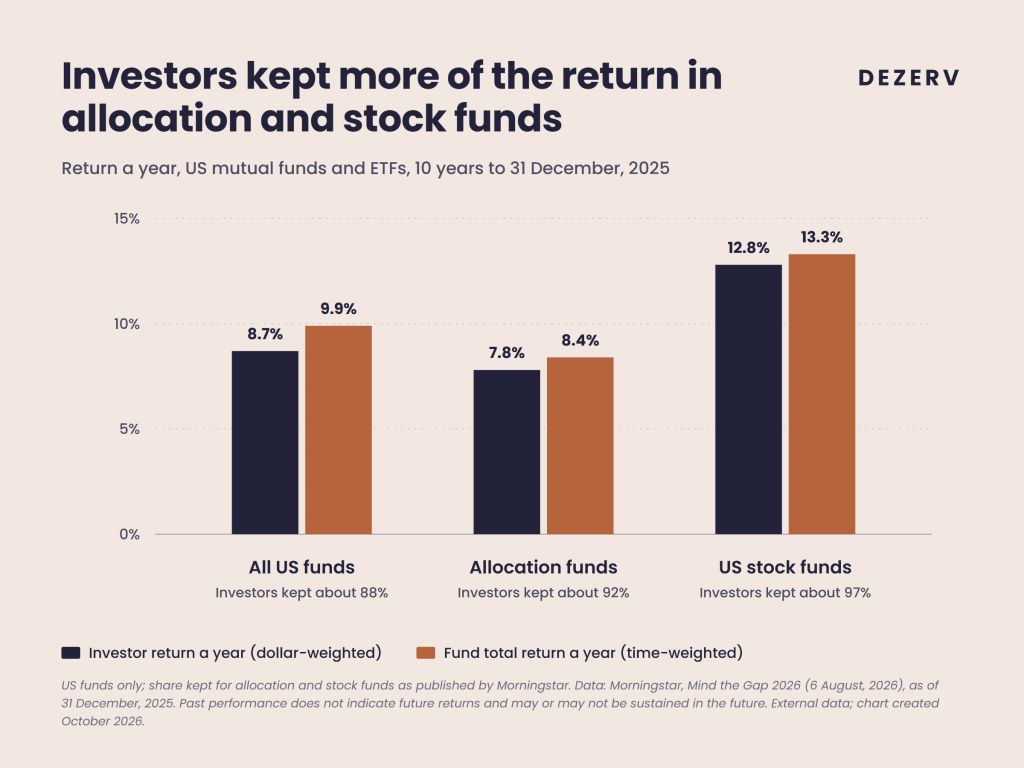
Morningstar's own reading is that investors fared better with simple, stand-alone options such as allocation funds, and with core holdings such as US stock funds, where the timing gaps were narrower. Benjamin Graham named the cause in 1973, long before anyone measured it.
"The investor's chief problem — and even his worst enemy — is likely to be himself."
— Benjamin Graham, The Intelligent Investor, Introduction, fourth revised edition (1973)
1. The Psychology of Money – Morgan Housel (2020)
Read Housel to decide when you have enough. His argument is that how you behave with money counts for more than what you know about it (Harriman House, 2020), and the chapter "Never Enough" follows people who keep moving the target after reaching it.
For a 58-year-old whose corpus is in place, that habit buys more work and more risk for money the household may never spend.
2. Thinking, Fast and Slow – Daniel Kahneman (2011)
Kahneman received the 2002 Nobel Memorial Prize in Economic Sciences (Nobel Prize). His book catalogues the shortcuts behind a panicked sale. Loss aversion makes a loss hurt more than an equal gain pleases, and it works alongside anchoring to an old portfolio value and the availability heuristic, which lets one vivid recent fall crowd out decades of record.
Read him for the first bad year after the salary stops, with the biases every investor should watch for open beside it.
3. Your Money and Your Brain – Jason Zweig (2007)
Zweig, who also edited the 2003 revised edition of Graham's book (jasonzweig.com), explains how biology pushes investors towards good or bad decisions (Publishers Weekly, 2007). For a retiree the useful part is the neuroscience. It makes the case for writing your rules down while markets are calm and following them when prices fall.
How much can you draw each year?
Fix an inflation-adjusted first-year rate from history, as Bengen does. Then decide, with Pfau, how far to let it flex with the portfolio.
4. A Richer Retirement – William Bengen (2025)
Read Bengen to set a first-year withdrawal rate.
He now puts the worst historical starting rate at 4.7% for a 30-year retirement and calls it stingy (Rethinking65, 5 August, 2025). Only one retiree in US history, he says, would have needed a rate that low.
He personalises that rate from inflation and stock-market valuation at retirement, measured by the Shiller price-to-earnings ratio, inside a plan of eight elements.
5. How Much Can I Spend in Retirement? – Wade Pfau (2017)
Pfau sets annuities aside in this book. He surveys the investment-based ways to draw an income: variable spending, time-segmented buckets, bond ladders, inflation-protected bonds and rebalancing (Retirement Income Journal, 16 November, 2017).
Bengen keeps a fixed, inflation-adjusted withdrawal and personalises where it starts. Pfau sets that beside rules that let income rise and fall with the portfolio, which lowers the chance of running out at the price of a less predictable monthly sum.
Watch out
Both books rest on US returns and US inflation. India's record differs: the Nifty 50 Total Return Index lost 51.3%* in 2008 and gained 77.6%* in 2009 (NSE Indices). Rerun Bengen's American method on Indian numbers, as sequence-of-returns risk in a long Indian retirement does for the order of returns.
Past performance does not indicate future returns and may or may not be sustained in the future.
Run it yourself or hand it over?
Both classics show a disciplined investor how to run it alone. Bogle's method rests on low cost. Graham's rests on a stock-bond mix fixed in advance and rebalanced.
6. The Little Book of Common Sense Investing – John C. Bogle (2007, revised 2017)
For a retiree, the book settles how much of the return you can afford to hand over in fees.
Bogle, who founded Vanguard, sets the compounding of returns against the compounding of costs, and his answer is to buy and hold a low-cost fund that tracks a broad market index (Wiley, 10th anniversary edition, 2017). That edition adds two chapters on asset allocation and retirement investing.
7. The Intelligent Investor – Benjamin Graham (1949; fourth revised edition, 1973)
Graham writes for two kinds of reader. The defensive investor wants to avoid serious mistakes and to be spared effort and frequent decisions; the enterprising investor will put in the time to select securities.
For the defensive reader he set a rule that has aged well: never less than 25% or more than 75% in high-grade bonds, the rest in leading stocks, and 50–50 as the simplest choice. Rebalance whenever markets push it out of line. His "margin of safety" and the Mr Market parable cover the rest: telling price from value.
The two men part ways on who should try. Graham thought a minority could select securities well and told the rest to stay defensive, while Bogle concluded that after costs almost no one should try to beat the market.
The dissent: spend it while you can
8. Die With Zero – Bill Perkins (2020)
Perkins argues that the number to optimise is net fulfilment, and that savings unspent at death are a measurable loss of life (Die With Zero, the book's site). Families planning a large legacy gain most from him: he favours handing it over while the children can still use it.
He plans experiences in "time buckets", the windows of life when each is still possible. Read him when deciding when to stop building the corpus and start spending it, because he cuts against the withdrawal books, which size spending so the money outlasts you.
The Indian shelf, and the law that moved under it
Two Indian books close the list, for the parts of retirement that depend on Indian law and Indian products.
9. Let's Talk Money – Monika Halan (2018)
Halan's system sends all income into one account, then moves fixed sums each month to a spend account and an invest account (Swarajya review, 12 July, 2018). She treats insurance as a cost, never an investment.
The book ends with a "money box" that gives cash flow, contingency funds, insurance and long-term investments their own cells, which is the plumbing to fix before anyone chooses a portfolio.
10. Retire Rich: Invest Rs 40 a Day – P V Subramanyam (revised 2019)
Subramanyam's book puts a rupee number on retirement. It is the only Indian retirement title on this list. It works through how much you will need with corpus worksheets and calculators, and returns again and again to post-retirement inflation (PrimeInvestor review, 11 March, 2021).
The April 2019 edition added retirement products such as the National Pension System, known as NPS (Cafemutual, 25 April, 2019).
Both Indian books predate two changes in the law. On 1 April, 2026 the Income-tax Act, 2025 replaced the 1961 Act and renumbered its provisions, so the relief on salary paid in arrears (gratuity included), which older books tell you to claim on Form 10E, now sits under a new section and is claimed on Form 39.
The Pension Fund Regulatory and Development Authority (PFRDA) also rewrote the NPS exit rules from 16 December, 2025.
Read the Indian books for method and habits. Then check any section number against how retirement benefits are taxed under the 2025 Act and any NPS split against the current NPS rules at 60, which differ for government and non-government subscribers.
Where to start, and who this list is not for
The order depends on how far you are from the last salary.
Before a corpus exists, Halan and one behaviour book do the most work. The costly mistakes at that stage are cash flow and panic.
Within five years of retiring, Subramanyam and the withdrawal pair matter more; after the last salary, Perkins earns his place.
Some readers will finish the behaviour books convinced they would sell in the next fall. For them, handing the decisions to a financial advisor or a wealth manager is a legitimate answer; a portfolio management service (PMS) hands the portfolio to a professional manager, in your name.
Dezerv Investments Private Limited offers Portfolio Management Services (PMS) that provide exposure to relevant asset classes, primarily through underlying mutual funds, in accordance with each investment approach's mandate. The minimum investment amount for PMS is ₹50 lakh, subject to applicable regulatory requirements and the terms of the relevant service. Investments are subject to market risks, and returns are not guaranteed.
This list is not for someone who wants a retirement figure to copy from a book; it suits a reader willing to read two or three of these slowly, test each idea against their own accounts, and then decide.
Key takeaways
- Morningstar's Mind the Gap 2026 put a measured investor-return gap of about 1.2 percentage points a year* for US fund investors over the decade to 2025, which is why the behaviour books come first.
- Bengen's 2025 book puts his worst historical case at 4.7% over 30 years, on US data, so rerun it on Indian numbers before relying on it.
- Graham's defensive investor holds between 25% and 75% in bonds, 50–50 at its simplest; Bogle's case is that costs decide much of what is left.
- Perkins is the counter-view: a corpus that outlives you unspent is also a planning failure.
- Indian books printed before April 2026 cite 1961-Act section numbers; check them against the Income-tax Act, 2025 before acting.
Past performance does not indicate future returns and may or may not be sustained in the future.
Frequently Asked Questions
Which retirement book should an Indian investor read first?
Start with one behaviour book and one Indian book. Morgan Housel's The Psychology of Money deals with the urge to keep raising the target and to sell in a fall, and Monika Halan's Let's Talk Money sets up separate income, spending and investing accounts and keeps insurance apart from investment. Add a withdrawal-rate book, by Bengen or Pfau, once you are within a few years of drawing on a corpus.
Which book explains withdrawal rates best for an Indian reader?
Wade Pfau's How Much Can I Spend in Retirement? covers the widest range of methods, from variable spending to buckets and bond ladders. William Bengen's A Richer Retirement (2025) is the latest word from the author of the 4% rule, who now puts the worst US case at 4.7% over 30 years. Both rest on US data, so use their methods and rerun the numbers on Indian inflation and returns.
Are Indian personal finance books written before 2026 still accurate on tax?
On habits and method, largely yes; on section numbers, no. The Income-tax Act, 2025 replaced the 1961 Act from 1 April, 2026 and renumbered its provisions, so the arrears relief an older book tells you to claim on Form 10E now sits under a new section and is claimed on Form 39. PFRDA also changed the NPS exit rules with effect from 16 December, 2025. Check any tax or NPS rule in an older book against current law before acting on it.
Should I read these before choosing a financial advisor or wealth manager?
Before. Whether to manage your money yourself or delegate it is the decision the behaviour and cost books sharpen. Once you know how you reacted in past market falls and what fees do to returns over decades, you can judge whether an advisor, a wealth manager or a portfolio management service adds enough to justify its cost, rather than deciding on instinct.
How many retirement books do I need?
Fewer than ten. Match one book to each decision you have not settled: a behaviour book if you have sold in a downturn before, a withdrawal book if you do not know your spending rate, Perkins if you suspect you are over-saving, and an Indian book if tax and products are unclear. One well-chosen book per open decision beats a shelf of famous titles.
Disclaimer
Dezerv Investments Private Limited is a SEBI-registered Portfolio Manager (Registration No. INP000007377). Distribution services are offered by Dezerv Distribution Services Private Limited, a wholly owned subsidiary of Dezerv Investments Private Limited, under AMFI Registration No. ARN-248439 and APMI Registration No. APRN-00615. This article is intended solely for general educational and informational purposes and should not be construed as personalised investment, financial planning, tax or legal advice, or as a recommendation, offer or solicitation to invest in any security, financial product or investment strategy. Readers are advised to consult their financial advisor before making investment decisions based on the information provided herein.
The books, statistics, rankings, historical data and calculations discussed in this article are based on the sources cited and are presented for general informational purposes only. The retirement planning methods, withdrawal rates and investment principles discussed, including those based on US market data, may not be directly applicable to Indian investors. Illustrative calculations and historical withdrawal rates are not forecasts or guarantees of future returns or retirement outcomes. Actual outcomes may vary depending on individual circumstances, retirement duration, inflation, healthcare costs, investment performance, taxes, fees and prevailing market, economic and regulatory conditions. This article is not a complete disclosure of every material fact, term or condition.
Investment in the securities market is subject to market risks. Please read all related documents carefully before investing. Past performance may or may not be sustained in the future.