A lifelong annuity sounds reassuring when a salary is about to stop. Yet the way that income is described can change whether people want it at all.
In December 2007, researchers asked 1,342 Americans over 50 to judge which of two fictitious retirees had made the better choice. When a life annuity paying $650 a month was described by what it let the retiree spend, 72% preferred it to a savings account of equal value (Brown and co-authors, American Economic Review, 2008).
Described as an investment instead, the identical annuity won over 21%. So before you hand an insurer part of your corpus, which description should you believe?
The annuity did not change between those two descriptions; only the framing did. That makes it worth examining the actual trade-off: income you cannot outlive in exchange for capital you may no longer be able to use or pass on.
In short
Annuitising means paying a life insurer a lump sum in return for an income it pays for as long as you, or you and your spouse, live. An annuity is best judged as insurance against outliving your money, but the purchase is close to irreversible and a standard annuity pays a level rupee amount that inflation erodes. For voluntary annuity purchases, one approach is to size an annuity around the after-tax gap between essential spending and income already secured for life. Compulsory annuitisation requirements, including the relevant NPS rules, apply even if they exceed that calculated shortfall. The rest of the corpus stays invested, where it can grow and pass to heirs.
Table of contents
Why so few people buy the income they say they want
Economists call it the annuity puzzle. A lifetime income insures against the risk retirees fear most, running out of money.
Yet few retirees buy one, the well-off included. The research points to how annuities are sold and how the choice is framed.
In a 2023 survey of Americans aged 55 to 95 with more than $100,000 of investable assets, about half valued an annuity above its market price. Only 12% of Americans with that much ever receive annuity income (Center for Retirement Research at Boston College, November 2023).
Jackson National Life, an annuity provider, supported the research.
The usual explanations fared badly in the same paper. Respondents would pay nothing extra for a death benefit or for the right to withdraw the remaining premium, so the authors point instead to "channel factors", the plain difficulty of finding, comparing and buying an annuity.
Framing: the loss comes first
The 2008 study offers a second explanation, framing. Handing over a large sum feels like a loss on the day you sign, while the security it buys arrives one month at a time for decades.
"It's not that we're dumb. We're wired to avoid pain and pursue pleasure and security."
— Carl Richards, The Behavior Gap (Portfolio, 2012), as excerpted by the publisher
Both datasets come from the United States, and our search turned up no comparable Indian survey.
What the one-way door costs
An annuity is a contract in which a life insurer takes a lump sum, the purchase price, and pays an income for as long as you live, or as long as either of two people lives.
Cancelling is allowed only briefly. You can do it within the free-look period, 30 days from receiving the policy document (IRDAI Master Circular on Life Insurance Products, June 2024); after that, an immediate annuity generally cannot be surrendered for cash.
For illustration, suppose a 60-year-old buys a ₹10 lakh immediate single-life annuity paying ₹6,600 a month, equivalent to approximately 7.9% annually. These are model assumptions, not a verified current insurer quotation.
A hypothetical return-of-purchase-price variant paying ₹5,600 a month represents about 6.7% annually. Actual rates depend on the insurer, age, payout frequency and annuity option selected at purchase.
The standard life annuity, one of the two options every Indian annuity product must offer (IRDAI, June 2024), pays the same rupee amount for life, though some insurers offer a version that raises the payout by a simple 3% a year from a lower starting income.
A level ₹1 lakh a month, with essential prices rising 7% a year, buys about ₹50,800 of today's goods in year 10 and about ₹25,800 in year 20. That is a sample scenario, not a forecast or guarantee.
The 7% is the post-retirement inflation input used in Dezerv's May 2026 retirement-maths webinar.
The second cost falls on your heirs
A single-life annuity stops at death, and the purchase price stays with the insurer. The return-of-purchase-price version hands it back to a nominee.
In the illustration above, that cost about 1.2 percentage points of yearly income, or ₹12,000 a year on every ₹10 lakh.
Told that leftover money would go to their children instead of to charity, fewer respondents in the 2008 study backed the annuity in the spending frame: 59%, down from 72%. If passing your corpus on through a will matters to you, that ₹12,000 a year is what keeping the capital costs.
Insure the floor, and only a slice of it
The floor is the spending that has to happen whether you live to 75 or 95: food, utilities, medicines, housing costs and insurance premiums. Travel and other discretionary spending sit above it and can move with markets. An annuity insures that floor against one specific risk, living longer than the corpus was sized for.
The annuity keeps paying through any market fall, for as long as you live. On the Registrar General's life tables for 2020-24, a little over one in four Indians alive at 60 is still alive at 85 (calculated from the table's survivor column; Registrar General of India, May 2026). For women the share is nearly one in three.
Sandeep Jethwani, a Dezerv co-founder, has argued that an annuity should carry only a slice of the floor: in a July 2026 media Q&A for Business Standard, he described annuities as longevity insurance for non-negotiable spending.
He favoured capping that allocation. Rates are modest, the capital is locked away and most annuities are not linked to inflation. In his framing, the Senior Citizens' Savings Scheme (SCSS), RBI Floating Rate Savings Bonds and debt funds cover the rest of the floor, and a systematic withdrawal plan (SWP) from the invested corpus pays for everything above it.
What counts as income for life
Count toward the floor only income that lasts for life by contract, which means a government or employer pension and any annuity you already hold.
Rent fails that test. It stops whenever a flat sits empty or a tenant leaves. SCSS interest fails it too. A deposit runs five years, capped at ₹30 lakh, with three-year extensions at whatever rate then applies (Central Bank of India, as of 14 October, 2026).
At 8.2% (Central Bank of India), unchanged for October–December 2026 (Department of Economic Affairs, 30 September, 2026), a full ₹30 lakh account pays ₹2.46 lakh a year.
How retirees size the annuity: a worked shortfall
The sizing arithmetic has three steps. Add up essential annual spending, subtract only the income that lasts for life by contract, and gross the shortfall up for tax. That last step matters because annuity income is taxed at your slab rate. The grossed-up shortfall is the most an annuity is designed to insure.
Take a household with a ₹12 lakh essential floor, a ₹5 crore corpus, a pension of ₹5 lakh a year and a flat that rents for ₹3 lakh.
| Reading of the floor | Annuity income needed a year | Capital at about 7.9% (single life) | Capital at about 6.7% (purchase price returned) | Share of ₹5 crore |
|---|---|---|---|---|
| Rent counted as lifetime income, tax ignored | ₹4 lakh | ≈ ₹51 lakh | ≈ ₹60 lakh | 10–12% |
| Rent treated as variable, tax ignored | ₹7 lakh | ≈ ₹89 lakh | ≈ ₹1.04 crore | 18–21% |
| Rent variable, 20% slab plus 4% cess | ≈ ₹8.8 lakh | ≈ ₹1.12 crore | ≈ ₹1.32 crore | 22–26% |
| Rent variable, 30% slab plus 4% cess | ≈ ₹10.2 lakh | ≈ ₹1.29 crore | ≈ ₹1.52 crore | 26–30% |
A sample scenario, not a forecast or guarantee of returns. Assumptions: ₹12 lakh essential floor in today's rupees; ₹5 crore corpus; ₹5 lakh pension and ₹3 lakh rent, both after tax; hypothetical annuity rates of about 7.9% (single life) and 6.7% (return of purchase price), selected for illustration rather than verified insurer quotations; actual rates depend on the insurer and selected option; marginal tax on annuity income of 20.8% or 31.2% (slab plus 4% cess, no surcharge). Capital = annual annuity income needed ÷ annuity rate. Source: Dezerv illustrative arithmetic using the stated hypothetical annuity payouts; not a current insurer rate quotation.
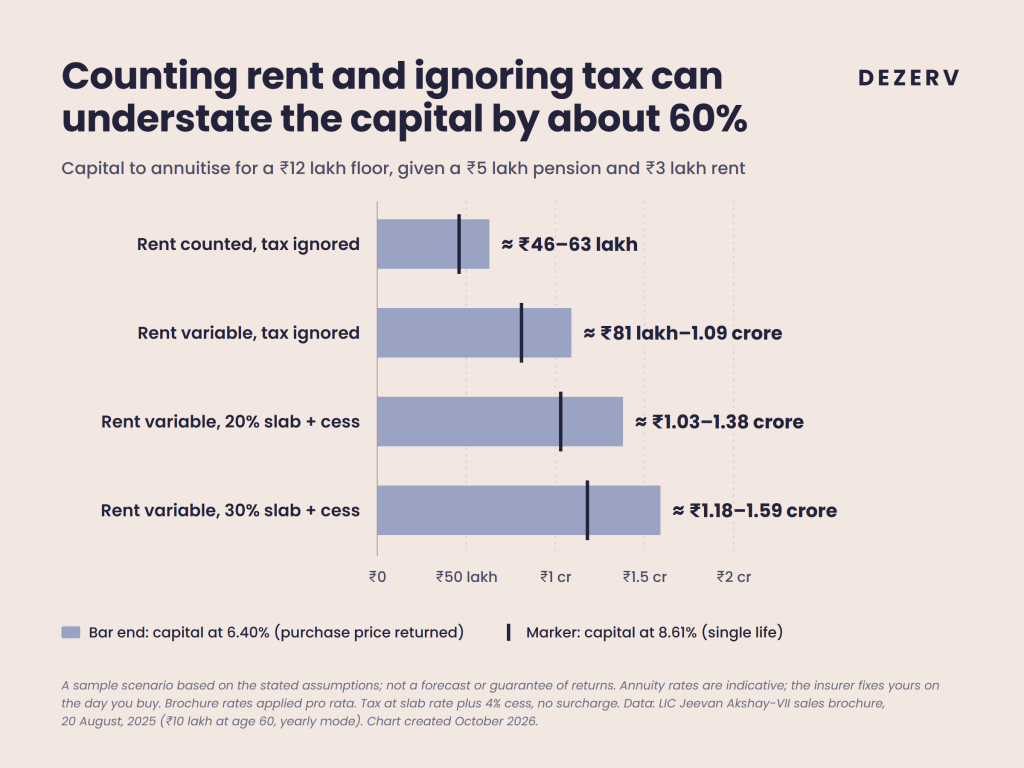
Counting rent as lifetime income cuts the answer by more than 40%. Ignoring tax understates it by a further ₹40–48 lakh of capital at a 30% slab, so the first row comes out about 60% below the last.
A full SCSS account's ₹2.46 lakh a year, itself taxed at slab, would cover part of the ₹7 lakh after-tax shortfall for five years at a time, which is why it bridges the floor but does not replace the annuity.
Even the bottom row buys a level income. At 7% inflation, the ₹7 lakh it leaves after tax covers about ₹1.8 lakh of today's floor by year 20, roughly a quarter of the shortfall it was bought to fill.
When the arithmetic points higher or lower
| Your situation | What the arithmetic shows | Why |
|---|---|---|
| A lifetime pension or existing annuities already cover the essential floor | No annuity needed | Nothing is left to insure; the corpus stays invested and inheritable |
| A partial shortfall | A capped slice of the after-tax shortfall, with SCSS, RBI Floating Rate Savings Bonds or debt funds covering the rest of the floor | Covering the whole shortfall would take 18–30% of the corpus in the scenario above, depending on tax and option |
| Little lifetime income, a family history of living past 90, or a spouse who depends on the income | A larger slice, closer to the full after-tax shortfall | The longevity risk being insured is larger, and the floor has to hold for whichever partner lives longer |
A decision framework, not a personalised recommendation. Ranges come from the sample scenario above.
For couples, the survivor's income
A single-life annuity stops paying when the annuitant dies. That can leave a surviving spouse without the income the household was built around.
A joint-life annuity keeps paying the survivor, in full or at a reduced rate, until the second death. In the illustrative rate assumptions, a joint-life option paying 50% to the spouse provides ₹6,300 a month on ₹10 lakh, roughly 7.6% a year compared with 7.9% for single life; actual joint-life rates require an insurer quote.
Size the floor around what the survivor would need alone.
Housing, utilities and household staff often cost much the same for one person as for two. A survivor's floor can sit well above half the couple's. A 50% survivor option on a floor that barely falls leaves the survivor short in exactly the years the annuity was bought to cover.
The case for annuitising nothing
Annuitising nothing holds up when the corpus is large relative to essential spending and the estate matters.
In the sample household, the ₹7 lakh after-tax shortfall comes to 1.4% of the ₹5 crore corpus a year. Such a household can self-insure longevity from a diversified portfolio, drawn down at a disciplined rate, that can keep growing and keeps its capital within reach for a medical emergency or a change in family needs.
Its main risk is a market fall in the first years of withdrawals, set out in how sequence-of-returns risk works in retirement.
For investors who delegate, a portfolio management service (PMS) is one route, and Dezerv Investments Private Limited offers Portfolio Management Services (PMS) that provide exposure to relevant asset classes, primarily through underlying mutual funds, in accordance with each investment approach's mandate. The minimum investment amount for PMS is ₹50 lakh, subject to applicable regulatory requirements and the terms of the relevant service. Investments are subject to market risks, and returns are not guaranteed.
A market-linked portfolio can fall in value. The annuity itself is a separate purchase from a life insurer, and Dezerv does not offer insurance. If a fixed income under the essentials would let you spend without watching the market, take the after-tax shortfall to an insurer for a quote, ideally after you estimate your corpus with the retirement calculator.
Key takeaways
- An immediate annuity is close to irreversible once the free-look period ends, and a single-life annuity leaves nothing for heirs.
- A standard annuity pays a level rupee amount, so the invested part of the corpus has to supply what inflation takes.
- Size any annuity from the after-tax shortfall between essential spending and income that lasts for life by contract; rent and SCSS interest do not count as lifetime income.
- Couples should price a joint-life option, and retirees whose pensions already cover essentials may not need to purchase an additional voluntary annuity, provided any compulsory NPS requirements are met.
Frequently Asked Questions
What does it mean to annuitise your retirement corpus?
It means paying a lump sum, the purchase price, to a life insurer in return for a regular income, usually monthly, for the rest of your life or the lives of you and your spouse. The insurer fixes the payout at purchase. An immediate annuity generally cannot be surrendered once the free-look period ends, which is why the choice is treated as a one-way door.
Is annuity income taxable in India?
Yes. Annuity income is taxed at your slab rate in the tax year you receive it under the Income-tax Act, 2025, in force since 1 April, 2026. A pension from an annuity bought with National Pension System, known as NPS, money is taxable in the same way, because the Act counts that pension as income in the year it is received. A quoted annuity rate is therefore a pre-tax figure; at a 30% slab plus cess, nearly a third of it goes in tax. See how retirement benefits are taxed.
How much of my corpus should I annuitise?
For a voluntary annuity purchase, one approach is to cover no more than the after-tax gap between essential annual spending and income already secured for life by contract, such as a pension. Any compulsory NPS annuitisation must still be met. Rent and SCSS interest should not count, because rent can stop and an SCSS deposit lasts five years at a time, at whatever rate then applies. In a sample scenario with a ₹12 lakh floor, a ₹5 lakh pension and a ₹5 crore corpus, that came to about 18–30% of the corpus, depending on tax and option. Dezerv co-founder Sandeep Jethwani has argued for annuitising only a slice of the essential floor, and capping it.
Can I reverse an annuity once I have bought it?
Generally no. An immediate annuity can be returned during the free-look period; after that, the purchase price stays with the insurer. A return-of-purchase-price option hands the price back to your nominee on death, but it pays a lower income: about 6.7% a year against 7.9% for a single-life annuity at 60 under the hypothetical rates used in this article. In this illustration, that income difference represents the cost of the return-of-purchase-price feature; actual premiums and payouts depend on the insurer and option.
Does NPS force me to annuitise?
Partly, and the requirements depend on your subscriber category. At a normal exit, eligible non-government subscribers with larger corpuses generally annuitise at least 20%, while government-sector subscribers generally annuitise at least 40%. The 15-year normal-exit route is confined to eligible non-employment-linked subscriptions, not corporate NPS. Small-corpus and premature-exit rules differ and should be checked against the PFRDA regulations for your own category. The separate NPS withdrawal article explains the tax consequences.
Should I choose single-life or joint-life?
For a couple, a joint-life annuity is usually the safer default, because it keeps paying the survivor after the first death. A single-life annuity pays more each month but stops when the annuitant dies. Under the article's illustrative assumptions at age 60, a joint-life option paying 50% to the spouse came to about 7.6% a year against 7.9% for a single life, a small difference for income that outlasts the first death.
Disclaimer
Dezerv Investments Private Limited is a SEBI-registered Portfolio Manager (Registration No. INP000007377). Distribution services are offered by Dezerv Distribution Services Private Limited, a wholly owned subsidiary of Dezerv Investments Private Limited, under AMFI Registration No. ARN-248439 and APMI Registration No. APRN-00615. This article is intended solely for general educational and informational purposes and should not be construed as personalised investment, retirement planning, financial, tax or legal advice, or as a recommendation, offer or solicitation to invest in any security, financial product or investment strategy. Readers are advised to consult their financial, tax and legal advisors before making decisions based on the information provided herein.
The information relating to annuities, retirement planning, taxation, inflation and other retirement income options is based on publicly available information and the sources cited in this article. Illustrative calculations, assumed annuity rates, inflation rates and scenarios are for explanatory purposes only and do not represent actual insurer quotations, guaranteed returns or future outcomes. Actual outcomes may vary depending on individual circumstances, annuity terms, tax treatment, fees, investment performance and prevailing market, economic and regulatory conditions. This article is not a complete disclosure of every material fact, term or condition.
Investment in the securities market is subject to market risks. Please read all related documents carefully before investing. Past performance may or may not be sustained in the future.