A retirement account can show a healthy amount of interest and still be unable to support the same spending for 25 or 30 years. That difference matters particularly when the entire plan rests on a round figure such as ₹1 crore.
At October–December 2026 rates, a hypothetical ₹1 crore split between the Senior Citizens' Savings Scheme (SCSS), an RBI Floating Rate Savings Bond and a bank deposit earns annual interest equivalent to about ₹64,500 a month before tax. The products actually pay on different schedules. For context, MoSPI's 2023–24 top-5% urban figure was per person; doubling it gives approximately ₹40,600 a month for two, not an observed retired-couple budget.
Yet a study of Indian returns, inflation and taxes from 2000 to 2023 put the sustainable starting draw from an all-deposit portfolio below ₹17,000 a month on the same sum (SSRN; reported by Business Standard). Which number should a retirement be built on?
In short
₹1 crore can fund a retirement that starts at roughly ₹33,000 to ₹40,000 a month and rises with prices, which suits a couple in most of urban India or a metro household that owns its home outright. It cannot fund an affluent metro life of ₹1.5 lakh to ₹2 lakh a month, which would use it up in about four to six years. Split across SCSS, RBI Floating Rate Savings Bonds and bank deposits, ₹1 crore yields annual interest equivalent to about ₹64,500 a month before tax, though payouts follow the respective quarterly, half-yearly or deposit schedules at October–December 2026 rates (indicative, not guaranteed).
Table of contents
What ₹1 crore pays each month
₹1 crore placed in the Senior Citizens' Savings Scheme, RBI bonds and bank deposits pays about ₹7.7 lakh a year before tax at October–December 2026 rates. That is roughly ₹64,500 a month as an annualised equivalent, not a monthly cash payment: SCSS pays quarterly, RBI Floating Rate Savings Bonds pay half-yearly, and bank-deposit payouts depend on the deposit terms. How the money is split moves that figure by several thousand rupees a month, because the best-paying option is capped.
The Senior Citizens' Savings Scheme (SCSS) is a government savings scheme for people aged 60 and over.
Eligible retired civilian employees aged 55 or more but below 60 can open an account within three months of receiving their retirement benefits, subject to the scheme conditions (SCSS rules).
SCSS pays 8.2% on accounts opened this quarter, fixed for that account's five-year term but indicative, not guaranteed for later quarters (Central Bank of India, as of 14 October, 2026). The Department of Economic Affairs left the rate unchanged on 30 September, 2026 (Business Today, 30 September, 2026; rate history at the National Savings Institute).
One person can hold at most ₹30 lakh in it, the limit the 2023-24 Budget doubled from ₹15 lakh (Budget speech).
RBI Floating Rate Savings Bonds 2020 (Taxable) pay 8.05% for July to December 2026 (indicative, not guaranteed: it resets every six months), set at 0.35 percentage points above the National Savings Certificate rate (RBI, 1 July, 2026). There is no upper limit on the amount.
A holder aged 60 to 70, though, can encash early only after six years (RBI guidelines). A guide to RBI bonds compares the series.
The last slice goes to a bank. State Bank of India pays senior citizens 7.05% (indicative, not guaranteed) on deposits of five to ten years under its SBI We-care scheme, a rate that includes the scheme's extra 0.5 percentage points (SBI, rates effective 15 December, 2025, checked 14 October, 2026).
| Where the money sits | Amount | Rate | Income a year | Income a month |
|---|---|---|---|---|
| SCSS, one person's ceiling (paid quarterly) | ₹30 lakh | 8.2% | ₹2,46,000 | ₹20,500 |
| RBI Floating Rate Savings Bonds (paid half-yearly) | ₹35 lakh | 8.05% | ₹2,81,750 | ₹23,479 |
| SBI We-care senior-citizen deposit, 5 to 10 years | ₹35 lakh | 7.05% | ₹2,46,750 | ₹20,563 |
| Total | ₹1 crore | 7.7% blended | ₹7,74,500 | ₹64,542 |
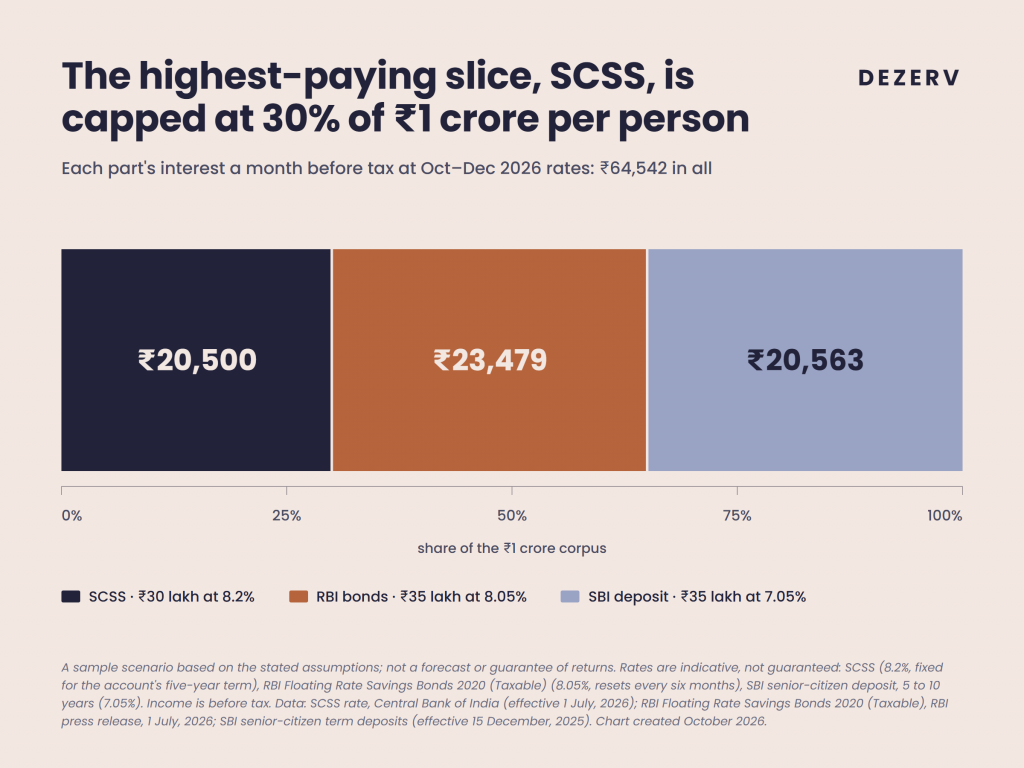
A sample scenario, not a forecast or guarantee. Rates are those set for October–December 2026: SCSS (Department of Economic Affairs, 30 September, 2026; rate as listed by Central Bank of India, 14 October, 2026), RBI Floating Rate Savings Bonds 2020 (Taxable) (RBI, 1 July, 2026) and SBI We-care senior-citizen term deposits (SBI, effective 15 December, 2025). Rates shown are indicative, not guaranteed: SCSS fixes its rate for the account's five-year term, the RBI bond resets every six months and banks change deposit rates for new money. Income is before tax.
Couples and the second SCSS account
Couples get more out of the same ₹1 crore. The ₹30 lakh ceiling is per person, so two eligible spouses can each open an account and put ₹60 lakh through the 8.2% rate. With ₹20 lakh each in the bond and the deposit, the income rises to about ₹66,200 a month (a sample scenario on the same rates).
Tax on ₹7.7 lakh of interest
On these sums, tax may take nothing at all. Under the new tax regime, the default under the Income-tax Act, 2025, a resident whose total income for the tax year stays within ₹12 lakh gets a rebate of up to ₹60,000, the successor to the 1961 Act's rebate.
A single retiree with ₹7.7 lakh of interest and no other income therefore owes no tax for the year.
Four ways to read the same ₹1 crore
An Indian study puts a sustainable starting draw on ₹1 crore at 3% to 3.5%, about ₹25,000 to ₹29,000 a month, and the US 4% rule allows ₹33,333.
Both sit far below the 7.7% the money earns. The interest figure says what ₹1 crore earns this year. A retirement needs to know how much you can draw in year one, raise with prices every year after, and still have money left at 90.
The best-known yardstick is the 4% rule, worked out in 1994 on US market data, under which you draw 4% of the corpus in the first year and lift the amount each year by inflation (William Bengen, Journal of Financial Planning, October 1994; Business Standard, 29 February, 2024).
India's own numbers come out lower. In Balancing Acts: Safe withdrawal rates in the Indian context (SSRN, January 2024), Rajan Raju and Ravi Saraogi ran the same test on Indian returns, inflation and taxes from 2000 to 2023 (Business Standard, 29 February, 2024).
A portfolio held entirely in fixed deposits supported a starting draw of under 2%. Adding equity helped up to a point: 40% in equity supported 3%, and a mix of 60% debt, 30% equity and 10% gold reached 3.5%.
The study's recommended 3% to 3.5% carries 95% confidence.
| Reading | Rate on ₹1 crore | First-year draw | A month | What it assumes |
|---|---|---|---|---|
| Spend all the interest | 7.7% | ₹7,74,500 | ₹64,542 | The draw stays flat while prices rise |
| 4% rule (US data, 1994) | 4% | ₹4,00,000 | ₹33,333 | The draw rises with inflation every year |
| Indian study, 60% debt / 30% equity / 10% gold | 3.5% | ₹3,50,000 | ₹29,167 | Rises with inflation; Indian data 2000–2023, 95% confidence |
| Indian study, fixed deposits only | under 2% | under ₹2,00,000 | under ₹16,667 | Same test with no equity or gold |
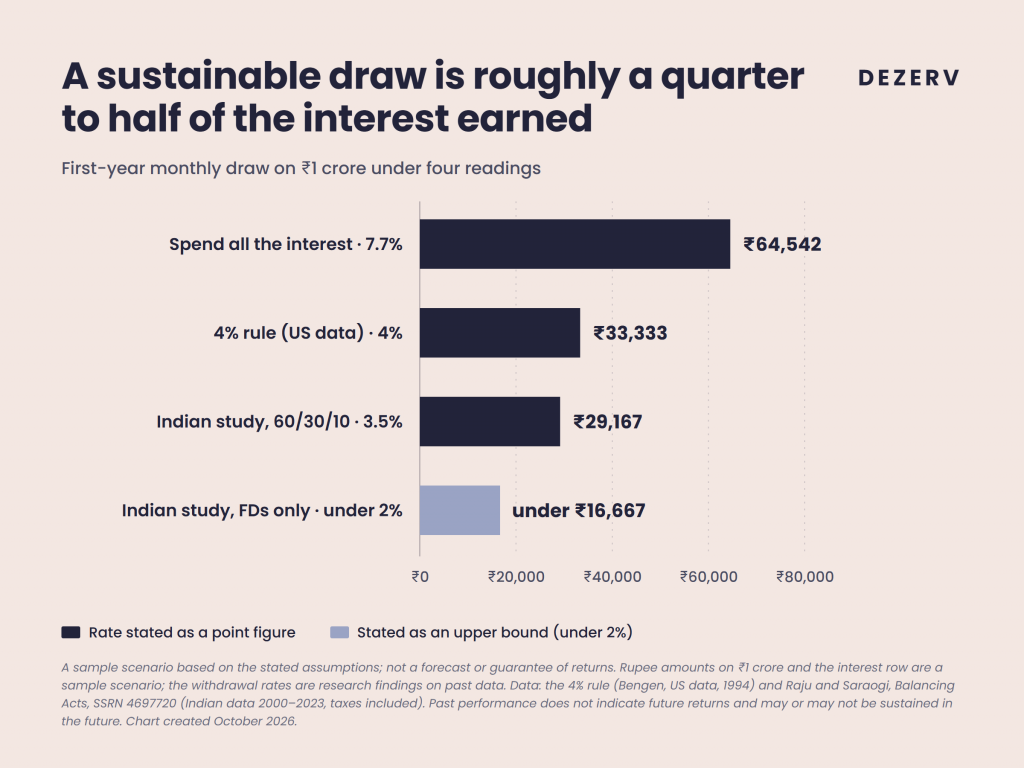
Rates for the 4% rule and the Indian study (Rajan Raju and Ravi Saraogi, "Balancing Acts", SSRN 4697720) as reported by Business Standard, 29 February, 2024 (study data 2000–2023, taxes included). Rupee amounts on ₹1 crore and the interest row are a sample scenario. Withdrawal rates are research findings on past data, not a forecast or guarantee.
Across the four readings, a sustainable draw comes to roughly a quarter to half of the interest the money earns. The study also warns against the obvious fix: pushing equity beyond 40% lowered the sustainable rate, because the added volatility cost more than the added return earned (same source).
The evidence favours some growth assets, held steadily, in a ₹1 crore retirement, and gives no support to loading up on equity to make a small corpus look larger.
How long ₹1 crore lasts at each monthly spend
At today's blended 7.7% (indicative, not guaranteed), ₹1 crore lasts about 33 years for a retiree who starts at ₹33,333 a month and raises the spend 6% a year.
The 6% sits a little above the 5.54% retail inflation MoSPI reported for September 2026 (MoSPI, 12 October, 2026, provisional). A household's own costs can run faster. At 7% a year the ₹40,000 row ends after about 23 years, near age 83. Every row below starts at age 60.
| Monthly spend at 60 | Lasts if spend rises 5% a year | Lasts at 6% | Lasts at 7% | Runs out at about age (6%) |
|---|---|---|---|---|
| ₹33,333 (the 4% rule) | 41.7 years | 33.2 years | 28.4 years | 93 |
| ₹40,000 | 30.9 years | 26.3 years | 23.3 years | 86 |
| ₹50,000 | 22.4 years | 20.1 years | 18.3 years | 80 |
| ₹64,542 (all the interest) | 16.1 years | 14.9 years | 14.0 years | 75 |
| ₹1 lakh | 9.6 years | 9.2 years | 8.9 years | 69 |
| ₹1.5 lakh | 6.1 years | 6.0 years | 5.8 years | 66 |
| ₹2 lakh | 4.5 years | 4.4 years | 4.4 years | 64 |
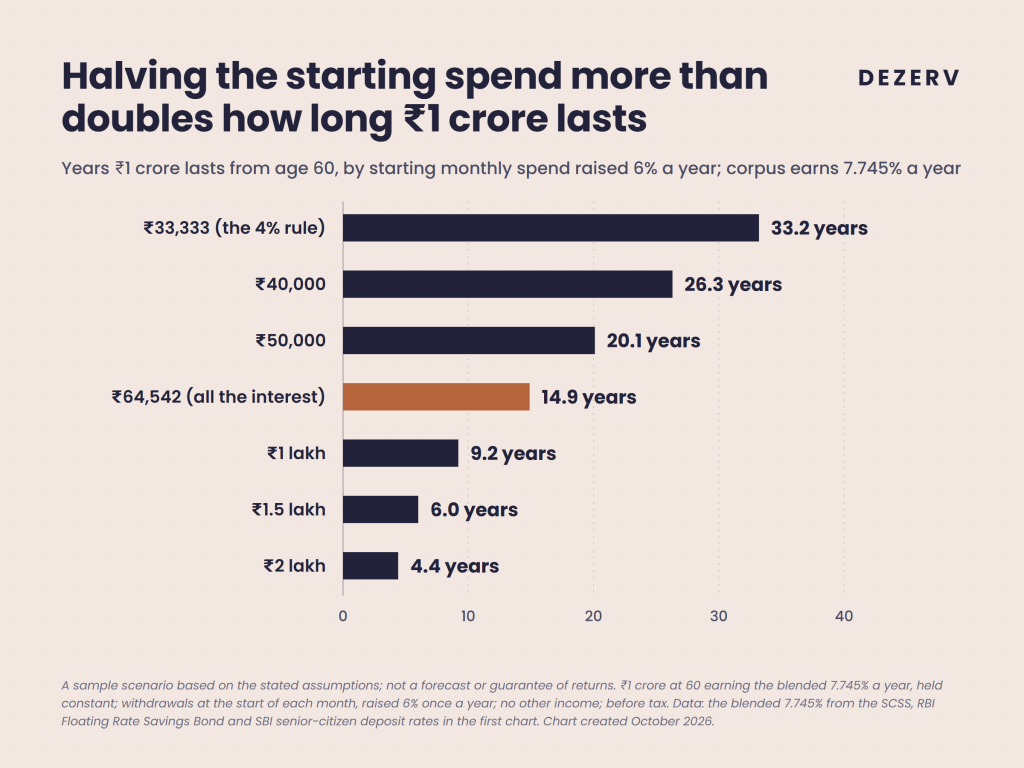
A sample scenario, not a forecast or guarantee. Assumptions: ₹1 crore at age 60 earning 7.745% a year (the blended rate in the first table, held constant, applied as its monthly equivalent); withdrawals at the start of each month, with the monthly spend raised once a year by 5%, 6% or 7%, one rate applied to every spend level as the scenario's assumption, so a household whose own costs rise faster would see its row shorten; no other income; before tax, which on the first table's income falls within the rebate for total income up to ₹12 lakh. Capital is assumed available to draw, but SCSS runs in five-year terms and the RBI bond locks money for six years at 60 to 70, so draws would come from deposits first.
Halving the starting spend from ₹64,542 to ₹33,333 more than doubles how long the money lasts.
Living on the interest feels careful. In the first year the principal is untouched. By year 13 the monthly spend has doubled to about ₹1.3 lakh at 6% a year.
The interest no longer covers it. After about 15 years the money runs out, at roughly age 75.
The Indian study's harsher under-2% figure for an all-deposit portfolio comes from 24 years of actual rates, taxes and inflation.
This table holds today's rates for decades. A rate cut when an SCSS term ends or the RBI bond resets would shorten every row.
Metro or smaller city: where ₹1 crore stretches
₹1 crore stretches furthest where a household's spending sits near the ₹40,000 row. Most of urban India spends well below that.
Urban Indians spent an average of ₹6,996 per person a month in 2023-24, against ₹4,122 in rural India, a gap of about 70% (MoSPI, Household Consumption Expenditure Survey 2023-24, fieldwork August 2023 to July 2024). For the top 5% urban per-person benchmark, the figure was ₹20,310 monthly; multiplying by two gives approximately ₹40,600 as a hypothetical two-person spending benchmark, not an observed retired-couple budget.
Among the major states, urban spending per person ran from ₹4,927 in Chhattisgarh to ₹8,978 in Telangana (same survey). These are 2023-24 averages across every income group, so an affluent household's own budget will run higher.
A retired couple who own their home in Coimbatore or Nagpur and spend ₹40,000 a month sit on the row that lasts to about 86.
A single retiree renting in Mumbai and spending ₹1.5 lakh a month, rent included, sits four rows lower and runs through the same ₹1 crore in about six years (both are sample scenarios on the table's assumptions). Rent sits inside that ₹1.5 lakh, and a renter keeps paying it every month for life.
If ₹1 crore is what you have
The moves that change the table most are the ones that lower the starting spend or add income in the first years of retirement. An extra half a percentage point of yield on the ₹64,500 spender's corpus adds only about seven months (a sample scenario on the table's assumptions).
Part-time income in the first five years
₹30,000 a month of consulting or part-time income from 60 to 65 stretches the same corpus from about 15 years to about 17.5 (a sample scenario on the same assumptions). That is more than four times what the extra yield buys.
A floor plus a growth share
One common structure splits the corpus by job. The essential monthly bills sit in SCSS, the RBI bond and deposits, which pay on a fixed schedule.
The rest goes into a diversified mix of equity and debt funds, drawn through a systematic withdrawal plan (SWP), which pays out a set rupee amount each month by redeeming units while the remaining units stay invested. Mutual fund returns are market-linked and vary from year to year.
The price of holding growth assets is timing risk. A market fall in the first years of withdrawals does lasting damage, which is why sequence-of-returns risk deserves a look before the split is set.
A longer guide on investing retirement funds for a monthly income covers the instruments in more detail.
"Save your money like a pessimist and invest your money like an optimist."
— Morgan Housel, author of The Psychology of Money, in his column for The Hustle (8 April, 2022)
Where a PMS fits on ₹1 crore
A portfolio management service (PMS) is a SEBI-regulated account in which a portfolio manager invests on your behalf. Dezerv Investments Private Limited offers Portfolio Management Services (PMS) that provide exposure to relevant asset classes, primarily through underlying mutual funds, in accordance with each investment approach's mandate. The minimum investment amount for PMS is ₹50 lakh, subject to applicable regulatory requirements and the terms of the relevant service. Investments are subject to market risks, and returns are not guaranteed.
On a ₹1 crore corpus, that is half the money. A PMS fits only with the SCSS and deposit floor kept outside it.
You can also invest with Dezerv directly, without a distributor.
Who this arithmetic is for
This piece is for a retiree whose ₹1 crore is most of the money. Someone with a full pension or rental income that covers the bills can treat ₹1 crore as a reserve and read the tables as a stress test.
Before fixing a date, run your own spend and other income through the Dezerv retirement calculator. If the money arrives as a single cheque at exit, the first 90 days after the EPF and gratuity land decide how much of it reaches SCSS at all. For eligible retired civilian employees aged 55 or more but below 60, the SCSS account must be opened within three months of receiving the retirement benefits, subject to scheme conditions.
Key takeaways
- At October–December 2026 rates, ₹1 crore in SCSS, RBI Floating Rate Savings Bonds and an SBI We-care senior-citizen deposit generates annual interest equivalent to about ₹64,500 a month before tax, paid on the products’ respective schedules; SCSS alone contributes a quarterly payout equivalent to about ₹20,500 a month because of its ₹30 lakh ceiling per person.
- Spending all of that interest while costs rise 6% a year empties the corpus at about 75 in a sample scenario; a ₹33,000 to ₹40,000 starting spend lasts into the mid-80s or beyond, though at 7% the ₹40,000 start ends near 83.
- An Indian study of 2000–2023 data found a sustainable starting draw of under 2% for an all-deposit portfolio and 3.5% for a 60/30/10 debt-equity-gold mix; equity above 40% lowered the rate.
- A ₹40,600 monthly budget for two roughly doubles the top-5% urban per-capita expenditure reported by MoSPI for 2023–24; it is an illustrative comparison, not a measured retirement-couple budget. Under the article’s specified assumptions, ₹1 crore may support that lower starting budget, but funding a ₹1.5 lakh to ₹2 lakh monthly metro lifestyle would exhaust it in about four to six years.
- A few years of part-time income, an owned home and a steady growth share move the numbers more than a higher yield.
Frequently Asked Questions
Is ₹1 crore enough to retire in India?
₹1 crore is enough for a modest retirement and short of an affluent one. In a sample scenario at October–December 2026 rates, it supports a starting spend of about ₹33,000 to ₹40,000 a month, rising 6% a year, into a retiree's mid-80s or beyond; if costs rise 7% a year, the ₹40,000 start runs out near 83. For context, a two-person ₹40,600 budget approximates twice MoSPI’s 2023–24 top-5% urban per-capita expenditure; it is not an observed budget for retired couples. A metro lifestyle of ₹1.5 lakh a month or more would use it up in about six years.
How much monthly income does ₹1 crore generate?
Annual interest equivalent to about ₹64,500 a month before tax, if ₹30 lakh goes into the Senior Citizens' Savings Scheme at 8.2% (Central Bank of India), ₹35 lakh into RBI Floating Rate Savings Bonds at 8.05% and ₹35 lakh into an SBI We-care senior-citizen deposit at 7.05%, at October–December 2026 rates (indicative, not guaranteed). SCSS contributes ₹61,500 every quarter on a full ₹30 lakh deposit, equivalent to ₹20,500 monthly before tax. RBI bonds generally pay half-yearly and bank-deposit payouts follow their terms. The income stays flat while prices rise, so spending all of it shortens how long the corpus lasts.
How long will ₹1 crore last after retirement?
It depends on the starting spend. In a simplified sample scenario assuming a constant effective annual return of about 7.7%, monthly withdrawals and spending that rises 6% each year from age 60, a ₹33,333 monthly spend lasts about 33 years, ₹50,000 about 20 years, ₹64,542 about 15 years, ₹1 lakh about nine years and ₹2 lakh under five years. Actual deposits and bonds follow different payment schedules, renewal rates, tax and redemption rules; lower realised rates or faster spending inflation can shorten these figures.
Can a couple retire on ₹1 crore?
A couple can, at a modest spend. If both spouses qualify for the Senior Citizens' Savings Scheme, each can deposit up to ₹30 lakh, and ₹1 crore split across two SCSS accounts, RBI bonds and a bank deposit pays about ₹66,200 a month before tax at October–December 2026 rates. Drawn at ₹40,000 a month and rising 6% a year, it lasts to about 87 in a sample scenario. Rent or a metro lifestyle shortens that sharply.
Is ₹1 crore enough to retire in a metro like Mumbai or Bengaluru?
Usually not for an affluent lifestyle. A retiree spending ₹1.5 lakh a month, rent included, would use up ₹1 crore in about six years in a sample scenario, and at ₹2 lakh a month in under five. ₹1 crore works in a metro only when the home is owned outright and spending stays near ₹40,000 a month, or when a pension or other income covers most of the bills.
Disclaimer
Dezerv Investments Private Limited is a SEBI-registered Portfolio Manager (Registration No. INP000007377). Distribution services are offered by Dezerv Distribution Services Private Limited, a wholly owned subsidiary of Dezerv Investments Private Limited, under AMFI Registration No. ARN-248439 and APMI Registration No. APRN-00615. This article is intended solely for general educational and informational purposes and should not be construed as personalised investment, financial planning, tax or legal advice, or as a recommendation, offer or solicitation to invest in any security, financial product or investment strategy. Readers are advised to consult their financial advisor before making investment decisions based on the information provided herein.
The interest rates, expenditure statistics, historical data and retirement calculations in this article are based on the sources cited and the assumptions stated. The income figures and retirement scenarios are illustrative, not forecasts or guarantees, and actual outcomes may vary depending on individual circumstances, inflation, investment returns, taxes, fees, withdrawal patterns and prevailing market, economic and regulatory conditions. The article is not a complete disclosure of every material fact, term or condition.
Investment in the securities market is subject to market risks. Please read all related documents carefully before investing. Past performance may or may not be sustained in the future.