


Six years ago, I became a first-time founder. This year, I’ve become a first-time author.
Around three years ago, I started writing about ESOPs online, mostly because I kept meeting accomplished people with meaningful equity and no real framework to think about it.
If you’d told me then that this would turn into a book, I’d have laughed. But for the last two years, I’ve spent most Sundays pulling everything I’d learned into one place, because no ESOP holder in India should have to piece this together from scattered blogs, random reddit threads or feel awkward asking their seniors basic questions.
That instinct today became a book called The Millionaire Employee.
You see, ESOPs aren’t an abstract subject for me. They’re the reason I’m sitting here writing this at all. I joined IIFL Wealth (now 360 One WAM) in 2008, and equity was something I barely thought about. Then, in 2019, it turned into real money, and the first thing I did was pay off my home loan. If you’ve ever had an EMI eating into your salary every month, you know what that relief feels like.
Paying off that loan did more than clear a debt. It gave me the confidence and capital to start Dezerv with Vaibhav and Sahil, which today has over 600 employees.
For any employee, ESOPs could end up creating a lot of wealth. But the outcome depends on a few important decisions, understanding what you’ve been granted, knowing when to exercise, when to sell, and when to hold. Most people never learn these things until it’s too late.
That’s why I wrote this book, to put everything you need to know about ESOPs in one place.
And today, I’ll walk you through it, chapter by chapter, giving you a glimpse of what’s inside and why each chapter exists. If you have ESOPs today, or you might get them in the future, this is something you need.
Let’s begin.
Chapter 1: The rewards of ownership
ESOPs weren’t invented by a startup. They came out of the Great Depression, when investment banker Louis Kelso structured the first leveraged ESOP buyout for Peninsula Newspapers Inc. in 1956, letting employees buy the company using its own future profits. The US formalized the structure through ERISA in 1974.
In India, Wipro introduced ESOPs in the mid-1980s, but Infosys is really the torch-bearer, launching its Employee Stock Offer Plan in 1994 and setting the template India’s IT and financial sectors would follow for the next two decades.
Today, ESOPs in India represent a ₹14.2 lakh crore opportunity, about 22% the size of the mutual fund industry. IPOs and buybacks have created life-changing wealth overnight for most Indian employees. Swiggy’s IPO created over $1 billion for employees, and companies like Zomato, Nykaa, Policybazaar, Paytm, and Flipkart have done the same for thousands more.
We saw something similar at Dezerv during our 2024 ESOP buyback. Some employees sold their shares, while others chose to hold on because they believed the company’s future was worth more than the cash they could receive that day.
That’s what ESOPs really are. They’re not just another part of your salary, they’re a chance to own a part of the company and share in the value you help create.
Chapter 2: More than a salary : How ESOPs build wealth
I know dozens of people who built real wealth through ESOPs, yet very few truly understood what they owned. Most only learn the details when they’re forced to make a big decision, and by then it’s often too late to change the outcome.
Here’s the simplest way to think about an ESOP. It’s like booking a Coldplay ticket months in advance at today’s price. You pay ₹1,000 now to lock that price in. If tickets later sell for ₹5,000, you’ve won big. If they drop to ₹500, you simply skip it and buy a cheaper one instead. That locked-in price is your exercise price, sometimes also called the strike price.
The actual ticket price on the day of the concert is the share’s fair market value (FMV). Your profit is just the gap between the two.
Face value is a completely different number, and it’s the one most people confuse. It’s just a small, fixed number stamped on the share when the company was first set up, usually ₹10. It never changes, no matter how big or valuable the company becomes later.
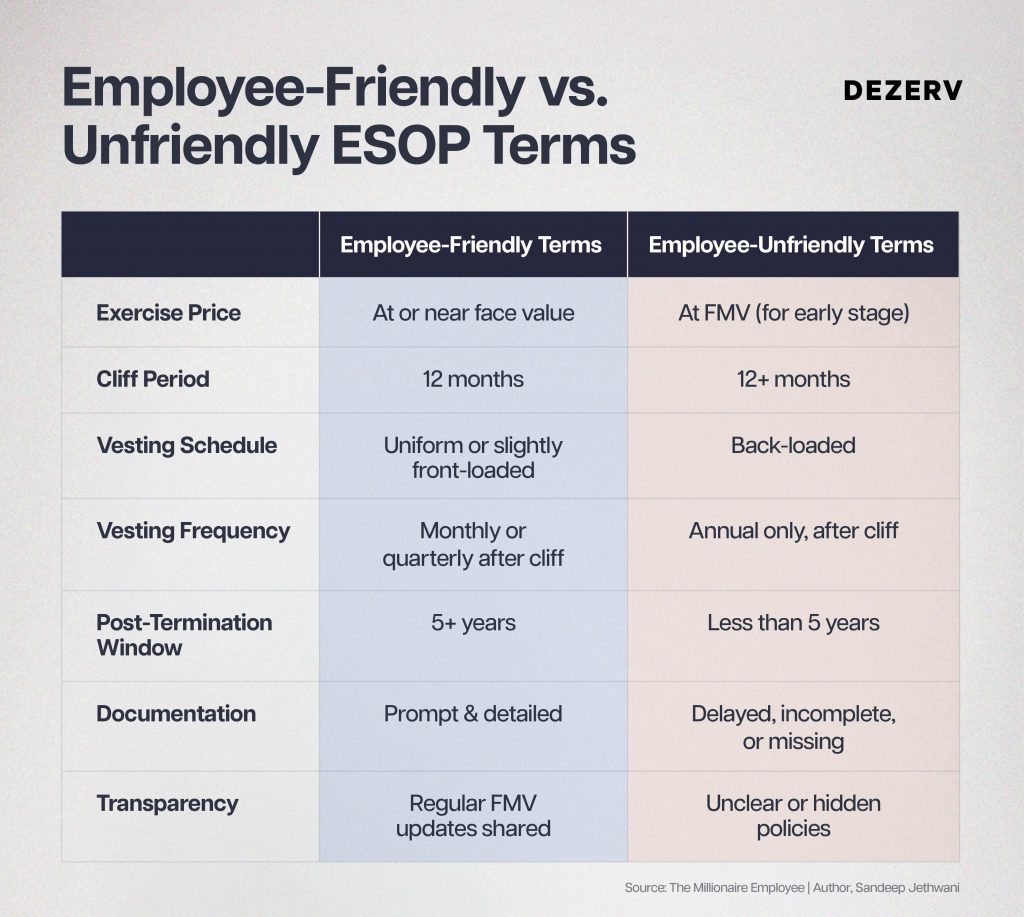
Then comes vesting, the process of earning your ESOPs over time. Most companies follow a four-year schedule with a one-year cliff. A cliff is simply the minimum time you must stay before earning anything. A one-year cliff followed by monthly vesting is common, but the schedule matters. Two employees with almost the same tenure can end up with very different vested shares simply because their companies structured vesting differently.
So, reading the fine print matters more than people realize. To make this easier, here’s a snippet from the book that shows a simple comparison of employee-friendly and unfriendly ESOP terms, so you can benchmark your own offer.
One more thing to remember: ESOP is often used as a catch-all term, but companies may actually be offering different kinds of equity.
- ESOPs / Stock Options: You get the right to buy shares later at a fixed price (exercise price).
- RSUs: You receive actual shares when they vest; no purchase required.
- ESPPs: You can buy company shares at a discount, often 10–15% below market price.
- Phantom Shares: You don’t own shares, but get a cash payout linked to the company’s value.
Each works differently and can lead to very different risks, rewards, and taxes. If your offer letter just says ESOP, ask which type of equity it actually is.
Chapter 3: Grant phase: The first step to ESOP ownership
Every ESOP eventually moves through four stages: grant, vesting, exercise, and finally, the sale.
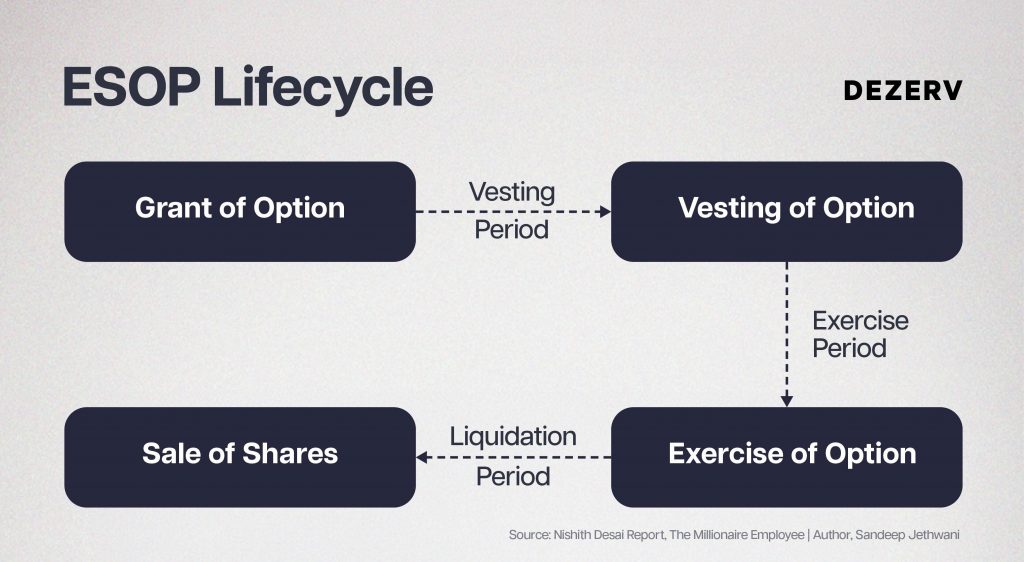
Grant is where all of it begins, and it’s also the stage people take least seriously, mostly because it feels like a formality rather than a decision. It rarely is.
A young COO I know accepted a lower salary in exchange for ESOPs at an early-stage startup. He spent more than two years helping build the company, but his grant letter never arrived. Every time he asked, he was told it was “just a formality.” When he eventually left, he had nothing.
The lesson is simple: if you don’t have a signed grant letter, you don’t have ESOPs.
Your grant letter should clearly mention the number of options, exercise price, vesting schedule, exercise window, and other key terms. These details decide what you own, when you can buy your shares, and what happens if you leave the company.
This chapter also decodes a real grant letter, so you know how to read a grant letter and what to check before you sign.
Chapter 4: The exercise decision: When to convert your ESOPs.
A friend once had just 90 days after leaving his company to decide whether to exercise his ESOPs. The exercise cost and taxes came to nearly ₹15 lakh, almost all his savings.
Exercising an ESOP involves five steps: confirm your options have vested, submit the exercise request, pay the exercise price, pay tax on the difference between the exercise price and the FMV, and receive your shares. For example, if you exercise 1,000 options at ₹50 when the FMV is ₹200, you’ll pay ₹50,000 to buy the shares and owe tax on a ₹1.5 lakh perquisite gain.
There’s a full decision-factor checklist for exercising ESOPs in the book to help you think this through calmly instead of under a countdown.
The real question is whether the risk is worth it. Startup valuations can fall sharply, as we’ve seen with companies like Byju’s, Oyo, and PharmEasy. Before you exercise, ask yourself if the potential reward is worth the capital and tax you’ll have to commit.
Chapter 5: From paper to prosperity : Navigating Liquidation
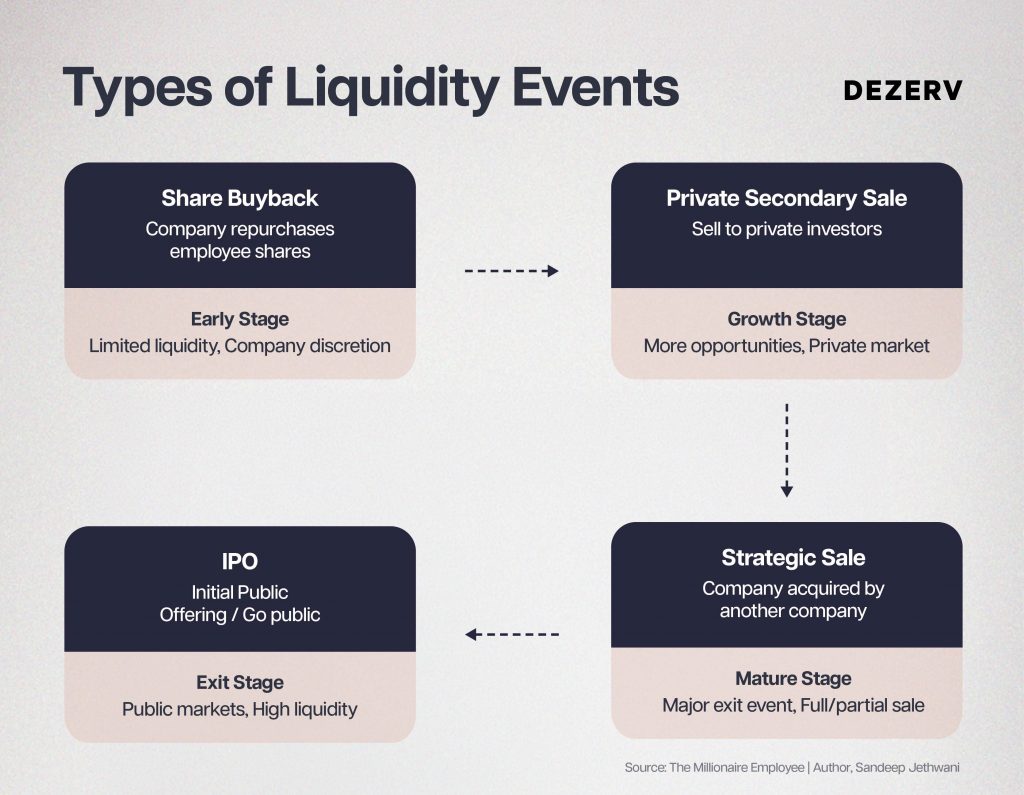
ESOP wealth becomes real money in four ways: buybacks, strategic sales, private secondary sales, and IPOs. Each offers liquidity differently
A buyback is when the company buys shares from employees, giving them a chance to cash out. Razorpay, for example, has completed four buybacks worth over $85 million, benefiting nearly 650 employees.
A strategic sale is when another company acquires the business. Employee shares are usually bought as part of the deal, and sometimes even unvested ESOPs vest early. Flipkart’s sale to Walmart led to about $800 million in ESOP payouts.
A private secondary sale lets employees sell their shares to private investors before an IPO or acquisition, without waiting for a larger liquidity event.
An IPO lets employees sell shares on the stock market, but not always immediately. Lock-in periods often apply. When Zomato’s lock-in ended in 2022, the stock fell over 11% in two days as employees and early investors sold their shares.
But before you celebrate that liquidity event, there’s one stakeholder that always gets paid first: the tax department.
Chapter 6: The hidden cost: Mastering ESOP taxation
One of the biggest surprises with ESOPs is that you’re taxed twice, at two different stages.
The first tax comes when you exercise your options. The difference between the FMV and your exercise price is treated as a prerequisite, added to your salary, and taxed at your income tax slab, even though you haven’t sold a single share. If your gain is ₹1.5 lakh and you’re in the 30% tax bracket, you’ll owe tax before you’ve received any cash.
The second tax comes when you sell the shares. Sell soon after exercising, and the gains are taxed as short-term capital gains. Hold them longer, and you may qualify for long-term capital gains tax of 12.5%, which can be significantly lower. Understanding these two tax events, and planning for them, can make a meaningful difference to your final returns.
Chapter 7: Timing your ESOP exercise
“Should I exercise now or wait?” is probably the most common ESOP question I get. And the answer depends on the numbers.
Take the same 1,000-share grant with a ₹50 exercise price, eventually sold at ₹8,000 ten years later. Exercising every year as your shares vest, exercising everything after full vesting, or waiting until a liquidity event all lead to different outcomes. In this example, waiting until the liquidity event actually delivers the highest post-tax return because you avoid locking up your money and taking valuation risk.
But there’s no one-size-fits-all answer. Early exercise gives you ownership sooner and can spread out taxes, but it also means committing your own money years before you know if there’s an exit. Waiting reduces that risk, but only if a liquidity event is likely.
I’ve built an ESOP Exercise Strategy Calculator into the book. You can enter your own grant details, tax bracket, and assumptions to compare different strategies and see what works best for you.
Chapter 8: Beyond the windfall: Transforming ESOP liquidity into financial freedom
When an early Urban Company employee received his ESOP payout, it was more than he had saved in all his previous working years combined. He paid off his home loan within days. “It wasn’t just financial freedom,” he told me, “it was mental freedom.”
What you do next matters just as much as the payout itself. Some people diversify across different assets, reducing the concentration risk they had in a single company. Others put most of the money into one property or one stock, replacing one concentration risk with another.
The size of the payout was never the differentiator I observed. What decided the outcome, every time, was the plan for the first few months after the money landed, before the excitement wore off and old spending habits crept back in.
Chapter 9: Decoding an ESOP offer
Not all ESOP offers are equal. Before you accept one, look at six things: the founders, the company’s potential, the cash-versus-equity tradeoff, the ESOP policy, how likely a liquidity event is, and the size of the market.
I learned the cash-versus-equity tradeoff the hard way. Early in my career, I chose cash over ESOPs because I had a home loan. Those ESOPs would be worth around ₹16 crore today.
It’s also worth checking the fine print. A one-year cliff, four to five years of vesting, and a 10-15% ESOP pool are common benchmarks. If your offer looks very different, ask questions before you sign.
In the book, I use this six-point framework to compare two job offers, one with higher cash and lower ESOPs, the other with lower cash and higher ESOPs, to show how to evaluate them step by step. I’ve also included an ESOP Evaluation Score Sheet so you can assess your own offer instead of relying on gut feel.
A note to every ESOP holder
When I joined IIFL Wealth in 2008, the markets were in a recession, and ESOPs were just something I didn’t really understand. A lot has changed since then. Startups are bigger, ESOP policies are more employee-friendly, and we’ve seen many success stories.
But we’ve also seen the other side. Companies like Byju’s showed that paper wealth can disappear just as quickly as it’s created. ESOPs can create significant wealth, but they also come with risks. Taxes, vesting, lock-ins, and falling valuations can all affect your payout
Here’s what’s concerning. In a survey of nearly 1,000 employees across corporate India, most people admitted they didn’t fully understand their vesting, taxes, or what would happen to their ESOPs if they left. Even employees holding over ₹1 crore worth of ESOPs said they were only somewhat confident about how their equity worked.
So if you take away one thing from everything I’ve shared today, let it be this: you owe it to yourself to actually understand how your ESOPs work, whether you just received your first grant or you’re sitting on a windfall you’ve been waiting years for.
That’s the one thing I hope this book helps with.
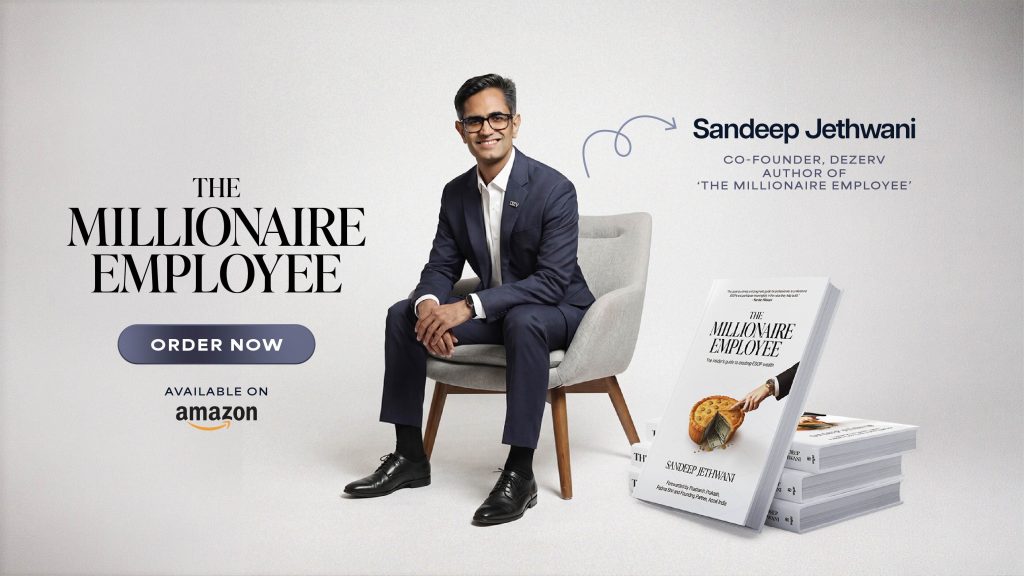
The Millionaire Employee is out now. Get your copy here
Disclaimer – The information provided herein is intended solely for educational purposes and is as on date of the document. In this material, Dezerv has utilized information through publicly available sources, and other data deemed to be reliable. Readers are advised to consult with their financial advisor before making investment decisions based on the information provided herein. All trademarks, logos, and brand names mentioned are used for identification purposes only and do not imply endorsement or recommendation. Dezerv, along with its directors, employees, or partners or any of its affiliates, shall not be held liable for any loss, damage, or liability arising from the use of this document.