


In 1930, John D. Rockefeller broke ground on a 22-acre complex in the heart of Manhattan that would become one of the world’s most valuable pieces of real estate: 14 office towers, Radio City Music Hall, the NBC studios, and America’s most famous skating rink.
For decades, owning even a small share of it was out of reach for most people. To benefit from the rent these buildings generated, you had to own the building itself. That meant investing large amounts of money, finding tenants, managing the building, and waiting years for returns.
By the mid-1980s, even the Rockefeller family faced a challenge. Ownership had been split among nearly 90 family members, and the property no longer generated enough cash for everyone. They needed liquidity, but they couldn’t sell Rockefeller Center one floor at a time.
The solution was to change how it was owned. A structure created by Congress in 1960 allowed investors to buy small units in a trust that owned large commercial properties, earn a share of the rental income, and trade those units like shares on a stock exchange.
The Rockefellers seized the opportunity. They created a publicly traded trust called Rockefeller Center Properties and took it public in a $750 million IPO. For the first time, a school teacher in Ohio could own a small stake in the same address that housed NBC and some of America’s largest companies.
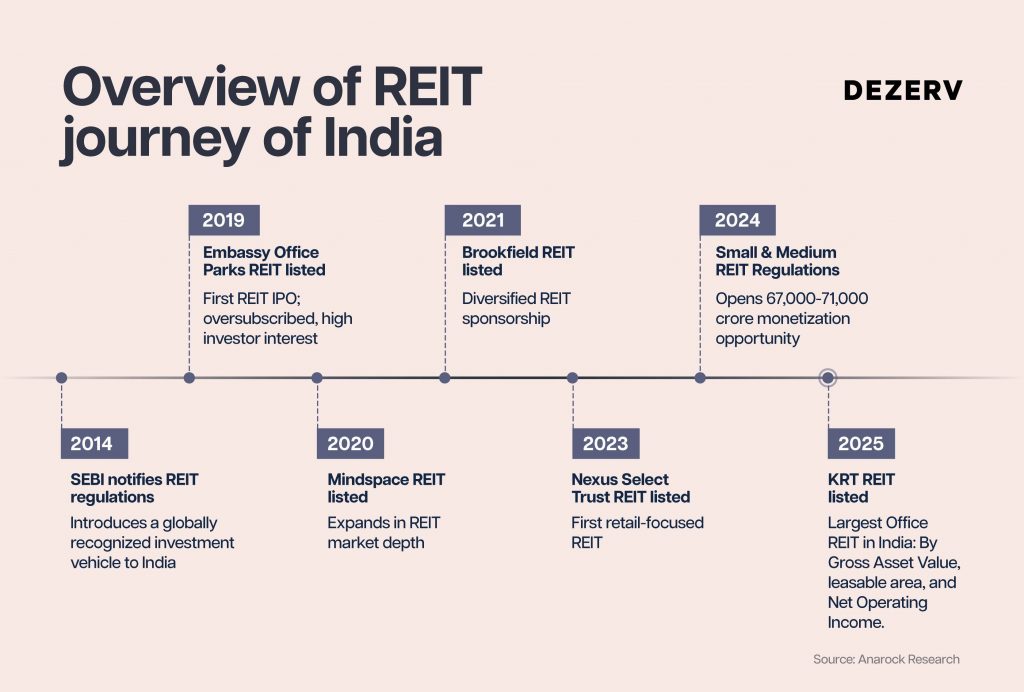
That structure is called a Real Estate Investment Trust, or REIT. India introduced its own REIT regulations in 2014, and the first listing followed in 2019. Today, you can own a floor in buildings where companies like JP Morgan and IBM pay rent, for roughly the price of a dinner.
In this edition, I will take a deep dive into how REITs work, the state of India’s REIT market today, and how to think about them as a portfolio asset.
Here’s what we’ll cover:
- What a REIT actually is, and the problem it was built to solve
- The types of REITS in India and how to invest in them
- How India’s REIT market got built
- What India’s REIT market looks like today
- Why the underlying real estate keeps getting stronger
- Where REITs fit in your portfolio and how to evaluate them
- The risks worth knowing
Let’s begin.
What is a REIT and how does it work?
A REIT works much like a mutual fund, except it owns buildings instead of stocks. It raises money through an IPO, uses that capital to buy income-generating properties like office parks, malls, or warehouses, and earns rental income from tenants. That income is then distributed to investors, while the REIT itself trades on the stock exchange.
That simple structure solves many of the biggest problems with owning property.
- Ticket size: A single unit replaces the crores a whole building would otherwise demand.
- Liquidity: The units are listed on the exchange, so they can be sold on any trading day instead of waiting months for a buyer.
- Diversification: One unit spreads your money across many properties and tenants instead of just one flat and one tenant.
- Transparency: NAV and holdings are disclosed regularly, unlike private property where the actual value is mostly a guess.
- Regulation: SEBI governs the entire structure, mandating that the trust has to distribute at least 90% of that income back to unitholders every quarter.
So, unlike owning a flat, the REIT handles tenants and rent collection for you, then distributes most of the rental income to unitholders. Many tenants are large companies like JP Morgan and IBM on long-term leases.
REITs in India fall into three broad categories
- Equity REITs own income-generating properties like offices, malls, warehouses, hotels, and data centres. They earn money from the rent businesses pay to operate there, and investors receive a share of that income. It’s a way to own commercial real estate without managing the buildings yourself.
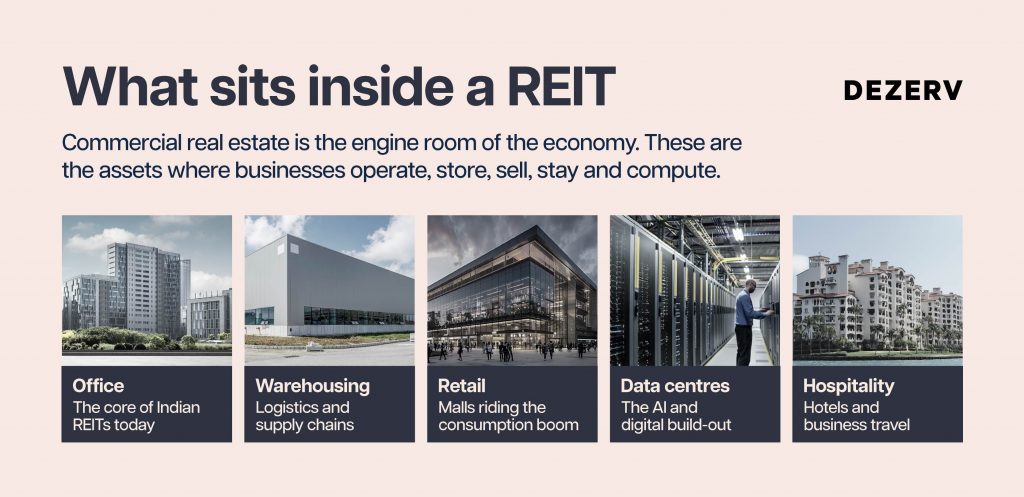
2. Mortgage REITs, or mREITs, never own a single brick. They lend against real estate instead, buying or originating mortgages and earning their return on the interest those loans generate.
3. Hybrid REITs sit in between, holding a mix of physical properties and real estate debt, picking up income from both rent and interest.
How to invest in a REITs
There are three ways to invest in REITs in India, and the entry point is different for each.
- Buy listed REITs: Purchase units through a Demat account, just like stocks. You can buy as little as one unit, with prices typically ranging from ₹100-500.
- IPOs: When a new REIT lists, the minimum application amount is usually ₹10,000-15,000.
- Mutual funds: Some mutual funds hold REITs in their portfolios, with SIPs starting from ₹500.
- SM REITs: Introduced by SEBI in 2024, these invest in smaller commercial properties (₹50–500 crore) and require a minimum investment of ₹10 lakh.
India’s REIT journey: Embassy, the tower that started it all
Seven years ago, there was one REIT on an Indian exchange. Today, five of them trade every single day, holding office towers and shopping malls worth lakhs of crores between them. To understand how it got here, it helps to meet the buildings, and the names behind them.
Every market needs a first mover to prove the whole idea actually works, and in India that mover was a company called Embassy. In 2019, Embassy Office Parks became India’s first listed REIT, walking in with 33.3 million square feet of office space and instantly becoming Asia’s largest office REIT by area. Once Embassy proved the model worked, others followed quickly.
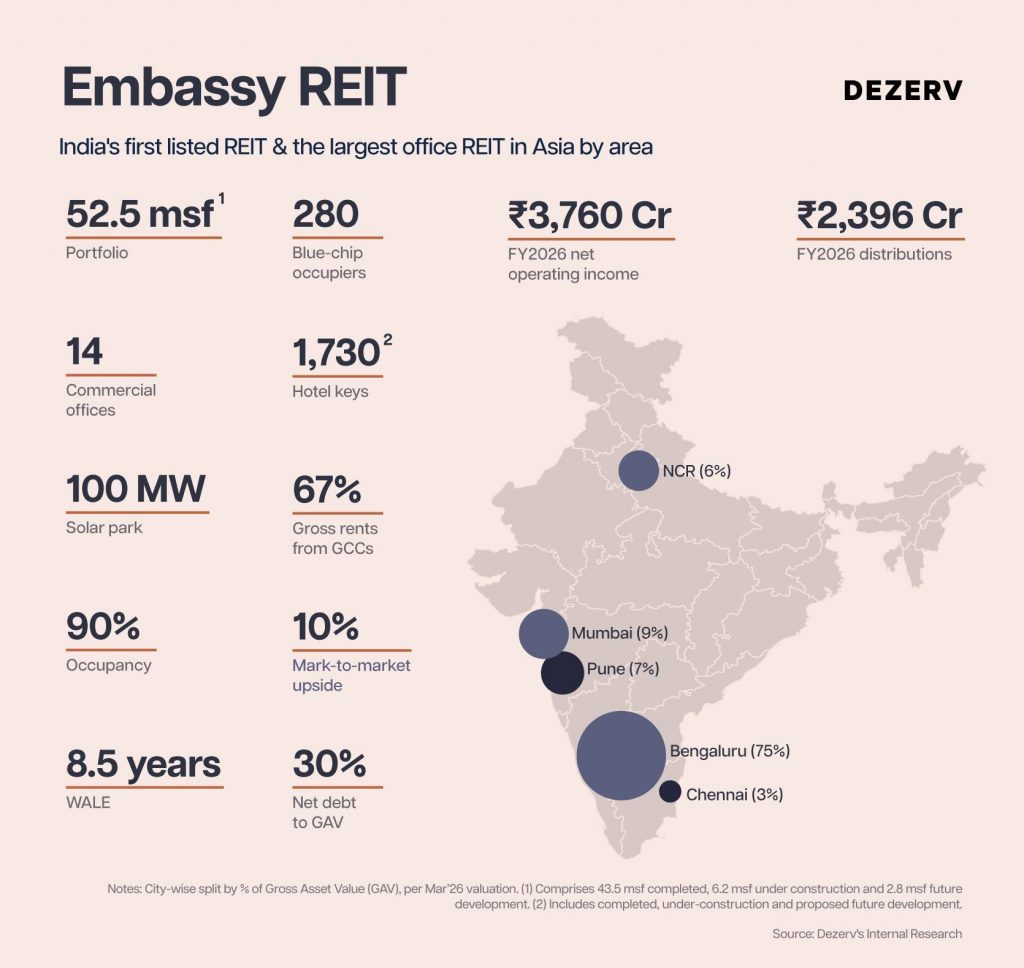
Mindspace Business Parks listed the next year, in August 2020. Brookfield India came in February 2021, the same year SEBI reduced the minimum application size at IPO from ₹50,000 to ₹10,000-15,000 and cut the minimum trading lot from 200 units to one, making REITs accessible to a far wider set of investors.
Nexus Select Trust arrived in 2023, India’s first retail REIT, built around malls rather than offices. And in 2025, Knowledge Realty Trust, backed by Sattva and Blackstone, oversubscribed 13 times on its final bidding day, the most subscribed REIT IPO India has seen.
Around the same time, regulators reclassified REITs as equity instruments altogether, putting India’s REITs on the same footing as how the rest of the world already treats this asset class.
What India’s REIT market actually looks like today?
Today, those five listings have grown into a market worth over ₹1.8 lakh crore, with market capitalisation nearly tripling in the last two years. The number of unitholders has also quadrupled to more than 300,000.
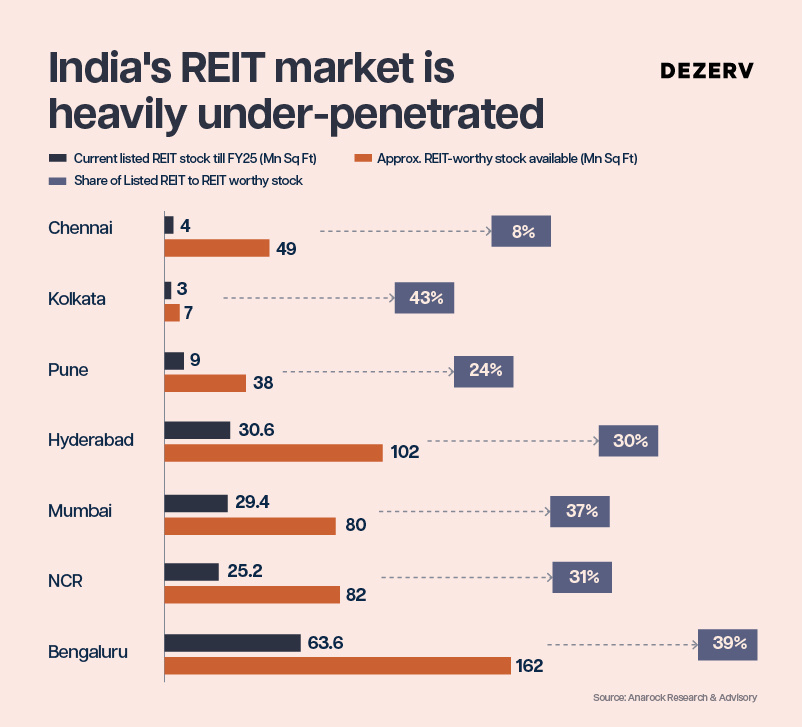
And almost all of it is in one city. Bengaluru dominates India’s REIT market with 69.1 million sq. ft. of Grade A office space, followed by Hyderabad and Mumbai.
Each REIT has followed a different strategy. Embassy focused on Bengaluru (60% portfolio), where strong demand comes from the city’s large technology sector. Mindspace built its portfolio across Hyderabad and Mumbai to benefit from growth and strong rental demand. Brookfield focused on Delhi NCR, with tenants spread across industries such as consulting, financial services, and multinational companies.
Looking across the country, the growth has been remarkable. REIT penetration across India’s top seven cities has also grown rapidly, rising from 11.2% of Grade A office stock in 2021 to 19.1% today.
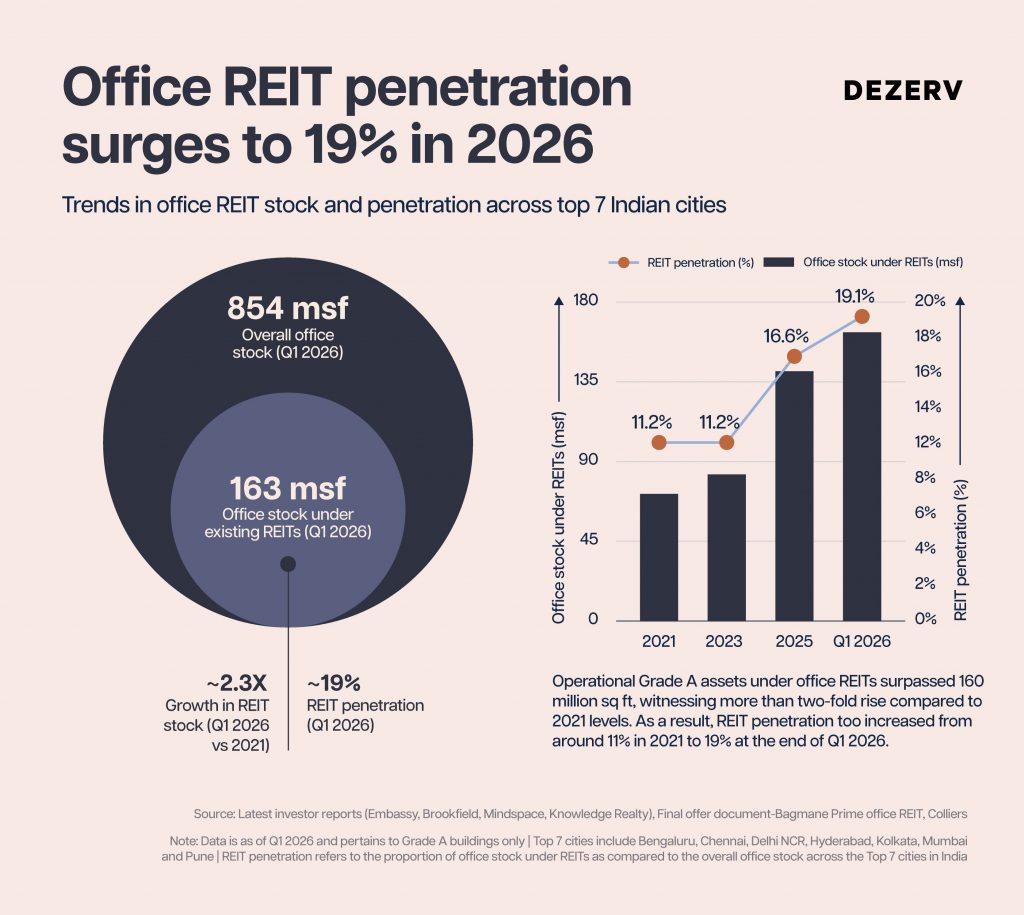
But what’s more interesting than what REITs already own is what they haven’t touched yet. Bengaluru has 162 million sq. ft. of REIT-quality office space, but listed REITs own only 39% of it. Across India’s top seven cities, around 370 million sq. ft. of institutional-grade office space still sits outside listed REITs, more than twice what they currently own.
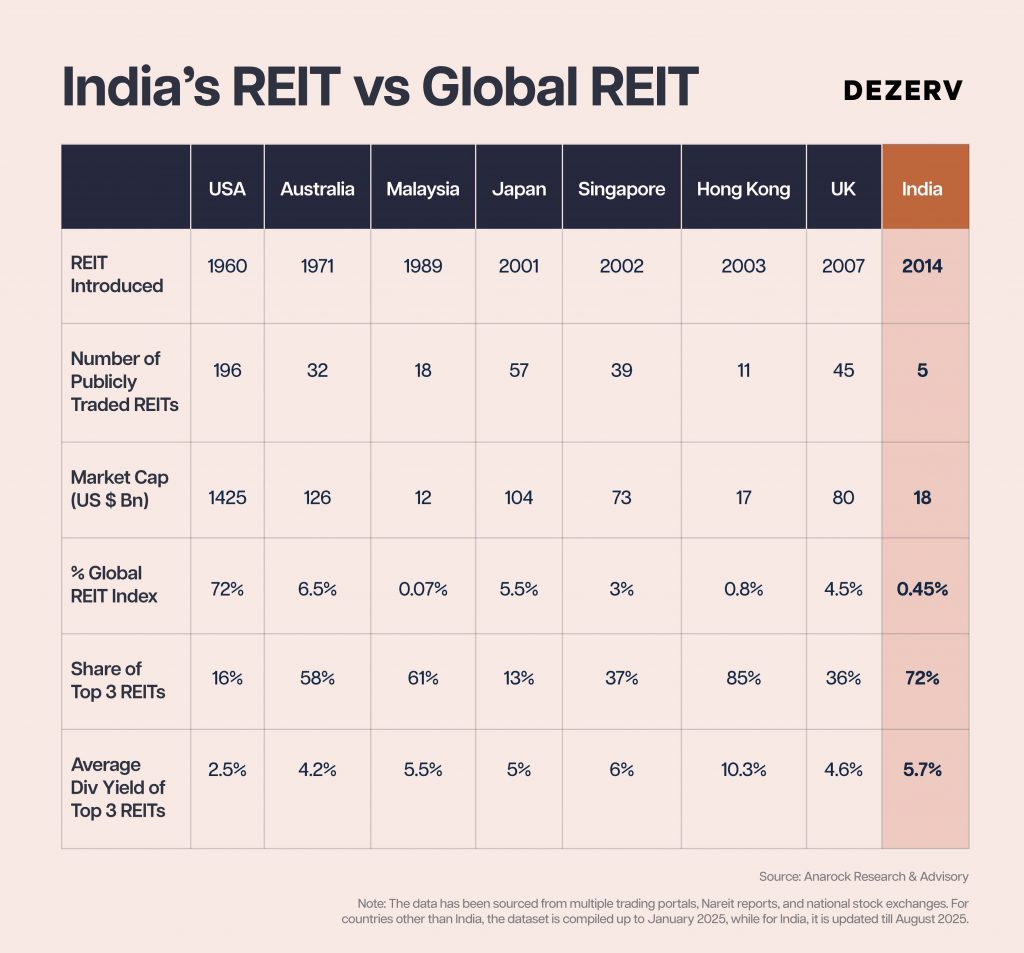
That shows how early India’s REIT market still is. India’s five REITs account for just 0.45% of the global REIT market, compared with 72% for the US and 3% for Singapore, despite it being a city-state.
The market could expand further in 2026. REITs have been reclassified as equity instruments for mutual funds and broader index inclusion is expected, bringing in passive investment for the first time. The RBI has also proposed allowing banks to lend directly to REITs, which could lower borrowing costs and make future acquisitions cheaper to finance.
Investment is already picking up. Indian real estate attracted $5.1 billion in Q1 2026, up 72% year-on-year. REITs currently account for 20% of India’s institutional real estate, compared with 96% in the US, 55% in Singapore, and 51% in Japan. By 2030, India’s share could rise to 25-30%, leaving plenty of room for further growth.
The Tailwinds: Why India’s commercial real estate keeps getting stronger
Commercial real estate doesn’t grow just because someone builds a new office tower. It grows as cities expand, businesses hire, and infrastructure improves. India’s real estate market is projected to reach USD 5.8 trillion by 2047. Here are some key trends driving that growth.
- Urbanisation: India’s urban population is projected to hit ~590 million (39% of the population) by 2036, creating sustained demand for commercial real estate.
- A rising services economy: As services keep deepening, the demand for more office space, and better quality space, keeps rising with it.
- New roads opening new ground: Metros, highways, and airports being built right now are creating business corridors that didn’t exist a decade ago.
- The multinationals building offices in India: Global Capability Centres (GCCs) are offices that global companies set up in India for work like engineering, research, finance, analytics, and product development. Over 500 new GCCs are expected by 2030. Companies are drawn by India’s large talent pool, lower costs, and affordable office space. GCCs now account for 40-60% of leasing across REIT portfolios, making them one of the biggest drivers of demand for REIT-owned offices.
- The upside inside old buildings: Bengaluru has nearly 100 million sqft of aging Grade A office space where renovations could increase rents by 16-20%. In Delhi NCR, the uplift could be as high as 30%. With the capital to fund these upgrades, REITs are well placed to capture that upside.
Where REITs fit in your portfolio
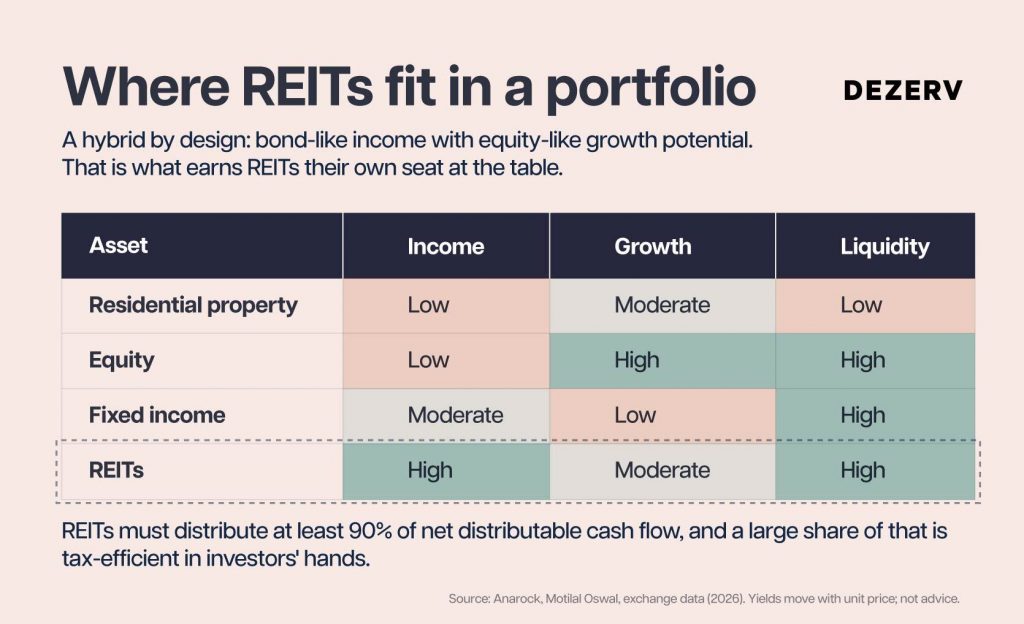
A REIT makes you money in two ways. First, through regular distributions. By law, REITs must distribute at least 90% of their cash flows, giving investors annual yields of around 6%-7.5% in India, compared with 2.5%-3.5% in the US and 5%-6% in Singapore. Much of this income is also tax-efficient.
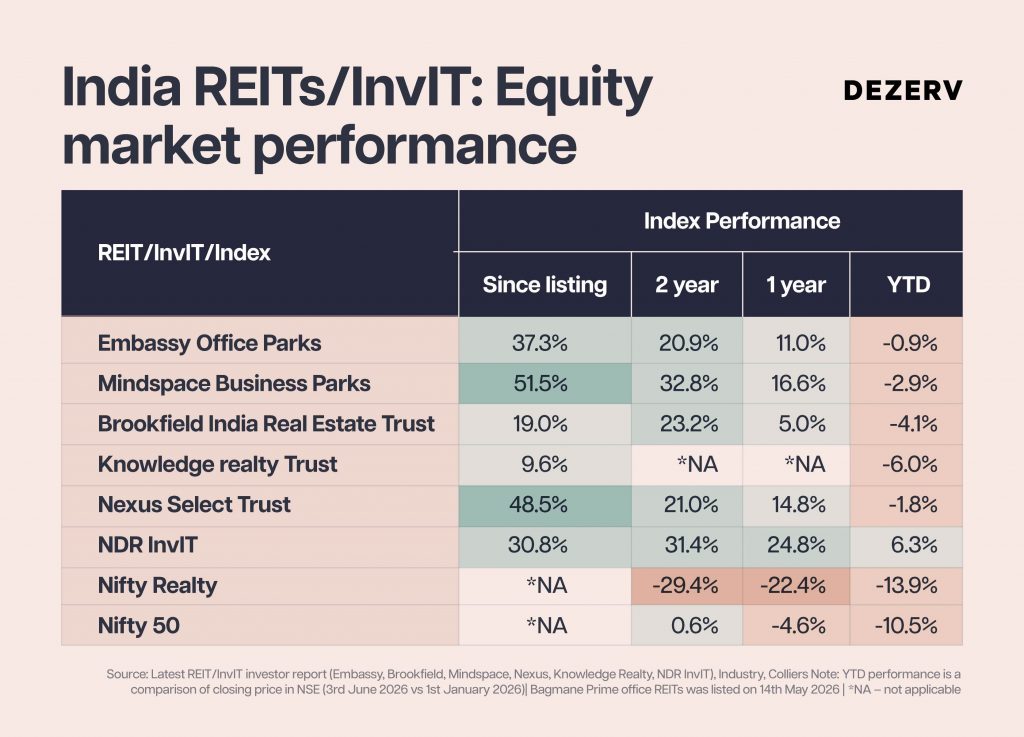
The second source of return is capital appreciation. As the value of the underlying properties grows, so can the REIT’s unit price. Since listing, Mindspace has gained 51.5%, Nexus 48.5%, and Embassy 37.3%, in addition to the distributions investors have received.
Returns matter, but so does how an investment behaves when markets fall. Through 2026, the Nifty 50 is down 10.5% year to date and Nifty Realty is down 13.9%. Listed REITs over the same stretch slipped only 1% to 6%, reflecting the stability of rental income.
This is what makes REITs different. They combine bond-like income, equity-like growth potential, and the liquidity of a listed security.
How to evaluate REITs
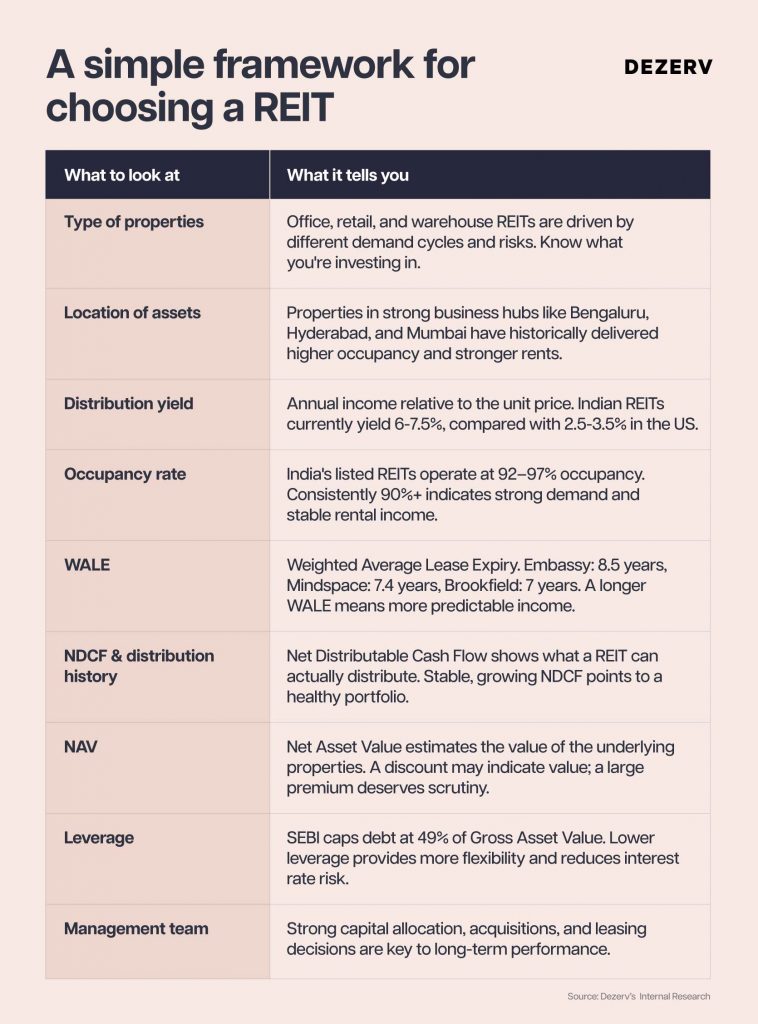
Choosing the right REIT goes beyond looking at returns. Here’s a simple framework to help you evaluate one:
The risks worth knowing
The biggest risk is concentration. Three REITs, Embassy, Mindspace, and Brookfield, make up most of the market, so the asset class depends heavily on a handful of players. The underlying asset base is also narrow, heavily weighted toward office space and technology tenants, making it vulnerable to a slowdown in either. Interest rates matter too, as higher borrowing costs can weigh on REIT valuations. And while leasing demand is strong, much of it is still driven by GCCs.
If this edition sparked your interest in REITs, you might enjoy this conversation with Karan Virwani, CEO of WeWork India and part of the Embassy Group, on the Create Wealth Podcast.
Watch the full episode here.
See you next week.
Disclaimer – Investment in the securities market is subject to market risks, read all the related documents carefully before investing. The information provided herein is intended solely for educational purposes and should not be construed as solicitation, advertising, or providing any financial or investment advice or an offer to buy or sell any financial instruments. Any statements about future developments are speculative and should not be taken as guarantees. Past Performance is not indicative of future results. Readers are advised to consult with their financial advisor before making investment decisions based on the information provided herein.
In the preparation of this document, Dezerv has used information developed in-house and publicly available information and other sources believed to be reliable. The information is not a complete disclosure of every material fact and terms and conditions. While reasonable care has been made to present reliable data in this article, Dezerv does not guarantee the accuracy or completeness of the data. The information / data herein alone is not sufficient and shouldn’t be used for the development or implementation of an investment strategy.
Any references to names of fund houses, investment securities, or asset classes are for illustrative purposes only. Dezerv, along with its directors, employees, or partners or any of its affiliates, shall not be held liable for any loss, damage, or liability arising from the use of this document. Additionally, all trademarks, logos, and brand names mentioned are the property of their respective owners and are used for identification purposes only. The use of these names, trademarks, and logos does not imply endorsement or recommendation.