


Earlier this year, some of the world’s biggest asset managers, BlackRock, Blackstone, and Morgan Stanley, started receiving an unusual volume of calls from investors asking for their money back. Some funds limited withdrawals while others delayed them. Blue Owl, one of America’s biggest private credit managers, shut its withdrawal gates permanently and even sold $1.4 billion of loans just to raise enough cash to pay whoever it could.
The asset class at the centre of this was Private Credit, a market that barely existed 20 years ago and is now worth more than $2 trillion. And here is how it got there.
After the 2008 financial crisis, banks became much stricter about lending. Mid-sized companies still needed capital, so private credit funds stepped in. They raised money from large institutional investors, pension funds, insurance companies, endowments, who were willing to lock their capital away for several years in exchange for returns of 8 to 12% annually, well above what bonds or deposits could offer at the time.
For a long time, it worked well. But then two things changed.
First, interest rates rose sharply after 2022. Since most private credit loans have floating rates, borrowing costs went up quickly, putting pressure on companies that had taken those loans.
Second, many US private credit funds had large exposure to mid-sized software companies. AI disrupted parts of that sector faster than expected, making some business models look weaker overnight.
When both problems hit at once, investors rushed to withdraw their money. But many funds had promised quarterly withdrawals even though their loans were locked in for 4–5 years. So when too many investors pulled out at once, a bank run on the fund, the funds ran out of cash and froze withdrawals.
That mismatch triggered the freeze. But most coverage missed that private credit isn’t one market, it’s six different strategies with very different risks. The affected funds mainly lent to software startups, loss-making firms, and stressed businesses dependent on uncertain future outcomes.
But there is one sub category of private credit that works very differently. It lends only to stable, operating businesses with real revenues, real assets, and a clear ability to repay. It’s called Performing Credit. That’s what this edition covers.
In this edition, we’ll cover:
- What Private Credit is and how the three-player system works
- Where it sits in the investment universe relative to every other asset class
- The six strategies within Private Credit, and where Performing Credit fits in
- How Performing Credit compares across the risk-return curve
- How fast is India’s Private Credit market growing, and what’s being funded
- Who is this for and how to access this asset class as an investor
- Top funds in India and key things to consider before investing
How Private Credit actually works
Picture a mid-size Indian pharmaceutical company that needs ₹200 crore to acquire a competitor. The deal needs to close in eight weeks. Their bank says the process takes four months and the structure doesn’t fit standard lending templates. The public bond market requires a credit rating and a roadshow that would take just as long. Neither option works.
A private fund closes the deal in three weeks. The loan is negotiated directly between the borrower and the fund, terms, repayment schedule, security package, everything built around the company’s actual cash flows rather than a bank’s checklist. The borrower gets the capital and the fund earns 14 to 16% annually, secured against hard assets and promoter pledges.
The diagram below shows how the money actually moves.
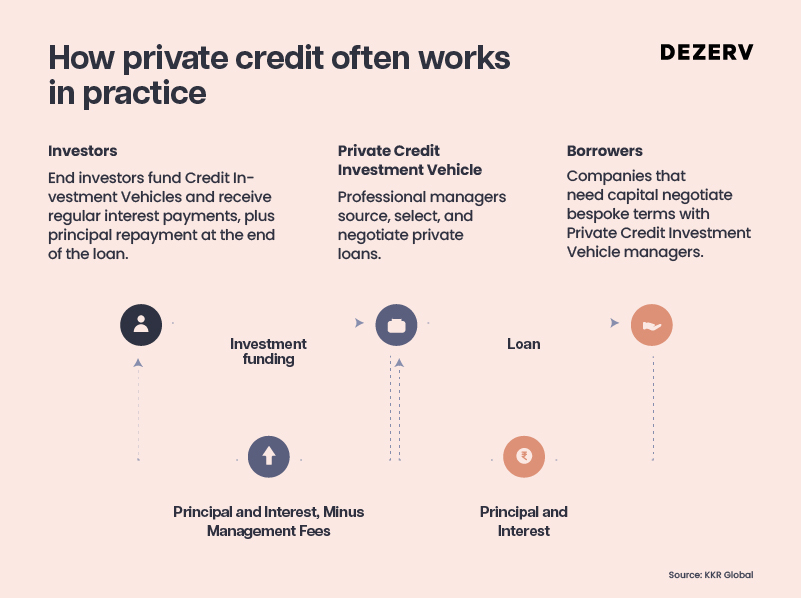
Three parties make every deal work.
- The borrower is usually a mid-sized company with steady cash flows that needs money for an acquisition, expansion, refinancing, or other business needs that banks either can’t support or won’t move quickly enough on.
- The fund pools capital from investors, underwrites the loan directly, negotiates the terms, and holds it to maturity.
- The investor is whose capital is being deployed, historically this was institutions like pension funds, insurance companies, endowments. In India today, it increasingly includes HNIs and family offices, with a minimum ticket of ₹1 crore.
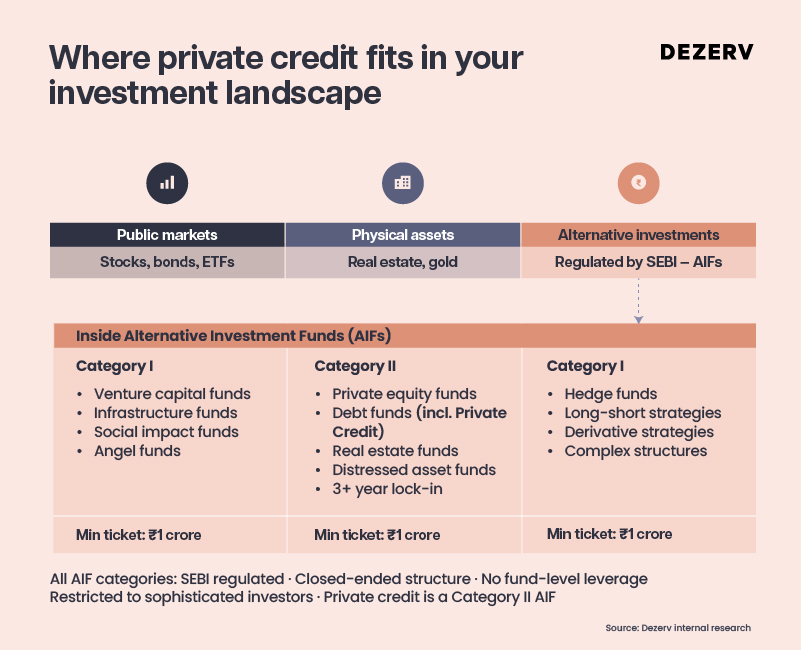
These investments happen through a SEBI-regulated structure called an Alternative Investment Fund, or AIF. SEBI created the AIF category to bring some order to investments that sit outside mutual funds and direct equity. They come in three types. Category I backs startups, infrastructure, and social ventures. Category III uses complex strategies involving leverage and derivatives. Category II is where private credit funds live. All these categories are closed-ended and accessible only to investors who meet SEBI’s criteria.
What are the different types of Private Credit and that difference matters
Private credit is a broad term that covers very different kinds of lending. Before understanding where Performing Credit fits, it helps to see the full picture of what private credit actually covers.
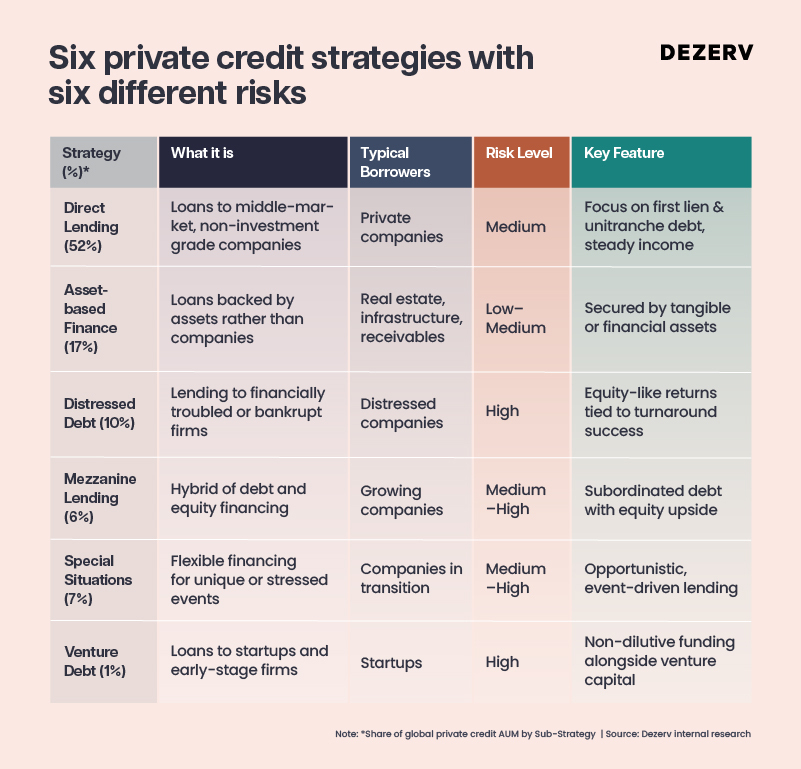
Direct lending, loans to mid-market companies with proven cash flows, dominates globally at 52% of AUM and is the foundation of India’s private credit market.
Asset-based finance on the other hand lends against physical collateral rather than the company itself, offering lower yields but hard security.
Then there are strategies like venture debt, which lends to early-stage startups with little or no cash flow, and distressed debt, which lends to companies already under financial stress. These can generate higher returns, but they also come with much higher risk and require a very different kind of expertise to manage well.
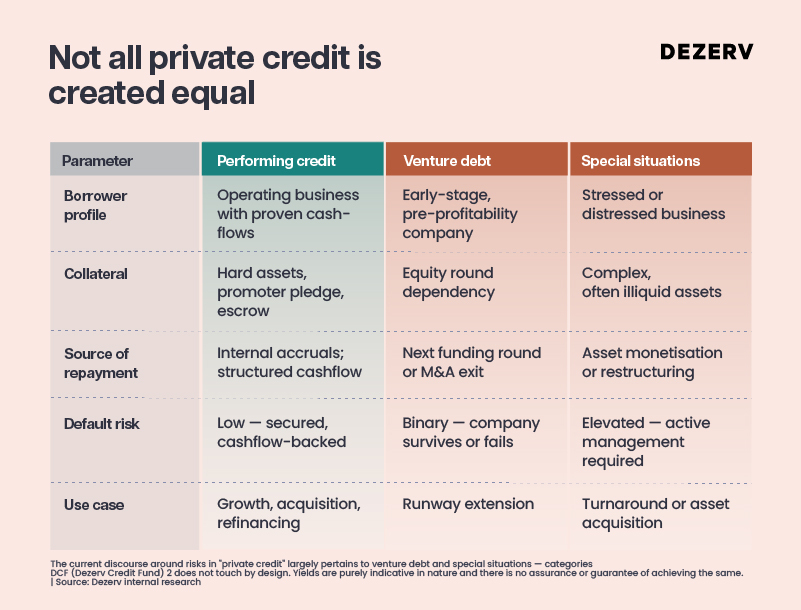
That is where Performing Credit stands apart, it focuses on lending to businesses that are still healthy, generating cash flows, and making regular repayments.
Many people may assume Performing Credit is just another name for Private Credit. But Performing Credit is a specific sub-category that lends exclusively to financially stable, operating businesses with real cashflows, hard collateral, and structured repayment. The borrower is a company that is doing well and needs capital to grow, not a startup burning cash, and not a distressed company hoping to turn around.
Most of the stress making headlines in the US right now is concentrated in venture debt and special situations, the higher-risk end of private credit. Performing credit sits at the other end of the spectrum entirely.
Where performing credit sits in the risk-return landscape
Performing credit doesn’t force you to choose between safety and returns. Instead, it sits in a unique space outside traditional public market investments, offering a balance of risk and reward.
When building a fixed income portfolio in India today, the trade-off is mainly between risk and return. Bank and corporate FDs typically offer around 7–8% with low risk. Debt mutual funds are in a similar range. A-to-AA rated bonds can generate 9–12% returns with moderate risk. At the higher end, venture debt and distressed credit strategies may offer 16–22% yields, but the risk involved is significantly higher.
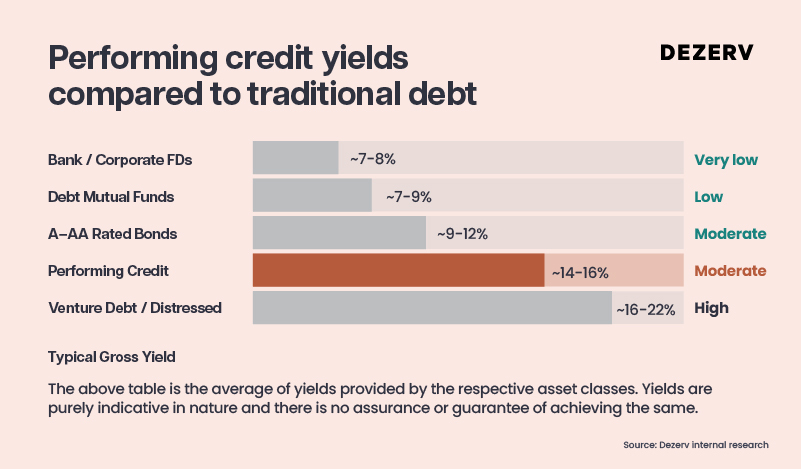
Performing credit sits between those two poles, aiming to deliver roughly 14-16% gross yields at moderate risk levels, similar to A or AA-rated bonds, but with relatively higher returns.
That reason being that these funds negotiate directly with borrowers, moving faster than banks and with more flexibility than public bond markets. That speed and customisation commands a premium. And since these loans are usually held until maturity instead of being traded daily in the market, returns are less affected by short-term volatility.
Why India’s Private Credit market exists, and why it’s growing so fast
Many investors worry that the problems seen in global private credit markets could eventually spread to India. But India’s market has been built very differently.
In India, performing credit is mainly offered through SEBI-regulated Category II AIFs. These are closed-ended funds, which means investors cannot redeem or withdraw money midway. That structure helps avoid the liquidity problems that created stress in parts of the US private credit market. Regulations around leverage are also stricter, and better-quality funds usually have stronger collateral and tighter lending terms.
What’s worth understanding, though, is that locked-up does not mean frozen. Capital is drawn in tranches over roughly the first year, quarterly interest distributions begin flowing from Year 1, and principal starts returning as loans mature through Years 2 to 4. The 6-year fund life is the outer envelope, not the average experience so the effective duration on your capital is closer to 3 to 3.5 years, making this a medium-term commitment rather than the long lock-in.
But the bigger story is growth.
India’s private credit market is still small relative to the economy. Private credit is around 0.6% of GDP in India, compared to about 3.8% in the US, showing how early the market still is. As banks tighten lending and companies look for faster, more flexible funding, private credit is becoming a bigger part of financing in India.
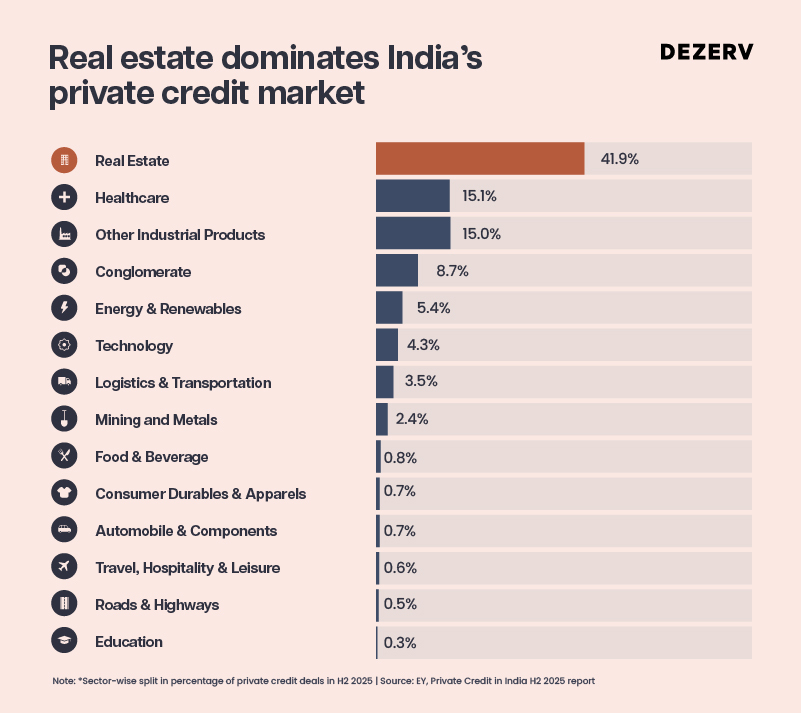
In 2025, India saw $12.4 billion in private credit deals, up 35% from 2024. The market has grown more than 10x from around $600 million annually in 2012. Real estate makes up about 42% of deal activity, while healthcare and industrial products account for roughly 15% each.
Earlier, private credit in India was dominated by global firms like Blackstone, Ares Management, Farallon Capital, and Värde Partners. But that is changing. Domestic funds now make up 64% of deal value and 69% of deal volume, showing that Indian managers have built strong underwriting capabilities and local expertise.
A major reason India’s performing credit market could grow was the introduction of the Insolvency and Bankruptcy Code (IBC) in 2016. Before the IBC, recovery cases could drag on for years if a borrower defaulted. The IBC created a faster, time-bound recovery process and gave lenders stronger legal protection. Since then, creditors have recovered over $44 billion, and resolution rates have improved sharply.
More than anything else, the IBC gave lenders confidence. It made lending beyond just the safest companies feel like a viable business, not a game of chance.
Who should consider this asset class?
Performing Credit tends to work best for investors who already have their core portfolio in place, equities, debt, real estate, and are looking for a source of income that is less tied to daily market movements.
They understand that locking money in for 3 to 5 years is part of the trade-off for earning higher yields than bonds or fixed deposits. They are not chasing maximum returns. They want steady income, predictable cash flows, and exposure to India’s mid-market corporate credit space, an area most portfolios usually miss.
In terms of risk, performing credit sits somewhere in the middle. You are lending money, not buying equity. Your returns depend on whether the borrower can generate enough cash flow to repay the loan, not on stock prices rising. That is why the quality of the borrower, the collateral, and the fund manager’s discipline are so important.
But it is not suitable for everyone. If you may need your money back in 2–3 years, if your portfolio is still not diversified, or if you are only attracted by the high yield without understanding the lock-in and illiquidity, this is probably not the right fit.
Here are two ways to access it
- There are two routes into performing credit: Investing directly into individual credit deals alongside institutional lenders.The advantage is transparency, you know where your money is going, can negotiate terms directly, and avoid fund fees. But the downside is concentration risk. A direct portfolio may have only 8–12 loans, so even one bad loan can hurt returns. Evaluating these deals also requires deep financial, legal, and collateral analysis, which usually needs institutional expertise.
- Performing credit fund, a SEBI-regulated Category II AIF where a professional manager handles the sourcing, underwriting, portfolio management, and ongoing monitoring. You get diversification across 15 to 25 deals, professional oversight, and a structured legal framework. The trade-off is fees, access quality, and the challenge of choosing the right fund, which is harder than it looks.
The top funds, and why getting into the right one isn’t easy
The table below shows India’s top 24 private credit lenders by deployment volume in H1 2025.
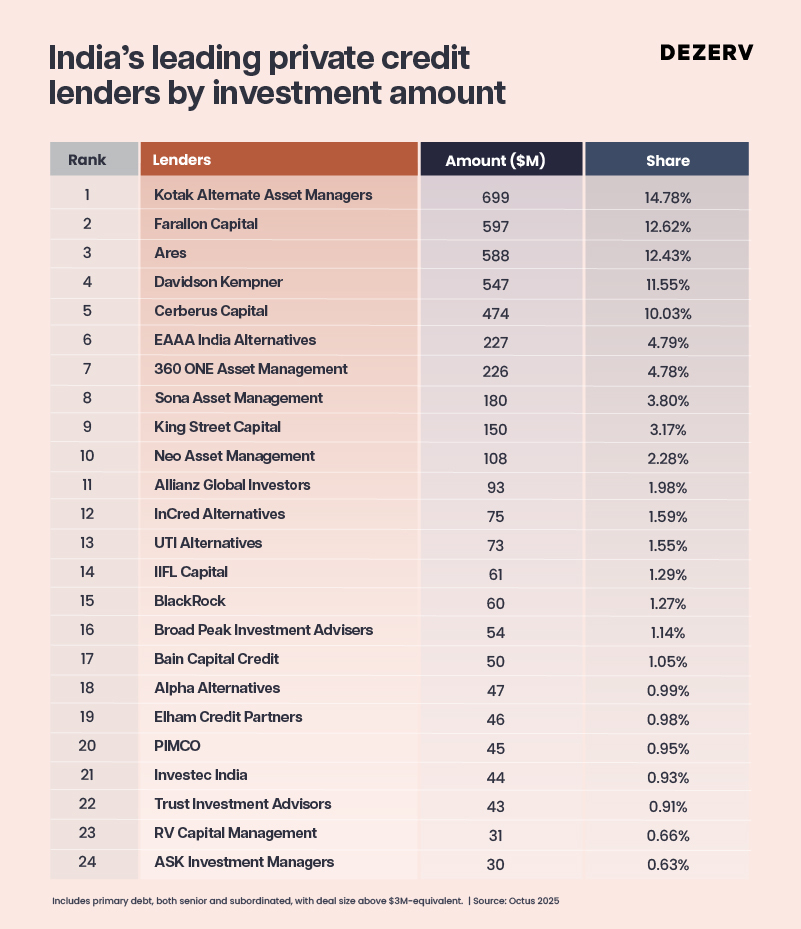
If you look at the large private credit funds like Farallon Capital, Ares Management, BlackRock, PIMCO, and Bain Capital, they mainly raise money from institutions, making access difficult for most individual investors.
Even in India, funds like Kotak, 360 ONE, Neo Asset Management, and InCred often offer better terms to larger investors. Smaller investors may face higher fees and less visibility into underlying deals. And while many funds look similar on paper, understanding borrower quality, collateral, and repayment history requires deep diligence.
So before committing to any fund, there are two sets of questions worth going through, one for yourself, one for the relationship manager/wealth manager.
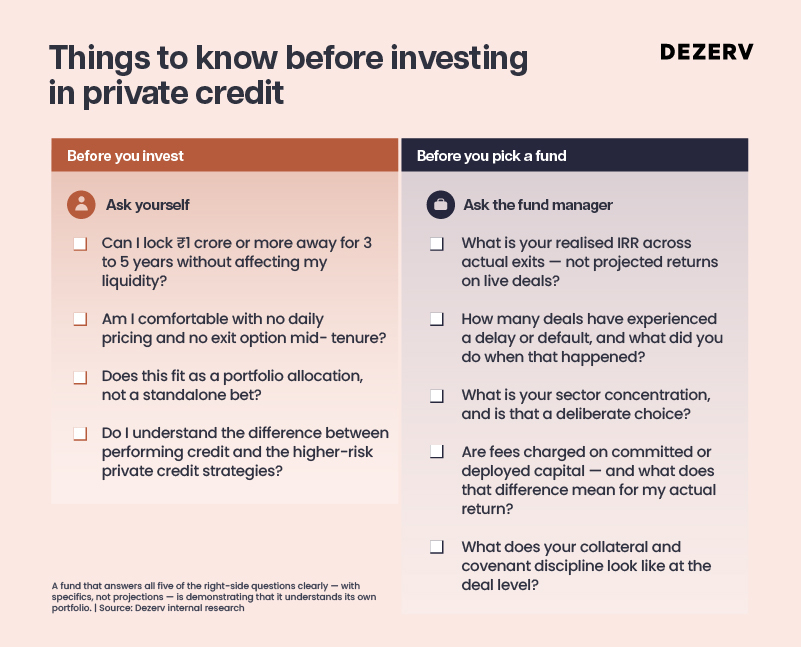
At Dezerv, Performing Credit is typically considered for clients with portfolios above ₹5 crore. Below that, the allocation often becomes impractical.*
In conclusion
India’s performing credit market is growing and the long-term opportunity is significant. But accessing it properly requires more work than simply investing in a mutual fund. You need strong deal sourcing, disciplined underwriting, good collateral structures, reasonable fees, and the patience to stay invested through a 3-4 year fund cycle.
The investors who do this well are usually the ones who treat performing credit as a thoughtful portfolio allocation, not just a way to chase higher yields. They understand where the returns come from, what risks they are taking, and what trade-offs they are making.
Disclaimer – Investment in the securities market is subject to market risks, read all the related documents carefully before investing. The information provided herein is intended solely for educational purposes and should not be construed as solicitation, advertising, or providing any financial or investment advice or an offer to buy or sell any financial instruments. The past performance of the financial strategies, instruments and portfolios is not indicative of future performance. Such past performance may or may not be sustained in future. Any statements about future developments are speculative and should not be taken as guarantees. Readers are advised to consult with their financial advisor before making investment decisions based on the information provided herein.
In the preparation of this document, Dezerv has used information developed in-house and publicly available information and other sources believed to be reliable. The information is not a complete disclosure of every material fact and terms and conditions. While reasonable care has been made to present reliable data in this article, Dezerv does not guarantee the accuracy or completeness of the data. The information / data herein alone is not sufficient and shouldn’t be used for the development or implementation of an investment strategy.
Any references to names of fund houses, investment securities, or asset classes are for illustrative purposes only. Dezerv, along with its directors, employees, or partners or any of its affiliates, shall not be held liable for any loss, damage, or liability arising from the use of this document. Additionally, all trademarks, logos, and brand names mentioned are the property of their respective owners and are used for identification purposes only. The use of these names, trademarks, and logos does not imply endorsement or recommendation.