


Earlier this week, we hosted the Dezerv Wealth Summit in Bengaluru, in partnership with Moneycontrol. Over 350 professionals, founders, CXOs, and wealth creators filled the room on a working evening, which itself says something about how seriously this city takes the conversation around building wealth.
We had four panels covering conversations ranging from geopolitics and market cycles, to asset allocation frameworks, to the ESOP wealth phenomenon, to where income-seeking investors should actually be looking in 2026.
The panelists were some of the sharpest minds in Indian finance:
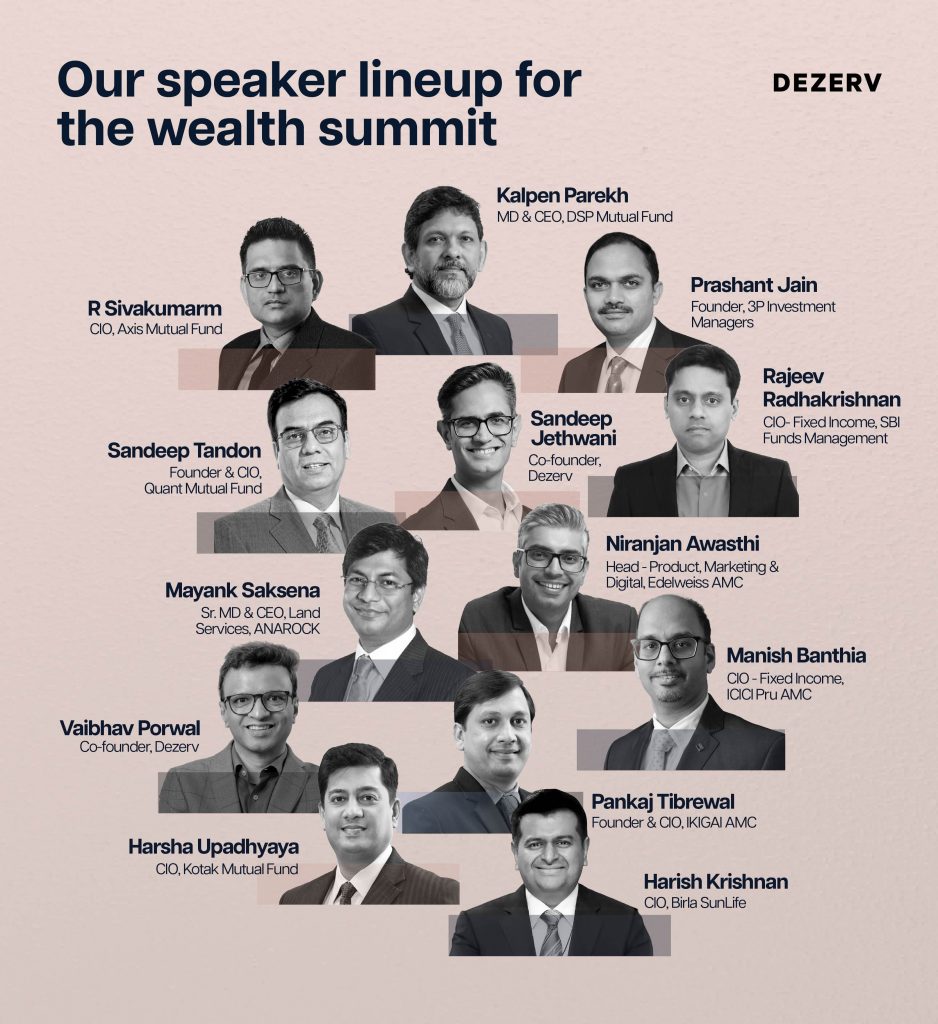
In today’s edition, I’ve distilled the most important insights from each panel, the kind of thinking that doesn’t make it into a news headline or a 30-second market update.
In this edition, we’ll cover:
- Why the biggest investing risk in India is staying out
- The one behavioral mistake that costs you more than bad stock picks
- What the ESOP conversation most people are not having
- Where the equity opportunity is actually hiding right now
- A simple framework for income investing in 2026
The market is messier than the headlines suggest and that’s the opportunity
Prashant Jain opened the evening with something every nervous investor in the room needed to hear right now, given how uncertain and unsettling the last 18 months have felt: pessimists sound smarter, but optimists make money.
His view on the current environment was nuanced in a way that I found genuinely reassuring. Yes, oil is elevated, FIIs have been selling, and there is real pressure on the balance of payments. But when you actually break down why FIIs have been selling over the last two years, it tells a very different story from the panic the headlines suggest. First India got too expensive relative to other emerging markets. Then money rotated into AI-driven markets like Taiwan and Korea. And most recently, the selling has been currency-related hedging driven by geopolitical uncertainty. Three distinct, explainable chapters, none of which touch the underlying trajectory of India’s corporate earnings or economic growth.
On where returns go from here, he made a case that is worth paying attention to. After 18 months of correction, Nifty valuations have fallen below fair value, and India’s earnings are still compounding at 11-12% a year. If valuations recover even modestly while earnings keep growing, Nifty can compound at 14% over the next 3 years.
Another observation that stayed with me wasn’t even about markets. It was about blue-collar wages. A gym trainer or a plumber in a large Indian city today earns close to what an entry-level white-collar professional makes. Most people frame this as a problem, stagnating white-collar salaries, but he reframed it entirely. India’s consumption pool isn’t narrowing but it is broadening. More people have purchasing power today than ever before. And over any meaningful period of time, markets follow the economy.
The one thing that will cost you more than a bad fund pick
The asset allocation panel was the most practically useful conversation of the evening, and the insight I’d carry into any portfolio review was this: switching funds too often hurts long-term returns more than choosing the wrong fund.
And Kalpen Parekh put a number to it. If you invest ₹100 at 10% compounding for 20 years, your corpus at the end is ₹555. Make just one fund switch at the 10-year mark, even if the new fund performs identically, and that corpus becomes ₹330. The tax drag and the timing cost compound silently, invisibly, devastatingly.
His framework for navigating uncertainty was refreshingly honest: we are in the middle. Not very cheap, not very expensive. Nobody knows which direction markets move from here over the next six months.
The framework he shared was simple enough to actually use:
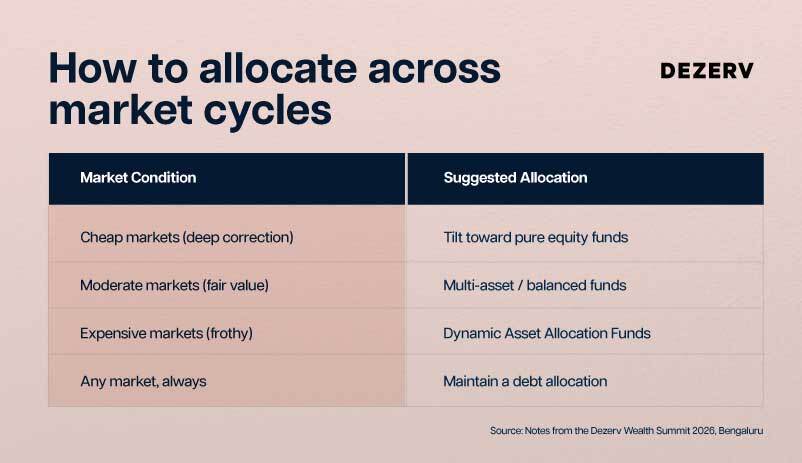
On the last point, and the one that matters most, the debt allocation. Kalpen made a point that may sound counterintuitive at first: if you want to earn equity returns over a long period, you need debt in your portfolio. Not because debt outperforms equity, but because most people simply cannot stomach volatility. Debt is what keeps you invested through a correction instead of panic-selling at the bottom. The behavioral anchor is worth more than any marginal return difference between funds.
Rajeev Radhakrishnan added the macro context: India’s fiscal deficit consolidated from 13% of GDP during COVID to roughly 7.5% today, while RBI simultaneously raised rates by 400 basis points. Two major brakes on the economy applied at the same time. Both are now being released, which means the cyclical setup for equity earnings is improving underneath all the noise about geopolitics.
The ESOP conversation most Bengaluru professionals are not having
I spoke at the third panel, on ESOPs, a topic close to home for this audience. And the number I opened surprised people: in a survey we ran across roughly 800 professionals, over 80% did not fully understand the basic mechanics of their own ESOP grant.
Vesting schedules, strike prices, exercise windows, perquisite tax at exercise, most people holding meaningful ESOP wealth could not clearly explain how their own grant worked. And yet, for a large number of people in that room, ESOPs represent the most significant wealth creation event of their professional lives.
Here’s the framing I find most useful for thinking about concentration risk. If someone handed you ₹100 today and asked you to invest it, would you put ₹80 of it into a single stock? Almost no one says yes to that question. But that is exactly the situation most ESOP holders are in after a buyback or an IPO.
The right response is a staggered exit plan, not trying to time the stock, but committing to a mechanical reduction in concentration over a defined period. If 80% of your net worth sits in one company’s stock, plan to bring it to 20% over two years, reducing in equal parts each quarter. It removes the timing pressure and the emotional weight of the decision.
A few other things I see people get wrong:
The tax hesitation trap: People hold concentrated positions too long because they don’t want to pay capital gains tax. But tax is on profit. Paying tax means you made money. The risk of not paying tax is losing the wealth entirely, as employees of some very well-known companies discovered the hard way.
The real estate overextension: The most common post-IPO mistake is going all-in on real estate immediately. Buying the home you want to live in is a perfectly fine decision. But we see people use an ESOP windfall as the occasion to over-leverage into investment property, before thinking through their actual financial plan.
And the number that most people miss: On the day you exercise ESOPs, the difference between strike price and market price is taxed as perquisite, at your marginal income tax rate, which in a windfall year is often 42%. The actual wealth in your hand is meaningfully less than the headline number on the grant letter.
Sectors worth watching right now
The equities panel was less about macro trends and more about where fund managers are actually investing today. And the takeaway was interesting: many sectors that have done poorly for years are starting to look attractive again.
A big reason is that midcap valuations may not be as expensive as they seem. New-age companies now make up a large part of the index, and many of them are either loss-making or trading at very high valuations. That pushes the overall index valuation higher and hides the cheaper opportunities underneath.
Fund managers highlighted eight sectors where valuations have fallen because of weak cycles, not because the businesses are broken: IT, banking, energy, metals, chemicals, textiles, FMCG, and cement.
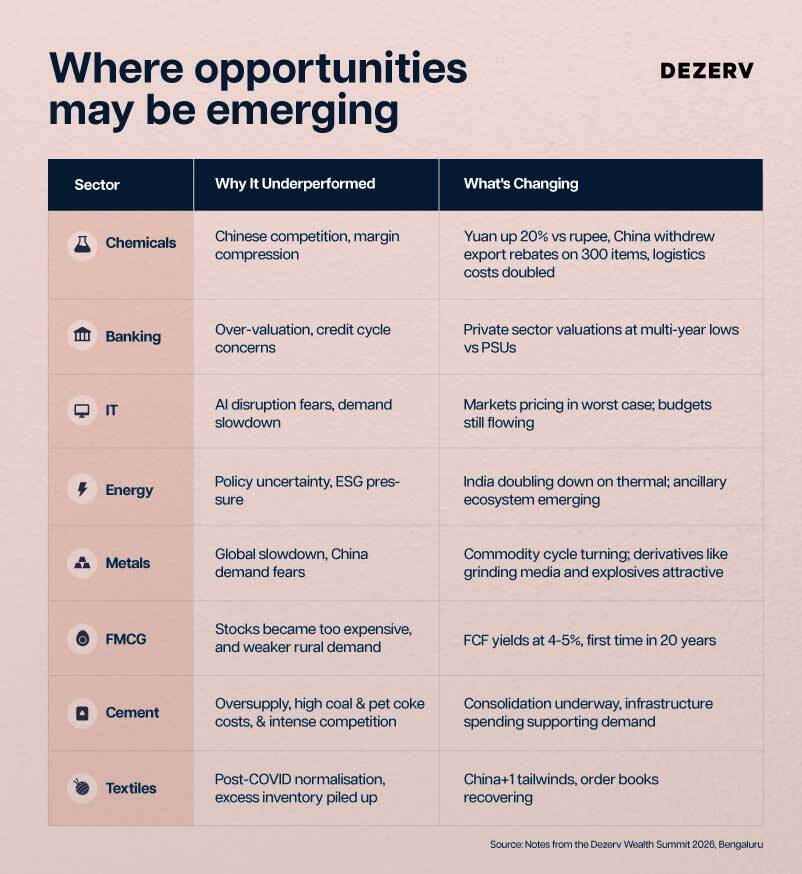
Chemicals stood out as one of the strongest opportunities. Chinese competition has pressured Indian manufacturers for years, but conditions are changing. The yuan has strengthened, logistics costs from China have risen sharply, and China has removed export rebates on many chemical products. That is improving the position of Indian companies.
Precision engineering and aerospace were also discussed as long-term opportunities because once companies get certified, revenue visibility becomes strong. Thermal power ancillaries are seeing renewed interest as India leans more on coal. And in metals, some investors prefer derivative businesses like grinding media and explosives rather than commodity producers themselves.
Consumer stocks are also looking more attractive than they have in years. Some companies now offer 4-5% free cash flow yields, something rarely seen during the previous bull market.
The broader message from the panel was simple: there is a huge gap between winners and losers in the market right now. Some stocks are up 30-40% this year, while others are down 20-30%. Global sentiment toward India is also very weak at the moment. Historically, periods of high pessimism and wide valuation gaps have been good environments for stock pickers.
Income investing in 2026: What actually works
The last panel was the one closest to where most of our clients actually live, not building wealth anymore, but managing it, protecting it. Making it work without taking on more risk than necessary.
We are in Bengaluru, so real estate came up early. And the version of that conversation is more nuanced than the usual “buy property, it always goes up” narrative. The math on a well-researched apartment in the right micro-market actually works, 7-8% rental yield once the property is tenanted, plus 5-6% annual price appreciation gets you to 12-13% total return. But that math is built on one condition: you did your homework before buying, not after. In an oversupplied micro-market, at peak prices, every number in that equation changes.
What I found more interesting was the conversation around where people are chasing yield and what they are not fully understanding about the risks they are taking on. Private credit products promising 16-18% returns have seen enormous inflows. And the question worth asking is simple – if debt is supposed to be the safe part of your portfolio, what does it mean when your debt is yielding more than equity has historically? You are not getting a free lunch. You are taking on credit risk and liquidity risk at the same time, often without realising it. The right mental model for any income product is safety first, liquidity second, return third. In that order. Most people have it exactly backwards.
And the most forward-looking part of the conversation was around Specialised Investment Funds (SIF’s), a relatively new regulatory category that sits between mutual funds and PMS structures. More flexibility than a mutual fund, more transparency and accessibility than a PMS. For someone looking for tax-efficient income or a structured multi-asset allocation, this is a space worth paying attention to as it matures. New SIF and hybrid products can deliver 8–9% returns more tax efficiently than regular debt funds. If you hold certain hybrid categories for 2 years, tax falls to around 12.5%.
Before I sign off
Three hundred and fifty people showed up on a Wednesday night in Bengaluru to think carefully about how they build and protect wealth. That is not a small thing, and it is not something I take for granted.
The markets are noisy right now and the list of things to worry about is long. But what stayed consistent across every panel, every speaker, every conversation was this: structure matters more than prediction, and discipline compounds faster than intelligence. India’s long-term story, for all its near-term turbulence, remains one of the most compelling wealth-creation environments in the world. We just have to stay in the game long enough to benefit from it.
To every panelist who gave the room their most honest thinking, and to everyone who showed up and stayed for the entire evening – thank you. Conversations like this are why we built Dezerv, and nights like this remind me exactly why it matters.
Disclaimer – Investment in the securities market is subject to market risks, read all the related documents carefully before investing. The views and opinions expressed are those of the respective individual and do not reflect or represent the views and position of Dezerv Investments Pvt. Ltd. or its affiliates (collectively “Dezerv”). The information contained herein is for informational purposes only and should not be interpreted as soliciting, advertising, or providing any advice. Any statement about the future developments or returns are speculative and should not be taken as guarantees.
In the preparation of this document, Dezerv has used information developed in-house and publicly available information and other sources believed to be reliable. The information is not a complete disclosure of every material fact and terms and conditions. While reasonable care has been made to present reliable data in this article, Dezerv does not guarantee the accuracy or completeness of the data. The information / data herein alone is not sufficient and shouldn’t be used for the development or implementation of an investment strategy.All trademarks, logos and brand names are the property of their respective owners. All company and product names used herein are for identification purposes only. Use of these names, trademarks and brand logos does not imply endorsement. Neither Dezerv nor its affiliates assume any responsibility for actions taken based on the information provided herein.