The retirement plans that fail most often are the ones nobody worries about: they hold for twenty years on inputs that each looked defensible at 60, and run short when there is least room to fix them. Take ₹3 crore at 60, drawing ₹1.15 lakh a month that rises 7% a year with prices, against a portfolio earning 7% a year.
The money is gone in the twenty-third year, at 82, with nothing in the market having gone wrong (a sample scenario, not a forecast or guarantee of returns). So which plans fail this way, and why does nobody see it coming?
In short
Longevity risk is the risk that you live longer than your retirement corpus lasts, and it is the failure that arrives slowly. Four plans look sound at 60 and fail a decade or two later: the fixed-rupee, the all-floor, the single-life and the no-review plan. The defence is to stress-test to age 90 or 95 as a starting point, extending the horizon for earlier retirements, younger spouses and other household circumstances, keep part of the corpus compounding, insure the non-negotiables no pension covers with an annuity on a slice, design every income for the survivor, and build a plan that outlasts the planner.
Table of contents
The failure nobody sees at 62, because it arrives at 82
A corpus that runs out at 82 does not announce itself. In the opening scenario the pot grows to about ₹3.3 crore by 68, is down to ₹2 crore at 78 and empties in the last four years, when a draw that rises with prices takes a larger slice of a shrinking pot each year.
What is left at 82 is the house, the children, or a smaller life just as medical bills peak.
Leaning on the children is a bet on the family structure staying what it is while families nuclearise, and I would not make it. A crash, a bad first decade (sequence risk) or a high starting withdrawal rate only brings that date forward; the slow failure needs none of them.
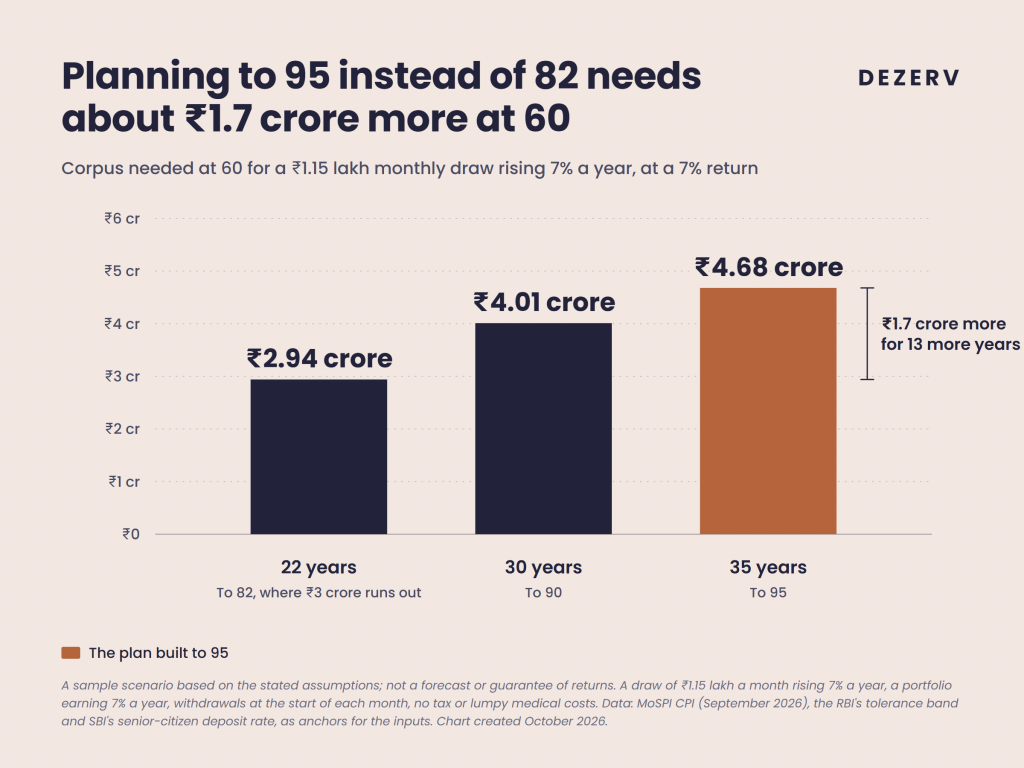
On the same inputs, thirteen more years, to 95, cost ₹1.7 crore more at the start, or more than a third less income every month for life.
| Plan built to last | Corpus needed at 60 | What ₹3 crore supports instead (starting draw) |
|---|---|---|
| 22 years, to 82 | ₹2.94 crore | ₹1.17 lakh a month |
| 30 years, to 90 | ₹4.01 crore | ₹86,000 a month |
| 35 years, to 95 | ₹4.68 crore | ₹74,000 a month |
A sample scenario on a monthly draw rising 7% a year and a portfolio earning 7% a year, withdrawals at the start of each month, no tax and no lumpy medical costs; not a forecast or guarantee of returns. The 7% rise in spending sits above the 5.54% consumer-price inflation of September 2026 (MoSPI) and the 6% top of the RBI's tolerance band (RBI); the 7% return sits next to the 7.05% SBI pays senior citizens on a five-to-ten-year deposit (SBI, rates from 15 December, 2025, reset at each renewal, so no deposit rate is fixed for thirty years). The pairing leaves a real return near zero, which is why the corpus scales almost one-for-one with the years it must cover. At 9% spending growth the same ₹3 crore runs out at about 79 (CPI inflation ran above 9% in both 2012-13 and 2013-14, RBI Handbook of Statistics, Table 236); the depletion tables run other corpus sizes, draws and inflation rates.
How long "the rest of your life" actually is
A man who reaches 60 in India is expected to live another 17.5 years, and a woman another 19.8, on the Sample Registration System, known as SRS, life tables 2020-24 (Registrar General of India, May 2026).
Those are national averages, pulled down by rural mortality; the urban tables give a man at 60 another 18.9 years and a woman 20.8.
For a couple both aged 65, those urban tables put the chance that at least one partner reaches 85 at 57%, against 32% for the man alone (a sample scenario on the SRS survivor counts, treating the two lives as independent; not a forecast).
A woman who reaches 85 in urban India is expected to live another 7.4 years (SRS). That takes her past 92.
Plan for the upside on longevity, not the average, because the average is the plan that fails.
The usual objection is "I won't live that long", and national averages seem to back it. Sometimes that is right, since the same tables expect an average man at 60 to live to about 78, but a retirement plan has to pay out in the long tail too, and the two errors are not symmetrical.
Die at 76 with money left and your family inherits it. Live to 91 on a plan built for 78 and the last thirteen years belong to someone else.
The Tier-2 version of the objection is sharper, and half correct. Life expectancy at birth ranges from 64.7 years in Chhattisgarh to 75.6 in Kerala on the same SRS tables, and a smaller city does lower the cost of a given life.
In my reading it does not shorten the horizon of an affluent household with private healthcare: where you retire changes the monthly number and leaves the years alone.
Longer lives are a global trend: the World Health Organization expects the number of people aged 80 or older to triple between 2020 and 2050, to 426 million (1 October, 2025).
"If you underestimate the capacity of your later years, then you don't invest enough in them."
— Andrew J. Scott, Professor of Economics, London Business School (London Business School Think, 30 January, 2025)
The four plans that fail slowly
A plan that fails suddenly, in a crash, gets written about. The plans below fail over a decade, and each one looks responsible on the day it is signed.
| The plan | What it looks like at 60 | How it fails | When it shows | The fix |
|---|---|---|---|---|
| The fixed-rupee plan | A level pension, annuity or deposit income; before 60, a Systematic Investment Plan (SIP) that was never stepped up | Prices rise (7% a year in the sample scenario); the income does not | Around 70, when the same rupees buy half | Keep a compounding sleeve; index what you can; step up what you contribute |
| The all-floor plan | Everything moved to deposits and small-savings schemes at 60 | The corpus cannot outpace 30 years of 7% spending growth after tax | In the second decade | A debt-tilted blend, not pure debt |
| The single-life plan | Pension and annuity on one life; assets and access in one name | Income halves or stops at the first death | The month after the funeral | Joint-life design; the survivor's income modelled on its own |
| The no-review plan | A sound allocation in 2026 that nobody rebalances after 75 | Drift, decline, and a plan that stops matching the person | Past 80, when the planner can no longer run it | A review cadence and a delegate that do not depend on the retiree |
Editorial reading; the 7% and "buy half" figures are the sample scenario above, not a forecast. The fixes are general frameworks, and none is advice for any one reader.
The fixed-rupee plan
A level income feels safe because the rupee figure never moves, and that is what goes wrong. At 7% inflation, ₹1.5 lakh a month buys ₹76,000 worth of today's life at 70, ₹39,000 at 80 and under ₹20,000 at 90 (a sample scenario, not a forecast or guarantee).
The life, meanwhile, costs ₹11.4 lakh a month by 90.
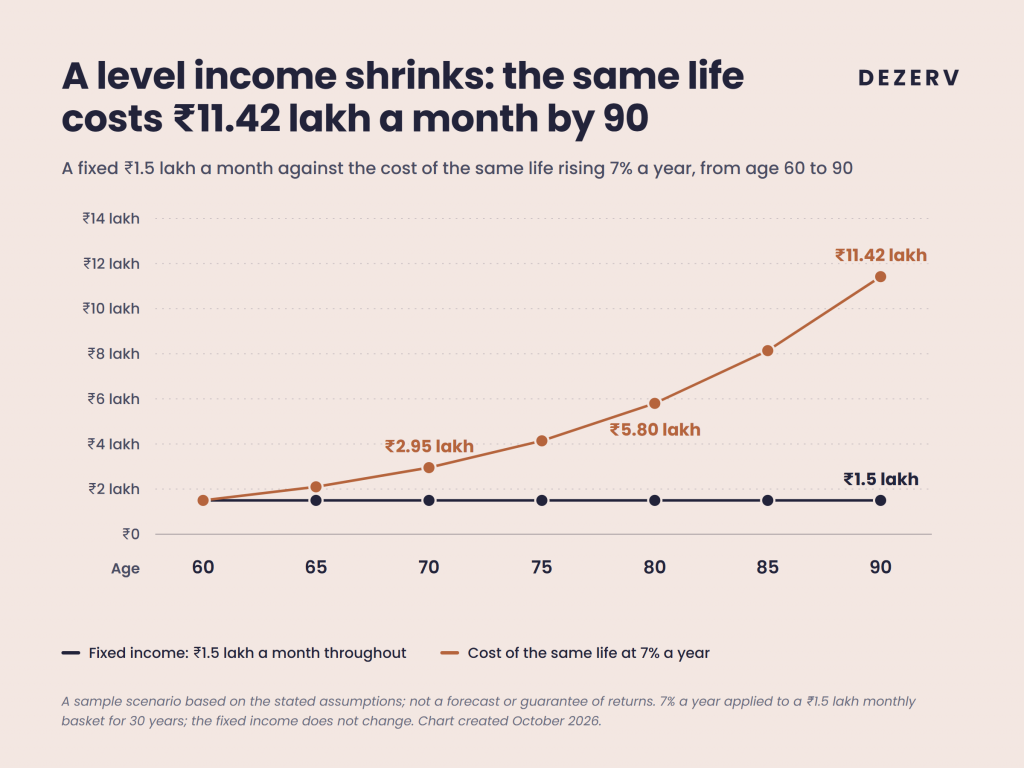
| Age | Fixed income (₹ a month) | Cost of the same life at 7% (₹ a month) | What the fixed income buys, in today's money |
|---|---|---|---|
| 60 | 1,50,000 | 1,50,000 | ₹1,50,000 |
| 70 | 1,50,000 | 2,95,073 | ₹76,252 |
| 80 | 1,50,000 | 5,80,453 | ₹38,763 |
| 90 | 1,50,000 | 11,41,838 | ₹19,705 |
A sample scenario, not a forecast or guarantee of returns: 7% a year applied to a ₹1.5 lakh monthly basket for 30 years. Your own basket inflates at its own rate; the direction is what matters.
The fixed-rupee plan has a working-life twin, the SIP set in your thirties and never raised: put ₹1.25 crore today plus ₹1.25 lakh a month to work for 20 years at an assumed 12.5% a year (the Nifty 50 Total Return Index's ten-year compound rate to 30 June, 2026*; Ace MF and NSE index data).
| After 20 years at 12.5%* | ₹1.25 crore lump sum | ₹1.25 lakh a month SIP | Total |
|---|---|---|---|
| SIP never raised | ₹13.18 crore | ₹12.22 crore | ₹25.4 crore |
| SIP raised 10% a year | ₹13.18 crore | ₹24.43 crore | ₹37.6 crore |
A sample scenario, not a forecast or guarantee of returns: each SIP instalment invested at the start of the month, no tax or costs.
Past performance does not indicate future returns and may or may not be sustained in the future.
The all-floor plan
Everything in deposits from the day you retire is the quiet way to run out when a corpus must fund thirty years.
The floor covers the non-negotiables, and the rest must keep compounding. I have argued that near-zero equity at 60 almost guarantees you outlive that corpus, though the answer changes when a pension covers the spending, the horizon is short or the corpus dwarfs the need, as the de-risking trap sets out.
Longevity insurance: a deferred annuity on a slice
An annuity is the one instrument you can buy that pools the risk this essay is about. You hand an insurer capital; it pays a contractual income for as long as you live, and the people who die early fund part of the income of those who live to 96. A portfolio cannot do that.
The costs are real: modest payouts, capital that is hard to get back (a surrender can cost a large slice of it) and income that is rarely inflation-indexed in India (the New Jeevan Shanti brochure calls its benefits "fixed").
The guide to annuitising at retirement weighs that one-way door and sizes the slice from the gap between essential spending and lifelong income.
For a corpus-funded household, the amount allocated to an annuity depends on existing pensions, the survivor’s needs and tolerance for longevity risk; a smaller or larger allocation may each be appropriate. What longevity insurance adds is timing. Keep the capital for that slice invested at 60, then buy a deferred annuity with it in your mid-70s, paying from 80.
That timing fits the published terms. LIC's New Jeevan Shanti, for example, allows a wait of one to five years, entry up to 79 and an income that must start by 80 at the latest, and pays a death benefit if you die during the wait (LIC brochure, 21 August, 2025); other insurers set their own limits.
The rate depends on the option, your age at entry and the length of the wait. A later start buys more income per rupee, because the insurer expects fewer payments and holds the money longer, and it insures exactly the years the opening spreadsheet ran out in. Rates differ by insurer, so compare annuity offers before you buy. Any contractual payment, escalation, surrender restriction, death benefit and return-of-purchase-price feature depends on the particular annuity terms; annuities do not automatically keep pace with inflation.
Watch out
An annuity bought on a single life stops with that life. For a couple, a joint-life option, where available, is one version to compare for income that can continue for the survivor, even though it starts lower: LIC's own illustration shows ₹6,624 a month against ₹6,888 for a single life, on ₹10 lakh bought at 45 with a five-year wait and a 35-year-old second life (LIC brochure).
The survivor's plan and the widowhood cliff
At 60, a woman is expected to outlive a man by 2.3 years on the national SRS tables, and by 1.9 on the urban ones, so for many couples the plan's final years are a widow's years, the years most plans are least built for.
The single-life plan fails in three places at once. A pension or annuity bought on one life ends with it.
Assets held in one name, with one login and a relationship manager who only ever spoke to one spouse, can take the survivor months to reach.
And the survivor's spending does not halve when the household does. The house, the staff and the medical cover cost almost the same for one as for two. The fix is to model the survivor's income as its own line in the plan, from the week after the first death, and to check it clears the non-negotiables without selling anything. An additional survivor annuity is one option, not a universal requirement; existing pensions, joint-life benefits and liquid assets may already cover the gap.
Nominations come next, on every account: the Securities and Exchange Board of India (SEBI) caps them at three per demat account or folio from 1 September, 2026 (SEBI circular, 29 May, 2026). And the conversation I keep asking for: does your spouse know where the assets are?
What capacity decline does to a plan at 80
A retirement plan assumes the retiree will keep running it. Many will not.
The nationwide dementia arm of the Longitudinal Ageing Study in India (LASI-DAD) estimated that 7.4% of Indians aged 60 and above have dementia, about 8.8 million people, with prevalence rising sharply with age (Lee et al., Alzheimer's & Dementia, 2023).
In the families I meet, the appetite for reading a statement or refusing a persuasive caller fades long before any diagnosis.
The no-review plan was right in 2026 and nobody touched it after that. By 2041 a gold sleeve that was 10% could be 20% by drift, a matured deposit could have idled in savings for two years and a policy could have lapsed, each too small to notice on its own; together they are the slow failure.
So the plan has to outlast the planner. Simplify holdings before 75, while the simplification is still yours to make.
Write the one-page version: where everything is, who to call, what to do in which order. Ask a lawyer about a power of attorney before it is needed.
Then set a review cadence, every three to six months, that does not depend on the retiree's energy. Delegation is the other half, and it is why I believe professional management matters more in retirement than at any earlier age: the family still decides the draws, nominations and insurance, but the portfolio's running stops depending on one ageing person.
The conversation at 60, and how I would stress a plan to 95
The first question I ask anyone handing over a portfolio is how much money they are willing to lose, because people overestimate the loss they can tolerate until it is made concrete. At 60 the question has a twin: how many years are you willing to be short? On the opening scenario the answer is thirteen, and three questions follow:
- To what age is it built, and what happens the year after?
- Which income stops when one of us dies?
- Who runs this when I cannot?
Then stress it: run the Dezerv retirement calculator to age 95, with post-retirement inflation at 7% or your own figure and a return a point below what you hope for; a Monte Carlo run turns one path into odds. Ring-fence the legacy you intend to leave before the first withdrawal, as I have argued on this blog before.
Then run it again with the survivor's income only. If the corpus clears both, the plan is built for the upside on longevity. If it clears only the first, you have found the slow failure while there is still time to fix it.
This essay is not for the household whose lifelong, inflation-linked pension already covers every non-negotiable; its longevity risk is largely pooled. It is for everyone whose retirement is a corpus.
Retirement income planning places this risk beside the others.
Key takeaways
- A plan can fail with no crash at all: in the sample scenario, ₹3 crore drawing ₹1.15 lakh a month rising 7% against a 7% return runs out at 82.
- A man at 60 in India is expected to live another 17.5 years and a woman 19.8 (SRS 2020-24); a corpus-funded couple can stress-test beyond 90 for the surviving spouse, extending the horizon when age differences or circumstances warrant it; the chosen horizon is not a prediction of lifespan.
- The four plans that fail slowly are the fixed-rupee, all-floor, single-life and no-review plans; each looks responsible at 60.
- A deferred annuity bought in your mid-70s can insure the years from 80; the suitable size and any joint-life benefits depend on other pensions, the survivor’s needs and the exact product terms.
- The plan must outlast the planner: simplify before 75, write the one-page version, set a review cadence or a delegate, and stress the plan to 95 on the survivor's income alone.
Frequently Asked Questions
What happens if my retirement corpus runs out at 82?
The choices narrow to three: sell or mortgage the house, depend on children, or cut spending at the age when medical costs peak. In the sample scenario above, ₹3 crore drawing ₹1.15 lakh a month rising 7% a year runs out at 82 with no market shock at all (not a forecast or guarantee of returns). The failure is slow, so the time to catch it is at 60, by stressing the plan to 95 and to the survivor's income alone.
Which retirement plans fail slowly?
Four: the fixed-rupee plan (a level pension, annuity or deposit income that inflation halves roughly every ten years at 7%), the all-floor plan (a corpus moved entirely into deposits at 60, which cannot outpace 30 years of 7% spending growth after tax), the single-life plan (income and access built on one life, so the survivor's income halves or stops) and the no-review plan (a sound allocation nobody rebalances after 75). Each looks prudent on the day it is set up and fails a decade or more later.
How do you build longevity insurance into a retirement plan?
Insure the essential spending that no lifelong income already covers. One approach is to keep the intended amount available and compare deferred annuities later, including a joint-life option where appropriate; the timing, share of assets and contract should be evaluated against the household’s pensions, financial resources and spending needs. The slice grows when there is no pension or a spouse depends on the income, and falls to nothing when a pension already covers the essentials. The one-way door and the sizing arithmetic are in the annuitisation guide.
Should I plan to 90 if my parents died in their 70s?
For most couples funding retirement from a corpus, yes. On the SRS 2020-24 urban tables a couple both aged 65 has a 57% chance that at least one partner reaches 85, and a woman who reaches 85 lives another 7.4 years on average. Your parents' ages are one input, not the horizon. The two errors are not symmetrical: money left at 76 passes to your family, while a plan built for 78 leaves a 91-year-old short.
What should a retirement plan include for the surviving spouse?
Model the survivor's income as its own line from the month after the first death, and check it clears the non-negotiables without selling assets. Use joint-life options on any pension or annuity, keep nominations current on every account (SEBI caps nominees at three per demat account or folio from 1 September, 2026), make sure both spouses can access every account, and write a one-page plan that says where everything is and who to call.
Disclaimer
Dezerv Investments Private Limited is a SEBI-registered Portfolio Manager (Registration No. INP000007377). Distribution services are offered by Dezerv Distribution Services Private Limited, a wholly owned subsidiary of Dezerv Investments Private Limited, under AMFI Registration No. ARN-248439 and APMI Registration No. APRN-00615. This article is intended solely for general educational and informational purposes and should not be construed as personalised investment, financial planning, tax or legal advice, or as a recommendation, offer or solicitation to invest in any security, financial product or investment strategy. Readers are advised to consult their financial, tax and legal advisors before making investment decisions.
The corpus projections, withdrawal calculations, inflation comparisons, life expectancy estimates, annuity illustrations and investment return figures discussed in this article are based on the sources, dates and assumptions stated and are illustrative only. They do not represent guaranteed returns, assured retirement income or predictions of an individual's lifespan or future financial outcomes. Actual results may vary depending on inflation, investment performance, taxation, annuity terms, healthcare expenses, withdrawal requirements and individual circumstances. Market-linked investments involve risks, including possible loss of capital, and no retirement strategy can guarantee that a corpus will last for a particular period. The approaches discussed are general frameworks and may not be suitable for every investor. This article is not a complete disclosure of every material fact, term or condition.
Investment in the securities market is subject to market risks. Please read all related documents carefully before investing. Past performance may or may not be sustained in the future.