


In September 1958, Bank of America did something unimaginable today. It mailed 60,000 credit cards, unsolicited, to households across Fresno, California. No applications, no consent, just a plastic card appearing in people’s mailboxes overnight.
The experiment was a disaster at first. Cards were stolen, fraud surged, and losses mounted. The programme nearly collapsed. But Bank of America kept going, expanded across the country, and BankAmericard eventually became what the world now knows as Visa. What began as a risky experiment in one California city became the backbone of global commerce.
The reason I am thinking about Fresno this week is a conversation in our office about people planning summer travel, comparing business class upgrades, checking lounge access, and figuring out whether their hotel points were still valid. It struck me how different this would have sounded a decade ago. Back then, credit cards in India were mostly about credit. Today, for a growing group of professionals, they are about spending strategically.
India now has 118 million credit cards in circulation and annual spending of ₹23.62 trillion, roughly ₹2 lakh per card each year on average. But the premium cards covered in this newsletter operate at a very different level. Cards like Infinia, Magnus Burgundy, and HSBC Premier often require ₹10–35 lakh in annual spending to truly justify their fees and benefits.
These users are a tiny fraction of India’s cardholders, but they account for a disproportionate share of spending. And yet, more than 50% of reward points in India still go unredeemed every year. This newsletter looks at a simple question: after years of changing reward structures and devaluations, how much value are people actually getting from all that spending?
In this edition:
- How India’s credit card market tripled in value, and what that growth quietly cost existing cardholders
- Who actually funds your rewards every time you swipe
- Why banks are cutting benefits even as they sign up millions of new customers
- The privileges premium cardholders still have access to, and the ones that have quietly disappeared
- A comparison of the six premium cards that matter most right now
- How to earn the rewards the right way
- Tools and people worth following if you want to go deeper
How India’s credit card market tripled in five years
India’s credit card market has gone through a fundamental transformation over the last five years that most people have not fully absorbed. Transaction volumes have doubled, from 2,087 million in 2019 to 4,472 million in 2024, while transaction value has nearly tripled from ₹7.1 trillion to ₹20.4 trillion. At the same time, debit card volumes have collapsed by 65%.
What happened is straightforward once you see it. UPI absorbed everything small and daily, the morning chai, the auto fare, the grocery run, and did it so seamlessly that carrying cash or swiping a debit card became unnecessary for most urban Indians. Credit cards moved in the opposite direction, claiming the high-value lane: flights, hotels, large appliances, luxury retail, international dining, and the kind of aspirational spending that a younger, more confident professional class was increasingly comfortable putting on credit.
The EMI culture did the rest, allowing large purchases to sit comfortably across monthly installments without the friction of a formal bank loan. India has graduated from a country that viewed credit with suspicion to one that has made it a lifestyle instrument.
But rewards are shrinking as the market grows
India’s credit card market has grown rapidly, but most of that growth has come from new users entering the system, not from existing users spending more. But rewards programmes have become much less profitable for banks.
First, defaults are rising. Credit card NPAs rose 28.4% in the year ending December 2024, increasing lending costs for banks.
Second, RBI regulations have become stricter. Banks now need to hold more capital against credit card loans, leaving less room to fund generous rewards.
Third, fewer people are carrying unpaid balances month to month. Before the pandemic, over 40% of users revolved their balances. Today that number is closer to 23–25%, meaning banks earn less high-interest income that once funded rewards.
UPI has added more pressure. RuPay credit cards linked to UPI now account for a large share of transactions, but payments below ₹2,000 carry almost no interchange fee, reducing income for banks.
Put together, the economics of generous rewards programmes no longer work the way they once did. So banks kept acquiring new users while quietly reducing benefits for existing ones. Lounge access now comes with spending thresholds, cashback caps are lower, transfer partners disappear more often, and reward points expire faster than before.
Privileges premium credit card holders still have access to
Banks have mostly cut the benefits that were automatic, free lounge entry, uncapped cashback, airline partners. What they have not cut are the benefits most cardholders never used in the first place. Travel insurance, hotel memberships, golf privileges, these are still sitting in your card, largely untouched.
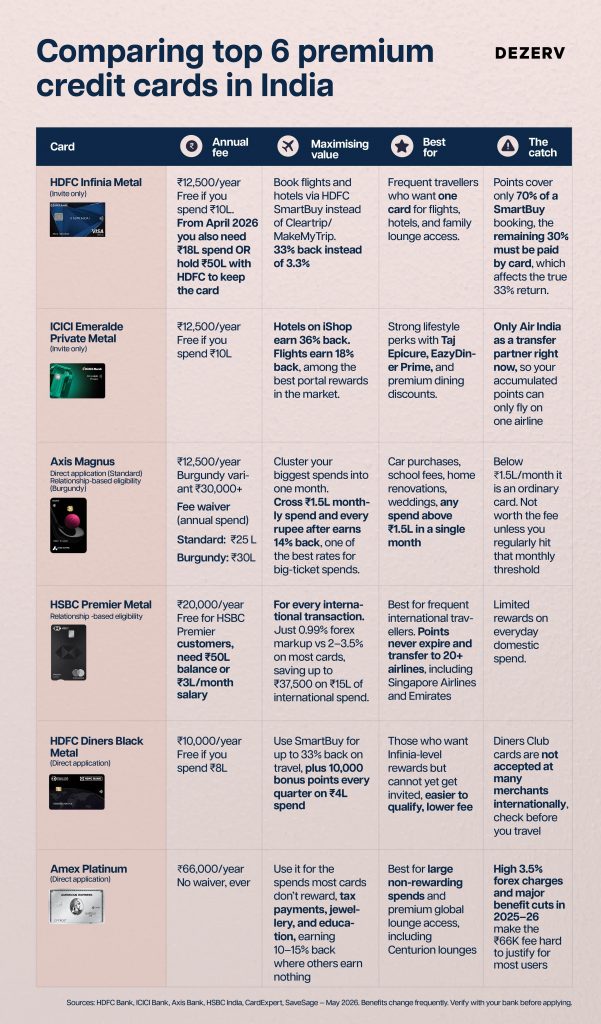
The table above shows the top six cards, but the real question is not which card is best, it is whether your points are spread across enough banks that one programme changing its terms does not leave you stranded. Most people use one credit card for everything because it is simple. But that usually means missing out on rewards. Different cards are good for different categories. A flight booked through HDFC Infinia’s SmartBuy portal can earn far higher rewards (33%) than booking the same ticket on a regular card (3%). Some cards are also much better for categories like jewellery, dining, or travel.
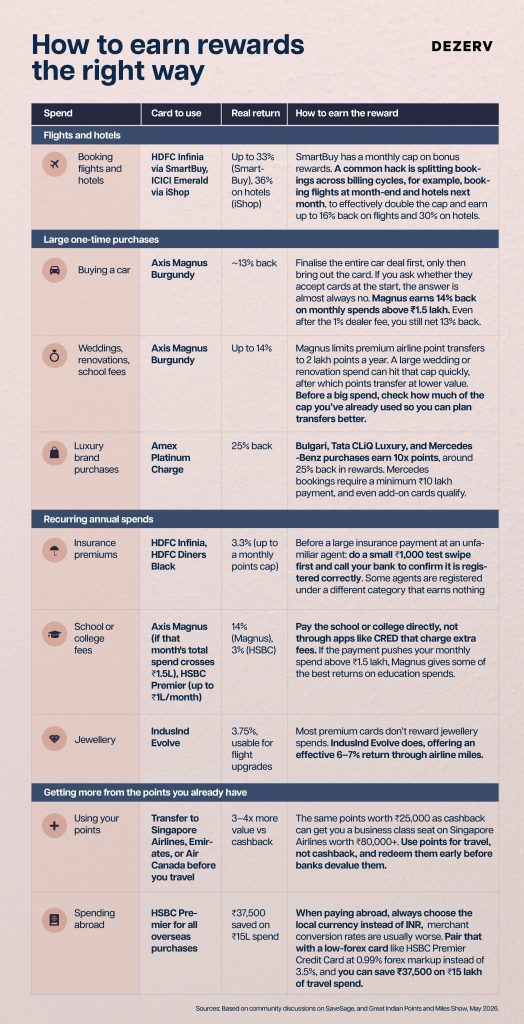
A simple habit helps: pick your four biggest spending categories and use the best card for each one.
It is also worth tracking annual spending milestones. Cards like HDFC Diners Black offer bonus points once you cross certain spending thresholds. HDFC Diners Black, for example, gives 10,000 bonus points every quarter when you spend ₹4 lakh, points that can be worth more than several months of everyday earnings.
If you are close to hitting a milestone near the end of your card year, shifting a month of spending to that card can unlock rewards worth far more than the extra spend needed.
What if you lose your card?
Metal cards cost more to replace than you might expect. HDFC charges ₹3,500 to replace a lost or damaged Infinia or Diners Black Metal, a figure that caused significant backlash in the community when it was introduced. ICICI charges the same ₹3,500 for the Emeralde Private Metal. The fee was widely believed to target people replacing cards to access new Visa offers rather than genuine loss cases, and the community’s view is that a genuine fraud or theft reported immediately is likely to get the fee waived if you push for it.
Your accumulated points are safe. Replacing a card does not wipe your reward balance, points transfer to the new card.
The bigger problem is timing. Losing an Indian premium card while traveling abroad means waiting for the replacement to arrive at your home address in India. Someone then has to courier it to you. If you travel frequently and rely on one primary card, keeping a backup card from a different bank active is worth doing.
Tools worth bookmarking
1) Points.casa transfer calculator: Shows exactly how many miles you get when moving points between programmes. Before deciding whether to transfer Magnus points to KrisFlyer or Skywards, run the comparison here first.points.casa/tools/transfer-calculator
2) SaveSage rewards calculator: Plug in your card and spend pattern and it shows what you are actually earning versus what a different card would give you. Useful before renewing any card. savesage.club/credit-card-rewards-calculator
3) Seats.aero: For finding award seat availability. Instead of checking each airline website individually, Seats.aero shows live availability across all programmes in one search. The web version is far more powerful than the app. At roughly $10 a month, the Pro tier pays for itself on a single booking. seats.aero
People worth following (for updates on credit cards)
1) Great Indian Points and Miles Show
2) Suvan Dural Jha I _djsuvan_
3) Manasi Jaiswal and Sanket Garg I Dobaniye
4) Aly Hajiani I thatcreditcardguy
5)Akash I https://x.com/ccg33k
In summary
India’s credit card market has never been larger, and the engineering behind premium rewards has never been more deliberately tiered. Banks are concentrating the best benefits at the top of the spend ladder, which means the gap between cardholders who understand the system and those who do not has widened considerably. The ones who understand it are extracting disproportionate value: free business class seats, hotel upgrades, forex savings running into tens of thousands on a single trip. Everyone else is paying ₹12,000 to ₹66,000 in annual fees for benefits that changed
In summary
India’s credit card market has never been larger, and the engineering behind premium rewards has never been more deliberately tiered. Banks are concentrating the best benefits at the top of the spend ladder, which means the gap between cardholders who understand the system and those who do not has widened considerably. The ones who understand it are extracting disproportionate value: free business class seats, hotel upgrades, forex savings running into tens of thousands on a single trip. Everyone else is paying ₹12,000 to ₹66,000 in annual fees for benefits that quietly changed while they were not looking.