
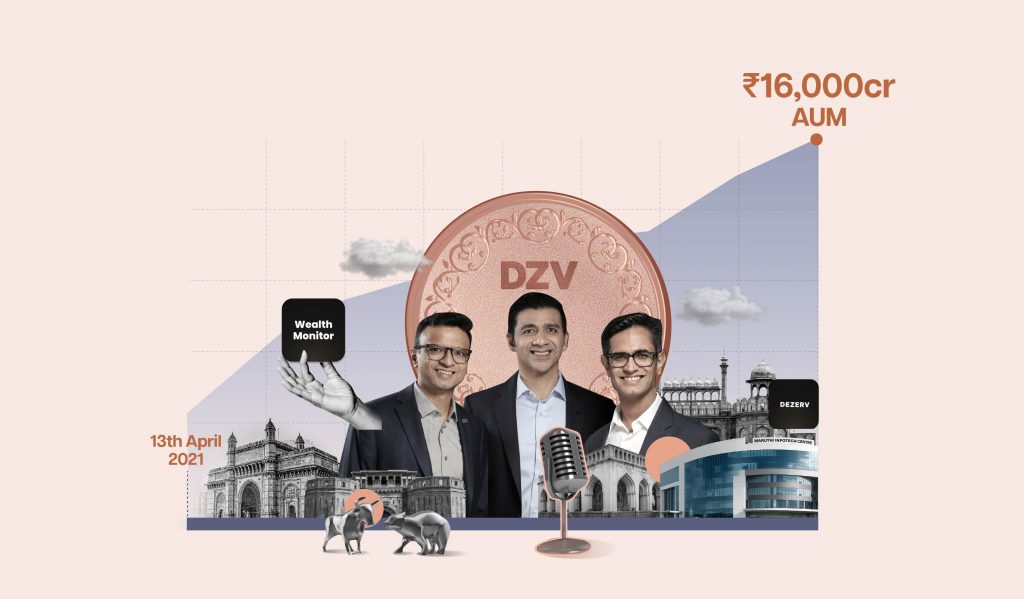

Last week, Dezerv turned five.
There is something strange about anniversaries, they make the same moment feel like yesterday and a lifetime ago at once. As I sit down to write this, I find myself thinking about where it all began: a small office in Mumbai, Vaibhav, Sahil and I, three people who had spent their careers inside wealth management, with a deep conviction that the future of this industry would be built on technology rails with the client at the centre of every decision. But none of us came from a technology background.
We did not know exactly how we would get there. But we knew it was the future, and that India’s wealth creators deserved better than what they were getting.
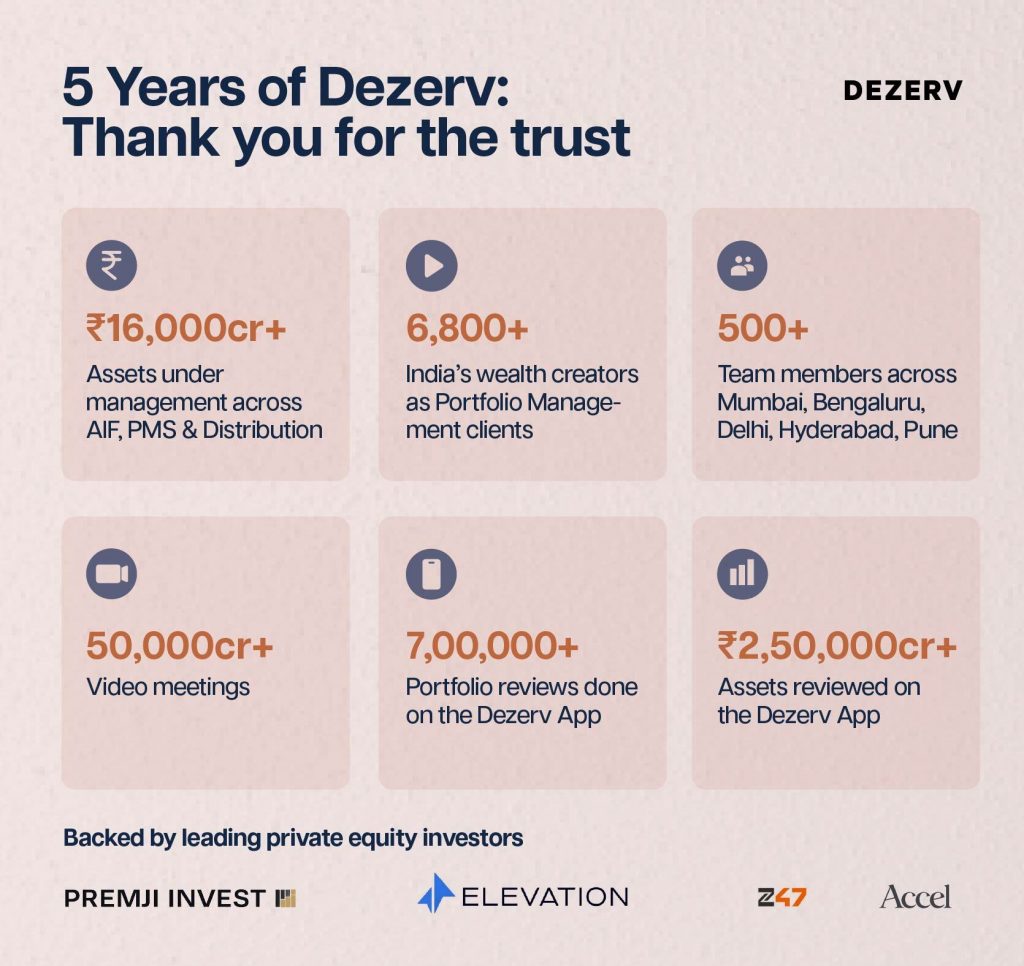
Five years later, that small office has become a team of 550-plus people across five cities, managing over Rs 16,000 crore for 6,800 wealth creators who trust us with their portfolios.
This newsletter is my attempt to write honestly about what those five years actually felt like, the apprehensions before we began, the years where progress felt invisible, what we learned about building a team, about which problems to solve when everything felt urgent, and the one thing every aspiring founder underestimates. I hope some of it stays with you.
In this edition:
- One non-negotiable decision before taking the first step
- What the early years of building actually felt like from the inside
- How we found the people who built Dezerv with us
- What five years of showing up looks like in numbers
- Five things I have learned as an entrepreneur, a team leader, and a wealth manager
- Three things I would tell anyone thinking about quitting their job to build something
Let’s begin.
Before we let go of the wall
There is a moment, just before a child takes their first steps, where they are holding on to something. Not quite ready to let go. That pause is not hesitation. It is the weight of understanding, however instinctively, that once you release your grip, nothing will be quite the same again.
I lived in that pause for a while before Dezerv began.
The apprehension I carried going in was not really about whether the business would work. It was more personal: what is the implication for my family if this does not work? Because individually, I could always find a way through. But there is a lot of responsibility sitting quietly behind every decision you make as a founder. And if you do not address that directly before you begin, it follows you into every room.
So before I took any of the external steps of building a company, I did the internal work first. The portfolio got restructured during those months. Simpler, more disciplined, oriented toward stability rather than complexity. Because here is what I understood then and believe even more firmly now: if the family is secure, you can take the risks this journey demands. If the family is insecure, you are always leaning over your shoulder. And you cannot build anything worth building while leaning over your shoulder.
There is something I find meaningful about this, especially given what Dezerv is. The first act of building a wealth management company was getting my own financial house in order. Making sure that the people I was responsible for would be protected regardless of what happened next. The alignment between what we preach and what we practise starts there, at the very beginning, before anyone was watching.
The first year and the biggest challenge
A newborn does not arrive with instructions. You figure it out as you go, with whatever combination of instinct and will you can assemble. Year one of Dezerv felt something like that.
We had a clear conviction about the problem. But conviction is not a company. The first real challenge was not finding clients. It was finding the right people to build with.
The three of us who started Dezerv came from wealth management. But we had made a non-negotiable bet that the next serious wealth manager in India would be built on technology rails. The problem was that none of us had ever operated in a technology environment. We knew it was a mega trend. We believed it was the future. But when you ask yourself where you actually begin, the honest answer is that you do not know. So the decision we made was simple: stop trying to figure it out ourselves and invest everything in finding the people who already had the answers.
But convincing people to join turned out to require something more specific than a pitch about the opportunity. There is a real difference between offering someone a business idea to chase and offering them a vision to believe in. A lot of talented people get asked to chase business ideas. Very few get asked to chase a vision.
What worked for us was being brutally transparent about the human story underneath what we were building. So in the early days, we focused on hiring missionaries, not mercenaries. Mercenaries do excellent work when conditions are favourable. Missionaries stay when conditions are not, because the mission means more to them than the circumstances. The valuation, the outcome, the money, all of that is secondary in the hard moments.
So for us, repeatedly talking about the vision, not once in a founding document but constantly, became the most important thing we did as founders.
Learning to walk : How we figured out what to build first
Around age two, a child starts walking. What you see from the outside looks like progress. What is actually happening is hundreds of small falls, constant recalibration, the slow invisible accumulation of balance that will eventually make walking feel effortless.
Between years two and four of Dezerv, progress felt invisible in exactly that way. I have come to think of this as the zone of frustration, and I believe it is where most serious building journeys either hold or break.
What made the difference was learning to separate signals from noise.
When you work inside a large organisation, the organisation insulates you from a lot of this. There is always somebody telling you what matters. As a founder, all of that scaffolding disappears overnight. You have to build the filter entirely on your own. And in building it, there is an enormous amount of noise you encounter. It is very easy to drift away from your core mission without even realising it is happening.
Initially, you tend to react to everything. Then you realise that reacting to everything is counterproductive. The first shift is simply appreciating that 99% of what you hear is noise. The signal is rare.
The second shift is developing a test for what survives that filter. The question I kept coming back to was this: is what I am seeing a permanent shift, or a temporary adjustment? An investor says no, but what is the actual reason? If the reason is temporary, you note it and keep moving. If there is something genuinely fundamental in what they are saying, you sit with it seriously. That distinction, applied consistently under pressure, is one of the harder and more valuable things I have learned.
From first steps to full stride: How far we’ve come
Watch a four year old and you will notice something. They do not just walk anymore. Everything is a run. The uncertainty of the early steps is gone, replaced by a kind of joyful momentum that looks almost reckless from the outside but is actually the product of thousands of hours of quiet practice finally clicking into place.
By year four, Dezerv felt something like that.
Clients who had joined us early were referring to people they trusted. In wealth management, that is the only signal that truly matters. The moment someone calls a friend and says, these are the people I trust with my money. You cannot manufacture that. You can only earn it, repeatedly, through how you show up week after week.
Today Dezerv manages over Rs 16,000 crore in assets across AIF, PMS, and Distribution. Over 6,800 wealth creators trust us with their portfolios. Our team of 550-plus people works across Mumbai, Bengaluru, Delhi, Hyderabad, and Pune. This is what genuine commitment looks like when it is repeated for five years.
To someone thinking about leaving a stable career to build something
The first is that if the idea is genuinely bothering you, the discomfort of not trying will outlast the discomfort of trying. The version of yourself that never attempted the thing you believed in will carry that weight in ways that are hard to anticipate from the outside. I believe deeply in what Bezos called regret minimisation, the simple practice of asking which version of yourself, at the end of things, you can live with. For most serious people who have a serious idea, the answer points in one direction.
Before you take the leap, do the work to secure the people who depend on you. Not out of fear, but because the boldness that building requires is simply not available to someone carrying unresolved anxiety about the people they love. That clarity is not caution. It is the foundation for real courage.
And finally, these are long journeys. Not a few hard years followed by some settled phase where things get easier. Decades of compounded effort, where the early decisions echo for years and the values you hold at the beginning either prove true or prove hollow under the pressure of growth. The people who build something lasting are not the ones who pushed through the hard parts of willpower. They are the ones who fell in love with the process itself.
Thank you for growing with us
None of what Dezerv has built happened because of a plan on paper. It happened because thousands of people extended their trust before the evidence fully justified it.
The clients who came early, when we had conviction but no track record. The team members who chose the mission over certainty. The partners, Premji Invest, Elevation Capital, Z47, and Accel, who believed at stages when belief required more than evidence could support.
Trust in this business is not something you earn once. It is something you earn continuously, through every newsletter, every portfolio review, every conversation that starts with a client’s real question rather than a product pitch. That is the work we signed up for. It remains the most meaningful work I have done.
Five years in. A long way still to go.