

Every working morning in Mumbai, a steel tiffin leaves a kitchen in the suburbs and, by lunchtime, sits on an office desk in south Mumbai. It changes hands several times on the way and rides the local train. In the afternoon, the empty box makes the same journey back home.
The system is said to have begun with a Parsi banker who simply wanted his home-cooked lunch at work. Mahadeo Havaji Bachche saw a business in that request, and in 1890 he organised about a hundred men into a delivery network. For over a century, the dabbawalas were how Mumbai outsourced its lunch.
That network is now shrinking. The number of registered dabbawalas has fallen from around 4,500 in 2018 to roughly 1,500 today.
It would be easy to read this as a city that has lost its taste for ghar ka khana (home-cooked food). Mumbai still wants it. What has changed is the direction of travel. For a hundred years, the food went from the home to the office. Today, the cook comes to the home, booked on an app, often within minutes.
Cooks are only the beginning. The same apps now send cleaners, beauticians and elder-care attendants into our homes, and one even dispatches an ambulance.
In an earlier edition, we saw that despite apps promising groceries in minutes, the kirana still holds about 91% of India’s grocery market, because mass India buys in small baskets that apps can’t serve profitably. Quick commerce won the affluent, time-poor home instead. The next wave targets that same home, delivering people, care and advice rather than groceries.
This week, I’ll walk you through how India’s convenience industry is moving into our homes, why it is happening now, who powers it, and what it says about how we value our own time.
In this edition:
- What Indian homes are outsourcing now, from chores to care to decisions
- Why smaller homes are creating a bigger market for household help
- How these businesses actually work, and why profits are still elusive
- How to use the Buyback Rate and DRIP Matrix to decide what to outsource
What Indian homes are outsourcing now, from chores to care to decisions
The first five ambulances went out on the roads of Gurugram, bookable from the same app that delivers milk and bread. Blinkit had found that many families avoided calling an ambulance in a crisis, preferring a car or a cab because they doubted help would arrive in time. So it applied its grocery playbook, keeping supply a few minutes from every home, to emergencies. The service now runs in parts of Delhi-NCR.
It shows how far convenience has travelled, and it points to a market far bigger than groceries: everything Indian households pay someone else to do inside the home.
That market is already worth over ₹5 lakh crore (about $60 billion) a year. Yet less than 1% of it is booked online. Almost all of that online demand sits in a handful of cities. India’s eight largest cities account for 85-90% of it, and their online market is expected to more than double, from ₹37-38 billion to ₹85-88 billion by FY30. The next 50 cities, where dual-income homes are rising fast, are expected to follow. Where that money goes tells us where the next wave is headed.
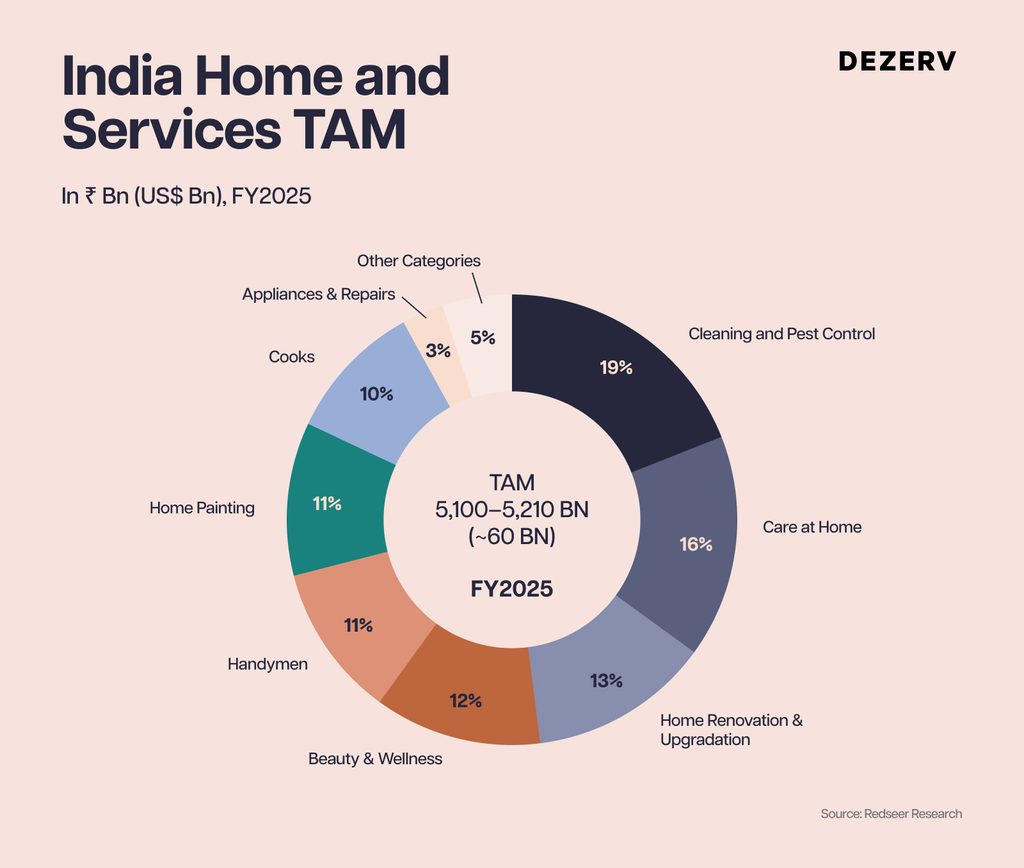
The first layer is hands. Cleaning is the largest slice of household spending on services at 19%, and cooks take another 10%. Apps such as Urban Company’s InstaHelp, Snabbit and Pronto now send trained help within minutes; InstaHelp crossed 50,000 bookings in a single day less than a year after its launch. ChefKart places daily cooks in homes, while Cookr and Mealawe run subscriptions for home-style meals, a modern version of the dabba.
The second layer is care. Care at home is the second-largest category at 16%, bigger than home renovation or beauty. With children often working in other cities, platforms such as Emoha and Samarth Elder Care now support ageing parents with emergency response, health monitoring and hospital visits. The ambulance on an app belongs here too.
The third layer is the head. It doesn’t appear in any market sizing yet, which is what makes it interesting. Meal planners like PlanNEat decide the week’s menu and build the grocery list. Swiggy’s Pyng connects users with verified professionals across 100+ specialisations, from nutritionists to financial advisors.
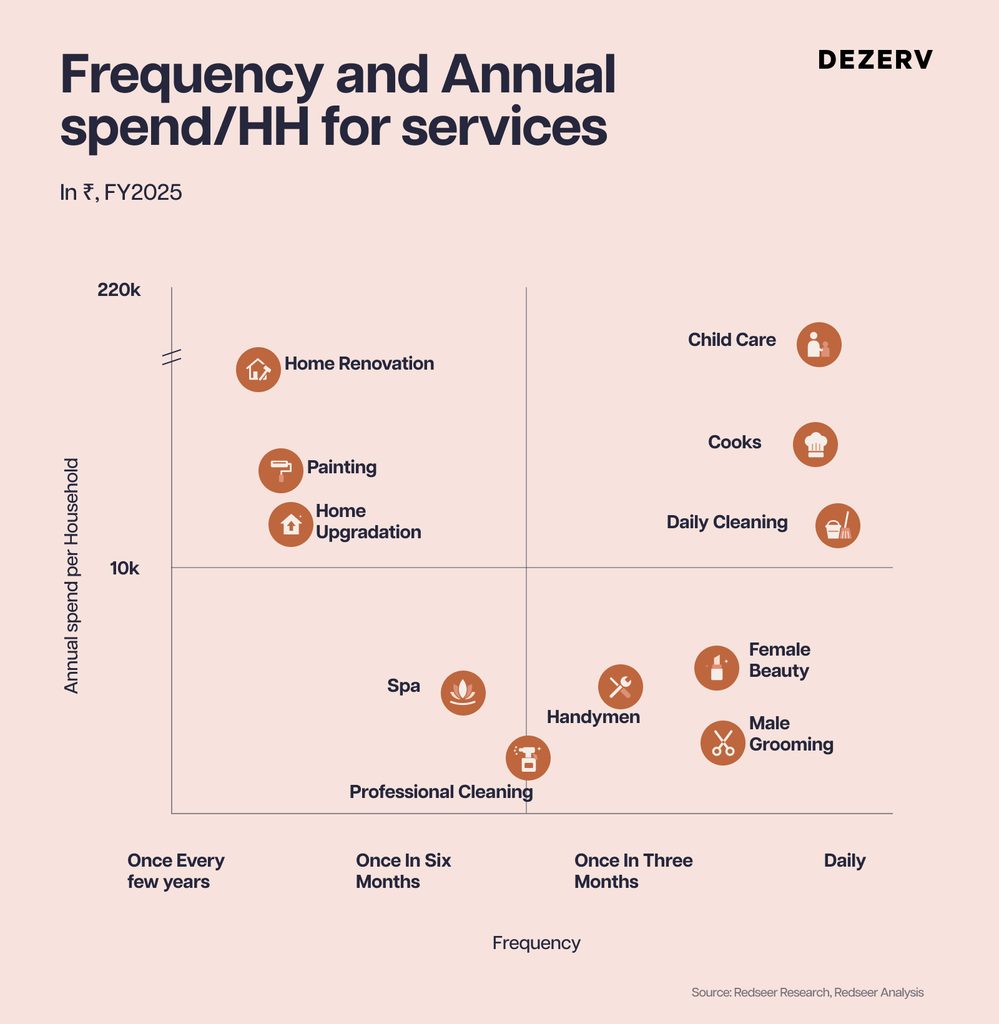
The most interesting pattern is frequency. Services households use every day, such as cooks, daily cleaning and childcare, carry the highest annual spend per household, while a painter or a handyman visits once in a few months. The real opportunity lies in services people need every day.
Why smaller homes are creating a bigger market for household help
A generation ago, most traditional joint families rarely hired a cook, a babysitter or someone to sit with an ailing grandparent. The house ran like clockwork, largely because of the women in it, and much of it went unpaid and uncounted. Even in well-off homes, where a house help came in every morning, she worked alongside the family. Planning meals, running the house and caring for elders still rested with the women of the home.
That way of living has been fading. Joint households fell from 19.1% to 16.1% of all Indian households between the last two Censuses, and nuclear families have since risen to 58.2%. With fewer hands at home, the same work now has to be shared, or handed over.
What I find encouraging is that more women are stepping into paid work, with their daily participation in paid activity rising from 17.1% to 20.6% in five years. Many modern homes now have two careers, one calendar and very little slack. Parents often live in another city. Most of these homes do have help, but it is informal, built on a neighbour’s reference and a lot of goodwill. When the regular house help takes leave, the whole week unravels.
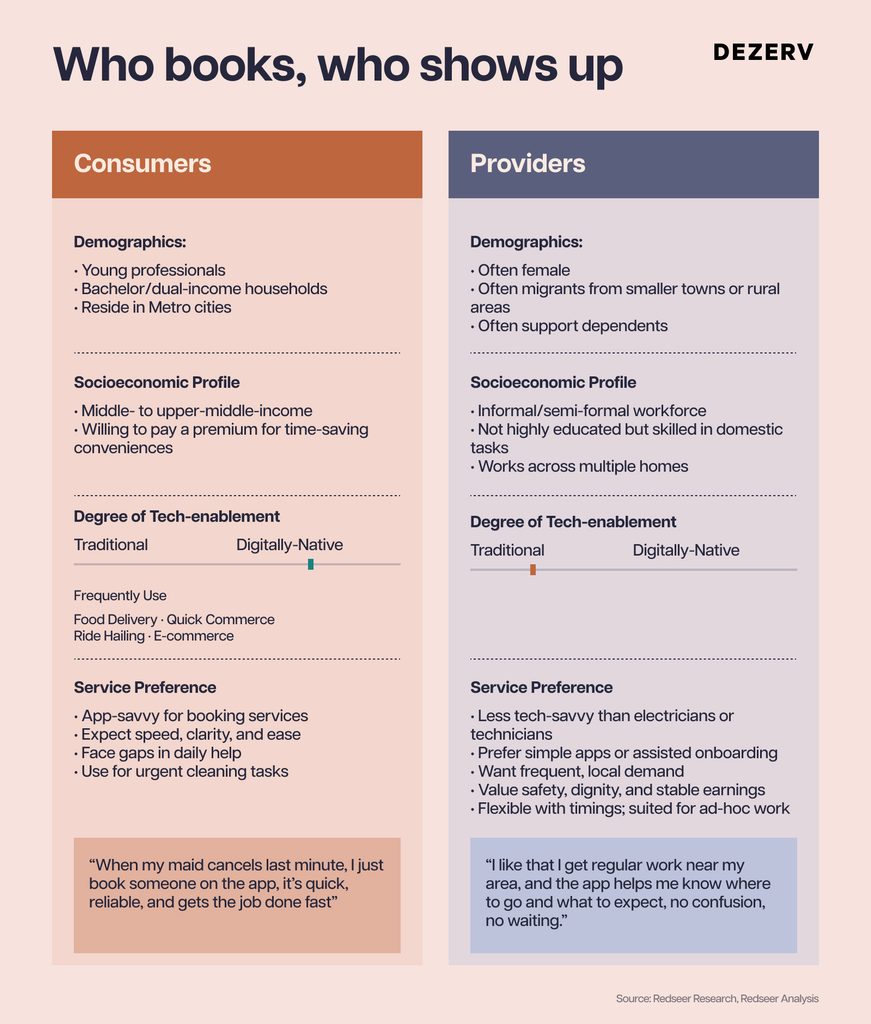
That moment, more than any advertisement, is what has pulled households onto these apps. The typical user is a young professional, often single or in a dual-income couple, living in a metro, already ordering food, groceries and cabs on their phone, and willing to pay a premium for anything that saves time. They rarely start with a scheduled deep clean. The first booking is usually urgent: dishes after a dinner party, or a morning when the regular help cancels at the last minute.
On the other end of that booking is usually a woman, often from a smaller town, supporting a family and looking for steady work close to home. That makes home services an outlier in India’s gig economy. Women make up 35-45% of its platform workers, against about 1% in delivery and ride-hailing.
For many of them, the app changes the terms of work that was always informal. Snabbit, which runs an entirely women-led fleet, puts its workers on full-time contracts with steady monthly incomes and health and life insurance, and they earn ₹25,000–30,000 a month depending on the hours they work.
Across the sector, full-time gig workers earn up to 2.5 times what comparable formal and informal workers do, and since May 2026, India’s social security rules have formally covered them too. The app is matching two very different Indias, each solving a problem for the other.
To me, this is one of the more welcome shifts in how Indian homes work. Labour that families long took for granted is finally being recognised, measured and paid for, and the time it frees up is going into careers, parents and children. It is also early days: even by 2030, close to 88% of home services are expected to remain unorganised. The apps are formalising only the moments where time is scarcest.
How these businesses actually work, and why profits are still elusive
In the summer of 2015, Homejoy, one of Silicon Valley’s most talked-about home-cleaning startups, shut down. Its founder blamed lawsuits over whether its cleaners were contractors or employees. But reporting afterwards pointed to something more basic. Customers who came in on discounts rarely booked again, and its best cleaners left to work directly for the families they had met through the app.
In India, three players are now racing to avoid that fate.
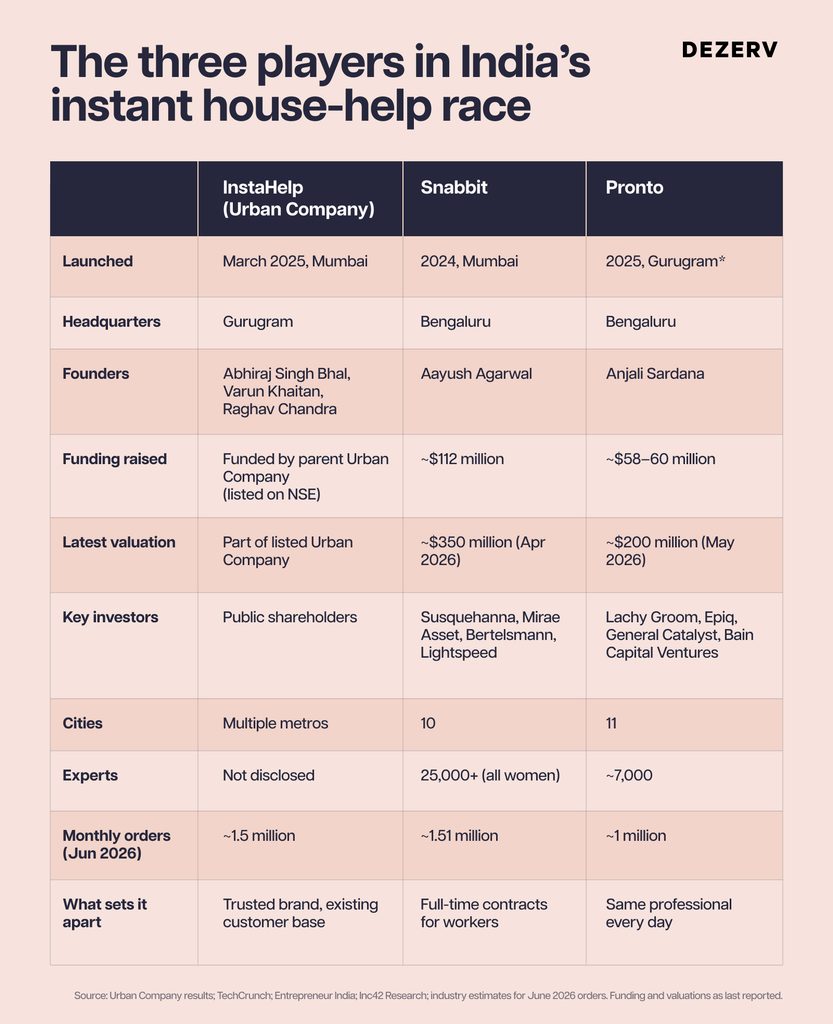
All three run on the same basic model, and the first lesson they have taken from Homejoy is about relationships. That problem is even sharper in India. Every household knows how to hold on to a good house help, and once a family finds someone it trusts, there is little reason to keep paying a platform. So Snabbit puts its workers on full-time contracts, and Pronto lets daily users request the same professional every day. Both are trying to own the relationship, not just the booking.
The second lever is density. These platforms station workers around dense residential clusters so they can reach a home within minutes, and charge about ₹150 an hour, with an average ticket of around ₹240. At those prices, the model only works if the same few blocks are ordered again and again, keeping every worker busy through her shift.
Every order still costs more than it earns. Average orders have slipped to ₹90-115 as discounts return, yet InstaHelp loses about ₹346 per order and Snabbit nearly ₹250. BofA Global Research puts the break-even at roughly ₹250 an hour, more than double today’s level. It is the small-basket problem we saw in grocery: a small basket rarely covers the cost of getting someone to your door in minutes. Density is the industry’s bet. InstaHelp’s loss per order fell from ₹447 to ₹346 in one quarter as its network grew denser, while Snabbit spent ₹15.92 for every ₹1 of revenue in FY26.
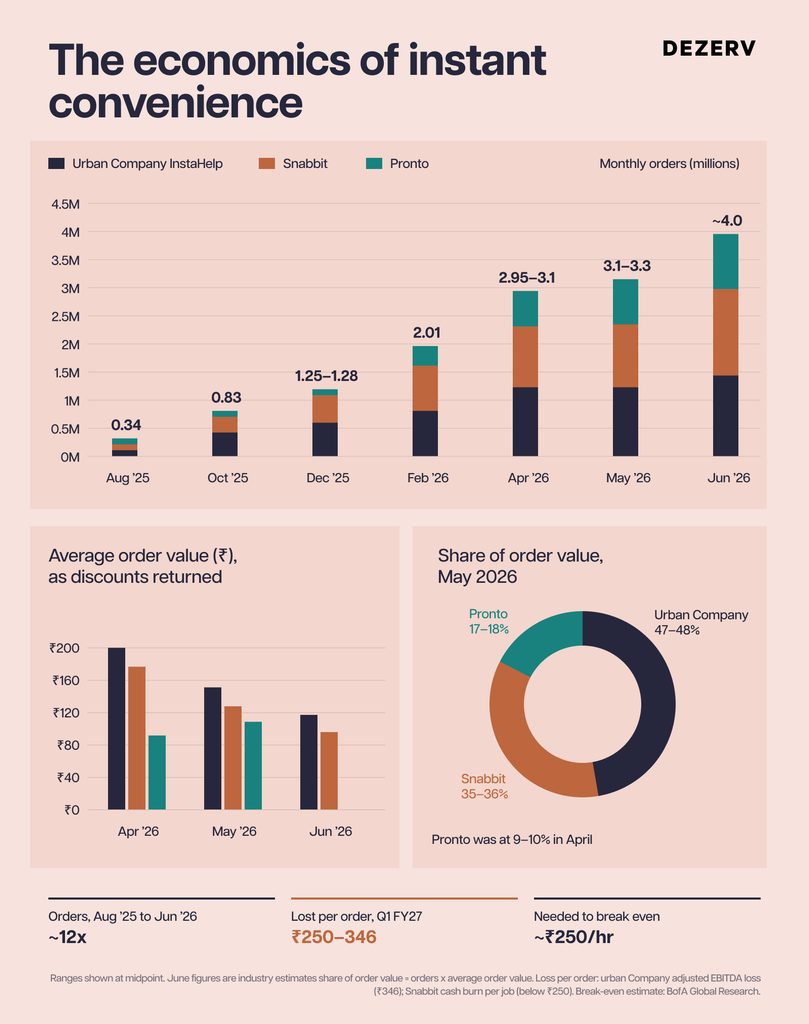
The third lever is breadth. A worker who only washes dishes has idle hours, so platforms are adding more to every visit. Snabbit has moved into home cooks, with salon services on the way, and Urban Company has said InstaHelp needs order values close to double today’s levels to break even. The goal is to turn a ₹99 emergency into a household habit worth far more each month.
None of this has slowed the race. Monthly orders across the three grew roughly twelvefold in under a year to nearly 4 million by June 2026, while combined cash burn hit $16-17 million a month. Despite talk of fewer discounts, order values fell again in June, and Pronto, the smallest player, is growing fastest. It is tempting to call this the next Blinkit, but services play by different rules: a grocery packet needs no training and can’t leave to work for your neighbour.
In the end, speed wins the first booking, but trust and repeat use decide who lasts.
How to use the Buyback Rate and DRIP Matrix to decide what to outsource
What do you do after a long trip: rest, unpack, or leave the suitcase in a corner for three days? I remember a video doing the rounds on Instagram of a Bengaluru woman who chose a fourth option. She booked Snabbit to unpack her suitcase for her, and the internet promptly called it “Peak Bengaluru”.
But it isn’t as odd as it sounds. On most of these apps, you don’t book a task, you book an hour, and what gets done in it is up to you. Which left me with a question worth asking: if you can hand over almost anything, what should you?
Most of us rarely think about it this way. In a Harvard-led study, working adults felt happier after spending money to save time than after buying things. Yet when asked how they would spend $40, only 2% thought of buying time. Nobel-winning economist Gary Becker made the case back in 1965: every hour at home has a price, which is whatever that hour could have earned.
Two simple tools from Dan Martell’s Buy Back Your Time turn this into something practical.
- Your Buyback Rate. Divide your annual income by about 2,000 working hours, then divide by four. If handing a task over costs less than that per hour, it’s usually worth doing.
- The DRIP Matrix. Sort every task by two questions: does it create value, and does it give you energy or drain it? Try it on a typical week. List your tasks, place each one in a box, and compare what it would cost to hand over against your Buyback Rate.

The goal isn’t to outsource everything. Start with the bottom-left box: the dishes, the laundry, even the packing, wherever the cost is below your Buyback Rate. For important but draining work, like coordinating a parent’s care, bring in skilled help so you stay involved without getting stuck in the logistics. And keep what you love, guilt-free.
Tasks also move boxes. Cooking can be a chore on a Monday night and a joy on a Sunday afternoon, so the matrix is worth revisiting. We track every rupee our portfolios earn. Our hours deserve the same attention, because unlike capital, time once spent can’t be earned back.
Disclaimer : The information provided herein is intended solely for educational and informational purposes. All trademarks, logos and brand names mentioned are used for identification purposes only and remain the property of their respective owners. In preparing this newsletter, Dezerv has relied on publicly available information and other sources believed to be reliable. While reasonable care has been taken to ensure the accuracy of the information, Dezerv does not guarantee its accuracy, completeness or reliability. The views and opinions expressed herein are based on information available as on the date of publication and may change without notice.