
On 23 January 2020, the day Wuhan went into lockdown, ten researchers in San Francisco posted a 19-page paper online. It had a dry title, Scaling Laws for Neural Language Models, and almost nobody outside AI research read it.
The idea was simple. Until then, better AI depended on a clever breakthrough, and nobody knew when the next one would come. The paper showed another way: make the AI system bigger, feed it more data and computing power, and it gets better along a predictable curve. Better AI could now be bought with chips, data centres and electricity, and planned like a budget.
A few months later, the same lab released GPT-3, about ten times larger than any language model before it. In 2021, Jared Kaplan and Sam McCandlish, the two physicists who led the research, left along with co-authors Dario Amodei and Tom Brown to start a company of their own. They believed in the curve as much as their old employer did, but differed on how cautiously to pursue it.
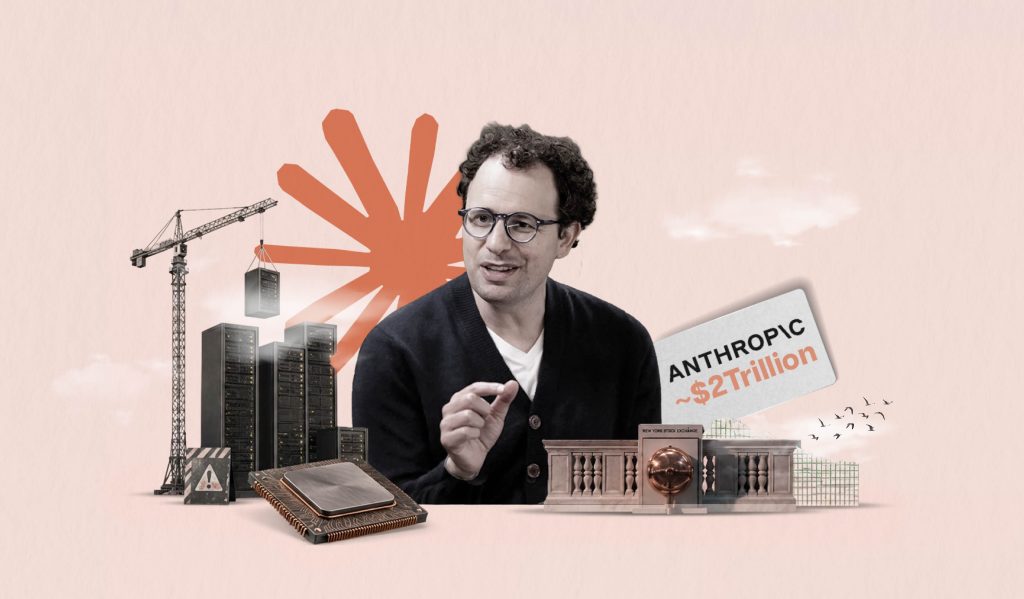
That company is Anthropic, the maker of Claude. Five years later, it is still betting on the same scaling curve, with hundreds of billions of dollars committed to computing power through contracts that run as far as 2045.
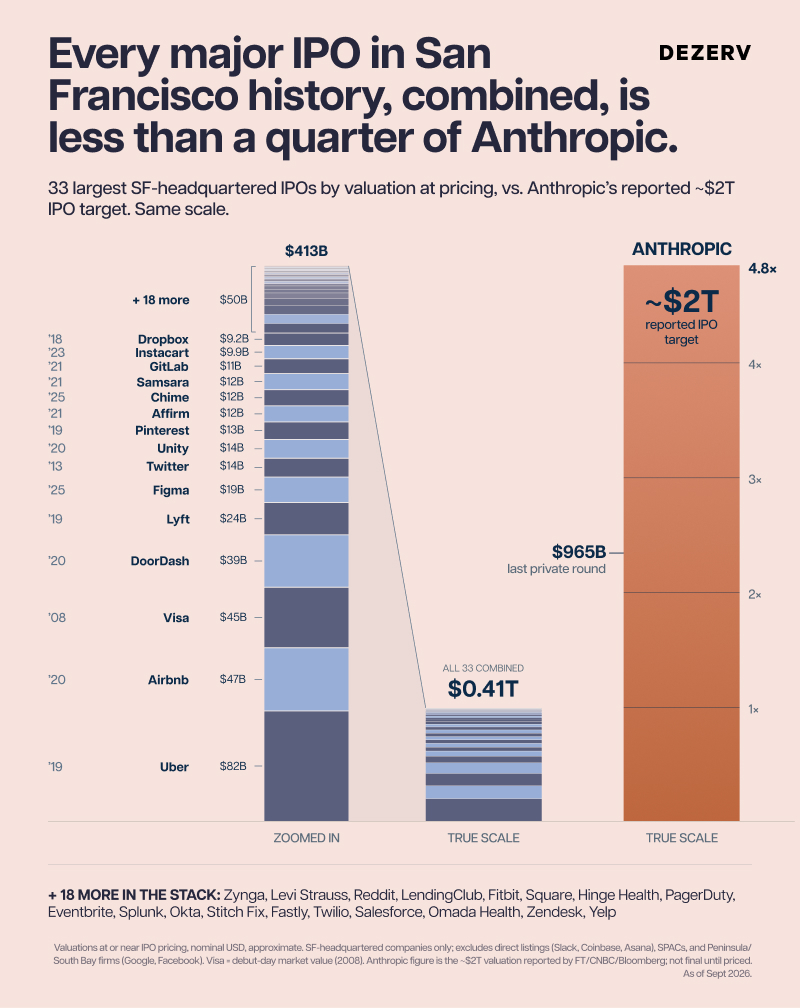
It filed for its IPO on 26 October and plans to list on Nasdaq in November, once its third-quarter results are out, at a reported valuation of $1.5-2 trillion. At the top of that range, it would be the biggest IPO in history, ahead of SpaceX’s $1.77 trillion listing in June, and nearly five times the $410 billion combined value of San Francisco’s 33 largest IPOs, with Uber, Airbnb and Twitter among them.
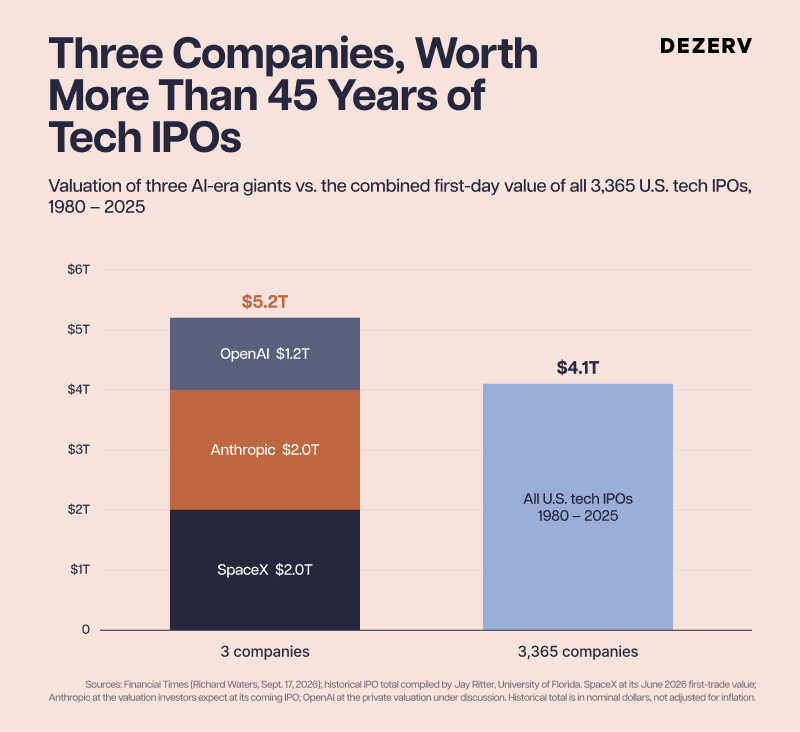
In today’s newsletter, we look at how Anthropic got here, how its business works, whether the price makes sense, and what it all means for India and for you as an investor.
In this edition:
- How a five-year-old company got to a $2 trillion conversation
- How Anthropic makes money
- Why investors would pay $2 trillion for a loss-making company
- What this IPO means for India
- How a wealth creator should think about a mega-IPO
How did a five-year-old company get to a $2 trillion conversation?
In February, Anthropic offered employees a chance to sell shares at a $350 billion valuation, with $5-6 billion in investor money lined up. The sale reportedly fell short as many employees chose to hold on. That conviction may come from seeing the business work up close. To understand what they see, it helps to look at how a company barely five years old got here. It comes down to three choices.
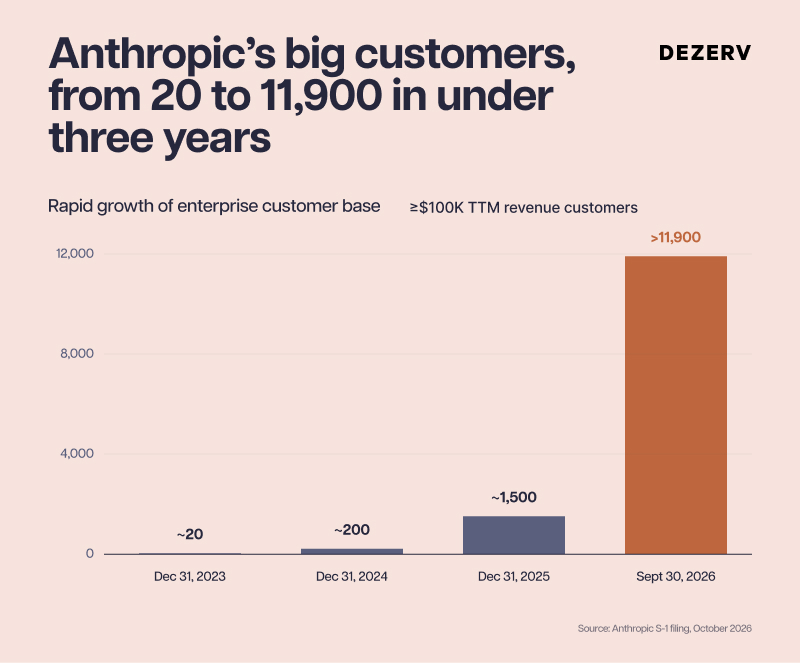
First, it built for companies and developers. While ChatGPT won over everyday users, Anthropic sold to businesses, which pay for reliability and spend more as their usage grows. Customers spending more than $100,000 a year rose from about 200 at the end of 2024 to more than 11,900 by September 2026.
Second, it found a killer use in coding, where results are easy to check and engineers are among a company’s highest-paid staff. Launched in early 2025, Claude Code lets engineers hand over entire tasks and reached a revenue run rate of over $2.5 billion within a year. Its models have also ranked near the top of SWE-bench Verified, a leading test of AI’s ability to fix real software bugs, for much of the past two years.
Third, it spent ahead of demand. It turned investor capital, including from Amazon and Google, into computing power before customers asked for it. Better compute made better models, which won customers and funded the next round.
The results compounded quickly. Revenue went from about $386 million in 2024 to $4.59 billion in 2025, and $16.3 billion in just the first half of 2026, with $11.6 billion in the second quarter alone. At that pace, Anthropic would earn over $46 billion a year, about one and a half times TCS’s roughly $30 billion, which took TCS five decades to build. Anthropic earned its first dollar of revenue in 2023.
The employees who held on were soon rewarded. A month after the offer closed, a funding round valued Anthropic at $965 billion, and by August it had reportedly out-earned OpenAI in a quarter for the first time. The right customer, the right use and the nerve to spend early built the company, and that last choice is what public investors now have to price.
The business of selling intelligence: how does Anthropic make money?
Every month, your electricity bill tells you how much you used and what it cost. Use more, pay more. Anthropic works the same way. It sells intelligence in units called tokens, each roughly a short piece of a word. When a business asks Claude to draft a contract, analyse a spreadsheet or write code, the meter runs, counting the words that go in and come out.
Anthropic sells those units in three main ways. Businesses and developers plug Claude into their products and pay for what they use. Individuals pay a monthly subscription. And coding tools like Claude Code sit in between, sold through both models.
The pay-per-use model matters most. A few weeks ago, I read an essay by Aswath Damodaran, often called the Dean of Valuation, who made a simple comparison. When Netflix adds a subscriber, its costs barely change. When an AI company adds a heavy user, costs rise with every question asked. On a flat monthly fee, he notes, such users “quickly become cost generators rather than profit centers.”
So Anthropic charges mostly by usage, which brought in 80% of its $16.3 billion first-half revenue, against $3.2 billion from subscriptions brought in $3.2 billion.Nearly half (48%) came through Amazon, Google and Microsoft’s cloud marketplaces. Its top five customers contributed about a quarter of revenue, though none accounted for more than 10%.
The costs are where AI differs from software. Selling another copy of Excel costs Microsoft almost nothing; every Claude answer uses computing power, and every new model needs training. In 2025, Anthropic spent $7.33 billion on compute and infrastructure, or $1.60 per dollar earned. By Q2 2026, it earned $11.6 billion against $5.6 billion in costs. Its latest model also cut the cost of a typical task by 40%, encouraging more usage.
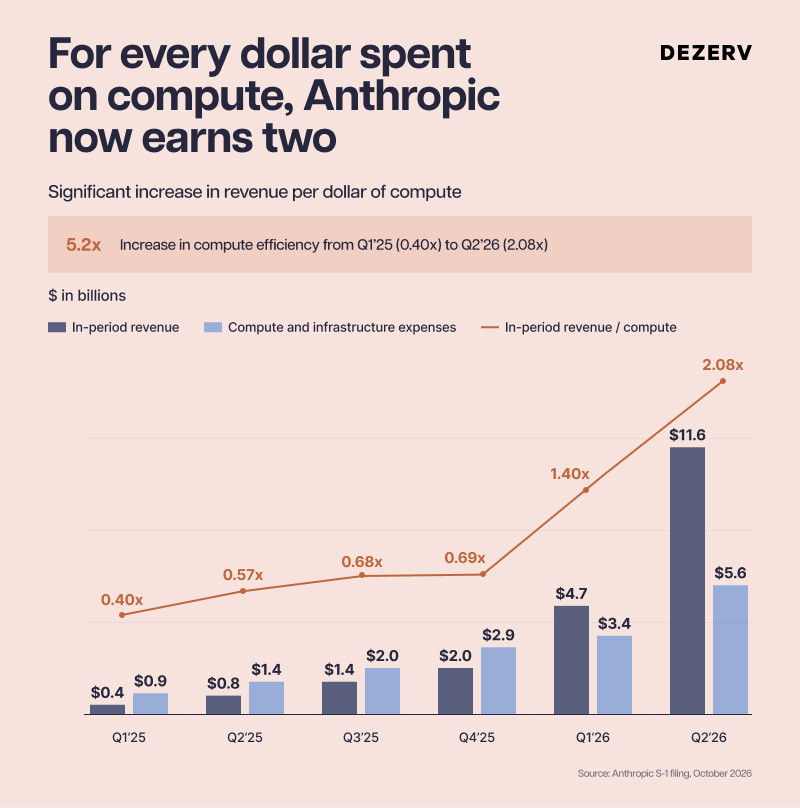
To secure compute, Anthropic has committed hundreds of billions of dollars, including about $114.5 billion to Google and $110 billion to Amazon, payable whether the capacity is used or not.
Picture a restaurant whose landlord runs the food court it sells through and owns a stake in the business. That’s roughly Anthropic’s relationship with Amazon and Google: they invest in it, rent it computing power and sell Claude to their customers. In November 2025, Microsoft and Nvidia committed up to $15 billion to Anthropic, while Anthropic’s commitments to Microsoft’s cloud reached about $44.9 billion.
In AI, one company’s capital spending is another’s revenue. Ares Management recently mapped $573 billion in AI financing across 26 deals involving eight companies, including Anthropic. Linked through debt, leases, chip supplies, customer contracts and guarantees, these deals all assume AI spending will continue. The structure helped Anthropic secure scarce chips, but a slowdown anywhere in the chain could ripple through the entire network.
The filing shows the model beginning to work. Anthropic’s adjusted operating margin rose from -221% in early 2025 to 19% in Q2 2026. It has shown that customers will pay for intelligence by the unit, and that it can now earn more from each unit of compute than it costs. The real test is whether that holds when hundreds of billions of dollars in new capacity come online.
Why would investors pay $2 trillion for a loss-making company?
Every IPO-bound company sizes its market generously. WeWork claimed a $3 trillion market in 2019, shortly before its listing collapsed. Anthropic points to over $40 trillion in annual global knowledge work, more than the entire US economy. If you read our SpaceX edition, this may sound familiar. SpaceX claimed a $28.5 trillion market, including $26.5 trillion from AI. By its own estimate, 93% of a rocket company’s market had nothing to do with rockets.
AI earns money by doing work people are paid to do today. Its market, therefore, cannot exceed what companies spend on that work, and it shrinks further if AI assists rather than replaces workers. After analysing the filing, Damodaran values Anthropic at about $1.475 trillion, even assuming its revenue approaches $1 trillion a year within a decade. Walmart, the world’s largest company by revenue, earns less than $700 billion.
The price also looks very different depending on which revenue you measure it against. It is about 435 times 2025 revenue, 43 times the annualised second quarter and 31 times the July run rate. The faster Anthropic grows, the cheaper the same price looks.
So why would anyone pay that price? Part of the answer is scarcity. Anthropic will be among the first frontier AI labs available to public investors, and says growth is limited mainly by computing power. Its 19% adjusted operating margin in Q2 gives investors more than hope to hold on to.
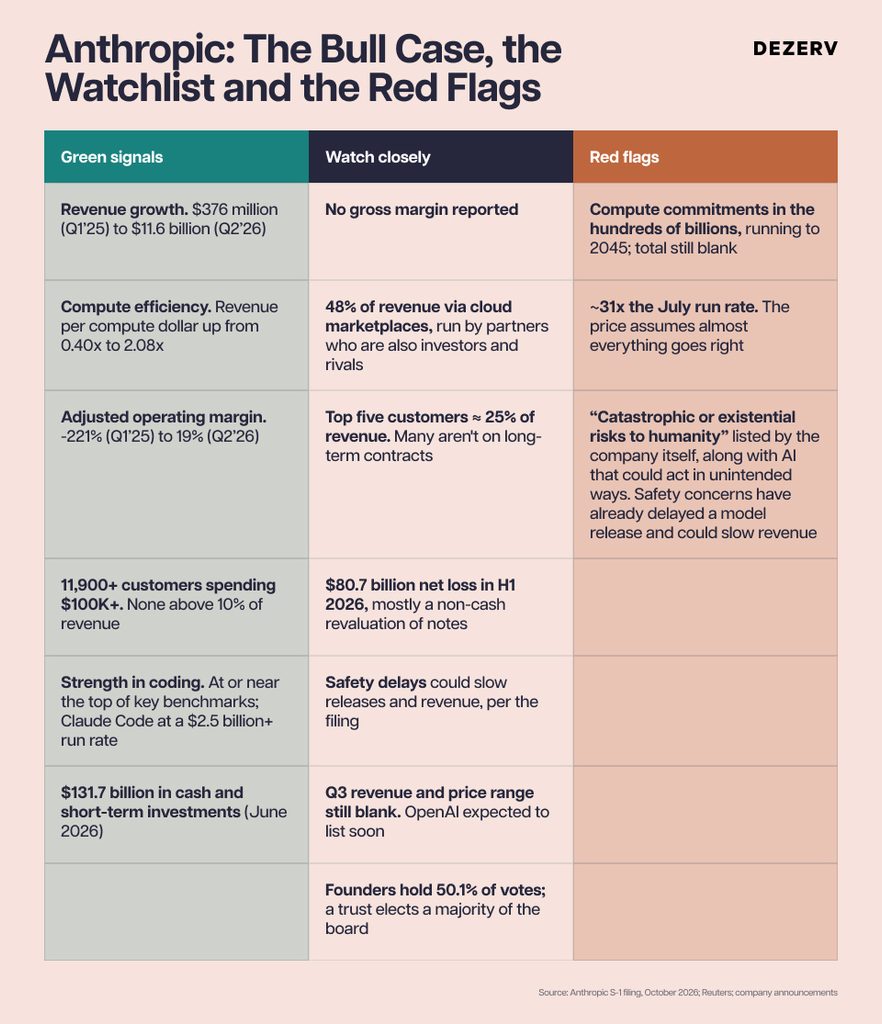
The filing is also unusually candid about the risks. Alongside slowing revenue growth and government regulation, it lists “catastrophic or existential risks to humanity” from the technology it sells. It warns that its AI could act in unintended ways, notes that it has already delayed a model release for safety reasons, and concedes that the scaling laws behind its growth may eventually plateau. The upside and the risks are being priced together.
What does this IPO mean for India?
For three decades, India’s IT industry sold skilled hours at prices below the West. Anthropic sells completed tasks by the unit. American clients now compare Bengaluru not just with California, but with AI software, and IT stocks have already felt the pressure.
Yet India is also among AI’s most eager adopters. It is now Claude’s second-largest market, with nearly half its usage going into coding and technical work. Anthropic’s revenue from India doubled in four months, and Cognizant is rolling Claude out to 350,000 employees.
Capital is moving in two directions. In the first four months of 2026, foreign investors pulled about ₹1.9 lakh crore from Indian equities, much of it flowing to Taiwan and South Korea for direct AI exposure. A $2 trillion Anthropic listing would add another destination. But Indian households, through monthly SIPs, now absorb much of that selling. With few pure-play AI stocks, some analysts see India as an “anti-AI trade”: less exposed if AI valuations fall and potentially a beneficiary if money rotates out of AI into other markets.
The physical build-out is coming here as well. Microsoft and Google are building major AI data centres in Hyderabad and Visakhapatnam, while AI labs, including Anthropic, are hiring in Bengaluru. India could supply both the infrastructure and talent behind AI, even as the biggest valuations sit in New York.
How should a wealth creator think about a mega-IPO?
Many of us used Claude this week, to draft a note or check some code. That familiarity can mislead, because knowing a product well is not the same as knowing what its shares are worth. Before reacting to a listing this size, four questions help.
- Is the belief in the company, or in the price? You can believe AI will reshape the economy and still question paying $2 trillion for one company today.
- How much do you already own? Amazon and Google hold large stakes in Anthropic, so US tech funds may already give you some exposure. If you work in technology or hold IT stocks and ESOPs, much of your wealth already rides on AI.
- What say will you have? The founders will control 50.1% of the votes, while an independent AI safety trust will elect most of the board. Public shareholders get the economics, not control, much like in promoter-led Indian companies. That concentrates power in a few hands, something investors should consider before buying.
- What will you watch? Five years of numbers is a short track record for a company seeking a century-old giant’s valuation. The final filing should reveal third-quarter revenue, total compute commitments and the price range. Revenue well above $16 billion would suggest growth is still accelerating beyond July’s pace.
The listing will be over in a day. Almost everyone trading the stock in those first weeks will be pricing it, not valuing it. The answers to these questions will take a few quarters, and they will decide whether $2 trillion was a fair price.
DISCLAIMER: Investment in the securities market is subject to market risks. Read all related documents carefully before investing. The information contained in this newsletter is for general informational and educational purposes only and does not constitute investment advice, a recommendation, or an offer to buy or sell any securities. The information provided is not a complete disclosure of every material fact, term or condition relating to any investment or security. In preparing this newsletter, Dezerv has relied on publicly available information and other sources believed to be reliable. While reasonable care has been taken to ensure the accuracy of the information, Dezerv does not guarantee its accuracy, completeness or reliability. The views and opinions expressed are based on information available as on the date of publication and may change without notice. Past performance is not indicative of future returns. All trademarks, logos and brand names mentioned are used for identification purposes only.