
On Sunday, 8 November, in the middle of Diwali, the stock exchanges will open for a little over an hour. The session begins with a Lakshmi puja, and families across the country place a small trade for a good start to the year. It’s called Muhurat trading, and the custom is older than the exchange itself.
In the 1850s, a handful of brokers began trading shares under a banyan tree in front of Bombay’s Town Hall. When the American Civil War cut off cotton supplies to Britain, Bombay cotton boomed, and the crowd under the tree kept growing. In 1875, a little over two dozen of them put in one rupee each and formed the Native Share and Stock Brokers’ Association, which later became the BSE.
Most of those early brokers were Gujarati, and they brought their Diwali traditions with them. Diwali was when the family’s account book was closed. The year’s accounts were settled, and a fresh book was opened with Shubh-Labh (good fortune and profit) written on its first page. In 1957, the BSE introduced an official trading session that evening, and the NSE followed in 1992.
The old ritual followed one order: close the old books, then open the new ones. We still keep the second half every Diwali. The first is easy to skip, especially with our investments.
Last Diwali, a 55-year-old Head of Product from Bengaluru came to us, a few years from retirement. He had ₹1.45 crore across 33 mutual funds, up 15.1% that year, a little ahead of its benchmark.
Everything looked fine until we laid all 33 funds out on one page. What we found were mistakes we see in portfolio after portfolio, the kind most investors make while being fairly sure they’re doing everything right.
So, this Diwali, let me walk you through his portfolio’s clean-up, and what you can take from it for your own.
In this edition
- How much equity is right for you now?
- How many funds do you really need?
- What to do with sector and thematic funds
- How to exit funds without overpaying tax
- How often should you rebalance?
How much equity is right for you now?
Harry Markowitz won a Nobel Prize for showing the world how to spread risk. Yet for his own retirement savings, he didn’t use any of his own equations.
He simply split the money half and half between stocks and bonds. Years later, he told the journalist Jason Zweig that he had pictured how he would feel if the market soared while he was out of it. “My intention was to minimize my future regret.” Much later in life, he said he no longer invested that way. His mix had changed as his life did.
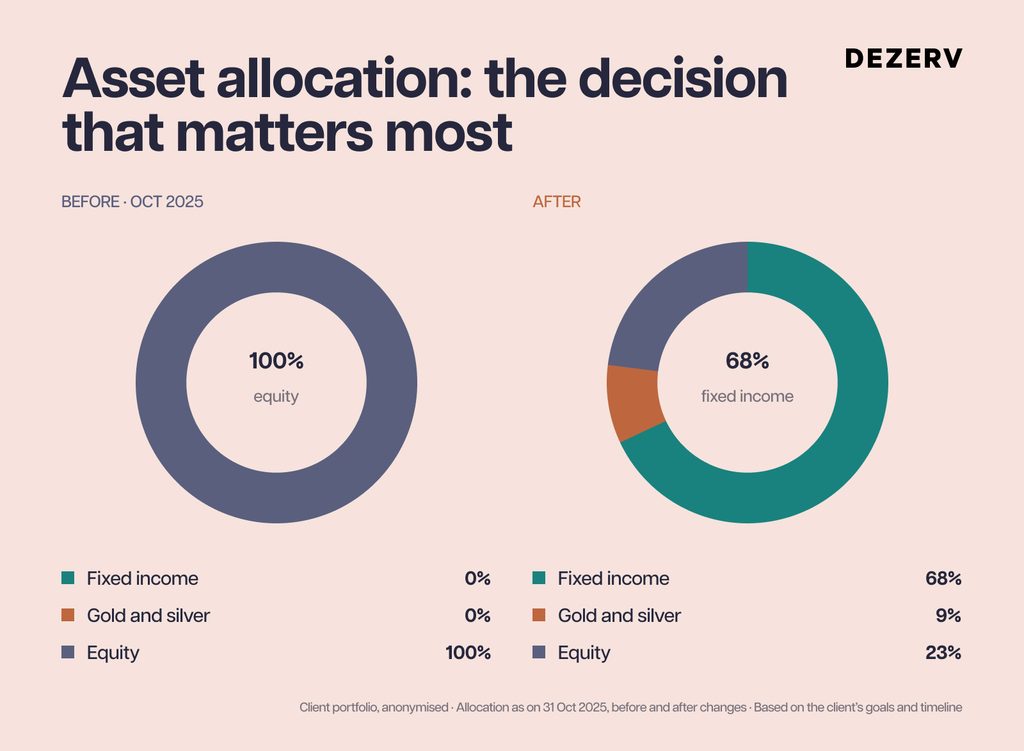
Our client was at the other extreme. At 55, a few years from retirement, every rupee of his ₹1.45 crore was in equity, with nothing in fixed income or gold.
At 35, you can wait out a market fall, even buy into it. At 58, the same fall arrives just as you need the money, and the only way to recover is to keep working. This is sequence risk: the closer you are to using the money, the more the order of good and bad years matters.
Based on his goals, we moved him to 68% high-quality fixed income for steady income, 9% gold and silver as a cushion, and 23% equity for growth.
There is no single right number. A 40-year-old might reasonably want 90% in equity; for our client, 23% was right. What decides it is less how you feel about the market and more when you’ll need the money. An easy way to work out yours is to split your portfolio into three pots:
- Money you’ll need within three years: keep it out of equity, because there is no time to recover from a fall.
- Money for goals three to five years away: a mix of equity and fixed income.
- Money you won’t touch for five years or more: this can lean heavily on equity.
Add up the three, and you’ll know roughly how much belongs in equity. Most of us set our mix once, in our thirties, and never revisit it. A portfolio should grow older along with its owner.
How many funds do you really need?
When Ratan Tata became chairman of the Tata Group in 1991, he inherited a group that made almost everything: soap, lipstick, paint, cement, medicines, refrigerators. Over the next decade, he began letting much of it go.
TOMCO, the soap maker, went to Hindustan Lever in 1993, and Lakmé followed. Merind went to Wockhardt, the Nerolac paints stake to Kansai, and ACC to Ambuja. Some, like Lakmé, were household names. Each had been added for a reason that made sense at the time, but together they no longer fit the group he was building.
Most portfolios grow in much the same way. One fund is added on a colleague’s recommendation, another because it tops a ranking, and another because a new launch sounds promising. By last Diwali, our clients’ portfolios held 33 funds.
Some did the same work twice. He held both a Nifty 50 TRI and a Sensex index fund, though nearly all of the Sensex’s 30 companies are also in the Nifty 50 TRI. He was paying twice for the same companies.
Then there were 11 tax-saver (ELSS) funds, which usually means eleven Marches of last-minute tax buying, each from whichever fund topped the list that year. Every instalment has its own three-year lock-in, so you can’t simply exit one that lags. And under the new tax regime, the default since 2023, ELSS earns no tax deduction at all, yet many still buy one every March out of habit.
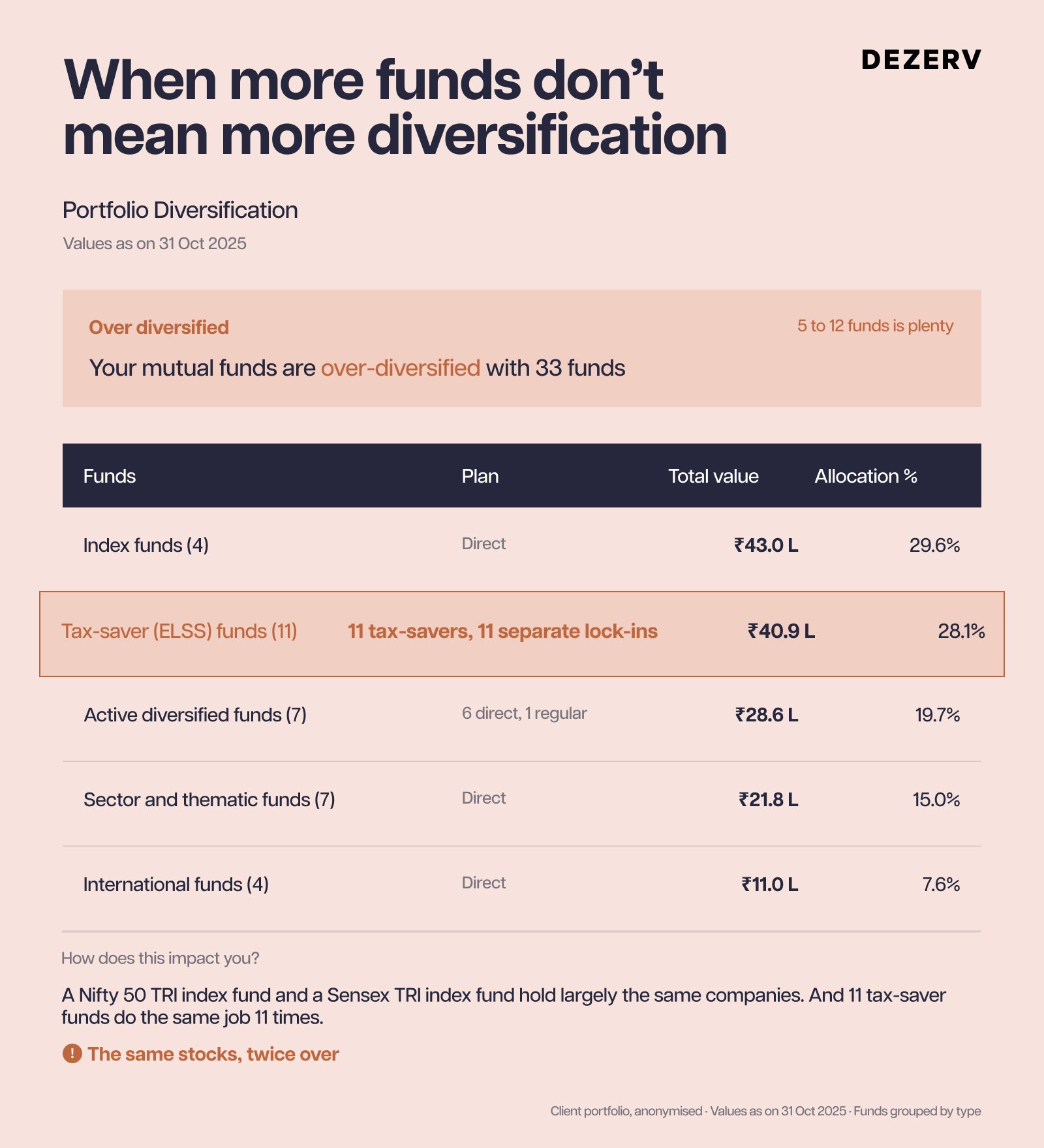
More funds feel safer, but past a point they only add fund managers holding the same companies, and leave you with less control over your own money. For most portfolios, 5 to 12 funds is enough. A simple way to get there is to give each fund one role:
- 1-2 funds for the broad market (large-cap, flexi-cap or index)
- 1-2 funds for growth (mid-cap or small-cap)
- 1-3 funds for stability (debt)
- 1 fund for gold
- 1 international fund, if you want one
- 1 tax-saver, only if you’re on the old tax regime
If two funds play the same role and hold largely the same companies, keep one. Ratan Tata kept a business when it did a job nothing else in the group was doing. The same test works for a portfolio: a fund earns its place when it does a job no other fund in it is already doing.
What to do with sector and thematic funds
Last Dhanteras, queues outside jewellers ran longer than usual. Silver had crossed ₹1.6 lakh a kg, and news channels were asking whether it was the new gold.
The rally kept going, to a record ₹4.20 lakh a kg on MCX (India’s main commodity exchange) on 29 January 2026. The very next day came one of its sharpest falls in decades, and this week it trades at about ₹1.96 lakh. Someone who bought at Dhanteras is still ahead. Someone who joined the January rush has lost more than half
Silver was only one of last Diwali’s hot ideas. The same season’s headlines said defence funds were “exploding,” large-cap IT was a “contrarian opportunity,” railway stocks were rallying, and pharma was falling after the US announced a 100% tariff on branded drugs.
A year on, the results look almost random. The pharma sector, the one with the scary headline, ended up 23%. IT fell 18% and railway stocks fell 25%, while the Nifty 50 fell 8%.
Our client had 11 funds riding on ideas like these: seven sector and thematic funds, and four international funds betting on other countries. Together they made up nearly a quarter of his portfolio.
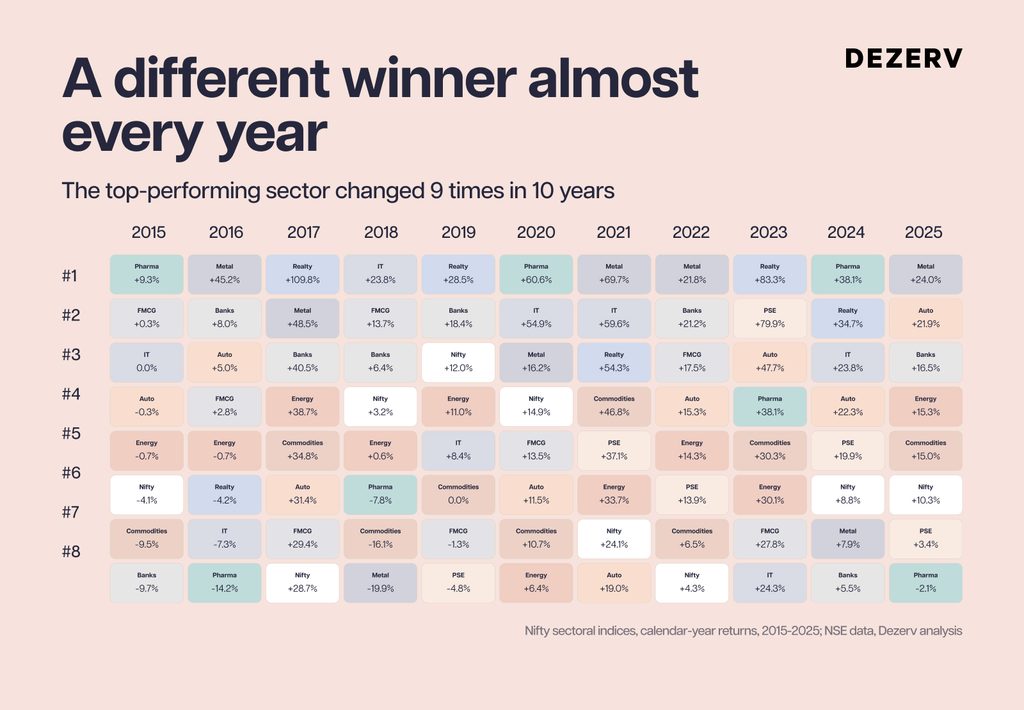
The table shows how hard the game is. Pharma topped the table in 2015 and finished last in 2016, then did it again in 2024 and 2025. Yet in 2024, two-thirds of all new fund money (₹79,109 crore of ₹1.18 lakh crore) went into sector and thematic launches, mostly chasing whatever had just done well.
A sector fund asks you to be right twice: once on when to get in, and again on when to get out. For him, those bets were the first to go, and his growth now comes from five diversified funds.
How to exit funds without overpaying tax
In the early 1990s, a young economist at Berkeley named Terrance Odean got hold of an unusual dataset: seven years of trades from 10,000 accounts at a US brokerage. He wanted to see what ordinary investors sold and what they held on to.
The pattern was striking. People sold their winning stocks far more readily than their losing ones, because booking a profit feels good and booking a loss feels like admitting a mistake. Then he checked what happened next. Over the following year, the stocks they had sold beat the ones they kept by 3.4 percentage points.
Behavioural economists call this the disposition effect. Over time, the portfolio fills up with the funds you were most reluctant to look at. When people finally clean up, they often swing the other way and sell everything at once. That can be expensive, because every exit comes with a bill.
Selling an equity fund within a year of buying it attracts 20% short-term capital gains tax. After a year, gains above ₹1.25 lakh in a financial year are taxed at 12.5%. Many funds also charge an exit load (a small fee, usually 1%, for leaving within the first year), and tax-saver funds can’t be sold at all until their lock-in ends. That is one fund. Our client had 33, and each one needed the same set of decisions, in the right order.
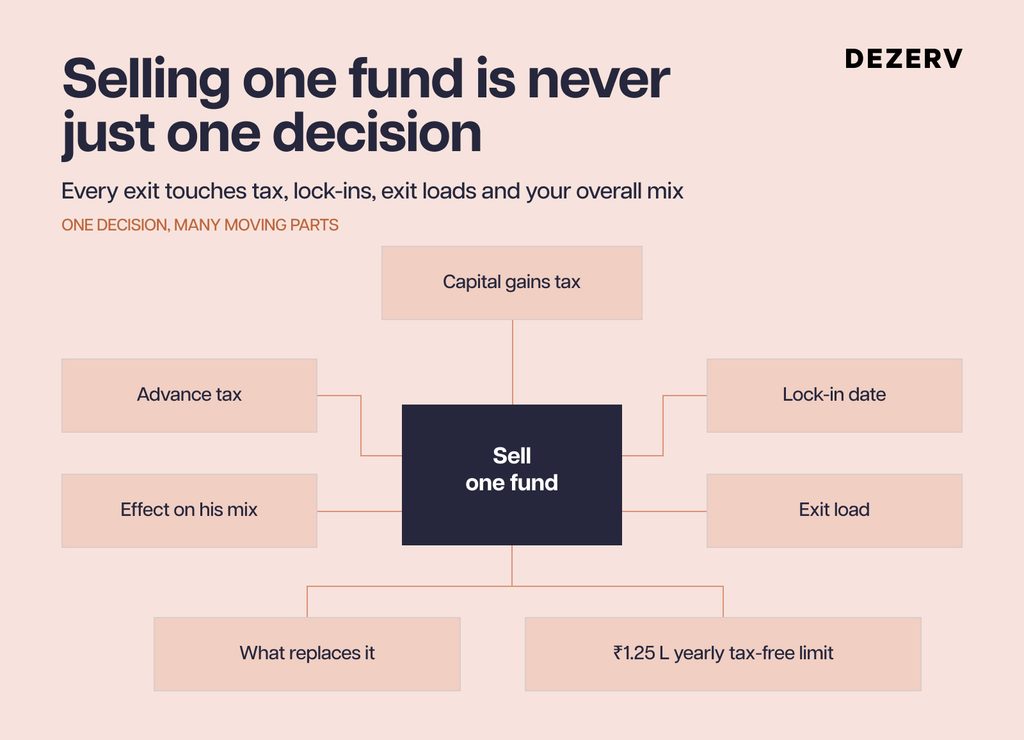
So our client’s clean-up was spread out, not done in a single day. Some funds went immediately; others waited for an exit load to fall away or a lock-in to end. Sales were spread across 31 March to use two years of the ₹1.25 lakh exemption, and losses were used to offset gains.
His 12 regular plans (which carry a distributor’s commission in their fees) moved to direct plans of the same funds, saving about ₹42,000 a year. Across the industry, regular plans still hold 70-78% of SIP money.
A clean-up done in a hurry can cost more than the clutter it removes. Knowing what to sell is half the work; deciding when to sell each one is the other half.
How often should you rebalance?
When Lehman Brothers collapsed in September 2008, panic spread through markets across the world, and investors rushed to sell whatever they could. In Oslo, the team running Norway’s oil fund was doing the opposite. As prices kept falling, they kept buying shares.
They had no special insight into where the market was headed. The fund’s rulebook required a fixed share of its money in stocks; as prices fell, that share shrank, so the rules said buy. By year-end its shares had fallen 40.7%, and the fund had lost about $90 billion, its worst year ever.
The buying carried on into the first half of 2009. That year, the fund gained 26%, and its CEO, Yngve Slyngstad, later said those crisis-time purchases had “yielded solid returns.”
What Norway was following is called rebalancing: bringing your mix back to target when markets push it off course. The fund aims to keep 60% in stocks. If that share rises above 64%, it sells; if it falls below 56%, it buys. Norway’s central bank governor estimated that this discipline alone added about half a percentage point a year to returns.
Back home, a portfolio drifts the same way, even untouched. A good year in small caps can turn a 20% holding into 35%. Fund managers move on, styles shift, and goals change: a child’s admission, a new home, retirement drawing closer.
So our client’s portfolio now has a fixed check-in every quarter. Each time, we look at four things: whether the mix has drifted, whether any fund’s fundamentals have changed, whether his goals have changed, and whether a new one has come up. It is adjusted only when something has moved enough to matter, and where possible through fresh investments instead of sales, so no tax is triggered.
There’s no perfect frequency for rebalancing. The sensible middle is a fixed review date, at least once a quarter, and a limit agreed in advance for when to act, so the decision is made calmly, before the market forces it.
Diwali gives the house one thorough clean a year. What keeps it that way is the attention it gets in the months in between.
After the clean-up
A year after the clean-up, the two versions of his portfolio stand far apart. Left untouched, it would be worth ₹1.38 crore today. With the changes, it is worth ₹1.56 crore.
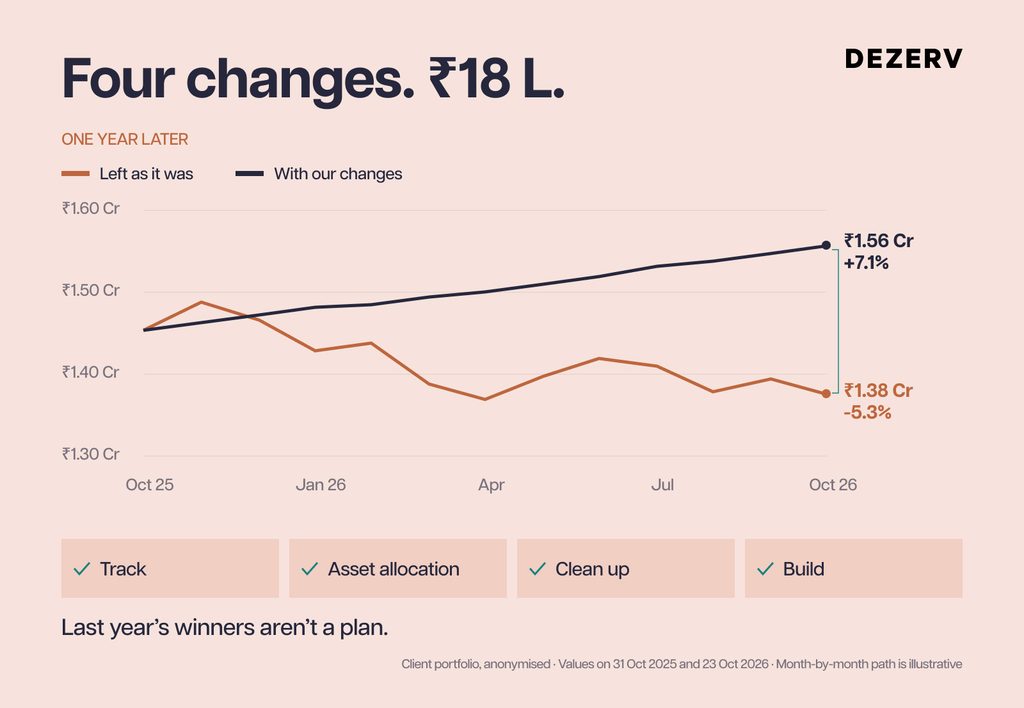
He made no bold market calls. The mix fits his retirement, every fund has a job, the sector bets are gone, exits were timed for tax, and the portfolio is reviewed every quarter
Happy Diwali.
DISCLAIMER: Dezerv Investments Private Limited is a Portfolio Manager with SEBI Registration No. INP000007377. Distribution services are offered through Dezerv Distribution Services Private Limited vide APRN-00615. Investment in the securities market is subject to market risks. Read all related documents carefully before investing. The information contained in this document is for general purposes only and is not a complete disclosure of every material fact, term or condition. The information provided herein is intended solely for educational purposes. In preparing this document, Dezerv has used publicly available information and other sources believed to be reliable. While reasonable care has been taken to present reliable data in this document, Dezerv does not guarantee the accuracy or completeness of the data. Please consult your legal, tax and financial advisors to determine the implications or consequences of your investments in such securities, assets or portfolios before making any investment decisions. Any examples, illustrations, portfolio allocations or performance figures mentioned are for illustrative purposes only and may not be representative of actual results. Past performance is not indicative of future returns. All trademarks, logos and brand names mentioned are used for identification purposes only.