


In the spring of 1956, two brothers in their eighties sat down with their lawyer in San Francisco. They owned a small chain of newspapers on the California peninsula. They were ready to retire, and they had a decision to make.
The easy option was to sell to a larger newspaper chain. Chains like that were buying up small papers across the country, and the money would have been good. But the brothers had watched what happened after those sales, the new owner would cut the newsroom, cut costs, and move on. They didn’t want that for the people who’d spent their careers building the paper with them.
So they asked their lawyer, a man named Louis Kelso, for something that didn’t really exist yet: a way to sell the company to their own employees, even though none of the employees had the money to buy it.
Kelso found a way to make the deal work. A trust was created to buy the brothers’ shares, using a loan. The brothers were paid in full immediately. The employees didn’t personally owe the loan. The trust repaid it over the years using the newspaper’s profits. As the loan was paid off, the shares were transferred from the trust to the employees. Eventually, the employees owned the entire company.
Two years later, Kelso wrote a book arguing that his idea could address a much bigger fear gripping the country. Machines were getting smarter, factories were automating faster, and economists feared workers would lose their bargaining power as businesses needed less labour. Kelso’s argument was blunt: if machines were going to do more of the work, financial security would belong to those who owned them, not just those who operated them.
Replace “machines” with “AI” and the argument could have appeared in a business paper last week. It was written in 1958. Kelso believed ownership was the one thing that couldn’t be automated out of a person’s hands. Seventy years later, AI is putting pressure on the jobs that once gave young professionals a reliable start. This week, we revisit Kelso’s idea and ask what ownership could mean for an Indian wealth creator today.
In this edition:
- Where AI is actually hitting jobs right now,
- AI Is changing work before It changes jobs
- How to build wealth when AI threatens your job
- Why ESOPs Matter for Economic Security in the age of AI
- A simple way to evaluate your own equity, as an asset and not just another bonus
Where AI is actually hitting jobs right now
Coal miners used to carry a caged canary down into the tunnels with them. Canaries breathe faster than humans and need more oxygen per pound of body weight, so if the air turned poisonous, the bird went quiet first, well before the miners were affected. The canary gave them an early warning that something was wrong.
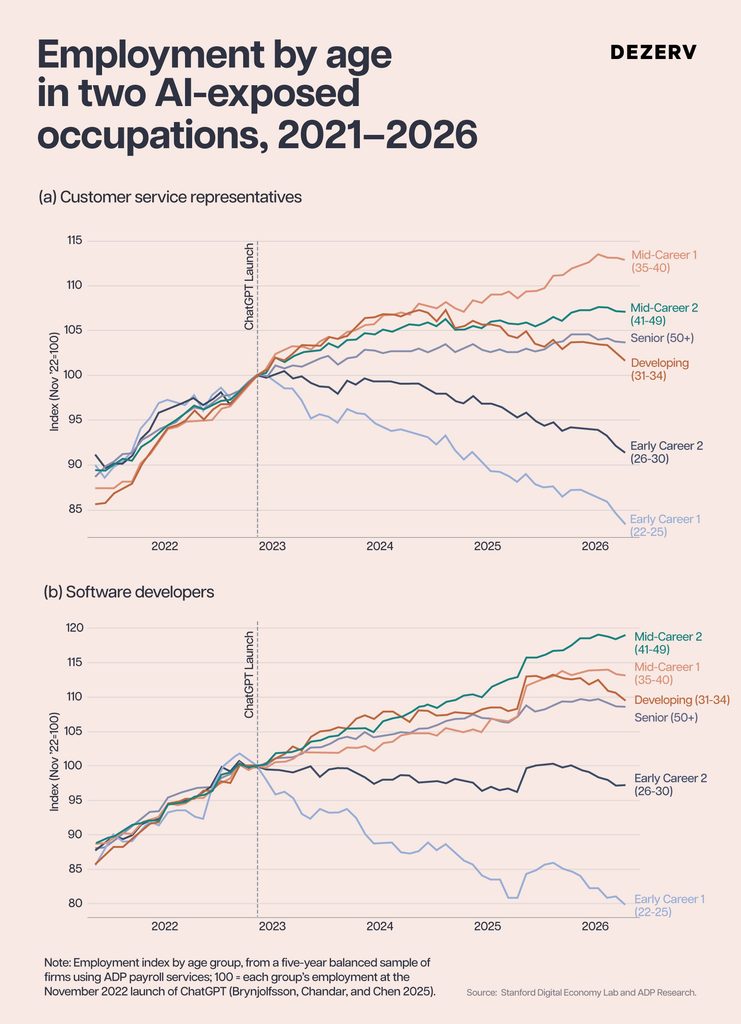
A team of Stanford economists found a similar pattern in US employment data. They studied software developers and customer service workers, two jobs heavily exposed to AI, and tracked employment by age from November 2022, when ChatGPT launched. Among 22-to-25-year-olds, employment in these roles has been falling. Among 35-to-49-year-olds doing the same work, it continued to rise.
They’re calling the younger workers the canaries.
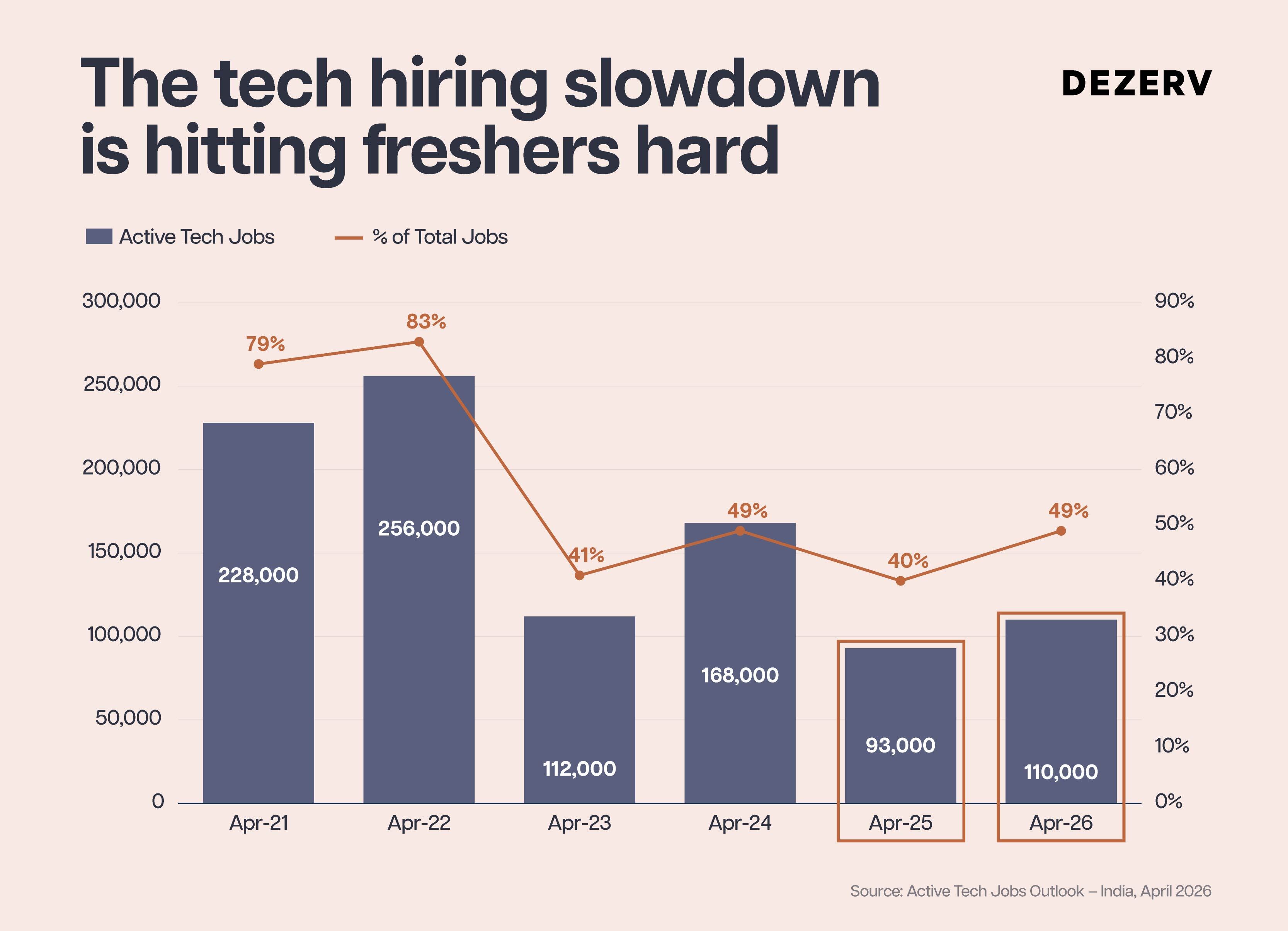
In India, the pressure is showing up earlier in the career ladder. Oracle cut roughly 21,000 jobs globally as it restructured around AI. TCS cut jobs too, but said most of the cuts were in middle and senior grades, not among freshers. The squeeze on younger workers is showing up somewhere else: getting in. Entry-level tech openings in India fell 44% year-on-year to roughly 10,000 roles by June 2026. Infosys’s under-30 workforce share has slipped from 60% three years ago to 51% today.
If AI keeps advancing at its current pace, many of the workers whose jobs are affected will have to find work elsewhere. According to Anthropic, over the next four years, many could move into jobs where AI has a harder time replacing human presence — electricians, nurses and other work that still needs someone physically there. The shift shows up in pay too: workers in these jobs could see wages rise more than 30% above where they would otherwise have been, while knowledge workers whose tasks are easier for AI to automate could see their pay remain flat or fall, even as the broader economy continues to grow.
For a 22-year-old starting out in software, that is a very different future from the one they were preparing for.
AI Is changing work before It changes jobs
Technological shifts have always changed the kind of work people do. In 1800, more than 80% of the US workforce worked on farms. Today, fewer than 2% do. But that transition took generations. AI is being adopted much faster, which raises the possibility that the disruption could happen much faster too. And this time, the workers exposed aren’t just factory workers or farm labourers. They are the “laptop class”, people whose jobs were long considered relatively protected from automation.
AI also affects workers differently depending on their experience. At a large call centre, a generative AI assistant helped novice agents resolve 30% more calls per hour, while the most experienced agents saw almost no improvement. With GitHub Copilot, junior programmers finished tasks 56% faster, while senior engineers saw a much smaller gain. Among writers, ChatGPT narrowed the gap between average and strong work more than it improved the strongest writers.
Researchers call this the jagged frontier. AI often raises the floor faster than the ceiling.
Experience used to compound over a long career. The World Economic Forum estimates that the useful life of a professional skill has fallen from 10-15 years a generation ago to under five today, and closer to two years for skills linked to AI. Goldman Sachs estimates that up to 300 million jobs worldwide have meaningful AI exposure.
Expertise still matters. But 20 years of experience can lose some of its advantage much faster when the tools themselves keep improving. That is why today’s employment numbers may not tell us much about where this ends. Gartner expects one in five organisations to cut more than half their middle-management layers by the end of this year. Whether AI is driving the cuts or simply making them easier to justify, the shape of the workforce is changing.
How to build wealth when AI threatens your job
Two things are true at once, and neither is going away on its own. The people just entering the workforce are the first to feel AI’s effect on hiring. And the people who spent decades building up experience are watching the value of that experience compress faster than it used to. These are different stages of the same problem: income that depends on your labour continuing to be needed is becoming less certain.
There is also a bigger question about who captures the wealth AI creates. Today, roughly 60 cents of every dollar the economy produces goes to labour, while about 40 cents goes to capital. If AI takes on a much larger share of knowledge work, that split could change significantly. In a more aggressive scenario, labour’s share falls from 59.4% to 45.2%. The economy grows. The total pie gets bigger. But workers take home a smaller share of it, while more of the gains accrue to those who own the AI, software and infrastructure behind the growth.
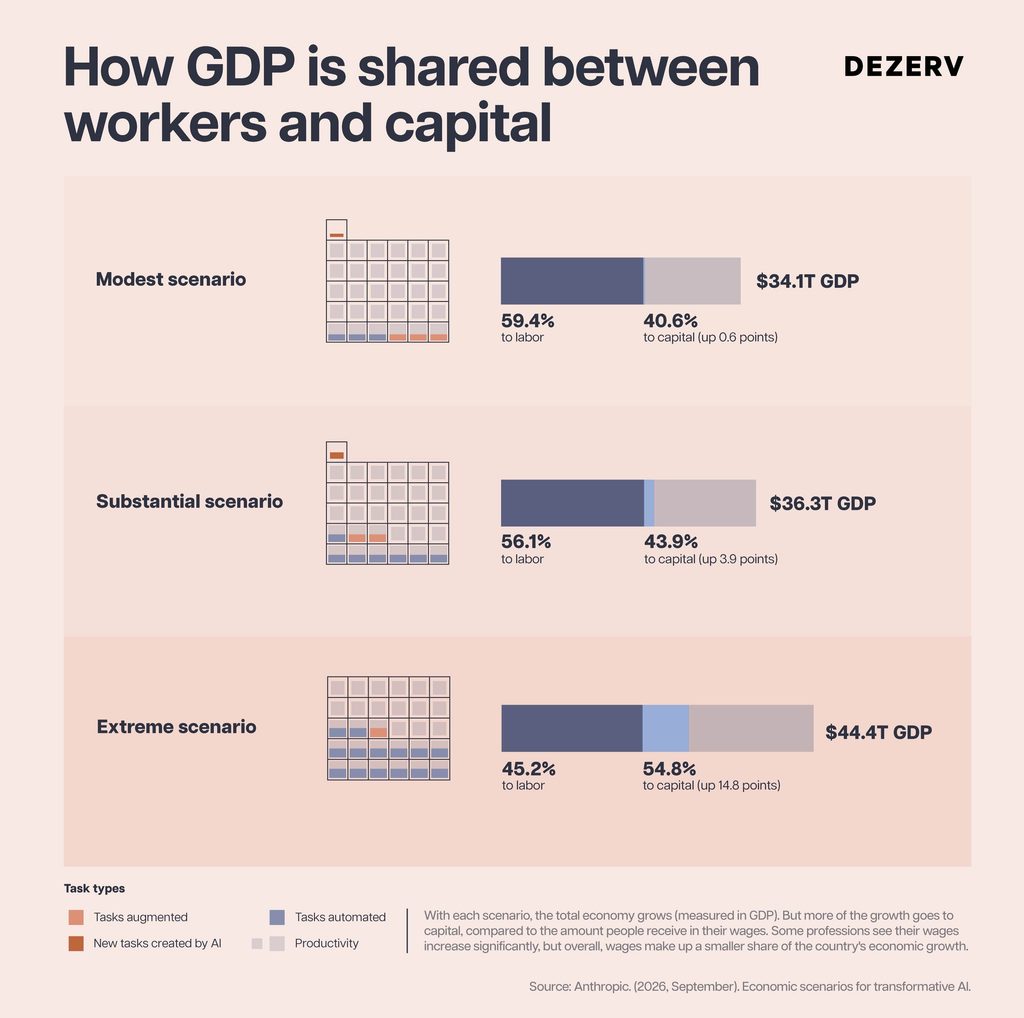
That may be one of the biggest changes AI brings to work. Your salary pays you for your labour. Ownership gives you a share of the value created by the technology you use.
Kelso was asking the same question in 1956: if machines create more of the wealth, who gets to own them? His answer was workers. It took nearly two decades for that idea to get a formal structure. In 1974, ERISA gave it a legal framework and a name: the Employee Stock Ownership Plan.
Today, ESOPs are often treated as a perk, extra upside if the company does well. But for many employees, they have become a meaningful source of wealth. In India, ESOP wealth now stands at roughly ₹14.2 lakh crore, nearly a quarter of the mutual fund industry’s AUM. And it goes well beyond startups. In 2024, HDFC Bank alone paid out ₹5,282 crore through ESOPs, more than all Series B+ startups combined.
The same shift is visible in the way multinational companies pay senior employees in India. Google, Microsoft, Amazon and Meta all use RSUs, restricted stock in their publicly listed parent companies, as a standard part of senior compensation. By 2026, this equity was adding 30-80% to fixed pay at senior levels.
For professionals, that changes how equity needs to be viewed. When a salary is the dependable part of compensation, equity can feel like a bonus. When the salary itself becomes less certain, ownership starts to matter differently. Equity starts to look less like a bonus and more like insurance.
Why ESOPs Matter for Economic Security in the age of AI
If you joined Nvidia seven years ago as a fresh graduate, you would be worth $1.6 million today. A 22-year-old joining in 2019 could be 29 now, and already a millionaire. Not from generational wealth, not from a lottery ticket, not from starting a company. Just an engineering job, and the discipline to hold onto the stock.
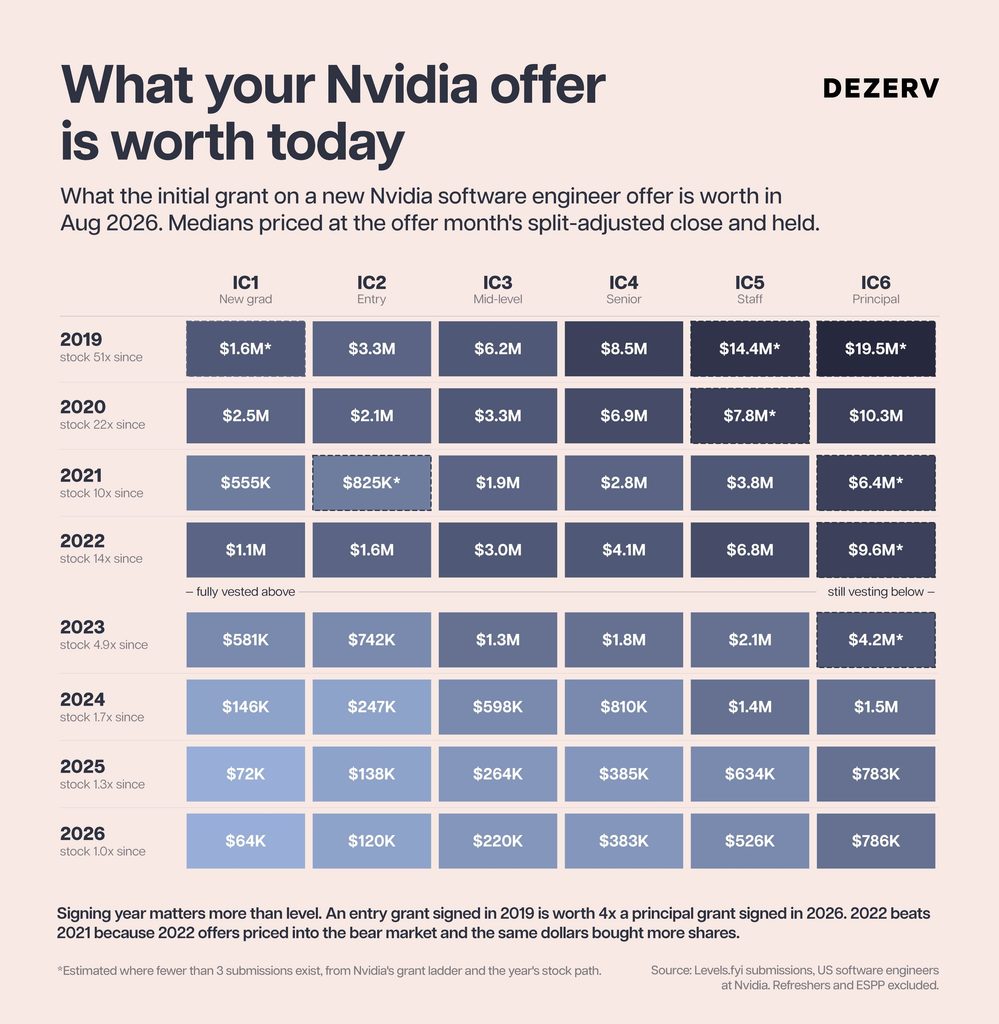
That’s what makes ESOPs so powerful. I like to think of it as Economic Security through Ownership and Participation. Your salary pays you for the work you do. Your equity gives you a piece of the company you’re helping build. If the company grows 10x, your salary probably won’t. Your equity can.
For most people, economic security depends on their ability to keep earning. Lose the job, and the income stops. If the value of your skills falls, your earning power can fall with it. But economic security also comes from owning productive assets, not just from selling labour.
That becomes important when technology changes how much labour a business needs. AI could allow a coder, analyst, designer or researcher to produce far more in the same amount of time. Companies may need fewer people even as they become more productive. Owning part of that company gives employees another way to participate in the wealth being created.
There is also a practical benefit. Imagine spending eight years at a company and accumulating meaningful equity. If your role disappears in year nine, you may still need another job. But if that equity has become valuable and you can sell it, you don’t have to start again financially. You have time — to take a break, retrain, start a business, invest, or choose a job that pays less because you have more freedom.
That is what ownership can ultimately buy you: the ability to say no. Of course, an ESOP only creates that security if the equity actually works. Ten thousand options can sound like a fortune until you realise they represent 0.005% of the company. What matters is what you own, what you pay for it, dilution, vesting and whether there is a realistic path to liquidity.
There is a trade-off too. Taking less cash for equity can make sense, but not at the cost of money you need today. So don’t just ask how many ESOPs you’re getting. Ask what could those options eventually do for your financial life?
A simple way to evaluate your equity, as an asset and not just a bonus
In 2002, more than 50 million people already owned a digital camera, and digital camera sales overtook film for the first time. Kodak had seen it coming: its own engineers had built the first digital camera decades earlier. Yet Kodak stock was still in the top third of the S&P 500. Anyone holding it had every reason to feel secure. Four years later, the stock had lost 90% of its value. By 2012, Kodak was in bankruptcy.
Nobody’s equity needs to be tied to a company as dramatic as Kodak for the same lesson to apply. Equity doesn’t automatically protect you. It only becomes insurance once you understand what you actually own and what could affect its value. There’s a simple way to check that, starting with the parts of your grant letter that determine what your equity is actually worth:
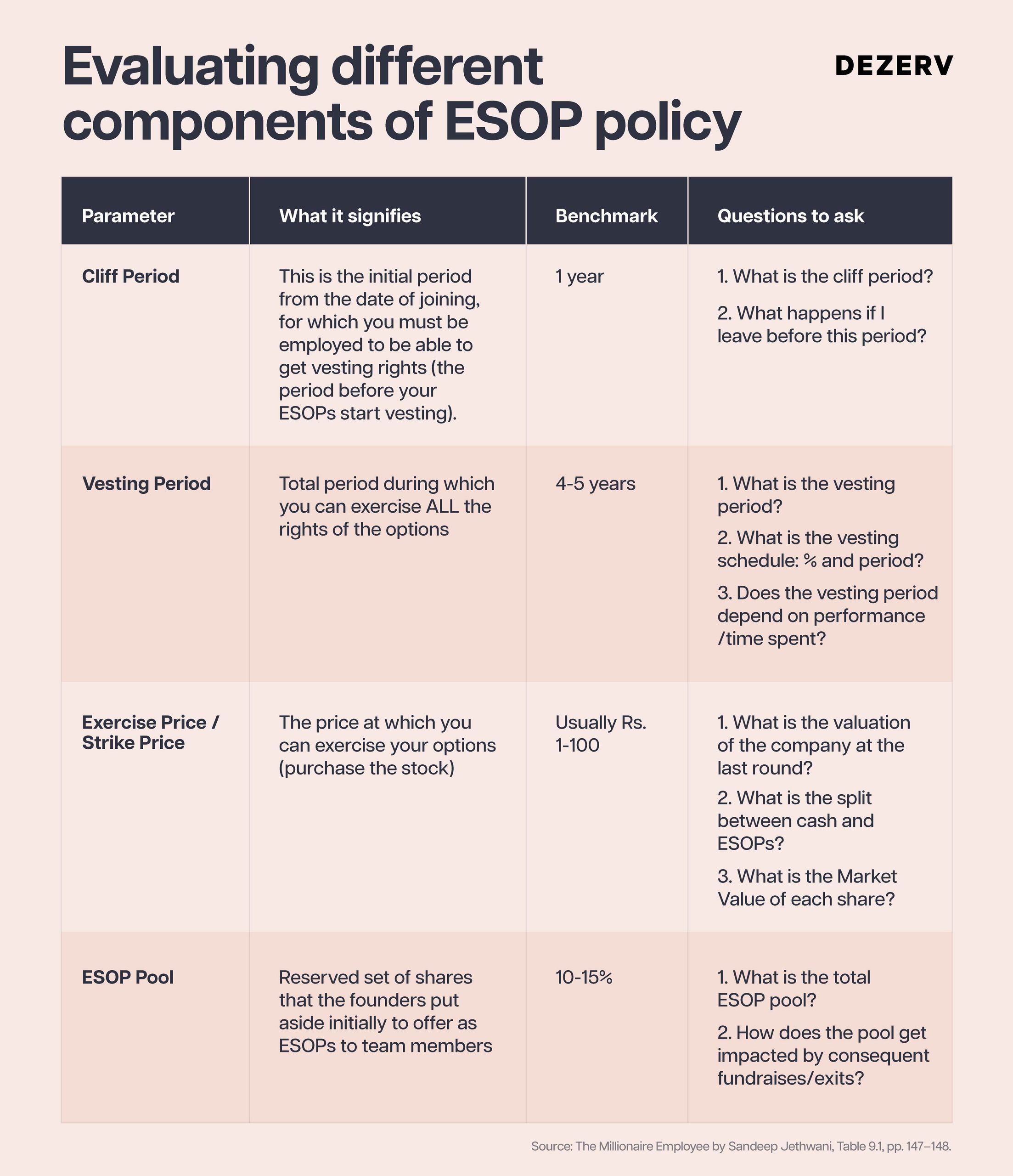
A Dezerv survey of 800+ ESOP holders found that even among those with over ₹1 crore in equity value, 94% couldn’t identify the most important document in their grant, and fewer than half could calculate their vesting correctly. The details can change what your equity is worth: your vesting schedule, exercise window, strike price and dilution all affect what you eventually keep.
I’ve tried to put all of this in one place in The Millionaire Employee, so you don’t have to piece it together from scattered blogs, HR documents and random advice. It covers the things I think every employee should know before treating equity as part of their wealth.
The more uncertain work becomes, the more important it becomes to have something of your own on the other side of the paycheque.
Disclaimer: The information provided herein is intended solely for educational and informational purposes. Investment in the securities market is subject to market risks, read all the related documents carefully before investing. In the preparation of this document, Dezerv has used publicly available information and other sources believed to be reliable. Readers are advised to consult with their financial advisor before making investment decisions based on the information provided herein. The information provided in this document has not been independently verified by Dezerv and are subject to change. All trademarks, logos, and brand names mentioned are used for identification purposes only.