


In 2017, in a rented warehouse outside Hamburg, two German entrepreneurs ran an experiment that 650 people showed up for. Just eight kilometres of running, broken into segments, each one followed by a punishing task: pushing a loaded sled, carrying sandbags, hauling a rope through a machine until your arms gave out. You didn’t need to be a professional athlete to attempt it. The idea was almost embarrassingly simple: put ordinary people in a warehouse, make them suffer against the clock, and see if they came back for a second round.
They did. The warehouse experiment became HYROX. Within a few years, it was running in 30 countries and attracting over 550,000 participants a year. Most came to test themselves and finish the race, rather than compete for a win.
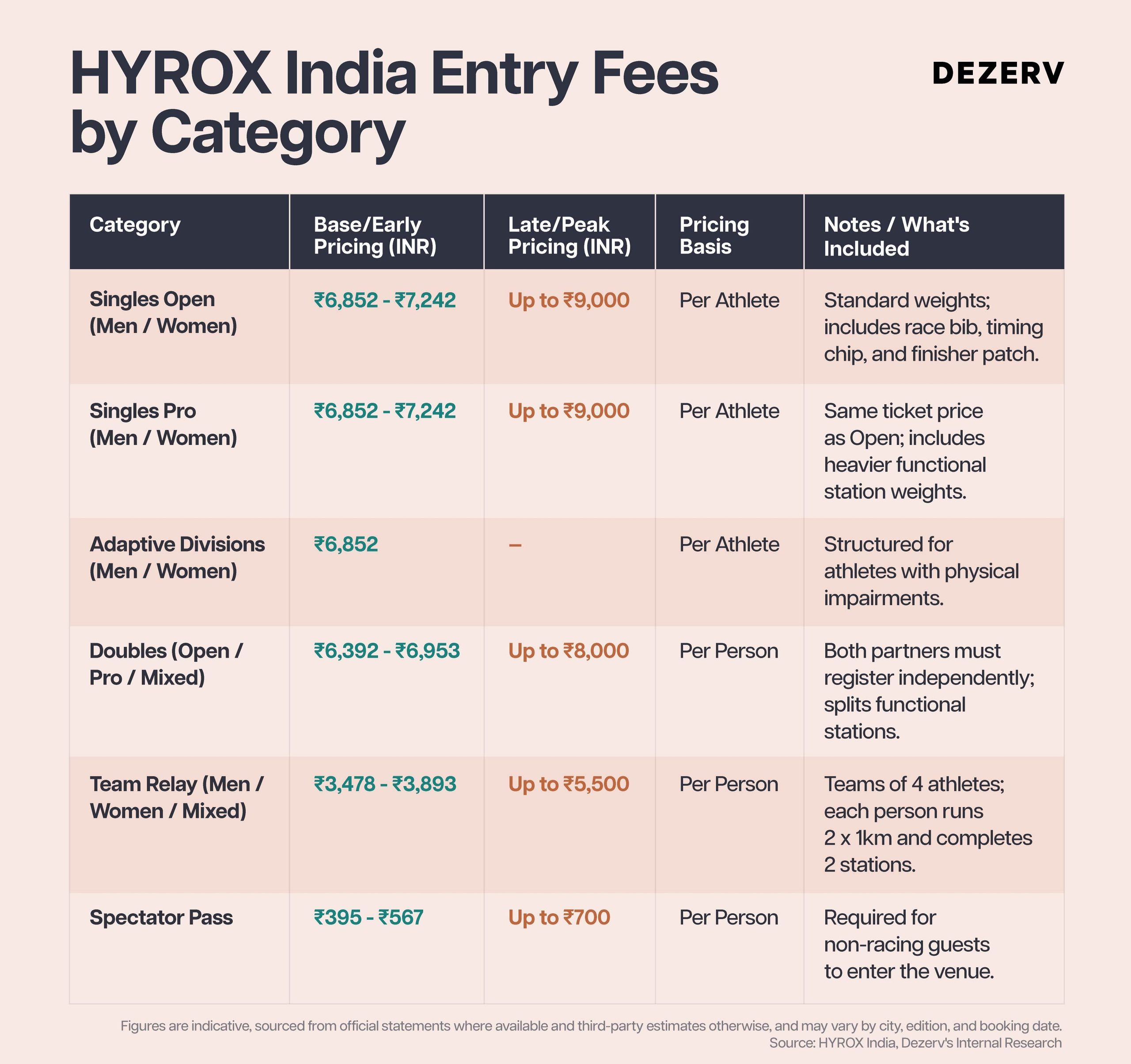
India got its first taste of HYROX in 2025, and the response was telling. When HYROX opened 15,000 slots for its Mumbai event this year, every category — Singles, Doubles, Relay and Pro — sold out within eight days. Entry alone for the event costs up to ₹9,000 a person, well above what most participatory fitness events in India charge. There’s no prize money for most participants, and no sponsorship waiting for them. What sells out is the chance to race against the clock, in public, and get a number that shows exactly how you performed.
It’s a strange thing to see at scale, especially in a country where gym membership sits at just 0.8% of the population, among the lowest rates of any major economy. The US is at 25% and China at 3%. Yet India’s affluent are increasingly willing to pay a premium to test themselves in front of an audience. That contradiction, and what it says about how India’s wealthiest are choosing to spend their time and money, is what this week’s newsletter is about.
In this edition:
- What India’s fitness economy actually looks like
- Why HYROX is more than a fitness race
- From HYROX to Ironman: the rise of endurance as a luxury
- What it really costs to get race-ready
- Why has physical suffering become a new status symbol?
What India’s fitness economy actually looks like
The more I look at India’s fitness numbers, the more I think this isn’t really a story about the country getting fitter. It’s a story about where fitness has chosen to take root first, and it’s telling us something worth paying attention to about how new habits actually spread in India.
Deloitte estimates India’s fitness facility market at ₹16,200 crore in 2024, growing to ₹37,700 crore by 2030 at around 15% a year. But the growth is concentrated in a few cities. Ten cities account for 56% of revenue but those same ten cities hold only 31% of the country’s fitness centres. The rest of India has plenty of gyms and fitness centres, but fewer people who can or want to pay for them. This is typical of a market that is still growing, led by cities with higher incomes, greater exposure to fitness, and busier lifestyles.
What I find more interesting is where the growth is happening within the market. Boutique fitness is the smallest segment by revenue, but it is growing the fastest. These premium formats, including HIIT and functional training, typically cost ~₹19,000-₹30,000 a year, with brands like Cult.fit Studios and F45 expanding across Bengaluru and Mumbai. The segment is growing at nearly 19% a year through 2030. Premium fitness follows at 16%, while the value segment, which still has the largest base of members and centres, is growing at 14%.
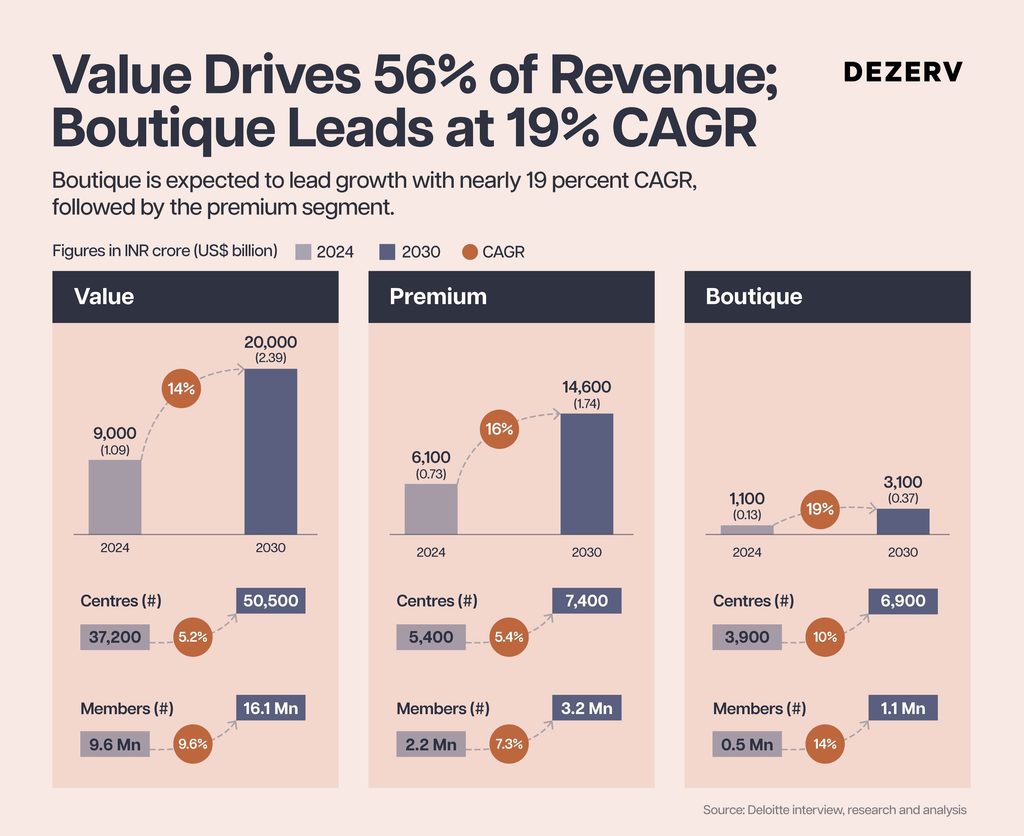
None of this means fitness is failing to reach the rest of India. It means the culture is being shaped first by people with the money, time and interest to experiment, before those habits spread more widely, as many consumer trends in India do. Overall fitness membership is still just 0.8% of the population, and is expected to reach only 1.7% by 2030. That makes this less a question of affordability and more an early stage in a much bigger shift in how India adopts fitness at scale.
Why HYROX is more than a fitness race
For most of India’s history, wealth meant never having to lift anything heavy again, the cook, the driver, the household help all standing in for the physical effort you no longer had to do yourself. Somewhere in the last five years, that idea flipped on its head, and nowhere is it more visible than in a fitness race that most of India hadn’t heard of eighteen months ago.
That race is HYROX, and it didn’t exist in this country until last year. In April, 8,200 people paid to push sleds and carry sandbags at the Bangalore International Exhibition Centre, with another 12,000 turning up just to watch, and for weeks afterward, every feed seemed to carry someone’s finish time like a badge worth showing off.

What that tells me is that the real audience for an event like this was never just the 12,000 people who paid to stand in that hall. It’s the thousands more who see it on social media days later. A HYROX finish photo on Instagram gives people something worth signalling: you were there, you did it, and here’s exactly how long it took. Your finish time becomes a number you can post, share and compare. That may also be why a format with no prize money can still sell out in days.
It’s the latest point in a growth story that has surprised almost everyone in the sport. HYROX had 1,650 participants at its Mumbai debut in May 2025. Two months later, Delhi drew 2,300, followed by 3,350 in Mumbai that September. Then Bengaluru brought in 8,200 this April, nearly five times Mumbai’s first event in less than a year. Globally, participation is expected to rise from 900,000 in 2025 to 2 million this year. India has quickly become one of HYROX’s fastest-growing markets.
None of this is India’s first experience with fitness as an event rather than a habit. Marathons gave urban professionals a finish line and a sense of identity. CrossFit later gave the same crowd a community and a routine to build around. Both found their strongest following among affluent circles in Bengaluru and Mumbai, before the novelty began to fade. HYROX has reached this audience much faster. That raises a fair question: is it simply the next fitness trend, or is there something about the format that could make it last?
My own reading leans toward the latter, and the reason has less to do with sleds and sandbags than with the business sitting underneath them. Unlike marathons or CrossFit boxes, which mostly ran on community and local ownership, HYROX arrives fully built as a commercial product, ticket revenue, a global licensing model, an official title partner in Ultrahuman, a PUMA deal, a layer of intermediaries between every participant and the finish line they’re paying for.
That’s a very different machine from what came before. It may be why HYROX has grown faster and reached more people than previous fitness events in India. The question now is whether people keep coming back for a harder attempt, or move on to the next big fitness trend.
From HYROX to Ironman: the rise of endurance as a luxury
There’s a particular kind of Goa trip that’s become common among people who could easily spend the weekend at a five-star resort, by the pool or on the beach. Instead, they fly in on Thursday, spend Friday and Saturday getting their bikes ready, and on Sunday morning, well before sunrise, swim 1.9 kilometres in the Arabian Sea off Miramar Beach, cycle 90 kilometres through Goa’s back roads, and finish with a half marathon back where they started. That’s the appeal of Ironman 70.3 Goa: a 70.3-mile triathlon covering a 1.9-kilometre swim, 90-kilometre cycle and half marathon, all completed back to back in a single day, with a finisher’s medal waiting at the end.
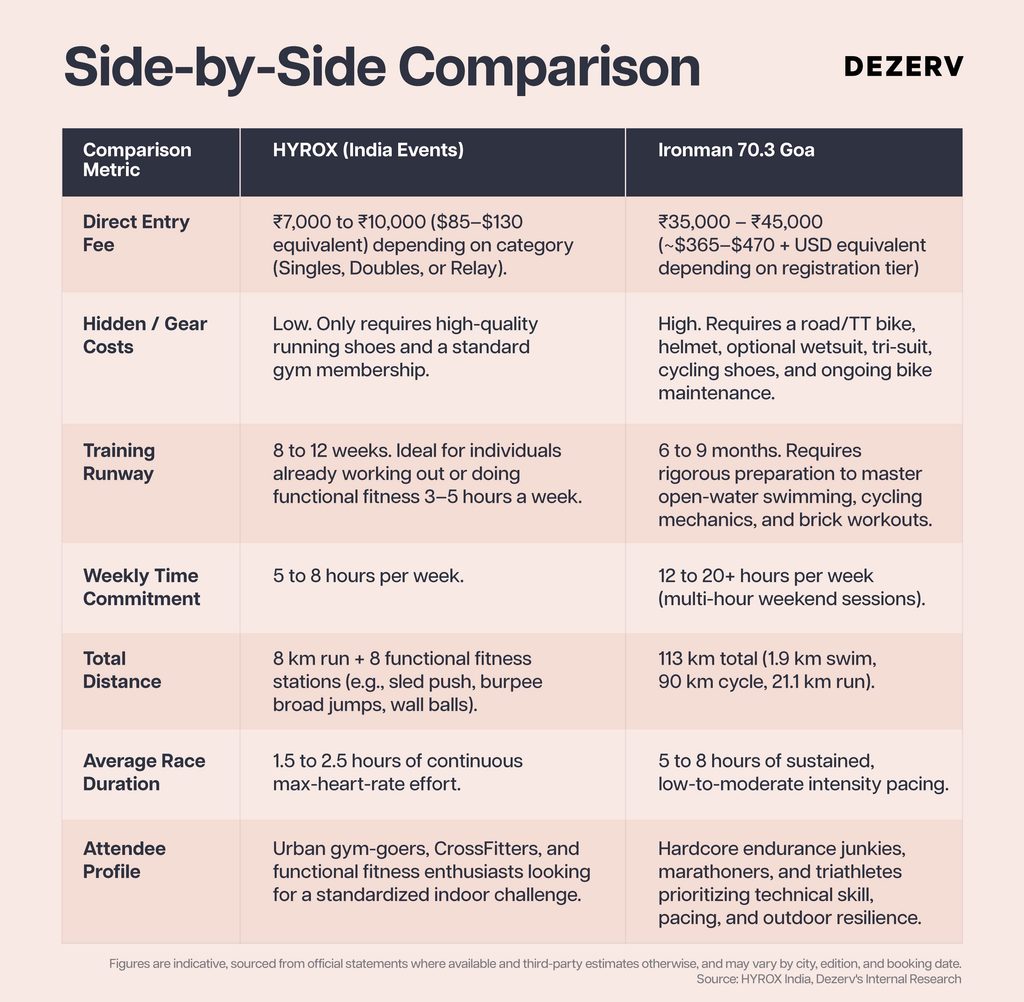
The race is now in its fifth edition since Yoska brought it to India in 2019, and the arc since then tells you plenty about who this is really for. Close to 4,000 people have taken it on across those editions, drawn from more than 57 countries, and more than 65% of finishers in the first four editions were attempting the distance for the very first time in their lives. An individual entry costs around ~₹35,000 to ~₹45,000, before flights, hotels and a bike. Yet demand remains strong. The latest edition saw nearly 1,200 registrations from 75+ cities.
What I find interesting is who’s shown up to do it. A sitting Member of Parliament completed the race in 2024, becoming the first MP to do so. A 66-year-old triathlete, seven years into retirement from a corporate career in Singapore, was preparing for his 14th attempt. And Leander Paes joined as the race ambassador. Together, they show how the race has grown beyond a fitness challenge into a serious test of endurance.
The comparison with HYROX is useful because they offer different levels of challenge to the same audience. HYROX can be done with a few months of training and a weekend trip. Ironman 70.3 demands far more time, training and money, but also gives you a bigger story to take home. If HYROX is the entry point, Ironman 70.3 Goa is the next level.
What it really costs to get race-ready
Every finish-line photo from a HYROX or Ironman hides a less visible number: the months of preparation behind it. Most of that preparation is paid for by the hour, and almost none of it makes it into the photo.
A personal trainer in Mumbai or Bengaluru typically costs ₹500-₹2,000 a session. At premium studios, it can go much higher. Top gyms in Bengaluru charge around ₹1,500 an hour for certified trainers, along with facilities such as Peloton bikes, infrared saunas and cryotherapy chambers. Memberships can cost ₹3,000-₹10,000 a month, before personal training. Some studios also offer DEXA scans, giving detailed body-composition data that was once mostly available through hospitals. Put it all together, and the race entry fee starts to look small compared with what it costs to get to the starting line.
This is the part of the fitness economy that conversations about HYROX and Ironman often miss. A race happens once or twice a year and makes for a great photo. A ₹1,500-an-hour trainer, twice a week for eight months, does not. But that’s where much of the spending actually happens.
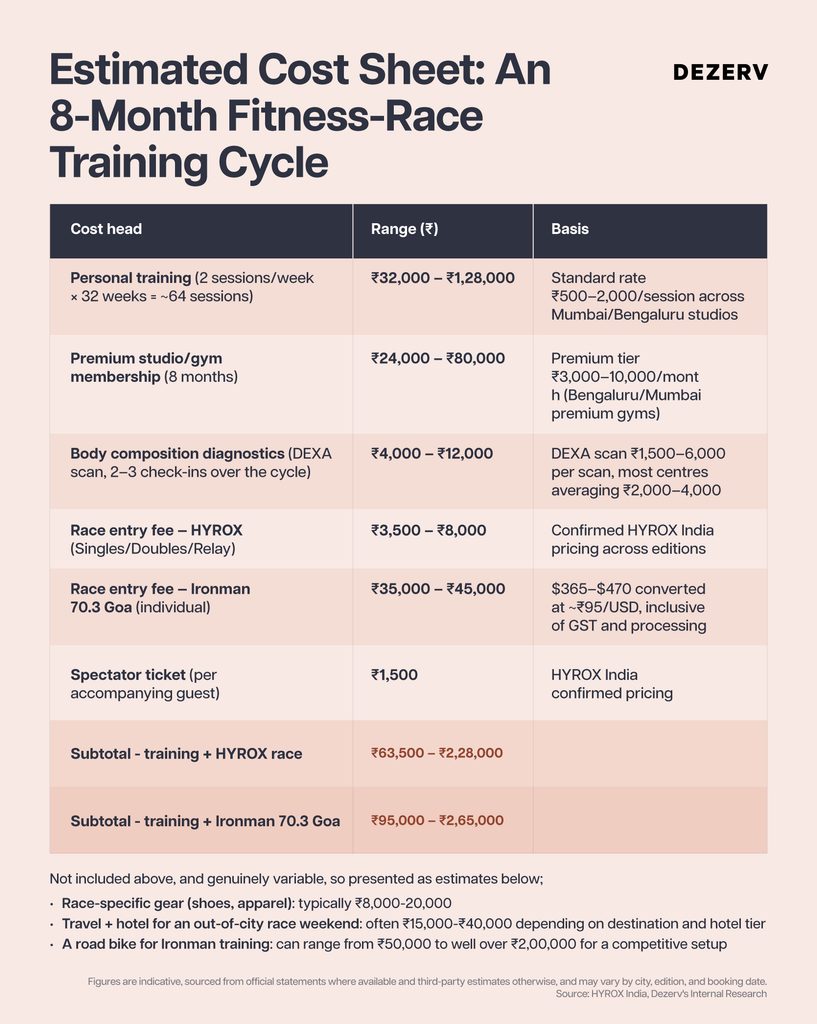
So even before travel or gear enters the picture, the training alone can cost several times more than the race entry fee.
Why has physical suffering become a new status symbol?
Wealth used to be easiest to show through what you owned: a bigger car, a bigger house, a holiday somewhere most people couldn’t point to on a map. But that signal has become weaker as more people can afford the same things. The finish time is different. You can pay for the race, the bike and the coach, but you still have to earn the result through months of training. The same is true of a resting heart rate or a sleep score. They offer something money can’t easily buy: proof of discipline.
The gym is no longer the only place where this plays out. Weekend cycling groups, pickleball courts and run clubs that end with matcha and croissants have become part of urban India’s social life. Even the workout itself has become social. Apps like Strava let you post your runs, compare your pace with friends, and collect the little trophies of consistency along the way. The more interesting shift is what happens when that same behaviour moves from everyday exercise to a formal event.
The wearable is simply the next layer of the same story. Sleep scores, HRV and biological age turn the body itself into a dashboard. You can spend money on the coach, the race and the device, but the numbers still have to be earned. And perhaps that is why physical suffering has become such an attractive status symbol: in a world where almost everything can be bought, the things that still have to be worked for become more interesting to show.
Disclaimer: The information provided herein is intended solely for educational and informational purposes. In the preparation of this document, Dezerv has used publicly available information and other sources believed to be reliable. The information provided in this document has not been independently verified by Dezerv and are subject to change. All trademarks, logos, and brand names mentioned are used for identification purposes only.