


A few weeks ago, I said something on a podcast that lit up my inbox for days. I said you probably need ₹40 crore to retire comfortably in India, and the responses came fast: that I’d lost my mind, that it was clickbait, that I was trying to scare people into doing something. I get it. A number that large, sitting without any context around it, sounds either alarmist or completely out of touch.
But here is what I actually meant, and why the context changes everything.
Retirement planning is one of the most personal financial decisions you will ever make. ₹40 crore is not a number for every Indian. It is the approximate corpus that someone who is 40 today, spending ₹2 lakh a month, retiring at 60 in 2046 and planning to live until 90, would need to sustain their current lifestyle across a 30-year retirement. Change any one of those variables and the number changes entirely.
It’s not about ₹40 crore. It’s about doing the math honestly with the right inputs, something most people skip. They pick a number that feels ambitious and assume it’ll work. History suggests it won’t, and that is what this newsletter is actually about.
In this edition, we’ll cover:
- Why the retirement shortfall is a pattern
- What 51 years of government data tells us about what inflation actually costs you
- A simple way to calculate the corpus you personally need
- Why building the corpus and making it last are two completely different problems
- The three phases of retirement, and how to structure your withdrawal across all of them
Let’s begin.
The number you’re chasing has always been wrong
Picture a family in 1986. Both partners are working, they are careful with money, and someone they trust, a family advisor, an elder, a colleague, tells them that ₹10 lakh is a solid retirement number. It sounds enormous at the time. They work toward it with discipline for two decades and they get there. And then they turn 60 and discover they actually needed ₹40 lakh. Four times the number.
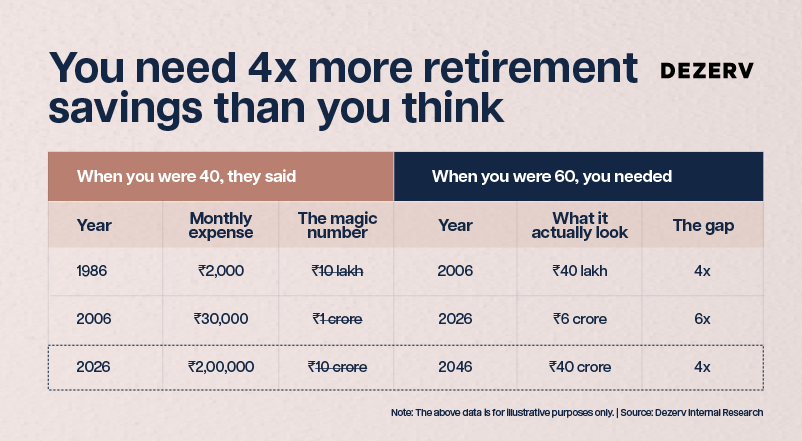
This isn’t one family’s story, it repeats across generations. People plan for what they hope is enough, but reality, driven by inflation and longer lives, usually demands about four times more.
Why this keeps happening
Four forces drive this gap and they have been consistent across every generation.
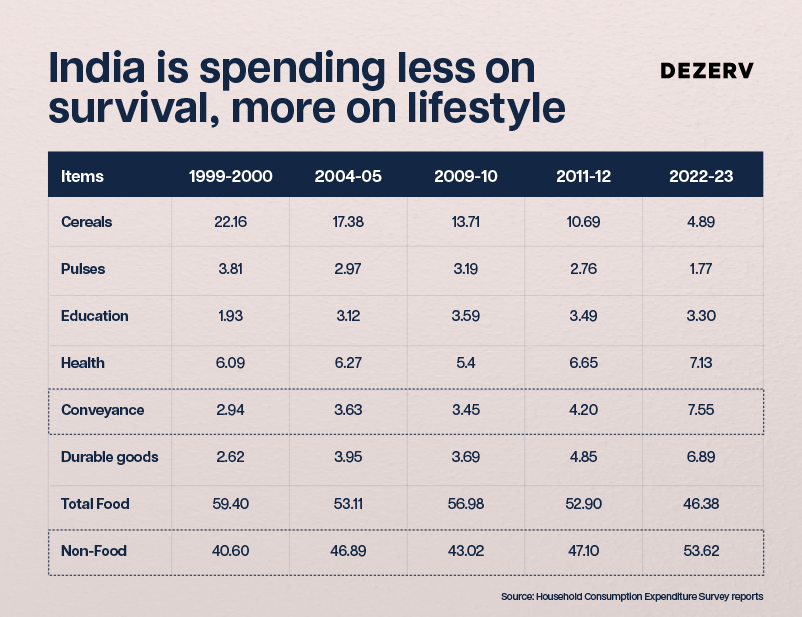
Force 1: Lifestyle creep is the one people underestimate most, not because costs go up but because the category itself transforms. In 1999, the average Indian household spent less than 3% of their budget on conveyance. By 2022-23, that share had grown to over 7.5%, more than doubling, and what sits inside that category today looks nothing like what it did then. It went from a bus pass and a two-wheeler to car EMIs, Uber, and annual flights. The line item did not inflate, it became an entirely different thing.
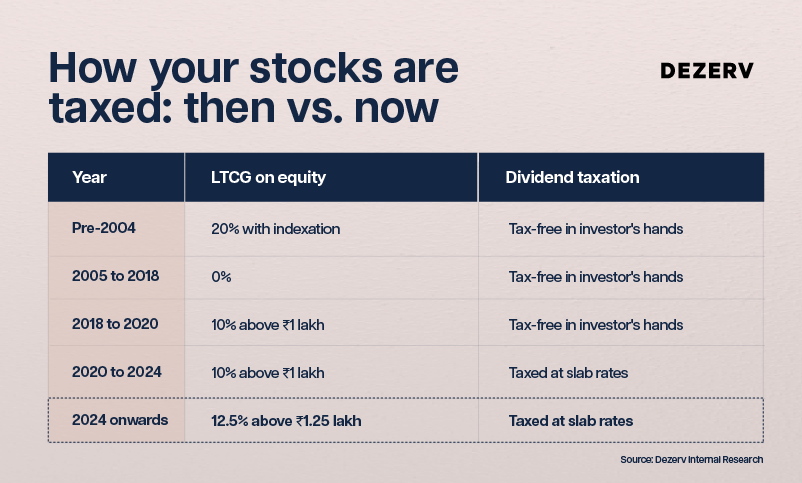
Force 2: Taxes are another silent drain that most retirement spreadsheets get wrong: LTCG on equity was zero not long ago, and today it sits at 12.5% above ₹1.25 lakh, with dividends taxed at slab rates. Every rupee of return is a smaller rupee in your hand than your model assumed.
Force 3: Then there’s longevity, which sounds like good news but functionally means your retirement corpus needs to fund 30 years of life, not 15. Life expectancy in India has moved from 60 to over 71 years in two decades, and with medical breakthroughs accelerating, planning to live till 90 is no longer pessimistic.
Force 4: The returns that built your wealth will not sustain it. The Nifty 50’s own history tells this story clearly. As India’s economy has matured, the explosive returns of the liberalisation era have moderated decade by decade. When a country develops, GDP and earnings growth slow, and market returns become more stable. India’s 12–14% returns after 1991 came from rapid growth, but that phase is now cooling. After retirement, returns drop further because you take less risk, so your money grows more slowly than expected.
What Inflation is actually doing to your runway
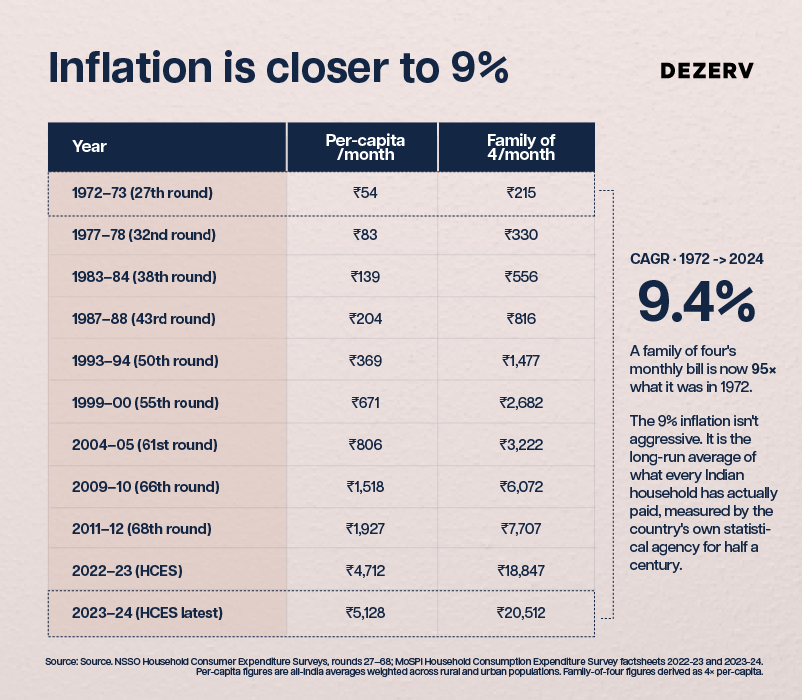
Since 1972, the Government of India has conducted eleven household consumption surveys spanning 51 years of data, and the answer has been almost exactly the same every single time. A family of four that spent ₹215 a month in 1972 spends ₹20,512 a month today. That is a CAGR of 9.4%, based on what real families actually spent.
If anything, it’s understated for affluent households, since average inflation for healthcare and education is lower than what upper-middle-class families actually experience.
Healthcare is a separate problem entirely. Medical costs in India have been rising at 12–15% annually, and surgery costs have increased by 300% over the last decade. Healthcare’s share of total household spending also rises predictably with age, from around 8.6% of income in your late fifties to over 13% after age 65, and continues to climb thereafter.
The person retiring today spending ₹30,000 a month on healthcare-related costs will be spending well over ₹1.5 lakh a month on the same needs in 2045. This is not a worst-case scenario. It is simply where the data points.
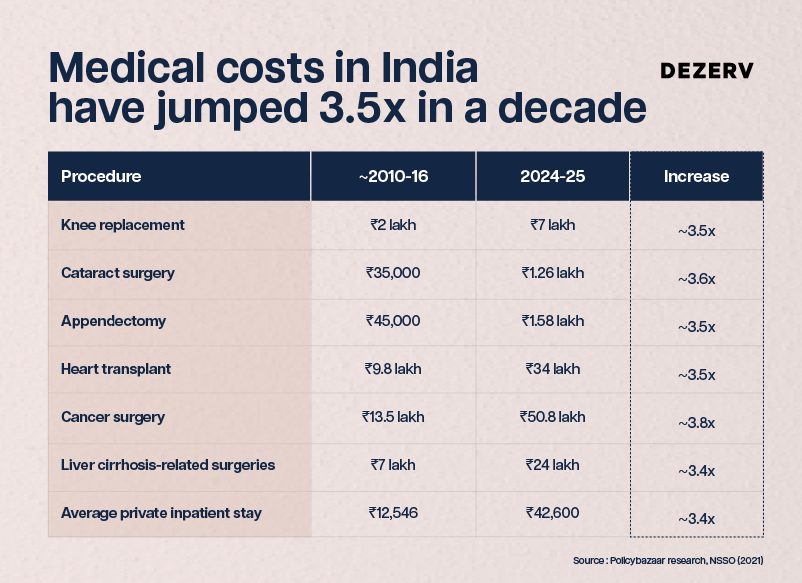
A 7-day ICU stay in a mid-range private hospital in a metro can cost ₹1–2 lakh, even before surgery or medicines. Health insurance premiums have also more than doubled in recent years, (from ₹12,000 a year in 2015 to ₹26,500 in 2023).
But most retirement plans use a single inflation rate for everything. This is a mistake, healthcare and everyday expenses don’t rise at the same pace, and treating them the same can distort your plan.
So what number do you actually need?
Before we get to the numbers, a caveat worth pausing on.
The variables that go into a retirement corpus calculation are not universal. A professional spending ₹50,000 a month and an HNI spending ₹2 lakh a month are not running the same equation, even if both are 40 today, retiring at 60, and planning to live until 90.
Take lifestyle inflation. The ₹50,000 spender sees moderate creep over time, costs rise, but the basket stays relatively similar. The ₹2 lakh spender experiences something faster. Travel upgrades, private healthcare, premium schooling for grandchildren, club memberships, these categories inflate quicker than the average. So while we use 7% pre-retirement lifestyle inflation for the first profile, the second runs closer to 9%.
Your actual number depends on your age, spending, retirement timing, and the lifestyle you intend to protect. The only way to know it is to calculate it honestly using your real inputs, not a round figure someone picked for a headline.
Use the Dezerv Retirement Calculator to figure out your retirement corpus. Every variable is adjustable and the math is shown transparently.
You’ve hit the corpus. Now the harder problem.
Here is where almost every retirement conversation stops. Hit the number, retire, done. But building the corpus and making it last 30 years are two fundamentally different problems, and almost all the attention, all the planning, all the anxiety, goes toward the first one. Almost nobody prepares for the second.
You spend 30 years filling a bucket. You then spend 30 years drinking from it carefully, knowing the bucket has a permanent hole called inflation that never closes regardless of whether you are earning, and knowing that the tap you are drinking from is not a guaranteed flow.
Managing that dynamic across three very distinct decades, with very different spending profiles, is what withdrawal planning actually means, and most people only discover it matters after they have already retired.
In my experience, the people who get accumulation right but ignore withdrawal often end up in more trouble than the people who planned less but thought harder about how to draw. And the reason is simple: building is linear, but spending in retirement is not.
Retirement is living three different lives
The single most important thing to understand about withdrawal is that your spending does not stay flat across 30 years. It follows a curve, and each phase has its own financial character that requires its own thinking.
A common mistake is treating retirement as one fixed monthly number. But your needs change with age, what feels tight at 62 may be too little at 87. And the legacy you want to leave in your 80’s needs to be ring-fenced in your 60’s, because the lifestyle of the active years, if left unchecked, is the single biggest threat to what you intend to pass on. Say you retire with ₹25 crore and want to leave ₹8 crore behind for a child’s business or a grandchild’s education. That ₹8 crore is no longer part of your spending corpus. You are retiring on ₹17 crore, not ₹25, and every part of your withdrawal plan needs to reflect that from day one.
How to actually draw from your corpus
Most people treat retirement like their working years, spend first, save what’s left. In retirement, that habit becomes costly. The goal is simple to state and genuinely difficult to live: draw enough to fund your life without interrupting the compounding that keeps your corpus alive.
Think of your portfolio in retirement as a tree you are harvesting fruit from. The fruit is what you live on. The tree is what you protect. The moment you start cutting branches for firewood, the future harvest shrinks permanently.
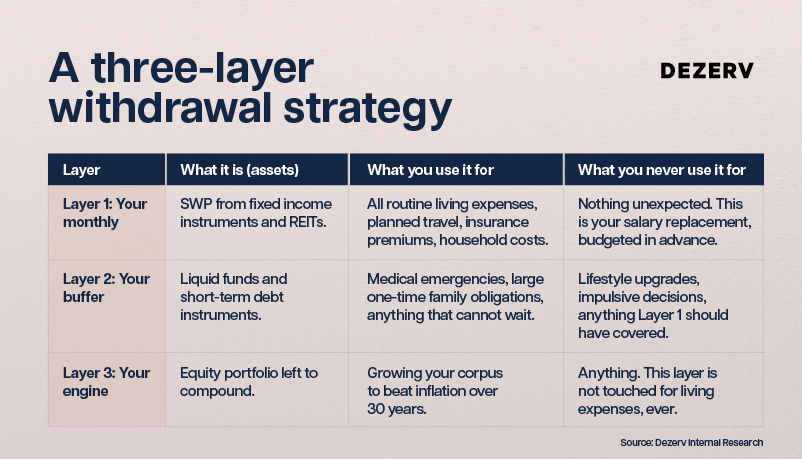
The logic behind this structure is simple. SWP funds your life, the buffer handles shocks, and equity fights long-term inflation. Each layer has one job, and the discipline is making sure nothing borrows from the wrong one.
The one rule worth internalising above everything else: if you can plan for it, it belongs in Layer 1. If you cannot plan for it, it belongs in Layer 2. Layer 3 is never the answer.
A Europe trip or renovation? Layer 1. A medical emergency? Layer 2. Selling equity after a market fall? That’s the mistake that cuts your retirement short.
In summary
₹40 crore is not a number I put out to alarm anyone. The real point is this: your target corpus number depends on your age, spending, goals, and timeline, and you need to calculate it honestly. Building wealth is one challenge. Making it last 30 years, through inflation, rising healthcare costs, and different life stages, is a different one that needs planning and discipline.
Most people focus only on building wealth and ignore making it last. That gap can hurt, but those who address it early are far better prepared.
Disclaimer – Investment in the securities market is subject to market risks, read all the related documents carefully before investing. The information contained in this document is for educational purposes only and is not a complete disclosure of every material fact, terms and conditions. The data/target corpus mentioned herein are for illustrative purposes only and are based on standardized assumptions. Actual outcomes are subject to market risks and depend on multiple variables which may vary from person to person. This should not be construed as a guarantee of returns or personalized investment advice. All trademarks, logos, and brand names mentioned are used for identification purposes only.